Whilst watching a TV documentry on Yellowstone Park, they were saying that within a wolf pack, the Alfa male's off spring never mate with him and must move outside the pack to mate.
Is this "knowledge" the same in all species I wonder?
Is this a sly dig at the people of East Anglia?
BTW, its alpha-male,
(an Alfa male wolf can be found driving lovely Italian cars with suspect reliability) 😉
Is this "knowledge" the same in all species I wonder?
Not that I'm aware of. But then neither is looking after your genetically flawed offspring, so maybe they go hand in hand.
To be serious, nearly all animal species have evolved strategies to avoid inbreeding. its especially important in the case of large social mammals with defined territories, such as wolves, lions,spotted hyenas and so on.
Both dogs and cats inbreed willingly?
Hamsters will shag owt and then happily eat the offspring
The Welsh will shag owt and then happily eat the offspring
bit arsh
Coffeeking, while domestic cats are closer to a 'wild' animal, neither they nor dogs live in anything resembling a natural social order. The influence of humans means mistakes happen, though domestic dogs are so f***ed up, they will obviously shag even inanimate objects.
Not in my village 😉
Coffeeking, while domestic cats are closer to a 'wild' animal, neither they nor dogs live in anything resembling a natural social order. The influence of humans means mistakes happen, though domestic dogs are so f***ed up, they will obviously shag even inanimate objects.
I'm not saying it's normal in the wild, but it's certainly common in domesticated animals. I know a cat breeder who has to be very careful with the family members she holds onto.
I think a bit of a clue is in the phrase cat'breeder'.
with the production of human-selected domestic strains, many of the rules have been changed for the animals concerned (dogs being the prime example)
Still requires two cats to get it together at their own choice, be it a domesticated animal or not.
What you'd find though, if humans disappeared overnight, is normal feline social order being resumed, with female cats and their female offspring living in groups, accepting one or more new unrelated males from outside the group, who would drive off any sexually mature male offspring. His brief time at the top would prevent potential for mating accidentally with any of his own offspring.
have heard psychologists say that the obnoxious parent hating behaviour of human teenagers is a letting go/help them leave the cave thing
or as i'm a non alpha/(ex alfa sud) male - i'll be the one migrating on my own to the shed
I've got a mate who shagged his cousin.
She wasn't even that nice.
I've got a mate who shagged his cousin.
How are the twins?
[img] 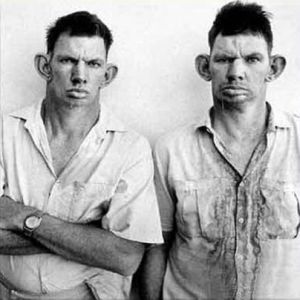 [/img]
Humans display the mechanism quite well - we tend to select partners who are very similar genetically to ourselves, even genetic traits that aren't perceptible to us. Have a look in the announcements bit of your local paper at the pictures of newlyweds and see how many got that 'couple look'. Now the people you would be most genetically similar too would be your own family but for some reason growing up in a family prevents that romantic bond from forming.
However if you get family members who have been separated at birth and later as adults they unwittingly meet, they not uncommonly fall madly in love.
[url= http://www.newser.com/story/16170/separated-at-birth-twins-marry.html ]Like this[/url]
How are the twins?
😀
Martin johnson's lost a bit of weight since he stopped playing
Pook it's the stress!...they look a bit happier than him I reckon!..bugger oj laughed over the screen...thanks for that fella!
Humans use both concious and subconscious cues for mate selection. Visually you tend to go for someone of similar attractiveness (although other factors can shift this - social conditioning, self esteem, etc.) but this isn't the same as genetically similar, it is taken as an indicator of "fitness" (i.e. likelihood of producing offspring able to breed given societal whims and requirements). In terms of that inexplicable attraction much is to do with how "different" you are to that person in some areas that are detected subconsciously. This includes things like the MHC types you have (immune system stuff) and tries to ensure that you get a mixing of genes rather than reinforcement of existing genes.
Interestingly this all gets set when young so you tend not to find people you grew up with until the age of 5 or so attractive. Basically you recognise these people as being from the same tribe or family grouping as yourself and ignore them as mates. This mechanism still exists so even though those at play school would likely make good mates as they are generally not related, once you had grow up you tend not to find them attractive as you body thinks of them as potential relatives.
These things have been mainly studied in mammals but some social insects show similar behaviours (bees, ants, etc). Not all species have these mechanisms but most that invest a lot of time and effort in a rearing small number tend to have something like this (large mammals, etc) whereas those that just produce as many as possible are less likely to (rodents and the like).
Nicely answered shackleton