
I have two amplifiers. They both have a variation of a 'loudness' button. It got me thinking about the switch's purpose and what it is that it actually does.
So, HiFi nerds/audio engineers/electronics geeks, what's the common opinion on these things? And how does it achieve the noticeable bump in volume/bass response? I kind of don't understand why they just have the amp 'loud' in its natural state and do away with the button entirely, which leads me to believe that it is a sales gimmick. Especially as, on my amps - one switch is called 'loudness' and on the other 'phase-correction loudness'
As the result of pressing these buttons is instant-awesome, it's tempting to just leave them on all the time. However, I sometimes work with audio and require a neutral as possible reference point. Which got me thinking about how these loudness switches achieve the extra oomph. Are they simply increasing the volume by a few db? Or perhaps it's a filter, increasing the low shelf, or a specific range by a few db? Perhaps in the amplifiers normal state there is a high-pass filter applied, or a notch filter cutting out some of the bass frequencies, and the 'loudness' switch just disables this and sets the frequency response to flat?
Thoughts?
my understanding is they boost top and bottom end.
Very much frowned upon by audiophiles. Apparently even having them in the same room as a music source like an LP contaminates it permanently.
would be happy to hear from anyone who's worked on these things!
I've always assumed it's just a wide EQ boost centered around 200Hz-ish of about 3dB to compensate for small speakers. Quite surprised that hifis still have it tbh...
They're going to be livid when they find out about graphic equalisers then
instant-awesome
Damn, I haven't got the button, but now I feel like I need one.
IME they're just a crude boost at the high and low ends to "improve" low volume listening where the speakers aren't being driven effectively. Audiophile kit doesn't have them.
I should add that both my amps are old.
Harmen Kardon PM650VXI, and a big yellowed-silver Hitachi thing with analogue VU'S which is at home so can't remember the model name.
It's a bass and treble boost because of this:
https://en.wikipedia.org/wiki/Fletcher%E2%80%93Munson_curves
[img] 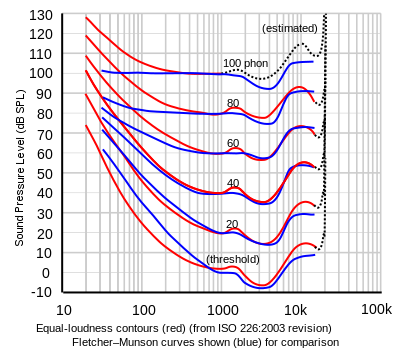 [/img]
Although it's misused 99% of the time when implemented correctly it's a good idea. Most hi-fi systems would perform better if they had a volume knob which you set (and then left alone) for the room size, speaker sensitivity, listening position etc and then a loudness knob which you use to vary the listening loudness which automatically re-EQs the system to compensate for the human ear's deficiencies at lower sound pressure levels.
chiefgrooveguru has it. Our hearing is not "linear". At low volumes our hearing loses low and high frequencies more than mid range,so they need boosting, which is what the loudness button does. It's a crude, blunt tool though.
It's not needed on audiophile kit largely because audiophiles tend to listen at "appropriate" levels.
The JCM 900 in that pic is the Marshall not to have. A hot-rodded JCM 800 or older plexis are the must haves. As for a loudness control theres one on the Slash signature 800 which means you can play at non painful levels aqnd it still sounds OK, apparently.
Interesting.
So basically, I should leave it 'off' and turn up the volume!
I would've thought the mixing of the music should account for it if you have a setup that faithfully recreates the music.
Having acquired (been given second hand) a high end amp and speakers it seems this is the case, you get all the bass and treble clarity with bass and treble dials in the middle (or bypassed).
I believe the purpose of the loudness button is to 'fill' the sound when listening at low volume.
So basically, I should leave it 'off' and turn up the volume!
Correct
I would've thought the mixing of the music should account for it if you have a setup that faithfully recreates the music.
Only if you are listening at the volume it was mastered at. Otherwise, see the Loudness curves above.
I did an audio engineering module at university and the lecturer said the loudness button was to compensate for less bass at low volumes due to the physics of speaker design. And then went into the formula proof, which un-suprisingly I have forgotten.
So are you supposed to switch it off when you play music louder or is it linked to the volume control i.e. does it boost more when the volume is set lower?
If you are listening to the music quietly and it sounds thin and reedy, switch the loudness on to see if it sounds better.
From my sound engineering days I always assumed it did the same job as a compressors/limiters (Dynamic Range Compression).
Basicly if you listen to music where the singer alternates between a whisper and shouting you need to be able to hear both of those. 'Loudness' is added to sound recordings so that you can do this, it basically meant that the quiet bits in the studio are given much more gain. Listen here (at 1:50 onwards):
The album everyone cites as being utterly ruined by this was Red Hot Chilli Peppers - Californication
It's more prevalent in music from the 90's onwards as producers realised that to make money they needed to sound good on the radio (before you buy the single, not on the record itself), and most people are listening to the radio in the car. With a lot of background noise the quiet bit's become harder to hear (decibels are a logarithmic scale, so dropping just a few decibels would mean the music is completely drowned out), so producers strived to keep the sound level constant through the whole recording.
It also works works for listening on a Hi-fi at low volumes, further boosting the quiet bits so you can hear them without waking up the neighbours when the loud bit's kick in.
A song with very little 'loudness' applied, there are very obvious changes in the volume:
Surely you are just talking about compression there? Loudness is a concept not a tool you add.
Jef Wachowchow - Member
If you are listening to the music quietly
That never happens.
thisisnotaspoon
You're talking about over-zealous mastering and the 'loudness-war'. Squashing the bejeezuz out of a recording using maximisers, limiters and compressors so it sounds loud when played through a stapler, and more importantly - sounds louder than the competition. At the expense of sound quality/dynamic range.
My cycling buddy has a mahoosive ****off hifi and likes to play it loud, luckily he has impeccable taste and a huge record and CD collection. He lives in a semi detached Victorian villa and one day while he was playing something loud he became aware that his neighbour was at the window, waving at him. He went to the door and she said: "Alex, would you care to pop into my house to hear why I'm having trouble hearing my TV?" It was a bit of a shock to him.
😀
I've been known to trouble the old ones and twos. So I now have a unit on an industrial estate. I can now have it so loud that my kidneys are vibrating free. Without giving everyone on my street nervous exhaustion through repetitive beats.
Surely you are just talking about compression there? Loudness is a concept not a tool you add.
You end up in the same place though, the compressor reduces dynamic range in a live performance and you end up with 'loudness'.
Or working the other way around, automatic gain achieves something slightly different, usually applied after compression on the same bit of kit.
I have a system with just one control in it.
It's called "volume". Sounds good whatever level I have it set at, from quiet at about "eight o'clock" to loud about "ten o'clock".
It's a high fidelity system...
As for a loudness control theres one on the Slash signature 800 which means you can play at non painful levels aqnd it still sounds OK, apparently.
That's a bit different, it's an attenuator on the power amp, which causes it to 'brown out' at a more respectable volume. They used to sell a 'power brake' to do the samne thing on most valve amps.
Loudness in hifi is an artificial cut and boost of various frequencies to achieve a fuller sound, but I guess its the artifice that boils a hifi enthusiasts piss, in the same way a SONOS PLAY sounds great to me but purists would disagree.
Woppit, you raise another question...
How come the effective range on the volume pot/knob is generally in the range you mentioned - 8 to 10pm? Can't remember having an amp where the knob would get past noon and I like it loud. Under-powered speakers?
That's not the "effective"range. That's the range in which I listen to it.
It starts at 7 o'clock and goes round to 5 o'clock, BTW.
Anything over 10 "o'clock" is way louder than I need it.
I did, just once, whack it up near full.
I thought the windows were going to explode... 😯
I don’t get the “purist” hifi stuff. Well into the 80’s amps had tone controls, sometimes graphic equalisers, and GE’s were popular as add ons to a system. Professionals use all sorts of EQ functions to get the sound right (as well as basic cables but that’s another argument) so I’m trying to find an amp with tone controls too.
It’s all about being happy with the sound. Boosting/reducing the bass or treble to suit you/your equipment/your room is perfectly ok, don’t let the “purists” tell you you need a straight through signal etc. It’s a great way of selling cut down amps to overpaid accountants but it shouldn’t be the way you have to listen to music.
newrobdob - Member
I don’t get the “purist” hifi stuff.
It's pretty simple.
A HiFi system is designed to relay as much of the input to your ear with the highest possible fidelity.
Any alteration you put in the way will alter the intention of the recordingists.
I suppose that an attempt to improve a bad recording with G.E. and the like may have it's virtues but a "purist's " point of view might be that such is not worth listening to in the first place.
[quote=thisisnotaspoon ]You end up in the same place though, the compressor reduces dynamic range in a live performance and you end up with 'loudness'.
Or working the other way around, automatic gain achieves something slightly different, usually applied after compression on the same bit of kit.
No, the loudness control does not alter dynamic range. It does not alter the volume, it alters the perceived frequency response. Maybe you're thinking of midnight mode, which (on my receiver at least) appears to do both things?
Any alteration you put in the way will alter the intention of the recordingists.
He's right you know. Tone controls (worse still graphic equalisers) are an abomination.
I'm not taking any notice of anything Woppit posts on this thread, 60-year-old drummers are generally so hard of hearing that they wouldn't hear a hi-fi playing at the sound levels a loundness button is useful. 😛
As for compressors, guitarists use one because it hides fluffs, so long as you hit the string you'll hear the note whereas without the compressor you have hit each string with the right weight. It also means you don't have to back right off if you start strumming several strings - and if you wind it up it adds sustain and grain (which overdone caqn sound dreadful). On the downside if you want to make some things stand out you can't. I dont use one on Sweethome Alabama because I like the brash Strat bark when you hit two strings in the middle of the run down. I wouldn't want on on any sound system for playing stuff that's already been mastered.
He's right you know. Tone controls (worse still graphic equalisers) are an abomination.
Balls to that. Maybe with classical CD's or albums recorded in the 70's - early 90's where money was no object... you might want as short and clean a signal path as possible to preserve the artistic intention. But for everything else I like to have EQ control. The artistic intention is not always what appears on the final product, and even if it does, you might not personally like it and prefer a little more bass perhaps. It's subjective.
Any alteration you put in the way will alter the intention of the recordingists.
You can never hear it as the recordingist intended, as all rooms will have an influence on the received sound.
Eq allows for the recieved sound to be altered at different frequencies to take the room characteristics into account.
[img]  [/img]
newrobdob - Member
I don’t get the “purist” hifi stuff. Well into the 80’s amps had tone controls, sometimes graphic equalisers, and GE’s were popular as add ons to a system. Professionals use all sorts of EQ functions to get the sound right (as well as basic cables but that’s another argument) so I’m trying to find an amp with tone controls too.
Well into the 80’s the only music systems you were likely to find with an EQ, and likely tone controls as well, would be car audio and Amstrad tower systems, which were made of cardboard and thin chipboard.
I used to sell audio equipment from the early 80’s, and it was from then that Japanese audio manufacturers started to get wise to what British and American makers were doing and getting amps designed to suit our tastes, by designing clean signal paths, dumping tone controls, and using concentric volume pots for balance.
The Rotel RA820 is possibly the first example. I have a Rotel preamp upstairs which is just like that, drives a pair of Crimson poweramps. I don’t recall selling anything which had an EQ, there might have been some Pioneer and Technics amps with tone controls around, but they tended to be at the lower end of the range.
Just had a look at my Yamaha DSP-AX2 amp, and it does have tone controls, but they’re hidden behind a drop-down front panel, I’d forgotten it even had them, I never use any processing when listening to music, only surround when watching movies or tv.
No tone controls on my Marantz PM66KI Sig. It does have a l/r balance control but there is also a source direct button which bypasses this (and the tape monitor switches) for a cleaner signal path.
NADs always had tone controls, cheaper Creeks and Arcams too.
Even Audiolab and Quad.
I don't mind tbh.
Current Marantz (Edit - snap!) doesn't have them and don't use them on the mini system downstairs.
Do like them on portables though, which usually need all the help they can get.
Thinking about Mr Woppit's post, I don't think I've ever ventured past mid-day on my dial.
I did an audio engineering module at university and the lecturer said the loudness button was to compensate for less bass at low volumes due to the physics of speaker design
Bad lecturer or memory fail! 😉 Speakers are great at low volumes, it's when playing loud that non-linearities become a bigger problem. Ears are rubbish at low volumes and very high volumes.
When designing an amp you need enough gain to be able to turn poorly mastered sources up loud enough, hence the unused pot rotation.
It's also a marketing trick - people often compare amps with the knobs in the same places and then declare the louder one to be more powerful. And if they don't realise there's a volume difference they'll usually declare the louder one to be better sounding.
When designing an amp you need enough gain to be able to turn poorly mastered sources up loud enough, hence the unused pot rotation.
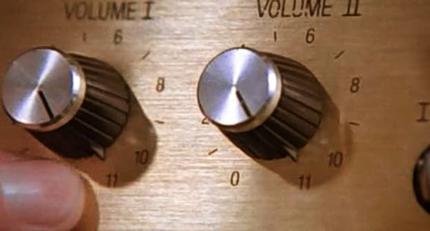
“Everything louder than everything else!”
[img]
 [/img]
😀
Do like them on portables though, which usually need all the help they can get.
Not entirely sure they work all that well on portables, TBH; maybe boosting the top end a bit helps clarify things, but putting up the bass usually just causes it to boom, or just distort.
Putting the device against a wall usually helps more, like putting bookshelf speakers against a wall.
then you factor the 'radio mix' of a song into the equation where they boost bass and treble as well and it sounds very odd.
I'm looking for a quality amp with balance control due to room asymmetry, the only ones I can find are Croft which have separate l/R volume controls or Luxman. I'm sure I'm not alone in this requirement. Both sound superb though even with so called non purist features.The Luxman amps also have loudness button and defeatable tone controls, very rare these days
I had an old Philips amp with a handy "lift" control. It seemed to be basically a variable loudness function. It wasn't high end kit by any means but worked as a workshop amp.
Currently running a Marantz 2226b from about 1977 with tone, balance, hi filter and loudness controls, that seems to be considered hi-fi.
I'd never had my hi-fi (well medium-fi, a 90s Kenwood amp with 70W a channel) flat out till junior listened to some techno or metal while I was out. On return one speaker had lost its bass. The driver showed 8ohms so he hadn't burned out the coil, I took it back to the shop and got a call not longer after "it's fixed now and sounds fine, the speaker cone had gone beyond its normal range and got stuck".
"It wasn't that loud" protested junior. Compared with band practice (150W guitar amp, 300W bass amp, keyboads and voice through a 400W PA and drum kit - all in a small room) I'm sure it wasn't that loud.
My Dad has a Wharfedale/Lenco setup he bought new in the early 70's. He said he packed it away when I got old enough to climb on stuff and didn't get it out again until my youngest brother could be trusted around it. I argue that he still can't be at 28..
Loudness is so that you can listen to Beatles albums and hear Paul McCartney.
My Naim apparently goes to 100. Had it at 75 last night. Seems one of my 20 year old castles didn't like it (despite them being rated far higher than the amp). Thankfully, the other one had this symptom a few months ago (it disagreed with Leftfield) and it cost the grand total of $45 to fix. Turns out 20 year old glue falls apart eventually.
I do like having a decent sized room at last. I just think after 20 years of being stuck in small spaces my speakers aren't quite so thrilled at the prospect. Hey ho, same guy that fixed it last time also makes his own, and they're rather good. Time for an upgrade, perhaps...
It's actually a lack of power which often knackers drivers. As the amp starts to run out of puff it can't properly control the coil and cone letting it flap and be damaged.
It probably didn't make your glue fail though.
It's actually a lack of power which often knackers drivers. As the amp starts to run out of puff it can't properly control the coil and cone letting it flap and be damaged.
Yeah, I know that. These are buggers to drive. I had an Alpha 9 that could handle them but that in true Arcam fashion for amps of that era gave up the ghost. It was then replaced for a few years by an old Alpha 3 that was previously in the study, but at 35W that really struggled, so if it's not old age and historical abuse from student days, I could probably blame their stint on the A3. But really i think it was the somewhat antisocially loud volume I was enjoying whilst the neighbours are away 😆
The Naim on the other hand is effortless, barely gets warm at anything but ludicrous (i.e. last night 😀 ) volume.
It's actually a lack of power which often knackers drivers. As the amp starts to run out of puff it can't properly control the coil and cone letting it flap and be damaged.
This isn't true at all. The only things that damage drivers are too much peak low frequency power (over-excursion) or too much longterm power (overheating).
Qualifying statement - I design (very) loudspeakers for a living. 😉
The only things that damage drivers are too much peak low frequency power (over-excursion) or too much longterm power (overheating).
says the man who has never had his speaker cones eaten by mice...
...or said "No, it's fine" through gritted teeth as a good friend's toddler pokes the tweeter inside out 😉