UPDATE: Reviews section refreshed, redesigned, searchable: Go take a look
Following a number of posts that I have been involved with, and some work-based knowledge which I have brushed up on recently... I would like to invite everyone to learn a little bit more about suicide.
I found the following resource very useful and would encourage EVERYONE to take 20 minutes and have a go at the on-line training.
Many of us who play in the outdoors have first-aid training. We are pretty good at patching up skinned knees and broken collar bones but we are less confident at dealing with and talking about the biggest killer of men under 50 ie themselves.
Please take the training. It could help you save a life.
https://www.zerosuicidealliance.com/
Bumped.
If we're going to have a frank discussion about suicide I'd like to raise something that I never see mentioned which is that sometimes suicide is a rational response to the situation someone finds themselves in.
A friend of mine committed suicide about a year after learning he had a degenerative condition. It was the kind of condition that he might have lived with for a good number of years, perhaps decades, and even had a decent quality of life but he was a high flier both in his career and physical activities and not the kind of person to compromise on either.
Whilst I miss him and feel for those closer to him I also feel like I should respect his decision and I certainly understand it. I realise that many suicides and suicide attempts are not so well reasoned as my friend's and that given help many might be avoided but I think that sometimes it's a valid choice and it's really important to acknowledge that. I think what I'm getting at is that while suicide is a grim thing for those left behind and our first response is always that it's a mistake it might not feel like a mistake to the individual.
My apologies if the above offends or upsets anyone, it's something that's been rolling about in my head for a while and a thread titled 'Let's talk about suicide' seemed like a good opportunity to raise it.
as above for whatever reason a person contemplates taking their own life, its that persons decision, the sad thing is it may leave lots of unanswered questions like that argument you had with them a few days ago, or you where to busy to see them or speak to them, you may have had no idea they had mental health problems, we all need to make time for everyone, to listen and chat to people, and listen out for cries for help, and offer that help and support.
Men are terrible for bottling stuff up, seeing it as not manly to cry and expose their feelings, women seem to do it quite well.
I was in a bad place mentally a few years ago. I did something silly. Thankfully it didn´t work. I was sectioned. I realised that for my life to change I had to be the one doing the changing. Previously I was a site manager on very stressful large construction projects and if I hated the stress and long hours. I had a massive burnout/breakdown that sent me to a dark place. If something in your life is bringing you down, change it. Now I love my life. I am now an official guide in the Danube area of Austria. Here´s a pic from today.
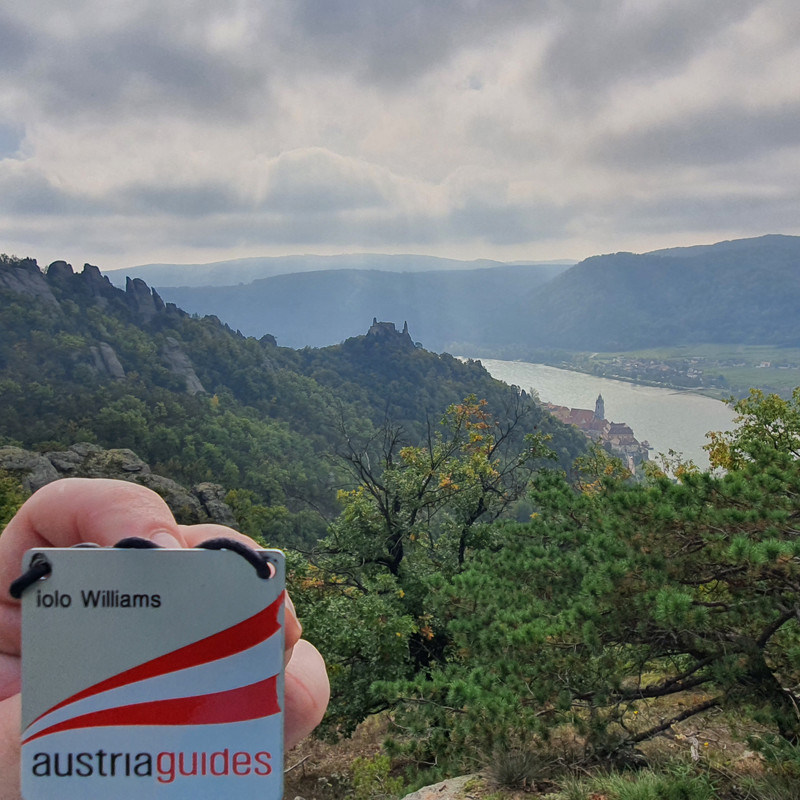
Believe me when I say no matter how bad you think it is, it will get better, as long as you want it to change.
If anyone is in Austria, contact me if you fancy a tour - bike, hike, historical, art, alcohol based, whatever.
Simon_Semtex: Thanks for posting this.
Nae bother. I hope it helps.
If we’re going to have a frank discussion about suicide I’d like to raise something that I never see mentioned which is that sometimes suicide is a rational response to the situation someone finds themselves in.
This. Often ignored but a real thing.
I know it is difficult to talk about suicide from a different perspective especially those from the religious perspective.
No matter how hard it can be instead of suicide just give it your best to get through it which is not easy and find as many experts to help you out as possible.
I shall keep it very short in my explanation and if you wish to know more just read all the available religious texts from Hinduism, Buddhism, Islam, Christianity etc ... they have the same conclusion about suicide.
They all forbid suicide because death from suicide will result in extreme suffering in afterlife.
It's hideously pithy and throw away but a phrase that always resonated with me is "suicide is a permanent solution to a temporary problem."
If someone had said that to me at certain times during my 20's I'd have wanted to try and strangle them in all probability. Now with hindsight? It's so bloody true.
So here’s a question for you: where’s the line at which point you need help between having dark thoughts that you’d never act on, and genuine suicidal thoughts? My family life is stable and financially I’m sound; I realise that this is a fortunate position to be in and don’t take it for granted. However, I constantly feel like I’m always rushing for others with rarely any time for myself. Chuck into the mix everything else that’s going on at the moment (Brexit, Covid, climate change etc which fills me pretty much with existential dread) and I frequently feel emotionally drained and numb. That said, at times I’m plenty happy....but then my mood will swing to a place where I just think to myself ‘Ah sod this, wouldn’t it be easier just to get off the world?’. I suffered a very close family bereavement earlier this year and at times I find myself irrationally jealous that he doesn’t have to deal with all this anymore.
I am absolutely confident that I would never try anything foolish, but is it normal or common to have these kinds of thoughts to the stresses of everyday life? I assume it is... Or should I go talk to someone?
(Incidentally, just writing this feels wrong, like I shouldn’t bother anyone by asking but in the spirit of being open and honest about suicide in an attempt to encourage others as well...)
^^ Normal? I'd say yes.
Should you go and talk to someone? Well...As a general rule it's unlikely to do you any harm and might give you insights that you would be hard pressed to find for yourself.
It's often completely exhausting and pointless to try and analyse your own mind and psyche. You end up chasing your own tail.
That’s a fair point: what harm can it do? You’re right though; in the lead up to the bereavement I mentioned, my sister started seeing a counsellor to prepare her. It gave her much better insight into a whole range of issues and she reckons it helped her cope better.
[Religions] all forbid suicide because death from suicide will result in extreme suffering in afterlife.
Nah. Religion evolved as a tool for social control at a time when life was tough and unpleasant. "Yeah, your life's shit, but knuckle down, keep working hard, do what we say, keep the priests rolling in food/gold/women, and you'll go to heaven forever." The only sane response would be for an individual to get the misery over with and commit suicide - so they made it a mortal sin.
I'd echo the comment above about it sometimes being a rational choice in certain circumstances.
I have been pretty far down this road in recent times and am still living on antidepressants (thank goodness before Covid arrived). My concern has long been how to do it without inconveniencing others, as per jumping in front of trains or off road bridges. That and not making life worse for emergency services with a grim find, let alone making sure it is not your wife or children who find you. My much mulled over solution of 20 odd years is drowning at sea with a weight to keep the body down. This had the added advantage of being something I was terrified of, so full points for self-loathing.
For what it's worth now, I'm closer to running away to Greece to live in a mountain hut as a hermit. I just need the kids to be old enough.
Yes, I have full psychiatric and psychological consulting. I spend my time reading about history. The present disgusts me and the future holds little interest beyond knowing my children are ok.
I had a failed attempt when I was younger and then a very close brush again in my late 30's as I was in an exceptionally dark place with no simple escape.I discovered that for me, the true danger sign isnt having emotional thoughts about killing myself but when it seem like the logical and coldly clinical only solution. It was only a chance encounter with someone, who, in all honesty is pretty much the only reason im stll here. life is pretty bloody good now and i am far more aware of the danger signs in me. so for anyone going through these sort of thoughts, or just needing an impartial listener, I am always available.
Not sure there is a huge amount that can be done, other than emotional education at school. I know a lad who took his life, his father had done the same years before. He never got to grips with it and was not offered the support by the NHS. Just counselling session after session, the usual bullshit where you leave the surgery bouncing and hours later you’re brains back doing it’s thing.
How long is the training for a mental health worker?
My family life is stable and financially I’m sound; I realise that this is a fortunate position to be in and don’t take it for granted. However, I constantly feel like I’m always rushing for others with rarely any time for myself. Chuck into the mix everything else that’s going on at the moment (Brexit, Covid, climate change etc which fills me pretty much with existential dread) and I frequently feel emotionally drained and numb. That said, at times I’m plenty happy….but then my mood will swing to a place where I just think to myself ‘Ah sod this, wouldn’t it be easier just to get off the world
That's me, 4-5 years ago. Struggling unsupported in a new job role, struggling to juggle busy kids, aging parents and a wife with a "properly stressful" life or death type job. I was eying up the multi storey car park, as I figured jumping would be an ironic way to go given my terror of heights.
Three months off work, low level meds, CBT and counselling helped me find the space to calm down my mind, take a step back, see the bigger picture and prioritise my responsibilities to everyone around me but also to myself. Took a step back at work, went 4 days a week, cut cloth accordingly. Now off meds, in a much better place to handle the current crazy world, able to support those around me and just got a big step up job wise. It's taken time, but I've done it.
I'd have been maybe 21 when my mentor at work committed suicide after being discovered to have been stealing from the business. His wife couldn't face coming into the building to pick up his effects, so I had to hand the box over to his 10 year old son at reception. He asked me if I'd known his dad. I said yes, and that he'd been a kind and clever guy who has always helped me when I needed it, which was true.
Though I can understand why he chose to end it, I never want one of my kids to have to go through what that poor lad must have been going through in those circumstances.
but is it normal or common to have these kinds of thoughts to the stresses of everyday life? I assume it is
Yes, think so.
A massive +1 @ Spin.
Is it wrong or incorrect for someone, after receiving news that is irreversibly going to give them a miserable future life, to want to end it all?
If someone has thought about suicide for a long time but not acted upon it (yet) then surely that person cannot be perceived as selfish, yet suicide is perceived as a selfish act?
The family left behind have each other to console themselves with, the other person probably felt alone for a long time, perhaps saying nothing to protect his loved ones feelings?
another +1 to spin - sort of, but from a different perspective, and also in response to MCTD
Though I can understand why he chose to end it, I never want one of my kids to have to go through what that poor lad must have been going through in those circumstances.
When things have got so bad, whether for physical or psychological reasons that suicide seems like the solution, how selfLESS is the person that keeps on going because of the impact it'll have on others. We hear about 'the coward's way out' but to get up every day, struggle through while hating every breath you take, every moment that you persist, if at some point that tips and they take that decision that person needs sympathy and understanding more than criticism.
Thanks to everyone who has been brave enough to post. Some very interesting views being expressed and some that have really challenged how I think about suicide.
One point that has struck a chord is about "warning signs." Tazzy... you say that the warning sign for you was the point at which "it became a logical and coldly clinical solution."
This really matches with something I read a while ago which describes suicide as "having a warrant to kill yourself." The old view might have been that death my suicide might have been an act of desperation or the act of someone who is so low that no other way out can be considered. Research has shown that people who take their own lives believe that they have a "warrant to kill themselves" in other words its not a negative thing to do but an "actively positive" thing to do which is accompanied with a state of calm, clarity and happiness.
Would you say this was the case?
If we’re going to have a frank discussion about suicide I’d like to raise something that I never see mentioned which is that sometimes suicide is a rational response to the situation someone finds themselves in.
I remember telling everyone, including family, that I didn't want to be here anymore. This was not long after lyanda passed away so was definitely a situation based thought. I won't lie, I still think it even now, nearly 2 and a half years on. So many more difficult and traumatic things have happened since then too, then add lockdown to the mix it is all completely overwhelming. All I keep thinking is the kids have lost one parent already, they don't need to lose two parents.
It's a really hard life now though. Not only am I lonely, I am alone too. Evenings are by far the worst once the kids have gone to bed. I'm here by myself with my own thoughts, been the same for nearly 2 and a half years now. It's a long time to be like this and doesn't look like it will change anytime soon. Apart from the kids, I have no one around. And if it weren't for them, I might not be here now.
As wonderful as the kids are, I really miss adult interaction and conversation. I have a handful of good friends around me, but they work and have families so rarely see them, especially recently. Buying unnecessary things creating more debt and comfort eating seem to be my coping mechanisms. I'm trying to get to grips with these but it's really difficult when you feel so low all the time.
I struggle to talk to anyone about it in person though, that's why I do my blog and occasionally rant on here. Even me posting here has decreased, just read through posts instead. I still have thoughts of pushing you all away with only posting dreary things and I really don't want that. I fully agree with what's been said though. There is a taboo surrounding men that makes it difficult to show emotions and talk. This somehow needs to stop. I hope everyone is doing OK. If anyone needs or wants a chat please get in touch.
Thanks gnusmas. Have read some of your posts. I feel for you. Didn't know about your blog. I'd be really interested in that. You have a link?
Research has shown that people who take their own lives believe that they have a “warrant to kill themselves” in other words its not a negative thing to do but an “actively positive” thing to do which is accompanied with a state of calm, clarity and happiness.
One I realised it was an option life became less stressful. Knowing there will be an end takes a certain degree of pressure away.
One thing that bugs me is, people saying "suicide is selfish". Yeah, that's how it looks like from the outside. People who commit heinous crime and take their own life to avoid justice, that's selfish. Not the average Joe, who is going through the darkest period of his/her life
Speaking from my own personal experience, for someone committing/attempting suicide due to depression, it really is the only option left. And it takes a lot of guts to swallow a bottle of pills, thinking you'll never see your loved ones again.
Thankfully, 15 years later, I'm in a better place, and can recognise any warning signs and deal with them
Mental health is probably one of the most complex things many of us have to deal with, with no formal training beyond the tools (such as religion) we gain through our upbringing and subsequent life experience.
I'd be surprised if most of us haven't contemplated suicide at one time or another. For me counselling rarely helped but one thing that did stick was the phrase 'reactive (or situational) depression'. That was literally a life changer.
If suicide is a warrant to kill yourself, then you are also warranted to make less drastic changes. You then have to live with those choices, and trust that it's worth it. In my experience, it is.
It seems that in Japan they hold a more "tolerant" view towards the act:
Historically, cultural attitudes towards suicide in Japan have been described as "tolerant", with certain types of suicides being considered honorable, especially during military service. For example, seppuku was a form of ritual suicide by self-disembowelment practiced mainly by samurai to avoid dishonor, such as after defeat in battle or after bringing shame upon oneself. During World War II, the Empire of Japan regularly employed kamikaze and banzai charge suicide attacks[8] and encouraged suicide as a preferable alternative to capture.[9]
As of 2020, the leading motive, with 49% of suicides was "Health issues". However because the category for health issues includes both mental (e.g., depression) and physical issues, it is not possible to distinguish between the two.
The second most commonly listed motive for suicides was "Financial/Poverty related issues" (e.g., Too much debt, Poverty), which was a motive in 17% of suicides.
The third motive is "Household issues" (e.g., disagreements in the family) listed in 15% of suicides.
Fourth on the list are "Workplace issues" (e.g., work relationships) with 10% of suicides listing it as a reason.
The last two major categories are "Relationship issues" at 4% (e.g., heartbreak), "School" at 2% (e.g., not achieving the results you were aiming for) then lastly "other", at 10%.[6]
There is substantial cultural tolerance for suicide, which has been "elevated to the level of an esthetic experience" through cultural and social experiences common to many Japanese.[31]
The general attitude toward suicide has been termed "tolerant", and in many occasions suicide is seen as a morally responsible action.[32] This cultural tolerance may stem from the historical function of suicide in the military. In feudal Japan, honorable formal suicide (seppuku) among Samurai (Japanese warrior) was considered a justified response to failure or inevitable defeat in battle. Traditionally, seppuku involved the slashing open of one's stomach with a sword. The purpose of this was to release the Samurai's spirit upon the enemy and thus avoid dishonorable execution and probable torture at the hand of an enemy. Today, honor suicides are also referred to as hara-kiri, literally "belly-cutting".[33]
Cultural tolerance of suicide in Japan may also be explained by the concept of amae, or the need to be dependent on and accepted by others. For the Japanese, acceptance and conformity are valued above one's individuality.[34] As a result of this perspective, one's worth is associated with how one is perceived by others.[35] Ultimately, this can lead to fragile self-concept and an increased likelihood of considering dying by suicide when one feels alienated.[34]
The cultural heritage of suicide as a noble tradition still has some resonance. While being investigated for an expenses scandal, Cabinet minister Toshikatsu Matsuoka took his life in 2007. The former governor of Tokyo, Shintaro Ishihara, described him as a "true samurai" for preserving his honour.[36] Ishihara was also the scriptwriter for the film I Go To Die For You, which glorifies the memory and bravery of the kamikaze pilots in WWII.[37]
Although Japanese culture historically permitted more tolerant views on the morality and social acceptability of suicide, the rapid growth in suicide rate since the 1990s has increased public concern about suicide.[38] In particular, the trend of increased Internet usage among adolescents and young adults as well as the rising popularity of websites related to suicide has raised concerns from the public and the media about how Internet culture may be contributing to higher suicide rates.[32]
One phenomenon that has been particularly concerning is that of Shinjū (suicide pacts) that are formed among individuals, typically strangers, via Internet forums and messageboards. These pacts, which are popularly referred to as "Internet group suicide", are formed with the intention of all individuals meeting to die by suicide at the same time, by the same method.[33]
While the concept of group suicide also has a historical presence in Japanese culture, traditional shinjū differs from modern Internet group suicide because it occurred among lovers or family members rather than among strangers. Another difference is that mutual consent from those who die by historical shinjū was not required. In other words, certain forms of shinjū might be considered "murder-suicide" in Western cultures rather than suicide. An example of this type of shinjū would be a mother killing her children and then killing herself.[34]
An example of historical shinjū in Japanese literature can be found in Chikamatsu Monzaemon's puppet play from 1703 entitled Sonezaki Shinjuu ("The Love Suicides at Sonezaki"), which was later re-engineered for the kabuki theater. The inspiration for the play was an actual double suicide which had then recently occurred between two forbidden lovers.[39]
These modern shinjū have not received the same level of tolerance or social acceptability as an honor suicide (seppuku or hara-kiri) from the Japanese media. Internet group suicide has generally been portrayed as a thoughtless and impulsive act by the media because it seems that there is no compelling reason for why individuals enter into such pacts. In contrast, seppuku serves a specific function; to preserve honor rather than die at the hand of an enemy.[32] However, this perception has been challenged by research on Internet group suicide by Ozawa de-Silva, who argues that these deaths are "characterized by severe existential suffering, a loss of the "worth of living" (ikigai)...and a profound loneliness and lack of connection with others".[32]
Overall, modern public concern about Japan's increasing suicide rate has tended to focus on suicide as a social issue rather than a public health concern. The distinction here is that Japanese culture emphasizes maladjustment into society and social factors as playing a larger role in an individual's decision to commit suicide than an individual psychopathology that is biological in nature.[38] Furthermore, stigma surrounding mental health care still exists in Japan.[32] Thus, there has been more emphasis on reforming social programs that contribute to economic stability (i.e. welfare) rather than creating specific mental health services.
According to The New Yorker, "by tradition, a mother who killed herself but not her children was thought to be truly wicked."[40][better source needed]
.
I have seen more successful suicides than i can actually remember, one question i've put to those who feel suicidal is: "do you actually want to die or are you fed up with feeling how you do?".
If someone genuinely wishes to commit suicide, they will, it's unpreventable. What can be done is trying to catch & intervene with these persons before they act, and that is the challenge.
U.K. NHS mental health services are over stretched, overworked & under funded, those in need often don't have their individual needs met satisfactorily.
.
The Swiss with their Dignitas etc have clearly had discussion on this subject & formed their own view on it, i'm not too sure of it other than the assisted dying we hear about, but its another angle to consider.
.
It's definitely not a one one cap fits all scenario, there are infinite reasons as to the "why".
@Simon_Semtex link is
https://brighteststarinthesky.com
I've been told it's helped people in their own situations before, whether it's bereavement or not. It's nice to hear positive feedback about it and makes doing it more worthwhile. Please feel free to share it if you want.
It’s hideously pithy and throw away but a phrase that always resonated with me is “suicide is a permanent solution to a temporary problem.”
Whenever someone says this it always irritates me. No doubt it's true in some cases, possibly even the majority of cases, but for many people the desire to kill themselves comes from something deeply rooted within themselves.
Some people are suicidal because of their situation, some are suicidal because who they are will never be compatible with the modern world no matter how many CBT classes they go to.
Qwerty.... I'd really encourage you to have a look at the Training I signposted in my original post.
https://www.zerosuicidealliance.com/Suicide IS preventable. Furthermore, the way we talk about it has a great impact on those who it affects.
It is not possible to "commit suicide." We commit "crimes" and suicide is not a crime (and has not been so since 1961 in the UK at least.)
The way we talk about suicide often stigmatizes the topic and continues to keep it as a taboo.
Please have a look at the training. It really is very useful.
The way we talk about suicide often stigmatizes the topic and continues to keep it as a taboo.
Its not just how we talk about suicide, but death in general in the UK, it certainly needs untabooing.
Would you consider having a look at the training?
The mhfa courses are really interesting and a bit harrowing on this topic.
apparently one of the major risk signs is when someone becomes content and happy within days of being very depressed as apparently it indicates that they have decided on their course of action and having that control improves things.
my view is that assisted dying (not calling it suicide) should be allowed but with controls.
I think when it happens as a result of mental health then it should be preventable. But in the case of prolonged and no chance of improvement for health issues it should be allowed
I think when it happens as a result of mental health then it should be preventable.
I hear this over and over again. To me this reinforces the idea that mental illness is somehow not a real illness. You don't hear people saying, 'All deaths due to cancer should be preventable.'
In many ways mental health is vastly more complex than cancer so I have no idea why people are so confident that all suicides are preventable.
Thanks everyone. Again, some very interesting views.
Thanks for reading the post. Hope it helps at least 1 person.
My PM's are always open for a chat but I'm going to bow out of this thread.
Again.... a big thank-you to all who have contributed. It's good to talk.
I know of two friends who have contemplated it, finding themselves in desperate situations, both convinced there was no future, one coming very close to (literally) pulling the trigger, both of them are now totally happy and content, things can, and do change for the better given time.
Not a great deal of experience with it, but 2 yrs ago my mate killed himself on xmas day.
Hit ne harder than I expected , mainly because he was the first of my mates to do it,(surprising as I'm 53)
The one thing that stuck with me was my realisation that the last thing he would experience was a panicking regret that he had done it and couldn't undo it.
He may not have, but I have always believed that anyone who kills themselves regrets it the second they realise they have managed it.
I just completed the ZSA Step Up Module. I now feel confident I could support someone who may be struggling with their mental health #ZSATraining #Letstalk
Messaging a mate I should be concerned about now. Thanks.
I've struggled in the past with this, even had it sussed in my mind and came to terms with how I was going to do it but sat it out and it passed. My issue is inability to speak out or ask for help, I dont want to feel a burden on others and many times in the past when I have asked for help I've essentially just been told to 'get over it' due to outdated attitudes.
I think as a society (and as men) the only thing we need to get over is the 'shame' of not being able to manage a stressful life event, be it work, family, finances, or just your own psyche. You even hear people talk about 'admitting' they are stressed or not coping. Why is that an admission? That implies guilt or that you have done something wrong or shameful.
Gecko...... Thank-you! Great job.
No worries. He replied to say he's OK but struggling with a situation at work. Going for a walk later
I didn't mean that mental illness is any less than a physical one.
simply that mental illness in itself will not kill you, where physical illnesses will.
the effect of mental illness is astonishing, I went through it this summer and the effects on me are still here. The brain is unbelievably powerful and worse when it sets itself against you.
I think the reason mental illness often leads to suicide is due to the failure of successive governments to address and support it
The title of this thread is 'Let's talk about suicide'
Like every other thread on suicide, people don't want to talk about suicide. They want to say things like:
Suicide IS preventable
Suicide is a permanent solution to a temporary problem.
Things can and do get better with time
In order to talk about suicide you can't start with per-conceived notions like the ones above. You have to at least be open to the idea that with the way society organises itself, suicide is always going to be part of our lives. We are living in a way which is fundamentally against our instincts and to a greater or lesser extent it is making us all miserable.
Of course, you only have to consider these ideas if you genuinely want to TALK about suicide. Otherwise feel free to continue offering patronising soundbites.
I think it can be a rational solution to a situation, such as a family friend tormented by severe schizophrenia and childhood sexual abuse who took his life a few years ago.
Obviously people were upset, but some who knew him understood why - and did not regard it as selfish or misguided.
On the other hand, a 13-year-old lad at the local secondary school killed himself after homophobic bullying a couple of weeks ago.
Knowing what I do about the school's culture, I think he was very badly failed and it could indeed be seen as "a permanent solution to a temporary problem" - despite that perhaps being an annoyingly glib phrase.

