just wondering, how big an eruption do you need before the weather is noticeably different?
It depends....basically though it has to be a big one
Pinatubu was enough to knock a degree or so celsius off global temperatures..although IIRC it managed to inject So2 right up to the troposhere directly - which is one weather modifaication mechanism...this So2 injection method has been proposed as a geoengineering mechanism to reduce anthropogenic warming. Pinatubu was also near the tropics, so it managed to get its So2 into both north and south hemispheres...most non tropical volcanoes would only tend to influence one hemisphere as the ICTZ would tend to prevent cross hemisphere transport.
Ashfall per se falls out very quickly, and so tends not to affect weather that much...the ash rich iceland eruption EyjaFjallaJokull a few years back had no discernible weather effects really...persistence of eruptions is more of an issue though - google for Laki Fissure eruptions - an ongoing event over a few months injecting SO2 and other nasties will almost certainly affect weather - reducing temperatures and likley rainfall rates..as well as acting as direct kill mechanism. If it were to happen tody it will kill thousands in UK
Its a known risk on the UK's Nationl Risk Register
Mt Tambora eruption in Indonesia give the vivid sunsets in UK that feature in Constables paintings - but again that was a very big ****er
in the same kind of way, didn't the sunsets resulting from the Krakatoa eruption in the 1880s influence Munch's The Scream?
in the same kind of way, didn't the sunsets resulting from the Krakatoa eruption in the 1880s influence Munch's The Scream?
Seems to be some evidence it was also a very big influence in climate change and we're still seeing some effects from it.
The SO2 has to reach the stratosphere to have a marked large-scale effect. Even Pinatubo only managed about 0.5C globally, though effects on regional weather can be more noticeable than that sounds.
I thought Pinatubu knocked a whole celsius off..but then again it's a while ago since I did any reading on it. It is a tropical volcano though - so better chance of influencing both hemispheres
Hadn't heard about Krakatoa and Munch - wiki mentions an astronomer proposed that though - it also says that Krakatoa knocked 1.2 c of global temps - but again its uncited so treat with caution.
Volcanic Explosivity Index is a handy guide
http://en.wikipedia.org/wiki/List_of_large_volcanic_eruptions
Note Mt St Helens was a big VEI but I don't think it had a big climate effect - blast was directed sidewards not upwards - and it was a long way from tropics..I also don't think the magma from Rockies volcanoes is particularly sulphur rich so less So2 anyway.
A proper geologist may wish to correct any of that......
Not correct but I'd like to highlight Toba in Sumatra which produced the biggest bang in the last couple of million years that concern man. Man was perhaps lucky to survive, many species didn't. World temperature dropped several degrees, ice age proportions and a thick layer of dust can be found in sediments around the world.
A geologist
The SO2 has to reach the stratosphere to have a marked large-scale effect. Even Pinatubo only managed about 0.5C globally,
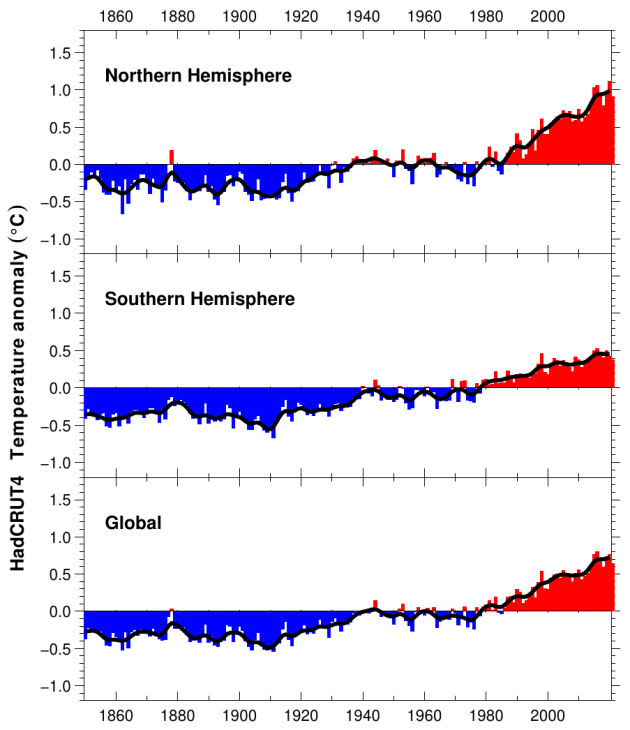
I'd say 0.5C was a large scale effect. It's the same as total global warming from the 1940s to today.
It's Yellowstone that bothers me a bit.
Isn't Krakatoa getting ready to go boom again?
Tom_W1987 - Member
Isn't Krakatoa getting ready to go boom again?
Anak Krakatoa is growing at a pretty steady rate of around a couple of feet a month, IIRC. If it does blow, it won't be the same magnitude as before. Yellowstone is the one we should be wary of!
BTW, for anyone interested, this is a superb read on the topic;
[img]  [/img]
I think it depends on the type of eruption as well as the size doesn't it?
As a side note, volcanoes produce about [b]0.26 BILLION[/b] metric tons of CO2 every year. 😯
That's a lot.
No wonder volcanoes can influence the climate eh?
Odd then that many people reject man-made CO2 as an influence on climate, when we currently produce around 35 billion metric tons a year, roughly 135 times what volcanoes produce.
http://volcanoes.usgs.gov/hazards/gas/climate.php
These big bangs occur when some magmas associated with subduction zones cool. Mike "moon rocks" O'Hara, our prof got us doing calculations on the crystallisation of magmas of various compositions. When these explosive magmas cool crystals are formed that remove some elements from the magma leaving an excess of gas. Whilst the formation of the crystals is exothermic the formation of the gas is highly endothermic and the net result is cooling of the magma. The cooled magma makes more crystals and gas which results in more cooling, and so on in a chain reaction that converts the whole magma chamber to crystals and gas which occupy a much larger space in a very short time. Bang.
So, there are plenty of large magma chambers around that when they cool to critical temperature will go bang. Predicting when to within hundreds or even thousands of years is not easy even with the help of a crystal ball.
As a side note, volcanoes produce about 0.26 BILLION metric tons of CO2 every year.That's a lot.
No wonder volcanoes can influence the climate eh?
Odd then that many people reject man-made CO2 as an influence on climate, when we currently produce around 35 billion metric tons a year, roughly 135 times what volcanoes produce.
http://volcanoes.usgs.gov/hazards/gas/climate.php
br />
Posted 25 minutes ago # Report-Post
Yes quite - although climate sceptics tend to talk about total quantities of Co2 though rather than annual production rates...conveniently forgetting the anthropognic co2 has all been geologically very recent and is still in the atmosphere, while the oevrwhelming bulk of Volcanic Co2 is so old it has already been scooped into other parts of the carbon cycle away from the atmosphere.
I thought the large volcanic eruption influence on climate was from dust particles blocking the sun not CO2. Hence global cooling after big eruptions
http://www.windows2universe.org/earth/climate/geosphere_volcanoes_influence_on_climate.html
As for sceptics claiming CO2 doesn't affect the climate. Very few do. Most sceptics argue that the influence of CO2 is less than feared and catastrophic global warming is unlikely.
Actual global warming so far, 0.5C since the 1940s, is compatible with either position.
Put a lid on a simmering saucepan and the temperature doesn't change, the climate in the saucepan changes a lot though. Going back to when I worked in the atmospheric pollution field in the 80s the predictions had as much to do with a higher energy atmosphere as temperature rises. The whole debate was sparked by observations of [url= http://www.universetoday.com/22551/venus-compared-to-earth/ ]Venus[/url] which we'll soon be getting news from. A quarter of a century on I'm subjectively witnessing the predicted changes.
Some Devonian and Cretaceous carbon sinks:
[img]  [/img]
Put a lid on a simmering saucepan and the temperature doesn't change
Actually it would but your overall point is valid 🙂
There's one on La Palma that I was reading about while I was there & if it goes 'POP' it has the 'potential' to crack a lump of mountainside off which could 'potentially' be up to 500 cubic kilometres in size. This could 'potentially' fall into the Atlantic & cause a MASSIVE tsunami which also has the 'potential' to swamp the Eastern seaboard of the USA.
Dunno how true this all is & I'm pleased it just has potential!
Eejit****syokell actually reduced carbon emissions:
[img]  [/img]
It's not the warming volcanic carbon dioxide you should be concerned about but the cooling sulphur dioxide aerosols that are erupted.
And off-topic; how did Edukator get labelled a troll? What sort of judicial process was involved it that decision?
STW is not a free state 🙂
I got a ban and "troll" for my posts on [url= http://singletrackworld.com/forum/topic/colorado-flooding ]this thread[/url] which were neither edited nor removed so you can judge for yourself, ohnohesback. A member on that thread often complains to the management when I make perceptive comments that are not sufficiently sympathetic.
On topic: the cooling sulphur dioxide is only a worry if you haven't already been blasted, fried, asphyxiated or choked to death.
just wondering, how big an eruption do you need before the weather is noticeably different?
Not sure about climate change but sometimes even a barely audible eruption from my wife is enough to totally poison the atmosphere in our living room.
I thought the large volcanic eruption influence on climate was from dust particles blocking the sun not CO2. Hence global cooling after big eruptions
Yup that's what I understood it to be.
It depends on the type of eruption. Explosive eruptions put up a lot of dust which cools for several years or decades. Basaltic outpourings don't put up much cooling dust but release a lot of greenhousing CO2. The Deccan plateau volcanism has been blamed for climatic changes and pollution that is an alternative or complementary explanation for dinosaur extinction, a meteorite impact being a more popular explanation.
Do they produce other greenhouse gasses?
The important factor is how high the aerosol particles are ejected. If they stay in the lower part of the atmosphere (the troposphere- where our weather occurs)then the effect is short lived as they are rained out relativley quickly. If the aerosols reach higher up into the atmosphere (the stratosphere) then they hang around much longer as the stratosphere is a much drier and calmer than the troposphere. The aerosols in the statosphere absorb the sunlight and therefore warm the stratosphere but this will reduce the amount of sunlight reaching the the lower atmosphere (the troposphere)resulting in a cooling effect.
My understanding of the cause of the big explosions, Krakatoa, Santorini, etc, is the type of magma in the chamber below; thin, 'runny' magma like that from the Hawaiian volcanos just keeps flowing, building up shield volcanos, whereas that from Krakatoa and the Mediterranian volcanoes is 'thicker', and tends to froth, forming pumice, which can choke the throat of the volcano, and then the top blows off.
I believe that Krakatoa kept venting, until the magma chamber was almost empty, just frothy magma that turned to pumice, choking the throat, and the side of the chamber split, allowing sea water into an almost white-hot void, producing super-heated steam, which blew the mountain into the stratosphere.
Got a book about Krakatoa somewhere, the human stories are as fascinating as the explosion itself, which apparently raised the sea level in the English Channel by around an inch*, and the noise heard hundreds of miles away.
*May or may not be correct, it was mentioned in the book.
How explosive an eruption is, is a combination of factors (amount of stored magma, the type of magma, how quickly gases within hte magma escape). In less viscous magmas like in Hawaii the gases 'degass' easily and so never build up to any great extent. Whereas in more viscous magmas the gases remain trapped within the magma and so build up. It is the sudden expansion of the gases (due the reduction in confining presssure as magma rises)that cause the explosions.
It's the crystalisation of the magma in-situ in the magma chamber that causes the biggest explosions in explosive-type volcanism. A chain reaction like an atomic bomb going off but far bigger and more powerful than an atomic bomb. My post 16 hours before this one, but to repeat: when the magma starts to cystalise the magma produces crystals and gas, a net endothermic reaction which cools the magma producing more crystals and gas and so on. the whole magma chamber cyrystalises in a rapid chain reaction converting all the magma into a large volume of gas and fine crystals (volcanic ash). The initial triggers are a cooling of the magma to crystalisation point, gas is then produced (mainly water vapour so call it steam if you wish) pressure builds and then fissuring results in a loss of pressure - at this point the chain reaction starts and the whole magma chamber converts to cystals and gas in seconds and minutes.
In answer to your question, Molgrips, acccept the simplistic answer of "yes but not enough to worry about even if they result in warming rather than cooling" or google "volcanic greenhouse gas emissions"