UPDATE: Reviews section refreshed, redesigned, searchable: Go take a look
22°C inside, no central heating, wood burner not lit yet this Autumn. If you insulate the outer shell of the house well enough zoning almost disappears.
You don't live in the North of England though...
You don't live in the North of England though...
Or in a 16th century house with glass the thickness of Rizla+.
Except that virtually no one does, whereas a log burner is, by design, localised.So the argument stands.
Virtually no one? Got anything to back that up with? I'm sure plumbers merchants and the like wouldn'tstock all that equipment if there wasn't a decent turnover involved.
Interestingly by definition, Central Heating heats more than one roomA central heating system provides warmth to the whole interior of a building (or portion of a building) from one point to multiple rooms.
By your own definition it can also heat a single room (last I checked 1 was still a multiple). So what exactly is your point other than confirming what I already said? Central simply refers to a single source (boiler) rather than having individual sources (fires) in each area you want heated.
You don't live in the North of England though...
Continental weather variations aside, he's right. Go look up Passivhaus.
I should probably mention I studied all this as part of my degree (Sustainable Energy course) and the underlying argument is very basic. Yes wood burning is better but only if sustainably managed from source to consumption. Better doesn't equate to good though, don't confuse the two. There are better ways you could be spending your money on insulating such that you wouldn't need a burner in the first place (Passivhaus amped up to 1 liter haus - basically requires 1 litre of heating oil per sq m per annum)
When we bought the house every room had a radiator including the toilet. Turning any radiator off resulted in the room going cold. After insulating the walls, under the floor and the roof, and triple glazing the difference in temperature between rooms is small.
As pointed out on another thread, February here is colder than many places in the UK including western Scotland.
have you got your zoned and controled from a central point then dave ?
or the standard "TRVs" that no one runs round the house adjusting every 20 minutes.....
What was your outside temperature at 5am this morning edukator - western scotland isnt a particularly cold part of scotland..... its the warm(er) wet side.
Oh and then theres the frequent multi day power cuts we get (overhead lines to a country location) where the boilers rendered useless.
No I don't, mainly because zoning would be a PITA in our circumstances (unless you can find me a 5 week programmer to cater for my shift pattern). We do have TRVs and I can't remember the last time we had to adjust them.
I'm not saying that stoves are useless for everyone but what I am saying is that they are not the be all and end all of 'sustainable' heating. (read my edit)
Virtually no one? Got anything to back that up with? I'm sure plumbers merchants and the like wouldn'tstock all that equipment if there wasn't a decent turnover involved.
Do you have any to back up your argument?
Plumbers merchants don't just rely on zoning kit for business....
Continental weather variations aside, he's right. Go look up Passivhaus.
That's a tangental argument to whether or not CH is more efficient than a wood burner.
Yes wood burning is better but only if sustainably managed from source to consumption.
Given that gas/oil CH is completely unsustainable and is the main competitor to wood burners, from a sustainability point of view wood burning can only be as bad as or better than fossil fuels (regardless of how it is sourced).
I didn't look this morning, Trailrat, it felt mild, say 13, after a couple of chilly mornings. The forecast minimums for the days to come are 13,13,7,5,0,-1 then a week between 0 and 3.
There's also the point that woodburners are a lot better for the environment than open fires.
If you like to burn things indoors for for warmth and aesthetics, doing that in a woodburner is going to be a big step up (or rather down) in terms of wood burnt for any amount of heat, and both the amount and proportion of other nasties released.
The whole Passivhaus is a distraction, we have something like 25 million homes in the UK and build about 120k a year, so even if all new homes were Passivhaus (which they're not) and we didn't need any new houses (which we do), then it would take 200 years until we were all in Passivhaus homes....
So CH and wood burners are relevant for a long time yet.....
Given that gas/oil CH is completely unsustainable and is the main competitor to wood burners, from a sustainability point of view wood burning can only be as bad as or better than fossil fuels (regardless of how it is sourced).
But not everyone is using a stove are they? If they were then it would quickly become unsustainable.
Do you have any to back up your argument?
Beyond the argument that a good business is unlikely to stock low turnover products, no. But you opened the argument so the burden of proof is on you.
That's a tangental argument to whether or not CH is more efficient than a wood burner.
I never said it wasn't, I was simply pointing out that living in the North of England (as you retorted) didn't necessarily have any bearing on his heating needs.
Given that gas/oil CH is completely unsustainable and is the main competitor to wood burners, from a sustainability point of view wood burning can only be as bad as or better than fossil fuels (regardless of how it is sourced).
I never said otherwise, what I did say was that whilst better that doesn't necessarily equate to good if it's not done in a sustainable way.
The whole Passivhaus is a distraction, we have something like 25 million homes in the UK and build about 120k a year, so even if all new homes were Passivhaus (which they're not) and we didn't need any new houses (which we do), then it would take 200 years until we were all in Passivhaus homes....So CH and wood burners are relevant for a long time yet.....
It's not really, existing stock CAN be upgraded as proven in German experiments. Really though we should be building to the Passivhaus standard if we want to seriously reduce our energy consumption as a nation. I do agree that it's a side argument, I suppose my argument was that if you spent the £3k or so that a woodburners costs (if you don't have an actual need for one as a primary heating source) then you could insulate your house a lot better. Really though, central heating IS more efficient than a single source no matter what way you look at it since your whole house will need heated at some point.
I'm not on one side of the fence or the other here, sustainability is as much about individual circumstances as the big picture. As with anything milage varies according to your needs and what you are replacing in order to achieve your 'gains'.
The US Department of Defence is the country’s largest consumer of fossil fuels. Research from 2007 showed the military used 20.9bn litres of fuel each year. This results in similar CO2 emissions to a mid-sized European country such as Denmark
I sense some selective use of data - Denmark might be "mid-sized" but it has a population of 5.6 million (i.e. whole country population is much less than that of a major city). They generate most (all?) of their electrical energy from wind power and they have very little heavy industry (it is mostly agricultural). So I'd imagine they have quite a low level of CO2 emissions (measured in relation to country size).
Really though, central heating IS more efficient than a single source no matter what way you look at it since your whole house will need heated at some point.
Based on what?
You don't need to heat all your house at all, the Victorians managed quite easily with open fires in some rooms (not all) and a large chunk of their housing stock is still standing and highly desirable in many locations.
I never said it wasn't, I was simply pointing out that living in the North of England (as you retorted) didn't necessarily have any bearing on his heating needs.
Why would it, he lives in the South of France IIRC...
If you define passivhaus as 44kwh/m2/year then insulating the current housing stock you can get very close. We consume 1700kWh of electricity (general use, not heating) and 2.5 steres (say 2m3)of mainly pine so about 5000kWh. That's only 50% over passivhaus despite heating to 20°C+ rather than 18°C.
Most British people consider their houses well insulated but have no underfloor insulation, consider cavity wall insulation adequate for the walls when it really isn't, have thermal bridges around all the windows and doors, barely insulated doors and only double glazing. All of that can be remedied without knocking houses down.
It's not really, existing stock CAN be upgraded as proven in German experiments. Really though we should be building to the Passivhaus standard if we want to seriously reduce our energy consumption as a nation.
If the UK wants to seriously reduce energy consumption it needs to retrofit existing buildings. Some 90% of current buildings will still be standing in 50 years time, so new Passivhaus would make a tiny impact on that. Passive is part of the answer, but retrofit is the big hitter in buildings. Decarbonizing transport is currently a bigger issue (before VW as well).
Are you sure about that? A modern Gas boiler is 5-10% better than a wood burner in terms of energy efficiency, but a wood burner heats the house more intelligently ie heast one room and not 5+ rooms that are unoccupied most of the time. CH is normally set to heat a house and ends up heating lots of rooms no one occupies more most of the time.
You can just turn off the radiator in a room that is not being used. Most of us live in houses where most of the rooms will be in regular use anyway, so I don't see a wood burner in one room as particularly "intelligent" heating. How does it cope with people eating a meal in one room and then dispersing to different rooms to watch TV, do their homework, play with friends etc?
In practice, I'd guess most people using wood burners are running CH as well, unless they genuinely live in one room, which is another reason that I suspect the effectiveness and efficiency of wood burning is not really so great.
I think most people have wood burners simply because they like the look of a real fire. I'm not convinced they are a "greener" solution to heating and I doubt it would be practical to have a wholesale switch to wood burning, with the issues of cultivation, distribution, storage and air quality that would entail.
The real solution to the financial and environmental costs of heating must be reducing consumption, whatever type of heating you use.
You don't need to heat all your house at all, the Victorians managed quite easily with open fires in some rooms (not all) and a large chunk of their housing stock is still standing and highly desirable in many locations.
Okay, seriously, you're showing your ignorance now. One reason why you need to keep your house warm: dampness.
As for what else my point was based on, see KCR's post above.
Most British people consider their houses well insulated but have no underfloor insulation, consider cavity wall insulation adequate for the walls when it really isn't, have thermal bridges around all the windows and doors, barely insulated doors and only double glazing. All of that can be remedied without knocking houses down.
If the UK wants to seriously reduce energy consumption it needs to retrofit existing buildings. Some 90% of current buildings will still be standing in 50 years time, so new Passivhaus would make a tiny impact on that. Passive is part of the answer, but retrofit is the big hitter in buildings.
Absolutely agree!
"In practice, I'd guess most people using wood burners are running CH as well, unless they genuinely live in one room, which is another reason that I suspect the effectiveness and efficiency of wood burning is not really so great."
Most but not all .
I can assure you ours are never on together infact the CH is only there to warm the house for getting up at stupid oclock -we did our first year in this house with no heating or mains hot water- we just boiled as we needed and had an electric shower
Okay, seriously, you're showing your ignorance now. One reason why you need to keep your house warm: dampness.
guess what the fires very good at removing. - damp air.
- but then i can heat the whole house from the stove without much issue so it wasnt really missed until about feb when the real cold came and it was -10 or so at night on a regular basis.
Absolutely agree!
I don't think anyone disagrees with this, the original question (snipped for briefness) was:
I live in an inner-city area and have central heating. It'd be less efficient than my gas boiler, and would put more pollutive nasties into the air.But how bad are they really?
I still contend than running a wood burner is more efficient than using CH in this scenario. Mainly because you heat less of the house so reduce heat losses without making a big difference to overall comfort.
I still contend than running a wood burner is more efficient than using CH in this scenario. Mainly because you heat less of the house so reduce heat losses without making a big difference to overall comfort.
That assumes you have insulated between rooms, in reality the heat loss will be the same but the localised demand is reduced. Again, simple zoning controls could do the same thing. Also, what happens if you want to move into another part of the house?
Efficiencies will vary but at best guess a stove could well come close to a boiler if you use a convection fan. If you're relying on radiation alone then no, it's not. Out of interest can you get a stove with a back boiler? Because that presents a whole new argument in favour of them.
guess what the fires very good at removing. - damp air.
Hands up, I misread that, I missed the 'all' so fair enough. Next problem though is that convection will draw the cold air from unheated rooms thus putting more strain on the fire.
Having seen the smog having over every New Zealand city over the winters, it'd have to be a very clean, modern wood burning stove I'd ever install in a house.
I mean, everyone looks back on the air quality of the 70's with such fondness.
When I stripped out the central heating I put one of the old radiators behind the stove and connected it to a new vertical radiator mounted high on the wall in our bedroom. It circulates by thermo-syphon and reaches 40-45°C at the warmest point in the circuit with the stove going at 5kW or so.
I lived in an old farm with a range that had a back boiler for hot water. That would boil the primary circuit if we didn't run baths.
Out of interest can you get a stove with a back boiler? Because that presents a whole new argument in favour of them.
What argument is that then?
What argument is that then?
Presumably that the CH wouldn't need to be switched on to heat water.
Don't think this has been mentioned:
[url= https://www.aecb.net/publications/biomass-a-burning-issue/ ]Biomass - a burning issue[/url]
The argument of wood burning stoves being environmentally benign is utter tosh, whilst it may be possible to argue some degree of carbon neutrality they are far from pollution free
What argument is that then?
That, as suggested, they could be used in place of central heating or in tandem. With modern under floor systems a Rayburn or such could warm the whole house using low grade heat (of course the problem with extracting too much heat is condensing of exhaust gasses and accumulation of creosote deposits). Then you at least get your money's worth so to speak.
The problem is polluting your neighbours
As with any thermal system involving combustion. Whats your solution?
Jivehoneyjive:
I appreciate that is US rather than UK, but when all is said and done, we all share the same planet...even in UK terms, how much of the £33,000 per hour it costs to run a Tornado is fuel?
Since you asked, a Tornado burns about 4 tons of Avtur per hour on a typical sortie. That's about 5000 litres. At 70p/litre, that's £3500/hr. Those figures you see bandied around for per hour operating costs are usually quite dodgy and include the purchase price and through-life maintenance of the aircraft, the salaries of the crew and all the maintainers, the operating costs of the base.....
Speaking as an air traffic controller, I'm pretty confident that UK military aviation emissions are a flea on the flank of UK civil aviation emissions. I personally think the security of the UK is more important than holidays, but then I guess you don't think that the military enhances your security.
If you've got to burn something burn the least polluting possible, wood certainly isn't
Are you happy to damage people's health?
You can fit particle filters and cats:
[img] 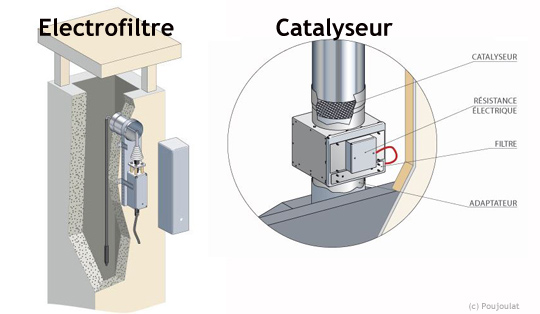 [/img]
But I'm not aware of anywhere that they are a legal obligation apart from Switzerland. I suspect that the filters remove only the large particles and the smallest most harmful stuff gets through.
On 'commercial' biomass plant (in Scotland) Building control want a six page form filled in specifically about particulates being emitted (helps if you select a boiler from one of the UK tested list). Way too technical for me, I stick it to the manufacturers agent...
Pretty sure they insist on air scrubbers/filtration on larger sized plant (or maybe just a carry over from the Austrians/Germans whose kit it is...).
Biomass is *big* due to the huge carbon reduction in comparison with oil and gas (based on the government approved calc methods). Helps make compliance with the regs easier for new build. So it's sustainability rather than anti-pollution.
However, having been involved in (and seen other installations of) I'm not convinced we're headed in the right direction. It's supposed to save money (my calculations says so... 🙂 ) but it's certainly problematic.
Re. Underfloor heating, I'm not convinced either. Because of the thermal mass you kinda have to keep it fed/topped up. Long reaction times also don't help. I went from a 'breezy' 1960s 2 storey house with gas CH to 1 storey cottage renovated in the last 5 years (I.e. To fairly modern standards and ironically so well I rarely use the stove as it gets too hot within an hour) with UFH (fed from pellet boiler) and my bills are 1/3 higher (and I pay per kWh, no standing charge and 5% vat).
"we" were all cooking on wood way before petrol. I'll listen to any anti wood burner person when they have removed all petro chemical influences from their life.
Just cause you used to do something doesn't make it right, in fact if you now know it's wrong that makes it worse
T1000 again, whats your solution?
T1000 - Member
Just cause you used to do something doesn't make it right, in fact if you now know it's wrong that makes it worse
I trust you don't drive a diesel. (Or buy products delivered by diesel powered transport). We now know just how dangerous the fine particulates are....
Speaking as an air traffic controller, I'm pretty confident that UK military aviation emissions are a flea on the flank of UK civil aviation emissions.
Is that including all bombs and missiles used?
How about the support infrastructure such as Aircraft Carriers?
What are your thoughts on Depleted Uranium munitions?
Is there any significant difference in localized pollution as a result of low level flying, which is almost exclusively carried out by military aircraft?
I personally think the security of the UK is more important than holidays, but then I guess you don't think that the military enhances your security.
That is a tricky one... being as we're told the main domestic threat is terrorism, what caused hatred and radicalization in the 1st instance?
What use are fighter jets in combating domestic terrorism?
Anyhow, back on topic, has anyone tried those tealight heaters made out of earthenware flowerpots?
What use are fighter jets in combating domestic terrorism?
Quite a bit when, for example, a helicopter sends a hijack code out a few miles from nuclear facilities
http://www.bbc.co.uk/news/uk-england-17699357
It confirmed that the helicopter pilot had transmitted the wrong signal by mistake.
Yikes...
evidence suggests that stairs, ladders, bathtubs, militant insects and keeping on topic, stoves, have a higher fatality rate than the vast swathes of terrorists whose motivation to come to the UK to kill and maim is still somewhat mysterious... could it have anything to do with fighter jets, bombers and drones?
And what is the best sustainable fuel for a smokeless area?
Squirrelking don't poison people, why do you believe it's ok to?
There are lots of other ways to heat properties than by burning wood in an urban environment
Stoves are a crappy and inconsiderate way
Metalhead what a silly comment, how would that be possible in this world?
Any how this thread was about stoves, which are horrible stinky things which pollute urban environments, and are subject to increasing scrutiny. at some point they may well have more stringent controls applied as they get recognised as the new diesel.
Metalhead what a silly comment, how would that be possible in this world?
Of course its not possible, however we all know its wrong. Why do you get to be wrong but not allow others to be?
All forms of heating have incidental pollutants (somewhere down the line).
With the storage required for fuel for stoves I doubt it'll become as serious a hazard as diesel/petrol fumes.
Wow stoves the new diesel.
Thats a corker.
Meanwhile i burn kerosene for my central heating - is tht better or worse than wood in your eyes - i dont have mains gas near by.
Go on T1000, what car do you drive and how much do you use it, what does your partner drive (if you have one)? We've got a Lodgy TCE petrol between three of us which has done 14597km in 2 1/2 years at 5.8l/100km.

