UPDATE: Reviews section refreshed, redesigned, searchable: Go take a look
jam bo - MemberExcept you don't drill for oil in the middle of a tide race...
Nope - you drill for oil in much more inhospitable places that the pentland firth and the sound of islay. Remember this is actually working installations now.
Cool, start with looking at getting a few quotes for the panels.
A 4kw system is around £6500 these days.
Will reduce your electricity bill by about £200 per year. Not sure on the reduced payments for the FIT these days, but it will be tax free.
Ideally you need a south facing roof, without any shading.
Typically the panels produce 4 Mwh per year.
The Tesla battery is about £6,500 , but would be cheaper to install with the panels at the same time.
Nope - you drill for oil in much more inhospitable places that the pentland firth
Not underwater they aren't....
I don't view it as any harder than getting oil and gas out of rock hundreds of metres below the sea bed. MCT had a prototype tidal turbine in the sea nearly a quarter of a century ago and a fully operational device ten years ago or something.
The big problem with tidal is not the hardware - that's all sorted - it's finding the right locations.
Just because there's a place with a big tidal flow doesn't mean you should drop a turbine in there. Adding something into the tidal flow can have a massive effect on the transport and deposition of sediments and if a turbine is put in the wrong place the effects years down the line can be catastrophic. This has been found even when building bridges over large rivers and estuaries.
It would be a bad thing to spend x million on a tidal system only to find that the disrupted flow and associated silting has caused the tidal flow to change in that particular area.
Since the tories cut the feed-in tariff, small domestic solar installations are not really economically viable. You might just about get your money back before the panels pack up, but not a lot more (and you'd have to wait 20y or more even for that).
But prices are always coming down, and in sunnier areas (and for larger installations) the economics can tip the other way. I'm optimistic that we are on the cusp of a real revolution in global terms.
scotroutes - Member
Only 50.7%?
That link says 'homes' so does it include industry? The link in the OP refers to the entire grid.
95% of all scottish homes just from wind - thats about 60% of all electricity used in scotland. Add in Hydro and its 70%+ of all electricity in scotland from renewables and last year the total was over 50% of all electricity in Scotland from renewables IIRC
That's 95% of home electricity [i]for the whole of May[/i] and
on one day output from turbines alone generated enough electricity to power 190% of homes or 99% of Scotland's total electricity demand compared to the 50.7% from a combination of sources in the originally linked item.
The big problem with tidal is not the hardware - that's all sorted - it's finding the right locations.
Just because there's a place with a big tidal flow doesn't mean you should drop a turbine in there. Adding something into the tidal flow can have a massive effect on the transport and deposition of sediments and if a turbine is put in the wrong place the effects years down the line can be catastrophic. This has been found even when building bridges over large rivers and estuaries.
It would be a bad thing to spend x million on a tidal system only to find that the disrupted flow and associated silting has caused the tidal flow to change in that particular area.
Having spent a fair bit of the last ten years working on marine renewables projects I'd say the hardware is not sorted, but getting there, Meygen have had good results so far but many devices would be classed as prototypes still. In terms of sediments, a lot of work goes into that but the places turbines are put are highly energetic environments with bedrock seabed. Tidal barrages like the proposed severn one etc are a different story - these are naturally areas of high deposition and relatively low current speed.
bigjim - calling the Pentland Firth installations "tidal" sees like a bit of a misnomer as that sounds like something that only generates on an intermittent basis. Is there a more accurate/descriptive term? Ta.
tjagain - Member
95% of all scottish homes just from wind - thats about 60% of all electricity used in scotland. Add in Hydro and its 70%+ of all electricity in scotland from renewables and last year the total was over 50% of all electricity in Scotland from renewables IIRC
Thanks, that's pretty good going. Shame NIMBYism seems to have curtailed our renewables down here.
There's so many figures in that report....
It's not [i]just[/i] nimbyism, though you can obviously do more when you've already relocated most of the population.
scotroutes call them tidal flow? Pentland firth will generate for around 14 - 16 hours a day, needs the sound of Islay as well as its high tide is 4 hours different giving a nice smooth baseload from tidal flow ie slack water in the pentland firth is near peak flow in the sound of islay
With BigJim on this.
The hardware for tidal is not sorted, far from it. If it was it would have been deployed on a commercial scale already. They're not there yet, but they're getting better and will get there eventually. We can't just sit here and wait for them though because there's no guarantee.
It is a technical and logistical challenge even on a small scale, let alone a commercial scale. Problem is, you put stuff in the sea with moving bits and it melts. Anyone like to tell me how you safely maintain an array of 100+ tidal devices when the water is moving at 15 knots on a still day? How about doing that whilst making a profit?
Scotroutes: I'd describe the Pentland Firth as "Tidal Stream", stuff like the Severn Estuary "Tidal Barrage".
Another development nobody has mentioned is floating offshore turbines - much cheaper to install, reduced environmental impact, greater flexibility on site selection, but again still in the test phase. I've seen a couple of designs with wave generators attached to them too which seem interesting. But I'm no engineer.
bigjim - calling the Pentland Firth installations "tidal" sees like a bit of a misnomer as that sounds like something that only generates on an intermittent basis. Is there a more accurate/descriptive term? Ta.
Nah I think everyone uses the word tidal. The devices will be optimised for the tidal current regime of the site to maximise power across the tidal cycle in that location, I guess there'll be a short period of slack tide when there's no generation but as has been said, tidal cycles vary massively around the country so theoretically you could have a pretty constant supply I would think.
Northwind
The key thing, and the thing a lot of places are doing wrong, is that it has to be a a renewed source- in the states they're logging virgin forest, old growth, and other areas which is terrible ecologically
It's actually not that bad compared to buring coal and oil in terms of Co2.
Coal and Oil are the result of tens of thousands (and probably millions) of years of carbon sequestration. Thousands of seasons of organic growth (powered each by each summers sun) were squashed together and enriched into a highly energy dense material. When we burn that material we release many, many years worth of carbon. (consider we have probably released >100,000 years worth of carbon in just about 200 years since the start of the industrial revolution)
But, for a [b] short term [/b] carbon cycle, you simply can't on average, release the carbon any quicker than it is captured! Say tomorrow we cut down and burn every single tree on the planet. ok, that's a lot of carbon released all at once, but then we have to wait, probably 20 to 50 years before we can do the same release again, and in those 20 to 50 years, that carbon is re-captured into the growing biomass. So, sustainable biomass sources can only, on average, emit the same carbon they capture. If you want more power (energy/time) you will need to plant more trees, which capture more of the suns energy.
has anyone built a DP vessel capable of installing anything in tidal races yet? i know there was some design on the cards a few years back but haven't seen anything since.
but don't let practicalities like that get in the way eh TJ...
ehrob Anyone like to tell me how you safely maintain an array of 100+ tidal devices when the water is moving at 15 knots on a still day
Don't most of the turbines wind up out of the water for maintenance?
[img]  [/img]
No, it's never going to be as cheap as wind generation due to accessibility issues, but it's a good way of getting some deterministic base load into a renewable source grid!
Another development nobody has mentioned is floating offshore turbines - much cheaper to install, reduced environmental impact, greater flexibility on site selection, but again still in the test phase. I've seen a couple of designs with wave generators attached to them too which seem interesting. But I'm no engineer.
Well it just so happens we have one under construction near Peterhead, the Hywind pilot park, which is a very interesting project
jam bo
has anyone built a DP vessel capable of installing anything in tidal races yet? i know there was some design on the cards a few years back but haven't seen anything since.
Pretty sure we didn't have the specific infrastructure to do this:
as little as 10 years ago either!
jack ups are nothing new. offshore windfarms construction just borrowed from the O&G industry.
try putting one of them in the pentland firth....
Don't most of the turbines wind up out of the water for maintenance?
Some are designed to, others you lift out a few times in their lifetime at slack tide for some tlc https://www.atlantisresourcesltd.com/services/turbines/
Yes in windy areas of low population density (Scotland) wind can make a useful contribution to domestic electricity demand. Note however that's a long way short of making a substantial contribution to total energy demand (inc industry and transport) across the UK. There simply isn't the land area for it unless you are considering putting up turbines literally everywhere. Solar gives many more watts per square metre (roughly 20x as much IIRC, though of course this varies by location).
Not saying wind is a bad thing per se, just a bit of perspective.
there are already heavy lift barges / cranes operating in the pentland firth with no great issues. No issue at all with this unless you want to invent reasons why it can't be done.
You'll note i used the word "specific" to indicate that whilst a jack-up is not a new idea, the exact implementation when used to install large offshore wind turbines is indeed specific (handling a 200M tall structure and landing it onto a pre constructed anchor point on the sea bed requires very specific processes!) and those didn't exist until the need drove them into existence.
Lets face it, you go to the petrol station today, stick that little nozzle in, pull the lever, and squirt 50L of gasoline or diesel into your car without so much of a moments though about how it actually gets to the tanks under your feet.
Let me remind you:
First we have to find the oil fields, that require survey and drill ships like these:
[img]  [/img]
[img]  [/img]
Then we have to put in place the commercial extraction rig:
[img]  [/img]
[img]  [/img]
Then get the crude oil to shore by pipeline:
[img]  [/img]
[img] 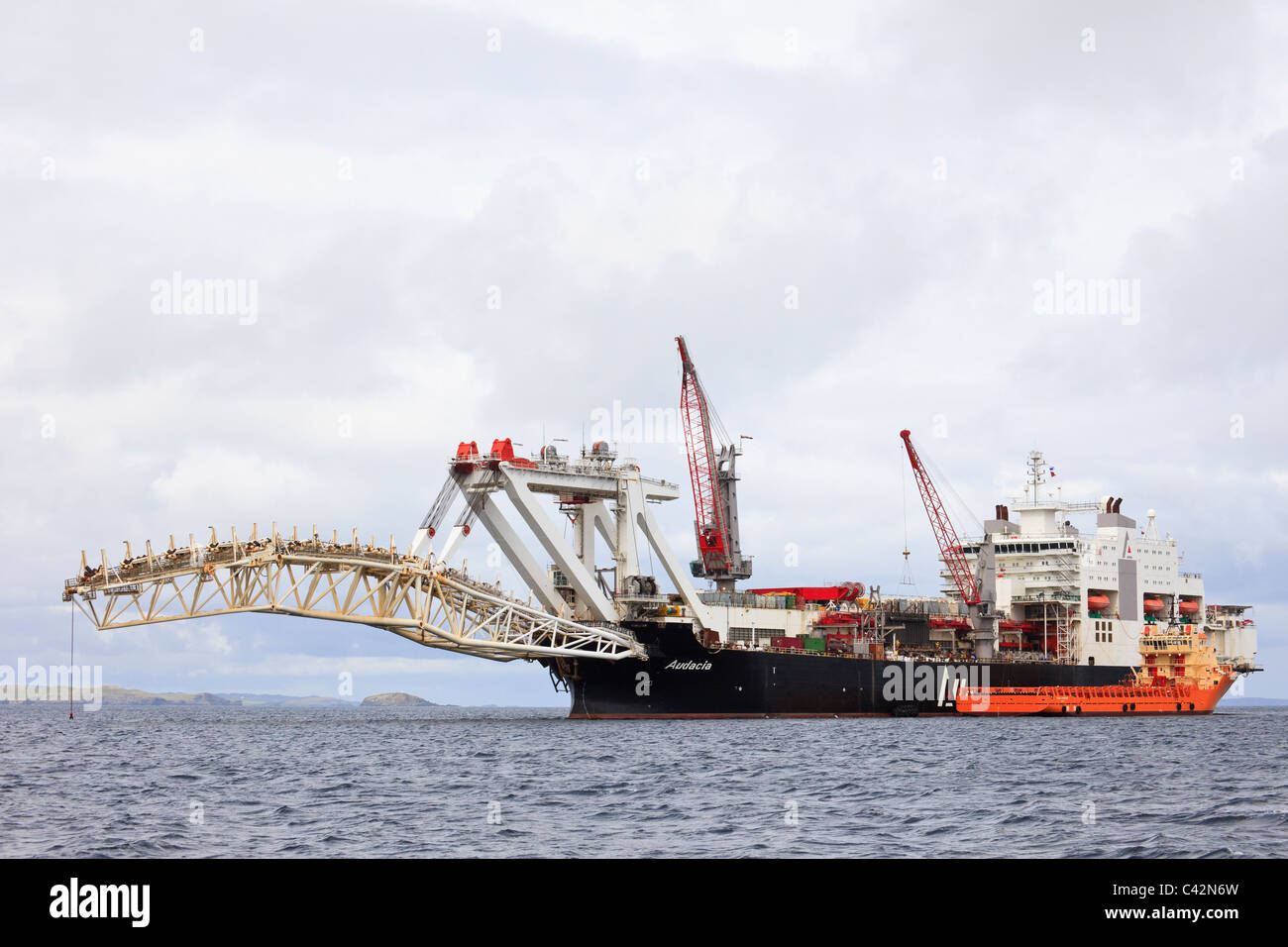 [/img]
[img]  [/img]
or in a fleet of tankers etc
[img] http://media.gettyimages.com/photos/oil-tanker-picture-id171272748?s=612x612 [/img]
Then we refine that crude into it's more valuable lighter fractions
[img]  [/img]
[img]  [/img]
Then we need to transport the refined fuels:
By road:
[img]  [/img]
By rail:
[img]  [/img]
By sea:
[img]  [/img]
By yet more pipelines:
[img]  [/img]
Finally, it gets to your local petrol station, where you stick it in your car without a moments thought:
[img]  [/img]
.
.
.
.
.
So, please don't tell me it's "difficult" to stick some turbines in a river eh!! 😉
maxtorque - MemberIt's actually not that bad compared to buring coal and oil in terms of Co2.
Oh yeah, absolutely- I'd kind of taken that for granted. But it's rubbish compared to closed cycle replanting.
It's kind of like the whole tar sands/antartic drilling thing where for years the argument has been "we'll run out of oil, we need to do something" and finally people were convinced but instead of going "not oil" they went "BURN ALL THE OIL TO THE LAST DROP". Somehow people find a way to make the worst.
thecaptain - MemberYes in windy areas of low population density (Scotland) wind can make a useful contribution to domestic electricity demand.
People always say that about scottish population density but the central belt is one of the UK's most populated areas. There's miles and miles of bugger all north of that but we still have a lot of wind generation in and around the densely populated areas and we're nowhere near saturation
It can be done, sure. But not yet. And it needs to be done safely, with minimal environmental impact. And someone still needs to turn profit.
Bit old now, and things have moved on a bit - but the Strangford Lough device was installed in 2008, and generated sufficient power for 400-500 homes. There are 25 million homes in the UK.
I'm not down on them, far from it. But we have to be realistic - like the investors. They're seeing the sector as too big a risk to come and put a load of money into. The payoff, if it happens, is some years away.
In that case it should be easy. Crack on.
I'd love wave and tidal to come to fruition, I wrote essays 20yrs ago at uni about the resource estimation. I work for a company that design and build marine instrumentation. A lot of the prototypes carry our kit.
But it doesn't seem to be happening. Wave power seems to dead in the water, wave hub was completed in 2010(?) for £28 million and as yet no one has connected to it. Survivabilty is a Achilles heel of waves power. The marine environment is brutal.
Tidal? Lagoons and barrages are the practical solution but no one has the political will to overcome the environmental concerns. Except the French, they have been operated a tidal barrage for about 40yrs.
It should be quite easy to find which vessels they used for meygen installation. Scotrenewables' tidal device is designed to be moved around by a normal multicat to keep costs down, which is cunning.
There's miles and miles of bugger all north of that but we still have a lot of wind generation in and around the densely populated areas and we're nowhere near saturation
I've not worked in onshore wind for a few years now but I think developers are now re-looking at sites that have previously been dropped, there's only so many suitable locations with all the constraints on development. Onshore wind will begin to taper off at some point - I don't know if the rate of applications is still rising, constant or declining.
personally I think we have enough wind capacity now. It can't be too big a part of the mix until the energy storage problem is solved.
Jambo
Wave does seem to be fairly dead in the water but tidal flow much less so. If only we had a few of those billions wasted at hinkley invested in it we would be a lot further on
A lot has changed in 20 years
With BigJim on this.The hardware for tidal is not sorted, far from it.
Thought it was... sorry 🙁
But it doesn't seem to be happening. Wave power seems to dead in the water, wave hub was completed in 2010(?) for £28 million and as yet no one has connected to it. Survivabilty is a Achilles heel of waves power. The marine environment is brutal.
I think it's a bit dead in the water in the UK, despite our technology developers leading the way for many years, but the vacuum will be filled overseas. It's an echo of the UK leading wind turbine development in the 60s and the government dropping it, it's a huge industry for other countries now.
Tidal? Lagoons and barrages are the practical solution but no one has the political will to overcome the environmental concerns. Except the French, they have been operated a tidal barrage for about 40yrs.
I still think tidal current turbines will take off, again maybe less in the UK, but fantastic potential overseas. I did a feasibility project in Indonesia a couple of years ago (sadly no site visits 🙁 ) and it looks like there is still momentum, it's a no brainer where there are huge tidal currents between populated islands. http://www.hydroworld.com/articles/2017/05/tidal-energy-project-in-indonesia-up-to-115-mw-at-us-550-million-begins-feasibility-study.html
A lot has changed in 20 years
that's the problem. it hasn't.
There simply isn't the capacity to build significant amounts of pump storage in the UK / Scotland. I believe our capacity represents a few hours of consumption only. The solution to this is the north sea interconnect to Norway and join with their plans for significant new pump storage capacity
What you appear to be saying is, we can flood Norwegian valleys, but not the highlands?
[url= https://www.ecowatch.com/coal-mine-hydroelectric-2321724350.html ]Have we seen this intriguing German pumped storage "battery", any of UK's old mining infrastructure up to this? Or were they closed too long ago?[/url]
Have we seen this intriguing German pumped storage "battery", any of UK's old mining infrastructure up to this? Or were they closed too long ago?
It'd be interesting to see how clean the water is and how they contain it. Then again it may well be fine as the spoil heaps are already there, and what's still underground should be no different.
That and with all the hoo-harr around fracking I can't imagine villages already worried about existing mine subsidence would be wild about the idea of effectively turning those shafts into rivers!
Wind farms will continue to go up. There's loads in the planning system, offshore and onshore. Many existing ones will likely be repowered at the end of their operational lives, with bigger turbines.
Interconnectors to other countries will help smooth issues regarding supply and demand.
Tidal stream will get there eventually I hope.
Barrages are unlikely to happen as the environmental consequences in suitable areas are too severe. These are almost always areas with habitats very important to birds, so are rightly heavily protected.
The French didn't overcome environmental issues with theirs, they just built the Rance station before anyone properly understood what it would do.
Lagoons are a possibility. Don't know loads about them to be honest.
tinas - the Norwegians are keen. there simply isn't the room in Scotland - there is in Norway
Jambo - perhaps it has and you have not noticed? From Strangford lough to the pentland firth to Unst to the Beuly Denny interconnect it seems to me a lot has changed in 20 years - including a lot of refined designs in tidal flow generators actually being in the water
tinas - the Norwegians are keen. there simply isn't the room in Scotland
An absolutely jam packed Scottish valley earlier.
[img]  [/img]
tinas - there is not much in the way of suitable places to put pump storage. that glen would not do - no damming point and for pump storage you need two dams - one higher than the other. Wheras the norwegians see this as an oportunity to take a leading role
Where is the electricity coming from to pump the water up the hill?
https://www.newscientist.com/article/dn7046-hydroelectric-powers-dirty-secret-revealed/
Is burning trees a good idea?
https://www.nrdc.org/sites/default/files/burning-trees-southern-forests-FS.pdf
http://www.huffingtonpost.com/ellen-moyer-phd/burning-trees-to-make-ele_b_1601275.html
tinas - there is not much in the way of suitable places to put pump storage. that glen would not do - no damming point and for pump storage you need two dams - one higher than the other. Wheras the norwegians see this as an oportunity to take a leading role
You've plenty of hanging valleys, the 'english' name for cirque even comes from Gaelic (Coire), Corrie!
Just seems daft adding more connections under the North Sea to pay a premium for Norwegian pumped storage when we could do it in the UK.
paton - Member
Where is the electricity coming from to pump the water up the hill?www.youtube.com/watch?v=CDlvjkfpX_o
https://www.newscientist.com/article/dn7046-hydroelectric-powers-dirty-secret-revealed/
Is burning trees a good idea?
Are you going to offer an opinion or do a JHJ and just post links to youtube?
Pumped storage takes surplus energy from inflexible sources (nuclear and to a lesser extent coal) and unforecastable or uncontrollable renewables (solar, wind) and releases it when demand requires it.
The alternative is moving towards more of a smart grid where things like home heating, car charging, water heating, freezer cooling, are done based on when the grid has a surplus of energy, now when the consumer demands it. I.e. you'd plug your Tesla in when you get home and at some point in the night it would charge up, and your house would heat up, but you wouldn't get specific control over exactly when.
Just seems daft adding more connections under the North Sea to pay a premium for Norwegian pumped storage when we could do it in the UK.
The idea of interconnectors is to sell electricity to each other to meet fluctuations in supply and demand. In winter in Norway their hydro capacity is reduced by freezing reservoirs, and we have an excess of wind. In summer, they have an excess of hydro and we have reduced supply from wind.
There are also more one-way interconnectors proposed, such as the IceLink interconnector, which would export electricity generated from the massive geothermal resource in Iceland. Existing interconnectors like BritNed have been very successful and I think the national grid are very keen on this supergrid kind of development.
There are plenty options for pumped. Sloy Dam Power station for example. Not currently pumped storage. Make the dam bigger and convert the power station to pumped storage. Only affects an existing Glen so not a biggie environmentally. Read that filling emptying a bigger dam would change the level of Loch Lomond by 80cm. less than current natural variation.
On the 50% headline. in perspective it was 37% on a very windy and sunny day.
[img]  [/img]
http://euanmearns.com/50-re-in-the-uk-the-ugly-facts/#more-18511
Tinas- that'll be the A82 in your photo. If you can come up with a suitable alternative route then Transport Scotland would like to have a word with you 🙂

