Funkmasterp I enjoyed that film. I share a van with a workmate. Possibly the only vehicle with 2 people in I see in the day! Not counting school runners. Eco friendly tradesmen hurray!
johndoh - Member
In Harrogate they have big signs saying 'Beat the Queues, Travel in Twos'.
Explains the amount of tits in cars I suppose.
I don't see what the problem is actually. In 10-15 years we'll all be in electric, self-driving cars. Onward from that it will become illegal to drive a car and then eventually you won't even own a car, you'll just summon one from the collective local compound via your communication device to take you where you want to go.
Won't make a difference, roads will simply be clogged with the same number of self driving cars. Actually more, as they will be driving themselves back to get other pickups instead of spending the day in car parks.
Some government will have to make some unpopular choices at some point in time.
In Harrogate they have big signs saying 'Beat the Queues, Travel in Twos'. However this doesn't help beat the queues, you just spend time stuck in the same queue but with someone you struggle to keep a conversation going with.
Majority of people in Harrogate are elderly, wedded to their cars, and retired, so spending all day sat in a traffic jam is no issue to them.
To fix it, Harrogate needs...
* Congestion charging
* Buses and trains that are affordable (5 min trips on the train > £3)
* Cycling infrastructure. There's none that I've seen despite a fair number of cyclists on the roads.
Hi Matt,
I think there are some good ideas here. I guess you need to check for your local campaign group. Cycling UK or Sustrans or Cyclescape may help, and get talking to the council.
The infrastructure needs to prioritise the bike, which most places don't. That takes time and money.
Bon Chance
dmorts - depends somewhat upon the part of the city. southsiude I see a lot more people on bikes rather than full kit cyclists. You do get folk on bikes in ordinary clothes a fair amount as well - 4 folk cycle regularly to my work - one in cycling kit the rest in including me in ordinary clothes and no helmet.
My Next door neighbour goes everywhere by car, soon her children's legs will drop off. She takes her eldest to school by car.
My next door but one neighbour has a child in the same school (same class) and walks her child to school (unless the weather is awful). These women are both housewives and have the time.
The shops around where we live are independent and about a 5 minute walk away. Neighbour 1. goes in the car, neighbour 2. walks. Aaarrgghhh.
I live about 1km away from my kids school. Easily done on foot or by bike. They are driven to school most days. It is not that I am [i]driving them to school[/i] but more the case that I drop them off as I drive to work. I would love to ride them in but I don't have time to ride them in, ride back home get changed then set off to work. They are too young to walk by themselves. Most people with young kids and full time working parents know that time is always tight, especially in the mornings.
My point is before you judge people for apparently driving their kids to school, perhaps consider what else the person may be doing with their car once they have dropped the kids off.
Frank - 1km = what 12min walking time, is it totally impossible for you to walk too and from school (say 25mins) & then drive to work?
franksinatra - Member
I live about 1km away from my kids school. Easily done on foot or by bike. They are driven to school most days. It is not that I am driving them to school but more the case that I drop them off as I drive to work. I would love to ride them in but I don't have time to ride them in, ride back home get changed then set off to work..
Home to get changed? Into what?
Most of the time there are ways and means to do it, if you really want to do it.
Frank - 1km = what 12min walking time, is it totally impossible for you to walk too and from school (say 25mins) & then drive to work?
Certainly not impossible very difficult.
25 mins 5 times a week equates about 2 hours. I can't drop the kids off at school any earlier so that means turning up at work later. The result is paying for more childcare, either breakfast club at school or after school club. The financial burden then outweighs the benefit.
I have tried organising walking trains but all of the neighbours with kids of a similar age are in the same position, working parents always in a rush.
I don't see what the problem is actually. In 10-15 years we'll all be in electric, self-driving cars
One of the problems is that it will be nothing like as soon as 10-15 years, more like 30 years. So what do you do in the meantime.
One of the problems is that it will be nothing like as soon as 10-15 years, more like 30 years. So what do you do in the meantime.
I disagree. I'd be very surprised if my kids first cars are not electric. I can see introduction of pay per mile vehicle tax with petrol and diesel cars being significantly more expensive to run. There will be a tipping point
Frank - you could park near the school the night before and then still walk them in the morning without loosing any time 😉
Lets not turn this into a why not thread. Am doing me best here in my employer. Stuff we're doing this year
training ride leaders and holding guided commutes in on 'safe' routes
asking people to commit to 1 day per week rather than full time, more achievable and then let them grow into it at their own pace
commuter strava group, looking into seeing if we can get a leaderboard based on number of commutes (distance not relevant in this case)
linking it in to wellbeing and environmental campaigns
Repetition of the message and provision of services/events
partnering with the local big shed cycle retailer to provide vouchers lights etc as incentives and promoting their maintenance services (would also work with LBS's)
We're still too wedded to the convenience of our cars unfortunately and I don't see too much hope coming from the next generation either. For me a bicycle was first and foremost a means of transport, but one son was put off from cycling to school after being labelled "bike boy" and only one of them used one for getting about whilst at uni - and that's from a pretty cycling favourable family 😳
you could park near the school the night before and then still walk them in the morning without loosing any time
Of course I could...
.. if I didn't need my car to ge to athletics club, piano lessons, cubs or attend mountain rescue callouts.
Look, I want to see car reduction as much as the next person. When my kids were pre-school I went 12 months car free, I cycled them to nursery with two in a trailer and one on a tagalong (road train with trailer attached to tag along). I use electric pool cars at work. At the weekends we cycle everywhere we possible can. I know the alternatives and how viable they are for me.
I also know that even if I walked the kids in to school, I will still drive past the school 15mins later when driving to work.
Yes, I probably am too tied to the car, and yes, in my heart of hearts I know I could probably drive fewer shorter journeys. But on the school run thing, for now, it is the right option for us.
franksinatra highlights something that is a real challenge - many of us are in a lifestyle and life choices (commuting etc) that causes real challenges for families.
I do believe that things can change, and there are practical things to be done such as the parking at school area the night before or a boss who understands I am in at 9am not 8:30am etc.
However I cannot impose that on people - they have to me motivated to do it for themselves. A bit like what we did with drink driving a few years back, we need to make sub 1km journeys by car seen as antisocial and unethical...
Yeah but you have to accept that it doesn't work for some people.
Also if you focus on a negative you'll harden attitudes, the push against drink driving was (almost) universally accepted as people were being killed by drunk drivers, [safely - which is everyone perceives that that THEY do] driving to get the paper won't cause anyone to die there and then so the imperative isn't there in the same way.
4 folk cycle regularly to my work - one in cycling kit the rest in including me in ordinary clothes and no helmet.
Sounds promising! South side too, but about as south as you can go. I find the cycle infrastructure is poor in comparison to the north, e.g. the old railway lines
I'd like to ditch the car. I have a 15 mile commute out of town, via the city bypass. However it's 30-40 mins in the car. 1 hour 37 mins (minimum) using public transport, that's bus-train-bus. Bike-train-bike may get that to 50 mins, looking to try that next week.
One thing that is clear is that franksinatra has clearly weighed up his options, thought about it and acts based on what he believes to be the best solution for him in his current situation, also evidenced by previously different behaviour (nursery etc.).
The key bit being missed is that [i]most [/i]people don't do this, they 'just jump in the car', they haven't weighed up the options and acted accordingly, they've just got in the car as it's their entrenched default action.
And it's that that keeps us/society in the position we're in now. We've gone past the point of people making decisions to drive, and into a time when people [i]don't[/i] make that decision. Unless forced, either by intneral or external factors that is unlikely to change.
It wasn't always the default action, and the reasons it has become so are many, but the reason it's hard to change is that it [i]is [/i]now a default. Changing default behaviour is hard to do without an external actor/influence. You could make all the well reasoned and sensible arguments you like to people individually, and they might not even disagree, but there's more to changing a default than that, it needs a decision to change, and that needs a reason.
What that reason needs to be is different for different people. For some it's financial, for some it's emotional, for some it's moral, for some it's convenience, for some it's health etc.
There are so many disincentives to riding. Cars are warm and dry. How many non-hardcore cyclists will cycle when it's cold or windy or raining or dark? And how many people can shower at work? And that's before you get to the cultural factors or the idea that cycling is dangerous.
Anyway, this is about Stevenage which apparently has had a great cycle network forever and no one uses it.: https://www.theguardian.com/cities/2017/sep/19/britains-1960s-cycling-revolution-flopped-stevenage
Cars are warm and dry. How many non-hardcore cyclists will cycle when it's cold or windy or raining or dark?
This is a perfect example of the 'default' effect.
It's raining/windy [i]might [/i]be a valid reason to use the car today, but because it's a default, people will use it tomorrow as well, even if it's lovely and sunny, they won't ever even consider the inverse idea of "It's sunny today so why don't I walk/ride my bike in to work."
Also, contrary to popular belief the Uk isn't [i]that [/i]wet. I commute every day by bike, I can count on just over one hand the times when I've actually gotten properly wet in the last year. This is one of those things that's not actually a reason, but an excuse. And it genuinely is an excuse becasue there are plenty of people who do still walk to work/use the bus/ride a bike in bad weather, and they miraculously don't melt in the rain getting between their front door and work/the bus stops.
So even if bad weather is a good reason to use a car occasioanlly, it's not a good reason why the car gets used for the other 250 odd days a year.
But this goes back to my post above, it's a default behaviour for many, and the only way to change it is with a big enough reason to change. And at the moment using the car is cheap enough, convenient enough, and quick enough that there isn't a motivator for most people.
If traffic was worse and people were genuinely gridlocked for hours they [i]might [/i]start thinking about alternatives
If motoring was hideously expensive they [i]might [/i]start thinking about alternatives
If alternatives were both cheaper, quicker and easier they [i]might [/i]start thinking about alternatives
If people were more aware of the actual effects on health from mass car use they [i]might [/i]start thinking about alternatives
But all of those are 'might's and 'maybe's, and change wont happen until the motivator is big enough for people to [i]decide [/i]to change.
Inertia is certainly a thing.
I wonder what the average cycle commute length is in Amsterdam.
London springs to mind, only because driving anywhere in London during the working day is a great way to kill time.
On a more serious note, similarly congested US cities do rideshare schemes. Because SF is water on three sides there's obviously a limited amount of space in the city, so a colleague uses a car-share scheme from Oakland; essentially he waits at a designated spot and passing registered users that are driving will pick him up if there's space in their car.
I wrote my masters on this subject. I can't be bothered to go into it but it's political. It's not that hard to do. The goal is not to stop car use, they are exceptionally useful modes of transport , it is to use them appropriately , a balance. The balance is clearly wrong right now, but it can be changed, and has been changed in many places
Maybe the government could incentivise employers to incentivise their own employees to ride.
So cyclists get a free coffee, or cyclists get a desk by the window or something. Those unable to ride would need to not suffer penalty though of course.
Matt - is that lethal bit of road design as you come into bridge of allan from the m9 still there? You have a lovely cycle lane on a wide bit of road separated from the cars by a wide crosshatched area which ends before a roundabout and at the roundabout there is a pinch point? Working to improve that junction could be a good aim perhaps?
the push against drink driving was (almost) universally accepted as people were being killed by drunk drivers,
However the evidence of both air pollution AND unhealthy lifestyles is that car culture DOES kill us.
molgrips - MemberMaybe the government could incentivise employers to incentivise their own employees to ride.
So cyclists get a free coffee, or cyclists get a desk by the window or something. Those unable to ride would need to not suffer penalty though of course.
Edinburgh council tried to do that. IIRC it was a small financial incentive. Killed of by the taxman as a taxable benefit
its time, that is the incentive. All the cities that have had success, it is time that is the most important. Cycling across Copenhagen is rush hour is the quickest way to get from A to B. Make is safe (or so that people PERCEIVE it is safe) and its simple, it really is.
cost, weather, incentives like coffee, health , status, they all play a role, but time is the crucial factor.
7-8km is optimum distance in Europe is seems IIRC, over that, people start to turn to the car or other modes.
My OH hats bikes (understandable, she has to live with me). But rode an e-bike for the first time a fortnight ago and has since been badgering me to sort out my BC membership so she can get one on discount from halfords.
She could ride a normal bike (or walk, it'd still only take an hour where it could easily be 30-40min at rush hour by car) but I think e-bikes appeal as transport rather than as a hobby/exercise.
I think we need more carrots and less sticks too. £500 car tax or £60 weekly tanks of petrol don't seem to have any effect. Maybe swap the cycle2work scheme for a pence/mile rebate on council tax. The former is still a ~£700 cost to the individual and ~£300 to HMRC but wouldn't £300 for cycling 2miles each way for a year be a better investment?
Edinburgh council tried to do that. IIRC it was a small financial incentive. Killed of by the taxman as a taxable benefit
That's why it needs to be top level government.
Living in an old residential village which is basically a road with houses down each side ad no pavement but with a large and popular secondary/6th form school down the bottom the parents pee me off something chronic!
They are the ones that speed (as little billy is late) or are on their phones or drive to close to the school kids walking along the road or try to overtake when it's not safe and stop on the zig zags etc etc.
we need a 500m parent car exclusion zone around the school.
As for commuting - I would love to and if I go permanent at my current place I will probably try splitting my commute to 10-15 mile drive, dump the car somewhere not antisocial - eg layby away from houses and then cycle the remaining 10 miles. My commute is particularly nasty with some steep exposed climbs and 50/60mph roads in that first 10-15 miles that I wouldnt want to ride.
But it would still be cheaper for me to just buy a Leaf than drive me diesel car that 10-15 miles each way and a lot less faff. I would greatly benefit from the health effects of cycling 20 miles a day though so might just do it for those reasons.
Cardiff does have some plans to improve things...there is at least an understanding in the council that things have to change. A couple of bike routes are at the planning stage...the council have just started recruitment process for a specialist cycling engineer. How far will this initiative get...who knows...but worth showing the politicians behind it support.
We can help make it easier for politicians to support it by constantly asking them for better cycling and walking facilities and complaining about antisocial driving, speeding, pavement/cyclelaneblocking air pollution.
I live about 13km from the office and, on the days that I go in (four of the week), I sit in traffic from pretty much the end of my road to work. The journey takes anywhere between 30 and 45 minutes. An hour on a bad day.
I know that I can cycle that distance and that doing so would be good cardio, but the roads I woudl have to use would make the commute like rolling dice. I just do not see it as a viable option.
Also, for Cambridge, it is not car free or anywhere close. It's too expensive for a lot of the people here to buy a house, so the level of commuting is incredible. People _have_ to travel by car unless they rent in town, in which case they can cycle. There are a lot of bikes, but only because there are a lot of people using them. There are still a lot of cars, so it is the worst of both worlds.
we need a 500m parent car exclusion zone around the school.
This, this would work in Dunblane, apart from main road past one primary. All four schools would massively benefit - and create safe walking zone for kids.
Unless its poring with rain (car) or icy (walk) I always take my daughter the 1km to nursery by bike. My wife picks her up and always drives, then wonders why she doesn't lose any weight etc.
I can understand that many people drop off / pick up as part of the work commute but how many of those work commutes need to be done by car? And even if they would add time to walk or bike I bet they then do go to the gym or do some other exercise 'to keep fit' where they could integrate it in to their daily routine.
Also, for Cambridge, it is not car free or anywhere close. It's too expensive for a lot of the people here to buy a house, so the level of commuting is incredible. People _have_ to travel by car unless they rent in town, in which case they can cycle. There are a lot of bikes, but only because there are a lot of people using them. There are still a lot of cars, so it is the worst of both worlds.
My wife's office is in Cambridge, we're 15 miles away in Ely, she has to have a car for client visits. The commute can easy take 1.5hours each way at rush hour, ridiculous.
This was an interesting watch. It's basically an attempt to do what the OP described, with some success, although obviously not everyone has the backing of a TV crew and the local council.
https://www.bbc.co.uk/iplayer/episode/b09m2djj/fighting-for-air
They've been cycling for years in China.
I read somewhere* that things are changing, and cycling is in China is becoming 'looked down upon' as they rush towards increased car-dependency for shorter journeys.
*This was a few years ago, so things may be changing yet again.
The UK is a done deal. Car-culture is now in our DNA. If you don't use a car you're an 'anomaly'. An earlier commenter suggested as they used bicycles their neigbours thought them to be 'poor'. Snotty neighbours or National norm?
We humans are every bit as stupid as we are clever.
[img] 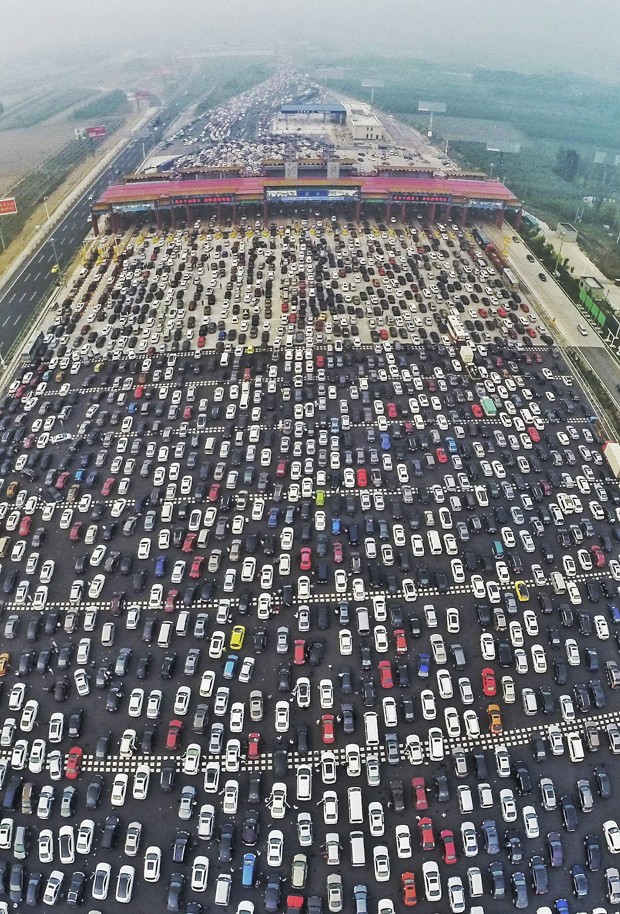 [/img]
Malvern Rider: there will be people who look at that photo and think that the obvious solution is to add a few more lanes.
I think the only way most people will change their driving habit for short journeys is taxation... Tax car users for journeys under say 5 miles.
Perhaps in combination with a tax rebate for those walking; jogging/running; cycling; using public transport.
While I miss the freedom of day trips in a car, in many ways, I'm so glad our old car became uneconomical ~5 years ago... On a day to day basis, we really did not need it. I can remember having my first car ~20 years ago and using it every day to travel a short journey of ~2 miles, which took ~5 minutes. On a bike it would only take ~10mins and that was going up a short incline!
IMO we should never have got to a stage where people were allowed to under-use a multi-person motor vehicle for regular personal use, with a driver and many/all passenger seats vacant, bellowing out crazy amounts of air pollution over the last ~50 years since owning a car became a Utopian aspiration.
UK Life expectancy is now in decline because so many of the population are doing far too little exercise, breathing in the fumes and further burdening our NHS.
http://www.bbc.co.uk/news/health-40608256
Seems China regretted 'binning the bike' almost as soon as they tried it (duh!) - but introducing 'bike share' schemes in cities seems to be only partially successful. The streets are still rammed with motor traffic, while mobile-phone payment-addicted pedestrians are taking the easier option of replacing walking with cycling via app-hired bikes and then just dumping the bikes everywhere.
https://www.citylab.com/transportation/2017/04/bikeshare-save-biking-in-china/521181/
Despite having decent bike infrastructure from the 1990s, Wang, who studies urban planning at MIT, thinks the city could do more to make biking inviting. “Most streets will have a 10- or 12-foot-wide bike lane that's cordoned off from the street, and there are also bike signal lights,” he says. “But that physical infrastructure is in decay and being abused. People will park their car or drive in the bike lanes, so when you talk to people there, they may not be very proud of Beijing—or most cities in China—being a bike city.”
If there is a lesson there it's that you can very quickly kill off a culture, and then there's no going back. One generation later and it's (almost) all forgotten.
China proudly embraced its title as the kingdom of bicycles.“Owning a bike used to be one of the four treasures,” says David Wang, the founder of Bamboo Bicycle Beijing, a workshop that teaches cyclists to build bikes from bamboo. “It quickly became an everyday kind of vehicle.” That was before Chinese officials essentially waged a war on cycling, declaring it a nuisance that stood in the way of China’s car-centric ambitions.
Amsterdam was a wildly successful about-turn. But the 70s have gone. Here come the robots. But if all our cars are to become car-share robots, then what about our status symbols? Our sense of freedom? How shall we transport our bicycles to where we wish to ride them? And will they stop for badgers?
Obviously this is some way off yet (not in many of our lifetimes) so I expect the trend for car-addiction (and that's what it is - a near-total dependency, a monoculture) to continue apace, hampered only by our plummeting economy and ongoing drop in car sales.
This could actually reap benefits for health as people eat less and are 'forced' to use their legs,whether walking or cycling. I predict that ebike sales will soar and ebike costs will come down.
UK Life expectancy is now in decline because so many of the population are doing far too little exercise, breathing in the fumes and further burdening our NHS.
Further dismantling the NHS will solve that problem. You can't overburden something that is non-existent.
Once the pesky NHS has all gone away, then we can work on this cyclist nonsense. Once they have gone, we can sort out the roads and return it to the rightful road-users. If things go to plan then 1950 should arrive in about 30 years time. It almost sounds feasible. All we'll then require will be 20m less people (3.6m are here from the EU, so they might have toddled off by then) to take us back to 30m (1950s figures). A war is always handy for political expedience and the community spirit. Worth considering? Maybe our special relation overseas has something up his sleeve to assist with that? 70 hr working weeks will mean less traffic on the roads as everyone will be indoors most of the time anyway. Looking good, we just need the foresight and commitment to pull together against the common enemies.
[img]  [/img]
Won't make a difference, roads will simply be clogged with the same number of self driving cars. Actually more, as they will be driving themselves back to get other pickups instead of spending the day in car parks.
This makes me think. It hurts!
[img]  [/img]