UPDATE: CLASSIFIEDS section refreshed, redesigned, searchable: Go take a look
Cobblers. The purpose of the atomic bombs was a show of strength from one of the two emerging super powers.
Forgot to mention that this was (sort of amusingly) pretty pointless in any case. On the day Truman became president, Stalin was far better briefed about America’s atom bomb than Truman.
Stalin was worried, sure, but he understood the ‘game’ better than most. Being almost totally devoid of any scruples, he was also able to ‘play the game’ in a less restricted way than politicians who actually had to get elected.
OoB - JRM comes close. Next.
The real obscenity though is I’m down in London the other day and find a RAF fly past getting in the way (come to Yorkshire, we see those aircraft on a regular basis) and I fail to find any mention of the tens (hundreds?) of thousands the RAF has killed in the celebratory shenanigans.
Ok I accept they may have some role in defending our country (whatever that means - and I have no idea how the U.K. would look today if we’d lost) can we also accept they killed a hellavulot of people.
Quiet reminiscing on all sides please.
I think the view at the time was that the Germans ‘had sowed the wind... ‘ as the saying goes. Hard to disagree.
I'm always fascinated in the the belief that the USA's entry was a decisive factor, Stalingrad to me was a majim turning point.
I've just had to Google majim thinking that I'm an educated fool. Now I just feel bitterly disappointed.
Cobblers. The purpose of the atomic bombs was a show of strength from one of the two emerging super powers.
I used to think this, I'm not so sure now. Japanese soldiers and pilots were hard ****ers, Guadalcanal, Iowa Jima and Okinawa were bloody brutal affairs...that country would have never have been beaten without tens of thousands of more American lives being lost. The yanks did an equation and decided dropping those bombs was the better option.
I’m always fascinated in the the belief that the USA’s entry was a decisive factor, Stalingrad to me was a majim turning point.
It was the absolutely the decisive factor.
The industrial might of the US supported the Russians and helped achieve the victory at Stalingrad.
Without this aid then it would of been possible the the USSR would of collapsed in 1942.
https://ww2-weapons.com/lend-lease-tanks-and-aircrafts/
The USA alone provided the Russians with 501,660 tactical wheeled and tracked vehicles, including 77,972 jeeps, 151,053 1-1/2-ton trucks, and 200,622 2-1/2-ton trucks.
<div class="bbp-reply-author">raybanwomble
<div class="bbp-author-role">
<div class="">Member</div>
</div>
</div>
<div class="bbp-reply-content">
that country would have never have been beaten without tens of thousands of more American lives being lost
Well, that's debatable- I think the same outcome could have been achieved with conventional bombing, Japan's ability to make war was already collapsing. But the real persuasive argument for me is, a longer war would have killed more Japanese people. And then of course we've no idea what would have happened after- without the horror of hiroshima, would we have been so averse to using nuclear weapons after?
</div>
Myself, I think Hiroshima is easy to defend. Nagasaki, not so much.
Having spent considerable time in japan and having many friends from there, they are the most nationalist bunch of people I have ever met and based on what we know of the Pacific campaign up to 1945 I am surprised they stopped after only 2 A Bombs.
Morality of war is a very difficult conundrum.
I am a pacifist by instinct but can see a moral justification for war in some circumstances. Using a utilitarian approach - greatest good of the greatest number - leads you to this. did certain actions increase or decrease the total number of deaths?
Taking that as a starting point then some war actions can be seen as morally justifiable. the DD landings, the first atom bomb etc. some actions such as the bombing of Dresden cannot. Dresden had nothing of military significance and it was a pure act of retribution for the destruction of Coventry was it not? The second nuke was simply a live test. Japan would have surrendered after one bomb.
Between these two sets of pretty clear cut examples lies a whole load of grey areas.
AS for not judging the actions of 80 years ago by the standards of today - pure bunkum. Ethics and morality was codified by great thinkers a long time before WW2. Morality and ethics stands outside of time. If its wrong now it was not wrong then
Its something I have thought about and read about a lot given my pacifism and hatred of facism which clearly sets up a dichotomy. My thought is that if you can clearly say by killing these people now less people will be killed in future then its morally justifiable. If you cannot then its not.
On the atomic bomb you have to consider the mindset of the Americans at the time...after Pearl Harbour they needed to re-assert their 'dominance' or power and strike back with something that was at a whole other level, something that the Japanese couldn't hope to replicate....enter the Atomic Bomb. The Americans were going to strike back at mainland Japan..it was either area bombing with the new batch of high altitude bombers they were developing at the time (B29) or the Atomic bomb...arguably the atomic bomb killed less people than a long and sustained carpet bombing campaign, the Japanese were a pretty tenacious people so would not have given in very quickly and easily in the face of carpet bombing, and the atomic bomb had a much more powerful and devastating show of force and impact on their morale. If the war in Europe was not already over by then, I reckon it would have been over pretty quickly after Hiroshima with the threat of an atomic bomb being dropped on Berlin.
It says in the BBC account at the start of this thread that Hamburg was a 'perfect storm' of things that came together to cause the devastation...it was not replicated when they bombed other cities, so not sure if the firestorm was the intended outcome or something that surprised the military planners at the time. But again you need to put yourself in the mindset of the people at the time...people who thought they were fighting for their lives, that their lives were under threat. They were scared. I don't think the bombing of Hamburg, or indeed our policy of carpet bombing German cities was particularly controversial at the time if it were debated in public.
These are the kind of conversations we have to keep alive if we are going to stay critical and thoughtful.
I agree with this. Our duty these days is to never forget and to keep the two world wars in our minds as a reminder about what is possible if we don't maintain our values and fight for them. It is becoming especially important as those people alive during the war who can give those first hadn't accounts are now becoming fewer and fewer. Those who complain about always talking about the war etc. need to be reminded of the reason why we should continue to be reminded of it. Human beings have the tendency to keep making the same mistakes...there is hundreds of years worth of history that demonstrate this. We need to break the cycle somehow and find other ways of solving difficult international problems.
Thoughts on the aromic bombs
1. The US had decoded Japanese ciphers and knew by early '43 that the Japanese wanted to sue for peace, and were making overtures to the Portuguese and Swedish Embassies to talk to the US ambassadors stationed there. The State Dept instructed the US ambassadors to rebuff every attempt, as the Japanese wanted the Emperor to remain head of State
2, The US had beaten Japan by April 45 the high altitude carpet bombing of Tokyo was just as devastating as the atomic bombs and Japan was ready to surrender, the Japan govt officials interviewed after the was have all said they would have surrendered given the chance, and had a plan to do so in place
3. There was no need to Invade Japan, it had no resources, no Allies, it knew the Russians were coming. The idea that the Japanese would fight to the last man, was already some thing the US were keen to avoid.It's unlikely it would have gone ahead, certainly there was no appetite in the US pacific Army for such an invasion.
I don't think the war was "shortened" by overly much, maybe a month or so, and arguably it did little to nothing to save US or Japanese lives but the weapons did show the world what they could do, and there's been little appetite to ever do that again (so far) so that's something I guess.
Why was there any difference between Dresden and thousands of other raids? In my mind there wasn’t. As seen at Hamburg it required a combination of factors to produce the firestorms seen at Dresden and Hamburg. The dumping of thousand of tons of incendiaries into a city was only part of the picture.
if you can justify Guernica, Coventry, Rotterdam, Hamburg, Berlin, Cologne I don’t understand why Dresden is any different. I know there have been lots of arguments as to why it is different, I’m just not sure I believe them.
The best discussion I have read of the morality of dropping the atomic bombs in WW2 was in George McDonald Fraser's (writer of Flashman) autobiography of hs time with Fourteenth Army Quartered Safe Out Here
He was a relatively new addition to a light infantry section which had fought the Japanese throughout the Burma campaign and fully expected to have to carry on fighting them for several more years.
The fighting was brutal against a barbaric enemy who refused to surrender even when starving, out of ammunition and isolated from their formations. Bunkers were cleared at the point of the bayonet and casulties were high.
Dropping the bombs saved many British and Empire lives as well as American and saved many others from the trauma of years of infantry combat. At the time Fourteenth Army were know as the "Forgotten Army" and little seems to have changed in the interim.
The Americans took all those lessons learnt about strategic bombing & the utilising of accurate meteorological data to aid incendiary strikes to bomb North Korea back into the dark ages. It does help explain why they aren’t their greatest fans.
so not sure if the firestorm was the intended outcome or something that surprised the military planners at the time.
Though the raid used heavy bombs to open up buildings prior to dropping incendiaries. A similar technique was used the year before in Lubeck with similar results (though on a smaller scale). The wind generate by the fires was strong enough to get the massive bells in the Marienkirche swinging and ringing! Well, before they fell out of the tower.
So, yes, the planners knew what they were doing.
Imagine sitting on an aircraft carrier facing this.
https://m.youtube.com/watch?v=PsI79eO23K0
We have become more impervious to stuff like this in the media age, but even so.
If you were Truman and knew that it was going to cost hundreds of thousands of the lives of your countrymen (and more of the Japanese) to defeat Japan with ‘conventional’ means (whatever that means in a pitched battle), and you knew you had the ability to finish it there and then, what would you do?
I doubt they took the decision lightly, but at the same time, I think there was only one realistic course of action.
Yes the planners knew what they were doing alright and did their best to get better at it, but my point was that it didn’t always ‘work’ to the extent that it did at Dresden.
I've just finished reading this.
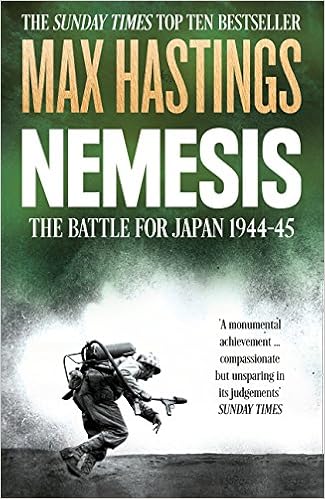
Thoroughly recommended if you want a rounded picture of the end of the war in the East.
Yes the planners knew what they were doing alright and did their best to get better at it, but my point was that it didn’t always ‘work’ to the extent that it did at Dresden.
It helped if there was a medieval town centre that had a preponderance of largely wooden bulidings. Harris preferred old towns as targets because they were burnable and so much better on the newsreels. The raids had surprisingly little net effect on German morale but British cinemagoers enjoyed them immensely.
Dresden is very different from Hamburg, though.
Spring 1943 versus spring 1945 certainly calls into question the ‘necessity’ of Dresden above all else.
Strategically, Dresden made little sense, tactically it was very questionable given what is now generally accepted as being its aim.
The real trick is not to get into a war in the first place!
dannyh
...The real trick is not to get into a war in the first place!
True. One way would be to eliminate any possibility of making a profit out of a war.
Most wars have a mercantile reason submerged in the background.
We can in a small way place todays morals into yesterdays events, Not in the sense that it shouldn't have happened in the first place, but in the context that we now view carpet bombing or nuking cities as wrong.
It seems us Humans have to learn lessons in the most tragic way.
But the trouble with learning lessons is that they often either get forgotten about, or certain elements learn the wrong lessons from it.
Britain’s right wing extremists are literally a handful of mindless skin heads.
The easily identifiable ones? Its the ones hidden in plain sight that should be the concern. Complacency is a killer.
Complacency leads to what this whole thread is about with its potential consequences.
It helped if there was a medieval town centre that had a preponderance of largely wooden bulidings.
As with Lubeck.
<div class="bbp-reply-author">johnners
<div class="bbp-author-role">
<div class="">Member</div>
</div>
</div>
<div class="bbp-reply-content">
The raids had surprisingly little net effect on German morale
It should never have been a surprise. All the way through the war people claimed that bombing would destroy german morale, while seeing that this didn't happen to british morale. How many genuinely believed it is hard to say, motivations were complicated and a lot of the official rationale was justification or excuses or strategising
</div>
WW2 Thats the one were we went to war to save Poland and then in 1945 gave Poland to another dictator.
Good one ! At least we got the NHS
20- 30 million Russian casualties give or take a million. They flattened Stalingrad before the ground campaign started and killed more in that than the UK lost in air raids in the whole war. War is not good.
It may well be true that 'victors' get to write history, however it's not that one-sided. Take the air war against German in WWII.Mention the town of Dresden and what does it conjure up ? almost globally it is accepted that it was a war crime by the 'planners' or the young men ordered to undertake the task. Fortunately the Germans are impeccable record -keepers. and gives an insight into why. The German Propaganda Minister Goebbels seized on this raid and immediately multiplied the number of deaths by a factor of 10,even now despite the true figure been accepted by Dresden itself the inflated figure is still used to sully the bravery of the airmen -British and American who risked their lives .The Communists, post -war, even used the raid to attack the West, despite the attack itself originating in a request by Stalin at the YALTA Conference. Goebbels was also able to convince the world that Dresden was a charming little town of no military significance that had somehow escaped the 'Total- War' drive of the Third Reich. Far from it, Dresden was not only a major railhead to move German troops ( and jews to the camps) but is was also engaged in manufacturing military equipment. At the Treaty of Versailles in 1919 the de-militarisation of Dresden arms manufacturing was a condition imposed by the Allies. Hitler slowly recommenced this production in Dresden along with every where else.Few Jews were killed in the raid because most had been enthusiastically exported to the camps by the Dresden authorities.Ironically some escaped transportation because of the raid itself.Some 1500 Czech resistance fighters didn't die in the raid because they had already been guillotined in the town's gaol.Yes, the raid itself was horiffic, as are all such attacks, but don't let the Nazi propaganda machine reach out over all the years to continue to besmirch the memory of of the men and women who fought for what was undoubtedly a just cause. I know Britain is a Country eating itself alive as it is fashionable to decry every historic action undertaken by its inhabitants, however can I ask you please to properly educate yourselves about the 'Air War'. A good start would be the excellently-researched "Dresden- Tuesday 13 February 1945" by Frederick Taylor.I know your minds are not closed.
slightly odd first post on a MTB website
BTW … the atomic attacks on Japan were straightforwardly wrong
Having spend much time in Japan, and with Japanese friends, I have thought of this many time however I recently read Quartered Safe Out Her and in it it gives an interesting perspective from a soldier (in this case in the 14th Army) who was actually on the ground fighting, I believe the same comments could be raised about the Western or eastern Fronts.
In summary, if you can degrade the enemies ability to fight, no matter how much, then you limit the amount of poor sods on the front line who have to lose their lives to defeat them.
In summary, if you can degrade the enemies ability to fight, no matter how much, then you limit the amount of poor sods on the front line who have to lose their lives to defeat them.
That presupposes that the enemy wishes to carry on fighting.
Actually I think it was the Russians entering the war against Japan at the last minute that brought the war to a close quickly. Japan knew it couldn't fight 2 super powers.

