
How serious are they and why do they seem to be a recent phenomenon?
It's just people wanting attention, like asthma and hayfever.
For a more useful response than above, this site has a lot of good info:
[url= http://www.anaphylaxis.org.uk/ ]http://www.anaphylaxis.org.uk/[/url]
How serious? My brother was at school with a girl who died as a result of a nut allergy.
Recent? It was about 20 years ago...
Don't know about pure nut allergies but I'm allergic to all fresh fruit and nuts. It only started about ten years ago when I started having a reaction if I ate fresh fruit. Used to eat loads of fruit as a kid, always been really healthy then it suddenly started. Now I can't eat / drink anything with fruit in it.
And no its not looking for attention - trust me, your throat swelling up, not being able to breath and your body covered in hives is no fun. Also have to carry an epi pen just in case.
like fish very serious - someoen near me died froma takeaway where the pan had been used for cooking cashews and not washed properly so in extreme cases it is fatal with just traces
Anyone see QI and walnuts[ was it Brazils?] - apparently you can transmit them to a partner in your love juice!!
I did first aid cover for an schools outreach event, were one of the darling little students had a "Severe nut allergy" and carried an eppipen.
I caught him eating a snickers at lunch time.....
I think it's one of those "How long is a piece of string" questions, some people may have quite severe reactions, others might just get a little bloated and windy.
Thanks Ian, the link was helpful. Quick look at the FAQs shows that the allergy is entirely manageable. The death referenced above is likely to be the result of not having an adrenaline shot to hand; I get the impression that it's more common now and therefore better understood and better managed. I wonder why it's more common now though?
[i]I caught him eating a snickers at lunch time[/i]
my wife can eat peanuts but has trouble breathing following a Pistachio.
you don;'t have to be allergic to [i]all[/i] nuts to have a nut allergy.
Ahh, but did he die after eating it?
I wonder why it's more common now though?
Hmm, possibly to do with a multitude of factors, possibly including the addition of certain nuts to our diets (or not) early on in life/whilst mum is pregnant.....
Or there's always the 'recognition' factor (just because you record more event, doesn't mean there are more events).
I might have a look into it (or if anyone really knows, please inform the group!)
DrP
Increase in nut allergies? Well this has been used as a potential explanation. Studied this for an essay during my clinical immunology module.
http://en.wikipedia.org/wiki/Hygiene_hypothesis
I did first aid cover for an schools outreach event, were one of the darling little students had a "Severe nut allergy" and carried an eppipen.I caught him eating a snickers at lunch time.....
Peanuts aren't nuts.
😀Peanuts aren't nuts.
Hmm, possibly to do with a multitude of factors, possibly including the addition of certain nuts to our diets (or not) early on in life/whilst mum is pregnant.....
I've heard it suggested that the addition of peanut oil in baby creams and lotions could be a factor.
my wife can eat peanuts but has trouble breathing following a Pistachio.
Aren't pistachios actually nuts whilst peanuts are legumes ?
she's ok with Almonds (or are they a type of banana?) too.
Cashews are not nuts.
I thought that almonds weren't nuts ?
[i]Cashews are not nuts.[/i]
It's a minefield this whole nut allergy malarkey, isn't it?
oh, ffs, wikipedia says that almonds are type of peach.
are real nuts just mythical?
http://www.ncbi.nlm.nih.gov/pubmed/19187334
http://www.ncbi.nlm.nih.gov/pubmed/15682935
Some interesting bits and pieces here.
Cashews are not nuts.
Aren't they part of a Brazilian pear or something?
[img] 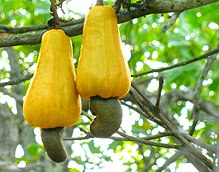 [/img]
Peanuts aren't nuts.
my brother is allergic to nuts, and at this point he would be making his regular 'donut' joke.
Dave
bwaarp your first link says that the most common allergy was to milk and dairy products. Surely what they are referring to is food intolerance which is quite different to an allergic reaction ?
Well, the 2 get used pretty interchangable- like, coeliac is an autoimmune disease not an allergy, but if you talk about autoimmune disease everyone thinks of AIDS, whereas if you talk about food allergy everyone thinks "Don't feed this man wheat or he'll spew buckets".
Also, when you talk about food intolerance, people think it's less severe than food allergy. "Oh you get bloaty?" "No, I get osteoperosis and cancer"
As for these things being a recent phenomenon- it's more that awareness is better. It used to be people with allergies/intolerances just had to get on with it in the face of ignorance/disinterest, and in all honesty it was completely rubbish. "Does this food have wheat in it?" "I ain't telling you my recipe mate, it's secret. Have the salad if you've got a problem with that"
Not that everyone's totally helpful these days, but at least a lot more people have a clue.
Dunno, I'm assuming they're talking about proper allergies as opposed to intolerance as you can actually have a milk allergy. Otherwise they would have worded it differently.
http://en.wikipedia.org/wiki/Milk_allergy
Milk allergy is the most common food allergy in early childhood. It affects somewhere between 2% and 3% of infants in developed countries, but approximately 85–90% of affected children lose clinical reactivity to milk once they surpass 3 years of age
Northwind -
As for these things being a recent phenomenon- it's more that awareness is better. It used to be people with allergies/intolerances just had to get on with it in the face of ignorance/disinterest, and in all honesty it was completely rubbish. "Does this food have wheat in it?" "I ain't telling you my recipe mate, it's secret. Have the salad if you've got a problem with that"
I have read a lot of literature that suggest food allergies are increasing though.
Yep, I think that's true too Bwaarp. But it's a combination of factors. Diagnosis is better, treatment is better (so there's better arguments for treatment). Food consumption patterns change too. (frinstance, sticking with wheat- it's far more commonplace today for wheat to be used in food for non-nutritional purposes, ie thickener/bulker. And pre-made foods are more common)
But it does seem like allergies in general are on the rise. That I know not much about.
Dunno, I'm assuming they're talking about proper allergies as opposed to intolerance as you can actually have a milk allergy. Otherwise they would have worded it differently.
Agreed. But I'm struggling to believe that a study showed that milk allergy was more than twice as common among children as peanut allergy. Peanut allergies make all the headlines but children dying of milk allergies don't.
Aren't pistachios actually nuts whilst peanuts are legumes ?
Apparently this is correct. I just got off the phone with the Anaphylaxis Awareness Campaign and they explained that this is indeed true.
The instance of food and all other allergies, such as asthma and hay fever, is indeed on the increase. The 'hygiene hypothesis' has been suggested as an explanation but is not conclusive. Instances of allergic reactions though are lower in third world countries apparently.
This all came about because my son's nursery is trying to implement a 'nut free zone' policy and that struck me as being both impractical and unfair. The Anaphylaxis Campaign seems to agree saying that the best approach is to have policies and procedures in place to manage the situation rather than hope there will be no nuts in the school (which totally rules my son out anyway as he's nutty as a fruit cake 😀
Agreed. But I'm struggling to believe that a study showed that milk allergy was more than twice as common among children as peanut allergy
This was also confirmed as true but the caveat is that the majority of children grow out of milk and egg allergies.
My daughters school banned bread/rolls with sesame seeds on as some kid had a 'proper' allergy to them.
Problem is trying to stick up for your right to send the lunch of your choice in is that you;re accused of putting some other childs life at risk for 'no real reason'.
It's supposed to be to stop the child that isn't allowed them from feeling singled out. Though in my school, it'd lead to "Because of freak-boy there we're not allowed proper food, let's get him".
It's difficult with young kids tbh. In fact it's not even all that easy as an adult! Over-reactions abound.
Instances of allergic reactions though are lower in third world countries apparently.
Hasn't a link between a lack of internal parasites and allergic reactions been established ? Which would help to explain lower instances in third world countries. It seems that our idle first world immune systems need a challenge to keep them occupied.
Problem is trying to stick up for your right to send the lunch of your choice in is that you;re accused of putting some other childs life at risk for 'no real reason'.
The response is that your not putting another child at risk. Certainly in secondary school, the children need to start taking responsibility for their condition as it's not going to go away and you can't hope to avoid whatever it is your allergic to your whole life.
In nursery or primary schools, the more effective policy is containment and management within the school premises. At least that's what the Anaphylaxis Campaign are saying.
It seems that our idle first world immune systems need a challenge to keep them occupied.
That's what was suggested to me as well.
It was only until a few years ago that I realised peanuts=monkey nuts.
DrP
in general i would agree GT1972 but for the sake of not using bread with sesame seeds on it - which do fall off all the time i think I could cope.
I suppose it depends what it is they ask - nothign with oyster sauce - probably easy - nothing with gluten in it probably hard etc
they do need to manage but i suspect the school are scared of being sued tbh
I've heard it suggested that the addition of peanut oil in baby creams and lotions could be a factor.
I seem to remember being told something like this in a lecture at university. Apparently it's to do with the use of nut oil in emollients which are/were commomly given for childhood exzema. Prolonged exposure to the oils leads to sensitisation.
Found the link: [url= http://news.bbc.co.uk/1/hi/health/1364131.stm ]BBC news[/url]
I suppose it depends what it is they ask - nothign with oyster sauce - probably easy - nothing with gluten in it probably hard etc
I thought that was pretty funny actually - the three year old going to nursery with beef in oyster sauce!
Obviously the nursery my son goes to is targeting things like peanut butter and muesli bars, his two favourite things, which makes life a bit harder.
Quick look at the FAQs shows that the allergy is entirely manageable. The death referenced above is likely to be the result of not having an adrenaline shot to hand; I get the impression that it's more common now and therefore better understood and better managed. I wonder why it's more common now though?
This all came about because my son's nursery is trying to implement a 'nut free zone' policy and that struck me as being both impractical and unfair. The Anaphylaxis Campaign seems to agree saying that the best approach is to have policies and procedures in place to manage the situation rather than hope there will be no nuts in the school
You've never seen someone in proper anaphylactic shock have you? Terrifying for the person, the staff, the other children. Obviously training and discussion etc can help manage that experience just as it would with someone with e.g. epilepsy etc - but we are not taking about someone getting dry skin or an itch here - it is potentially life threatening*, and failing to take a simple precaution like not having nuts in around is stupid, especially at nursery school age. As pupils get older it becomes more reasonable to expect them to understand their condition and avoid appropriately; but in the most extreme cases no physical contact with the nut is required simple proximity is all that is needed [although fatal reaction would be very unusual from such a small dose].
There is anecdotal evidence (but as far as I know no clinical evidence) that subsequent anaphylaxis gets progressively more serious. i.e. first attack minor, second attack worse, third attack very nasty etc. Given that those vulnerable to anaphylaxis can expect to avoid suspect foods and therefore subsequent attacks will most likely be from lower doses this is probably hard to prove. But if that is even partly true then avoidance is actually quite important in terms of long term prospects - think of it as a cat with 9-lives - is it only the final person that kills them or all the preceding ones too?
Life is unfair. It IS unfair that some people have to live with a risk of sudden life threatening condition though no fault of their own. It is unfair that those people will never get the pleasure of a coffee and walnut cake, or a chicken and cashew nut, etc. I'm not sure its really unfair to ask that you don't send in nuts with your child and risk serious harm to others with a known risk. Your child will still be able to enjoy their snack at another time.
* People will normally only carry one epipen with them. What do you do if they have forgotten it, broken it, the staff can't find it, etc. Even with adrenaline some people do not respond with the first treatment - and need a second dose (perhaps 1/3rd of serious incidents). There are about 20 fatalities a year in the UK (a third of them due to food) - which isn't a huge number but try telling that to the parents of a child who dies in your nursery because another parent was too selfish to account for their condition! Survival rates are good but not guaranteed; underlying other health problems like asthma make it difficult to judge how likely a child suffering anaphylaxis is a nursery is to die.
I'm asthmatic and also allergic to nuts. It's not for attention seeking 😉
I'm allergic to all the things people traditionally call nuts almonds, peanuts, cashews, etc but not to seeds like sesame, poppy, sunflower etc.
The allergy was worst in childhood. Simply rubbing a peanut on my skin brings it out in hives. When I play poker with the lads they can't eat peanuts as after touching the cards if I then touched my eyes they would swell up.
On holiday in Turkey a couple of years ago I ate something with nuts in without realizing. Within minutes my body was covered in large fluid filled blisters and my eye lids and throat started to swell up. Not nice. Fortunately taking a couple of antihistamines caught it but it took days for the swelling around my eyes to subside.
I've got a couple of epi-pens at home but have never had occasion to use them (I only got them after being told to by a paramedic friend when I got back from Turkey).
You've never seen someone in proper anaphylactic shock have you?
No that's true, but to be fair mate, I'm not advocating anything that the experts aren't advocating as best practise. The aim is to keep everyone safe, not implement an impractical and misguided policy because of either parent pressure or fear of litigation.
You've never seen someone in proper anaphylactic shock have you?
I have, and it's not fun.
An ex was violently allergic to, of all things, kiwi fruit. She once ate something here that had been in contact with kiwi, maybe melon pieces or something, I don't remember exactly. That tiny cross contamination was enough to merit an emergency dash to A&E, in the few minutes it took to get her there she could barely breathe. Terrifying.
Really, I can't see anything on their website (or that of others) which says banning nuts is a bad idea - I can see plenty which says you need a plan in place to deal with incidents, and recommendations about labelling foods etc. You obviously got a different message when you spoke to them. I've no idea whether that was the message they intended or just what you wanted to hear. Google suggests that the Anaphylaxis Campaign commented in various news articles on allergies - but none say, "we believe it is inappropriate to stop other children bringing in peanut butter sandwiches to nursery". IF there is a genuine risk of Anaphylaxis (rather than a mild allergic reaction) in a nursery school environment then it seems reasonable to me. [I am not allergic and neither are my children; both the nurseries we have used have had policies like you describe (one before we started and the other recently introduced on the arrival of a new child - although its less of a 'pain' as this nursery provide all the food). We have friends with a Coeliac daughter who its not uncommon to get 'contaminated' with wheat products at the nursery despite the staff all being aware - fortunately the consequences are relatively minor but I find it quite easy to believe that with a whole gaggle of children eating different foods it would be very difficult to ensure your child's peanut butter never got consumed by another child. If you think your children are being more closely monitored/managed/supervised than that you probably want to take them out of nursery! ]I'm not advocating anything that the experts aren't advocating as best practise. The aim is to keep everyone safe, not implement an impractical and misguided policy because of either parent pressure or fear of litigation.
I think this is a case where nuance around language is key. This is from the Anaphylaxis Campaign's FAQ sheet which you can download from their website:
Generally speaking the Anaphylaxis Campaign would not necessarily support ‘peanut bans’ in all schools.
In conversation with them they said that they would never say it was a 'bad idea' when all parties are willing to sign up to the policy but they did say that that is very often impractical because it means all parents effectively need to approach their child's diet as if the child was allergic to a given food stuff, at least as far as providing them with the meals they take to the nursery is concerned.
Now I know that neither I nor my wife have that kind of bandwidth without it being something we absolutely have to subscribe to. Unless my son has the allergy, I'm just not prepared to start scrutinising everything we give him to take to nursery. I'm happy to avoid the obvious food stuffs but that's not what a 'nut free zone' means.
The more effective approach is to manage the situation on site. Of course I don't believe that my son has one to one supervision at all times. But if you know you have one child who does have the allergy, then the obvious thing to do is make sure you have that child covered at meal times. That is both very effective and entirely practical.
The other thing that was pointed out to me was that trying to remove 'nuts' as one food group should also mean you try to remove all food groups that are problematic. So anything with milk, gluten, eggs whatever should also be on the list of banned substances. Which pretty soon makes the policy ridiculous as well as untenable.
What the Anaphylaxis Campaign was saying is that management of the situation is a far more effective approach than banning offending foods.
One final point. The note we had said 'due to the large number of children with nut allergies'. That's a problem for me because short of a statistical miracle, I can't imagine in a class of 20 that there is more than one child with this problem and even that would make it an unusual event. The instance is at worst, one in 50 (for all nuts and legumes, not just nuts).
Parents claiming their child has a nut allergy is not the same thing as the child actually having a nut allergy and let's face it, the negative comments about allergies on this thread do indicate that there are at least some people guilty of hysteria and over reaction (if you'll pardon the pun) when it comes to their kids. I've had this conversation with friends before who claimed their kid was allergic to xyz and when pressed the only evidence they could present was circumstantial and not an actual antibody test.
On a trivia note, the Brazil nut is the only nut whose allergen can be passed on through semen
Generally speaking the Anaphylaxis Campaign would not necessarily support ‘peanut bans’ in [b]all [/b]schools.
I think banning it in most schools would be ridiculous. As others have said, it needs to be managed.
Banning it somewhere like a nursery though would seem wholly appropriate. It's an environment where, given half a chance, kids are likely to stick peanuts up their nose and eat crayons. It's not a great leap to have concerns about a teacher accidentally leaving a Snickers bar in her handbag under her desk where little hands might be crawling.
The thing is that if you ban nuts do you ban everything else that people can be allergic to. Why single out nuts? It leads to the assumption that nut allergies are the only severe allergies and nothing else is life threatening.
[url= http://www.telegraph.co.uk/news/uknews/1419842/Cereal-killed-dairy-allergy-baby.html ]Milk allergy death[/url]
[url= http://news.bbc.co.uk/1/hi/england/kent/4289187.stm ]Tomatos[/url]
It's an environment where, given half a chance, kids are likely to stick peanuts up their nose and eat crayons.
This plus this:
The thing is that if you ban nuts do you ban everything else that people can be allergic to. Why single out nuts?
Makes for a difficult decision.
ebygomm - MemberThe thing is that if you ban nuts do you ban everything else that people can be allergic to. Why single out nuts? It leads to the assumption that nut allergies are the only severe allergies and nothing else is life threatening.
Er, you realise they're only banning them because they have a child with a serious nut allergy? It's not random!
The thing is that if you ban nuts do you ban everything else that people can be allergic to. Why single out nuts?
Because you have a kid in the class who's allergic to them?
Because you have a kid in the class who's allergic to them?
If it's only one child it's easy to manage without banning nuts.
So what if you also have a child who is allergic to bananas, and another allergic to egg and another allergic to milk? Are you banning everything?
I know people who have children with severe allergies to cows milk protein, one thing they struggle with is the assumption that it's not life threatening because it's not a nut allergy and nobody would insist that a school becomes dairy free because of it.
Noone is suggesting a peanut ban in all schools. Your NURSERY are proposing one in this instance whilst they have a child who is at risk. The final caveat of the paragraph undermines the entire thrust of the rest of your argument.[b]GT1972[/b] - In conversation with them they said that they would never say it was a 'bad idea' when all parties are willing to sign up to the policy but they did say that that is very often impractical because it means all parents effectively need to approach their child's diet as if the child was allergic to a given food stuff, at least as far as providing them with the meals they take to the nursery is concerned.
No idea what that means. You appear to have confused business jargon with the process of raising children and having some idea what you are feeding themNow I know that neither I nor my wife have that kind of bandwidth without it being something we absolutely have to subscribe to.
nice - I hope you never require anything from the parents of any other children now or in the next 13 odd yrs of schooling!Unless my son has the allergy, I'm just not prepared to start scrutinising everything we give him to take to nursery.
Well it would be a really good start. If you assume nut allergy risk is directly correlated to concentration of nuts in it - then its probably reasonable to assume that anything you know has nuts in it is bad and anything where it is a hidden ingredient (they usually have very clear warning!) is not.I'm happy to avoid the obvious food stuffs but that's not what a 'nut free zone' means.
its neither practical nor particularly effective. If Johnny gets 1:1 attention at meal times the other kids get reduced attention. Nurseries are already staffed to the limit. What happens if little Jamima or George spill something or wet themselves. That attention would need to be incredibly diligent, to stand any chance of success but given the reports of people having severe nut allergies just from being in the same room as nuts I can understand why a nursery might not even want to risk it.The more effective approach is to manage the situation on site. Of course I don't believe that my son has one to one supervision at all times. But if you know you have one child who does have the allergy, then the obvious thing to do is make sure you have that child covered at meal times. That is both very effective and entirely practical.
whilst allergies (or intollerances, or disorders) with those other foods are relatively common severe life threatening anaphylaxis is not. IF you had a child with anaphillaxis to another food it might be just as appropriate to exclude that.The other thing that was pointed out to me was that trying to remove 'nuts' as one food group should also mean you try to remove all food groups that are problematic. So anything with milk, gluten, eggs whatever should also be on the list of banned substances. Which pretty soon makes the policy ridiculous as well as untenable.
They certainly aren't suggesting that you just let people have anaphylaxis as one of your earlier posts seemed to hint at - they are suggesting developing procedures to avoid exposure (that might mean the Nursery provides all foods so it is in 'their control' (but not all parents will approve of their choices and not all parents will be happy with an inevitable price rise).What the Anaphylaxis Campaign was saying is that management of the situation is a far more effective approach than banning offending foods.
you need to learn more about statistics then. I'd suggest you start by looking at Poison distribution.One final point. The note we had said 'due to the large number of children with nut allergies'. That's a problem for me because short of a statistical miracle, I can't imagine in a class of 20 that there is more than one child with this problem and even that would make it an unusual event. The instance is at worst, one in 50 (for all nuts and legumes, not just nuts).
on this count I do agree, and I'd like to think that a nursery going to this extreme (it will affect their own staff, and their own buying too) were acting in response to severe allergy with a clinically identified risk of anaphylaxis. Several years ago when I used to have 'parental responsibility' for other people's children for weekends - I only really sat up and paid attention to allergies (not that I didn't accommodate others but I didn't worry too mucj) if they were coming with an Epipen - as that signified that a Doctor somewhere believed there was a real risk of a severe reaction.Parents claiming their child has a nut allergy is not the same thing as the child actually having a nut allergy and let's face it, the negative comments about allergies on this thread do indicate that there are at least some people guilty of hysteria and over reaction (if you'll pardon the pun) when it comes to their kids. I've had this conversation with friends before who claimed their kid was allergic to xyz and when pressed the only evidence they could present was circumstantial and not an actual antibody test.
Ban the child?If it's only one child it's easy to manage without banning nuts.
Cougar speaks sense.
Would that be a proportionate response? It accidental ingestion likely? Is a small amount likely to cause potentially fatal reaction (each case is different - but typically nut allergen requires much lower dose to cause a problem)? What are the consequences for everyone else? In some extreme circumstance that might be the right answer. Particularly if you somehow had 2 or 3 children who would require special attention at meal times to prevent mix ups, and perhaps another 2 or 3 who's parents have said they are allergic (but perhaps to a minor degree) for rapidly changing staff knowing who's who and what's what could be difficult. If its one child who gets the runs and vomits if they have a teaspoonful of milk it might be disproportionate.[b]ebygomm [/b]
I know people who have children with severe allergies to cows milk protein, one thing they struggle with is the assumption that it's not life threatening because it's not a nut allergy and nobody would insist that a school becomes dairy free because of it.