Whats the safest way to hook up a generator as a back up for power cuts?
By 'hook up' do you mean run your house's electrics from a generator? Or do you just want to have a generator available to plug into.
If its the former then that sounds a bit hardcore, do you have an iron lung or similarly critical life support systems at home?
[img] 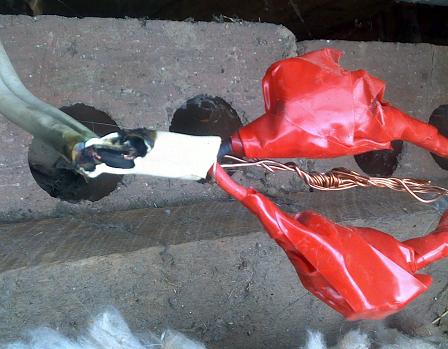 [/img]
This should work 😉
Depends on how much of the house you are hooking up. If the whole house then you need a two way switch either to the main incoming supply or the generator. If just part of a building then again a two way switch to that part of the building.
My experience says that unless you have a big generator you are better separating out the lighting circuits and a couple of rooms but avoiding the big circuits such as water heaters and cookers
I've seen people attach a mains plug to the end of a generator to plug back into a socket before 😯 (not in this country thankfully). I'm not sure it is possible to do anything more dangerous than that but pdf's pic is close
Edit:: I'm wrong- see below...
[img]  [/img]
The end of the Mayan calendar has passed without disaster hasn't it ?
What are you preparing for 😐
We had a very rich long term client back when i did gardencare
He had a big back up genny in his woodshed for power cuts - started off firing it up everycouple months keep it runniing - this waned off.....sat idle for a year or so
Boom - power cut and the genny would not start 🙂
What are you trying to power ? The easiest way would be run an extension cord to what ever you need to power. Its unlikely unless your spending lots you will be able to power the whole house.
I'd just run the generator and power only the things you need eg lights and CH pump off sockets rather than try and wire it into the distribution board.
NB If you do wire it into the Distribution board you'd need to disconnect the incoming Mains supply as your generator would be powering 1/3 of the street (each house is on one of the three phases of the 415v supply, normally every third house is on the same phase).
you'd need to disconnect the incoming Mains supply as your generator would be powering 1/3 of the street
That's what the two way switch is for. Also prevents the generator dying when the power comes back. I had one once where I heard the neighbours running a washing machine when I knew they had no power. Sure enough, a sneaky wire had made it back to their house 😡
You can get a changeover breaker that takes up a double position in the breaker box.
I ended up with one after buying some second hand electrical stuff for my campervan, the idea is that it will switch between a campsite electrical hookup or the output of an inverter powered by the leisure batteries.
However, I'm not sure if you can use it on home electrics...there are regulations to remove any risk of electrifying the network during a power cut and the changeover might not satisfy this.
http://www.hellotrade.com/pigeon-agency/automatic-changeover-switches.html
That's what the two way switch is for.
You'd need at least a 100A two pole switch which seems a bit overkill when all the genny can power is a few lights and the CH pump. Having seen cheap 100A switches melt at much lower currents, I'd not bother personally.
the easy way would be t isolate the supplier mains and power int the main board via a two way circuit breaker.
You'd need at least a 100A two pole switch which seems a bit overkill when all the genny can power is a few lights and the CH pump
for the whole house yes - but the generator would be huge as well
For part of the house you only need the appropriate sized switch (assuming that no-one has wired between circuits, e.g. on a two way switch 🙁 )
But you are correct, even if the generator is small because you aren't planning on running everything in the house you still need a switch sized to how your house is fused minimum if the two way is going to go at the start of your distribution.
We still don't know what this is for though...
dont DIY it if you want to power the whole house - it is illegal to connect a generator to the grid without notifying the DNO, and you will require to isolate the house from the grid when the genny is connected.
there's a thread from a while back on this very subject.
Also - do not confuse a cheap emergency generator designed to run for a few hours every day with something that can provide full time power when required. There is a massive difference in cost and capability. As has been said - what for, where and why?
Pdf - you dont know how close that is to my old house wiring .... Only less tape to go with the twisted pairs.
All renewed now 🙂
It is quite normal over in oz to have a back up generator in case of power outages usually with an automatic mains failure transfer / switch over panel. [url= http://www.pandigenerators.co.uk/amf-ats-panels.html ]See here.[/url]
As for size of generator it doesn't necessarily need to be to huge, the issue you generally find is that you will overload it on the amps before you run out of Kilowatts. I'm a slightly different setting and I use a 13kVa (10kVa actual) which runs two full size fridges, two full size freezers, 6 under-counter fridges, three vans full of lights, 6 air conditioner units, water pumps and a van full of computers and electronics. For a regular sized house you will likely need less than 5kVa provided it will provide 15-20amp minimum.
Indeed, you can't do this in the UK without special installations of anti-islanding hardware (much like is provided by some renewables power conversion systems). Your house has to be pulled from the grid when it is generating (for a number of reasons, but primarily so you don't kill people working on nearby lines off the same phase). Likewise if you get the power coming back on while your generator is on, your generator will without a shadow of a doubt lose the battle between it and the megawatt scale generator at your local plant. And go bang.
I needed to make sure Mrs GB can run her business in a power cut, as it's internet based and time critical to her customers. I also wanted to be able to run my central heating (gas fired but wired into the mains). So I have a 3kW genny and one of these: http://www.lawson-his.co.uk/briggs-stratton-bst-9200m-transfer-switch-p25201
Yes, it cost half as much as the genny, plus I paid a registered sparky to fit it. It just switches the whole house over to the generator, so no issues with backfeeding the mains.
Greybeard - is that a variable speed generator, or are you just putting a tiny load on it, or running something other than computers and CH power?
TooTall - it's not variable speed. I've only had to use it twice - computers, freezers, fridge, etc. So mainly small loads. Potential to use it to run a washing machine, etc, at quiet times if the power was off for longer. Why do you ask?
It just seemed like a large generator to be running a fairly small load, which can lead to problems if run for a long time (coking and wet stacking). It didn't seem well balanced for the load you described.
[i]I needed to make sure Mrs GB can run her business in a power cut, as it's internet based and time critical to her customers.[/i]
If this is the case, then you are better just buying a UPS, APC do all sizes - and what about offsite backup of data etc? Or just pay for a managed service.
And where are you that gets regular power cuts, India?
I've been responsible for data centre disaster recovery and we need to fire the generators up regularly as its quite often you can go a year without a long power cut - and UPS's handle short outages.
As above get professional help
I witnessed what happens when a fool managed to switch a 100kva set in parallel with the incoming.
The alternator came of its bed and went bouncing around the room the building had to be demolished thankfully no one was killed