UPDATE: Reviews section refreshed, redesigned, searchable: Go take a look
Democracy, what is it good for?
Most systems are fine regardless whether they Democracy, Dictatorship, Communism, Monarchy, Religious based etc.
The problem is really Not the systems but the people who are in power or put in charged of the system.
Power is a very strong temptation and most cannot resist power if they are given that responsibility.
You can have the best system in the world but if the people who are in power abuse it, then regardless of the system in place it will just be another rotten system.
Therefore, horses for courses.
A similar pattern can be seen for countries further West as well though, just earlier. Is this a good time to mention the EU and its precursors?
people who are in power abuse it
Or in other words, "power corrupts, and absolute power corrupts absolutely"
That thing that democracy should give is some checks and balances on the exercise of power by those elected or the executive/government of the day.
Someone said above that the people we vote for are experts. That's not true, they are just good at persuading people to vote for them.
One of the frightening things in recent years is the attacks on democratic checks (house of lords, judiciary, pretty much all of Americas institutions) on the basis that they are thwarting the "will of the people". Again not true, it's just the people in government don't seem to realise they have do not have absolute power.
Parliament might be sovereign, governments and minsters are not.
@thols2 that graph belongs on the spurious correlations site. Same thing has happened all over the world under all forms of government.
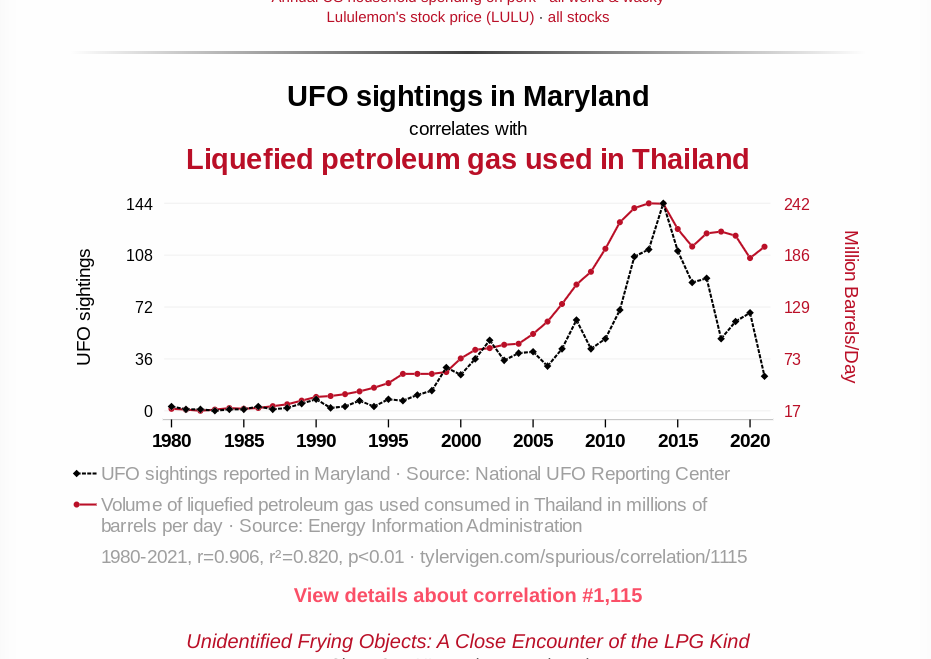
Same thing has happened all over the world under all forms of government.
Not at the same time. Those Eastern/Central European countries were held back for a large chunk of the last century, and then caught up from the fall of the Berlin Wall onwards. The graph for France, Germany, USA, UK etc is a much straighter line starting much earlier.

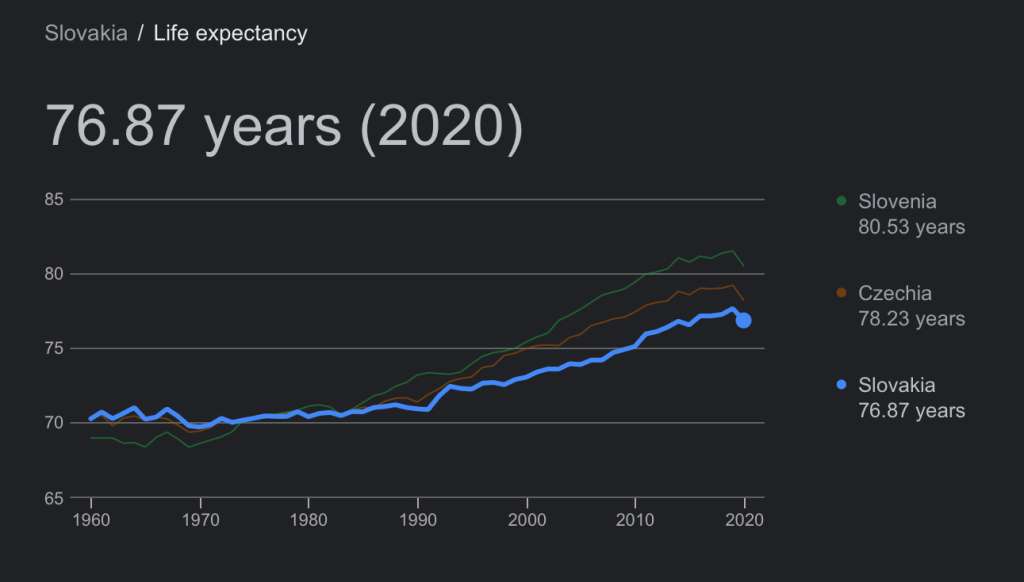
under all forms of government
Oh, sorry, I missed your more general point… health and life expectancy can and has improved under non-democratic regimes. True. But moving to democracy, and away from the control of Russia, has helped in the countries listed.
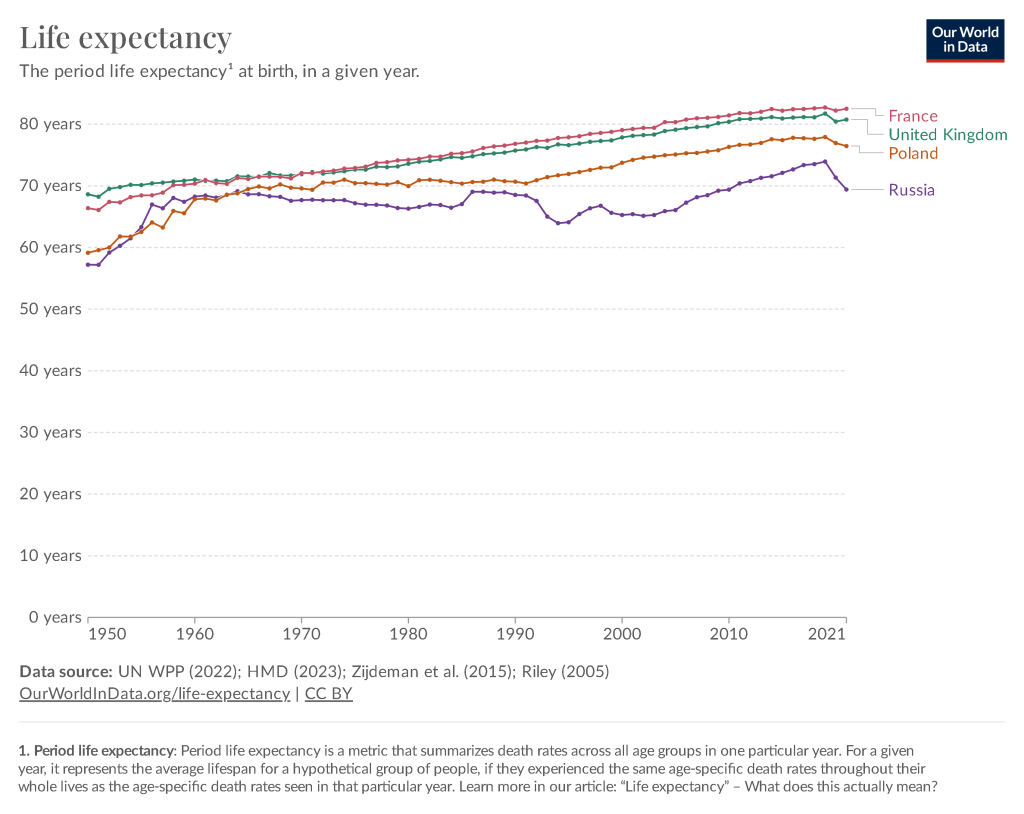
That is more about the conditions under the people running country before it split up and not really democracy as those same people could have been voted in, who knows.
Dictatorship is clearly a better option as long as you can find a good dictator. I genuinely believe I could have done a better job as dictator of the UK than the current tory government have. I wouldn't had to have done much would I as what have they actually done that has made anything better for the general public?
It is also apparent from the history of Roman Emperors that the alternative system of an absolute leader is substantially worse.
I don't know. I think Russell Crowe could have made a go of it. Just wasn't to be.
I really don't like FPTP and you can see the nasty effects on the US and UK governments/parties as your main mission is to get selected as a party candidate, and the the most likely person to do this is an extremist , and usually a noisy extremist. You drift away from the centre, and what the majority wants isn't especially important for a few years at least. Social media has just exaggerated this ..
But getting countries away from FPTP isn't easy, or likely to happen as long as it suites those in power.
Obviously direct referenda on a lot of things are a really bad idea and totally open to manipulation.
But the alternatives are worse. I also am not fond of disenfranchising people just because I think they're stupid or ill informed..
I've said this before but I think that voting on your local MP (for whatever reason, even their personality or some other local debate/reason) shouldn't automatically come with a government and a Prime Minister.
I think should be able to vote for your local MP and Prime Minister as two separate votes.
Also, the Prime Minister should staff their cabinet with the best person for the job, from any of the elected MPs, not just their party.
And lastly, MPs should not have another job. You'd think that being an MP would be enough job for anyone.
So essentially we need electoral reform but turkeys don't vote for Christmas.
Do we expect too much from our MPs?
My Polish pal thinks I'm naive to think that politicians should be honest and trust worthy. But maybe that's more a reflection of Polish politics.
Also ban them from Social Media. ****ing sick of 'news' basically being a thread from X. IT's lazy and some people think it's work.
Meh, democracy has its problems, but it all comes down to people rather than the principles, the tories aren't great, but democracy means we have processes in place to stop them doing what they want without thought, that's why we've still got an NHS, why social care is still a big thing and so on, it's why when the likes of Liz Truss tried to go full tory she was out the door in record time. It's why we always here governments like the tories talking about 'cutting back the red tape', they want to remove processes stopping them doing what they want without balances and checks and selling it as the reason why the country has failings, rather than why the country isn't falling faster!
As for FPTP vs PR, they both have flaws, we've seen it throughout the world, it's one thing i don't have too much care about, either does the job, but again, both tend to have flaws, which come to the fore when being used.
I think should be able to vote for your local MP and Prime Minister as two separate votes.
Also, the Prime Minister should staff their cabinet with the best person for the job, from any of the elected MPs, not just their party.
That is simple with a proportional representation system - you allocate half the seats based on local electorates, then use the other half to ensure that the parties get the same proportion of seats in parliament as they got in the nationwide vote. Each voter casts two votes - one for a local MP, the other for a party (which is voting for the party leader to be PM). The party publishes a list of their candidates in rank order and the people on that list are then awarded seats in parliament until their party has filled its quota.
A PM who was directly elected by the popular vote without needing majority support in parliament would be a president, not a prime minister. The parliament would not be able to sack them unless they were convicted of wrongdoing.
Except in wartime, appointing cabinet ministers from outside the ruling party will never be accepted. If you're a member of the winning party, you expect your guys to be running things. Coalition governments obviously require awarding cabinet posts to the junior partners, but that's a different thing to giving them to the opposition. The opposition has members with committee positions, legislation has to work its way through committees so the opposition does have input. On non-controversial matters, there will be bipartisan agreement even if there is public posturing from the opposition against the government.
In the Uk we have the unenviable position of one of the worst forms of democracy and an electorate who largely don’t understand how it works
To the first point before we even get onto the rights and wrongs of electoral systems we still have a monarch who decided to let a government exist and govern. The monarch still has absolute power to shut down parliament at any time and take back direct rule. Will it ever happen, almost certainly not, but that doesn’t mean it cant and in my view shouldn’t. The fact that no law can land on the statue book without the monarchs signature is absurd, especially as they have no obligation to actually sign them if they’d don’t want to.
As for first past the post, it has to be the worst way of electing a parliament because you. Always end up with minority government that really get to 40% of the vote let alone even close to a majority.
To the second point the number of people who think they vote for a party and prime minister is quite frankly shocking. I understand why because all parties like to give that impression and so does the media becuase it suits them all. It is of course not true and all we get to elect is an individual to act as out consituency mp. The party they sit which is upto them, and they can change thier ones without any recourse to the electorate unless they choose to, who become PM after an election is down to what ever process the majority party makes up and decides. There is no guarantee at the time of voting the party leaders will even. Get elected to be eligible to become PM although I accept it is unlikely to happen.
The monarch still has all the power. Will they use it? Almost certainly not, but they still have it hence the way they are exempt from some laws and have others changed to suit themselves. The last time it was overtly used was by Victoria who exited that same sex female relationships weren’t a think hence being gay was only an offence for men and not women.
the key phrase being convention rather than statue
Democracy is a great way of making sure your toast is never butttered the way you like it.
We need a change away from the adversarial politics where two parties whose differences are more apparent than real score "points" by personal attacks on one another or some carefully scripted witicism.
We need more examination of policies and decisions so some form of pr and much more power at the most local level possible
We need more examination of policies and decisions
That's the reason for having an adversarial system. The opposition's job is to question the government and make them justify their policies. In many cases, the opposition will probably agree with the policies but they still need to publicly challenge them.
I feel there has been some loss of understanding between direct democracy and elective democracy.
Too many loud mouthed little englander gammons yelling "We didnt vote for this" "Its not democratic" (See cycle lanes, 20mph speed limits, LTNs)
Correct, you didnt, you elected (in a round about way) someone who appointed someone who actually knows what they are talking about, and with experience and qualification, to make the decisions on your behalf.
just because YOU dont like THIS decision, doesnt make it undemocratic.
I wonder if, when their ruddy faces have frothed into a heart attack, and they end up on an operating table, whether they would like their heart bypass carried out by the popular vote, or by a suitably qualified surgeon.
The problem is that more people can say "I didn't vote for this" than can say they did though as in last election, as always, less than 50% voted for the winning party.
Doesn't sound right that more than 50% don't want whoever is in government does it.
thols2
Full Member
We need more examination of policies and dThat’s the reason for having an adversarial system.
That is the reason for it but the examination of policies and decisions is not happening in the HoC nor in the the debating chamber nor in public debate. We need to get away form personalised politics and culture wars.. We need a new systemy
The debate happens (in select committees and on the floor of both houses), but with a majority of MPs and a certain attitude, it can all be ignored by the executive chosen by a minority of voters. It's also mostly ignored by most of the public.
in the UK we rely on our politicians to police themselves - something they seem incapable of doing anymore. Its what Peter Hennessey calls the "Good Chaps" theory of government.
A key characteristic of the British constitution is the degree to which the good governance of the United Kingdom (UK) has relied on the self restraint of those who carry it out.
Unlike nearly every other democracy in the world, we lack a ‘written’ or ‘codified’ constitution. The UK has, therefore, no single text setting out the core principles, institutions and procedures of the system, protected from casual alteration by amendment procedures, and enforceable by the judiciary.
Instead, in the UK, we have trusted politicians to behave themselves. We have long assumed that those who rise to high office will be ‘good chaps’, knowing what the unwritten rules are and wanting to adhere to them.
Recent events suggest it is worth considering the implications of a decline in the viability of the ‘good chap’ system in this country
All taken from here:
Most people are greedy bastards.
Democracy enables greedy bastards.
Dictatorships enable greedy bastards.
Go back to the first line.

