UPDATE: Reviews section refreshed, redesigned, searchable: Go take a look
So, any non diabetics managed to break double figures yet?
No.
Over the 14 days the sensor lasted I exceeded 9 on 4 occasions and my 2 peakiest peaks were briefly 10.
So, any non diabetics managed to break double figures yet?
Yep!
[url= https://live.staticflickr.com/65535/52700983415_7e4312f2c2_w.jp g" target="_blank">https://live.staticflickr.com/65535/52700983415_7e4312f2c2_w.jp g"/> [/img][/url][url= https://flic.kr/p/2oi1ji6 ]Breakfasts[/url] by [url= https://www.flickr.com/photos/brf/ ]Ben Freeman[/url], on Flickr
No idea WTF is going on to be honest.
This is yesterday's and today's traces. Both days I slept for the same time, got up at the same time and ate the exact same breakfast at the same time, which normally doesn't do much as I've changed it to reduce glucose peaking.
Only yesterday over 10 and this morning back to 7. Also, another spike over 10 in my sleep, hours after I last ate anything...
Just shows there is a lot of variability in there which isn't directly linked to the last thing you ate....
I got to 10+ a few times during my fortnight. Also crashed out the bottom with a 2.9 a few times, which explained my lifelong very occasional bouts of weakness/shakiness/sweating etc which I always recover from in 20 minutes without having to eat anything.
Cycling with the monitor on was interesting. I could see a slow gentle rise in response to exercise to about 4.5 . If I eat say a Nakd bar or banana I tend to get a big peak and crash. Mid ride snacks have changed to nuts, and homemade bars with oats/nuts/seeds and very, very little maple syrup. Cafe stops are a lot quicker - no cake, no latte - and then its easier to get going again after.
I also found that there was some small degree of variability each day that I couldn't account for, but then once I was unwell the next day and thought maybe it was my body fighting infection. Zoe say that blood sugar is related to the degree of inflammation in your body [I think thats an accurate if vague and unscientific recollection of what they said...not a doctor].
Three months in, my diet has changed. More veggies, less fruit, more nuts and pulses. I'm going to try the CGM again to see if I have made any real improvement to my blood sugar levels.
My 1st (trial) kit arrived today - "fitting" tonight
I'm a weirdly uncontrolled t2 - diet and metformin do nothing really at all. Had some genetic testing but I'm not an interesting MODI-type anomaly so this is going to be me stressing my system to see what does what. Might end on the Zoe thing (just the returnable FL at the moment) if I can't get enough data out of myself (and/or end up on some different meds, I guess)
to see if I have made any real improvement to my blood sugar levels.
Bet you won’t have, save for maybe reducing spikes a bit, but that won’t have a massive effect on HbA1c. Non diabetics should be below 42mmol/6%, diabetics (or, their doctors at least) are happy below 60mmol/8%
No idea WTF is going on to be honest.
Welcome to my world. You have that reaction when you dip to double figures, come back when those double figures start with a 2, despite not changing anything…
Apologies if I come across as dismissive, but to me, anyone without a medical need for this does seem to be playing at being diabetic, only on super easy mode.
Apologies if I come across as dismissive, but to me, anyone without a medical need for this does seem to be playing at being diabetic, only on super easy mode.
I can see where you're coming from, but at the same time it's clear a lot of people (me included) are interested in knowing what goes on inside their bodies and how changing diet and/or habits affects that. In my case I do ultramarathons, and I'm definitely curious to know if a monitor would help out with nutrition and knowing when to eat (or when not to) as this is a critical part of long distance racing. Necessary? Clearly not, but definitely interesting.
Tom, some of this is collecting data that could be useful medically in future. It’s not all just about sport and lifestyle, even if that’s often the hook to get people involved. Not as likely to prove useful for type1 people in future, but could be useful for learning more about type2 and the pathways to it.
I clicked through as thought great sounds like a good idea to monitor glucose. Till I got to the 25 pounds a month bit. Is there a minimum subs period- can the units be bought stand alone?
I'm sure I read somewhere that the UCI were/have banned them as Chris Froome did something on his Youtube channel about them and how it helps getting feeding right during long races
The combination of what you eat together makes a big difference on sugar levels.
So there maybe is a science behind two or one meal a day to control insulin response?
I read somewhere that stress and anxiety can also raise blood sugar, to provide energy to fight or flight, which in turn raises the insulin response?
Which then comes to caffeine ingestion - whilst black coffee is low in carbs, the adrenaline response it provokes can inadvertently raise blood sugar and then an insulin response?
Anyone monitored their blood sugar after drinking caffeine? Interesting.
Till I got to the 25 pounds a month bit. Is there a minimum subs period- can the units be bought stand alone?
It's actually £300 for the test kit, plus the monthly fee after it arrives, for however long you continue on the program. Not cheap by any means, but the test kit costs a lot - £60 CGM sensor, blood test kit, feces test kit and some muffins...
can the units be bought stand alone?
Yep, I've just 'continued' the GCM bit by buying the monitors direct from FreeStyle Libre - £98 / month though...
I read somewhere that stress and anxiety can also raise blood sugar, to provide energy to fight or flight, which in turn raises the insulin response?
Yep and hard exercise, when I ride hard, my blood glucose rises and stays up for the whole ride, the tougher the ride, the higher the level.
Apologies if I come across as dismissive, but to me, anyone without a medical need for this does seem to be playing at being diabetic, only on super easy mode.
A friend (also on Zoe) did joke that she felt like she might get hauled up for 'diabetic appropriation'.
Has anyone used Supersapiens over this Zoe scheme? Supersapiens seems more sport/ athletic performance biased?
My daughter is Type 1 diabetic and has been since she was 4 years of age, currently going through the fun of puberty and her wildly swinging BG levels, and the alarms 3-4 times a night.
For myself, as i've mentioned on her a few times, i was diagnosed Type 2 after COVID, but since with a more controlled diet and exercise 6 days a week have kept it in remission from a few months after diagnosis, but I find it is a really fine balance on longer rides on trying to take on enough carbs to fuel the effort, but to not carry high BG levels on for the rest of the day, and i tend to do a lot of turbo trainer intervals, so would like to see what is happening with BG levels during these interval sessions, especially as for longer rides, i cannot carb load in the days running up to an event in the normal way.
Has anyone used Supersapiens over this Zoe scheme? Supersapiens seems more sport/ athletic performance biased?
Double the price of buying the FSL sensors (which is what they use).
I have tried registering a FSL sensor with the SS App, but it didn't work, so I guess the restrict it to the IDs of ones they have resold.
Seems a massive premium for whatever programming advice they off over just monitoring your glucose levels.
especially as for longer rides, i cannot carb load in the days running up to an event in the normal way.
I've not done anything super long yet, but up to 120 km on a road bike, I don't really find my BG levels change much, I certainly don't dip at all and don't find eating cereal bars etc makes a lot of difference - which was not what I was expecting. I don't carb load or anything special, just rely on whatever glucose is in my system and a bowl of cereal + toast before the ride.
The other interesting thing, is one evening I was getting really Hangry and would have wagered money my blood glucose was dipping as I was craving chocolate and feeling crap. Perfectly normal levels - was quite gobsmacked.
It's not a premium, it's the price (try buying a Freestyle Libre for a type1 diabetic outside the NHS ... ∼£100 for a pair). The Zoe research has (some how) enabled a much lower than shelf price... presumably because they intend to make money (and advance medical knowledge) from the large scale population data they will be collecting. It's what Zoe does.
It’s not a premium, it’s the price (trying buying a Freestyle Libre for a type1 diabetic outside the NHS).
It is a premium as I'm currently wearing a FSL I just bought off their website, so I know exactly what they cost outside the NHS.
You can just buy them online: https://www.freestylelibre.co.uk/libre/
The Zoe research has (some how) enabled a much lower than shelf price… presumably because they intend to make money (and advance medical knowledge) from the large scale population data they will be collecting. It’s what Zoe does.
The Zoe kit costs £300, a FSL costs £48 + VAT at RRP.
SS is something like £150 a months (2 sensors), so 50% mark up ish (assuming they don't get a discount buying them).
I thought you were talking about Supersapiens... which we used to get some sensors when there was no Libre stock in the UK at one point during the pandemic... and that was about £110 for a pair... when stand alone sensors were about £50 a piece, but there was no stock. Zoe worked out less than £50 a sensor when I looked late last year... quite a bit less, but I can't recall how much.
(trying buying a Freestyle Libre for a type1 diabetic outside the NHS … ∼£100 for a pair)
I feel your pain, we self funded for my T1 daughter for 3 years before it was made available to her on NHS, expensive especially when early versions seemed more likely to fail, and for a while the NHS took up the whole provision, so you couldn't buy direct from Abbot, and ended up buying off Amazon and the like for £70-80 a sensor only for there to be a connection failure or for her to knock it off her arm after 3 days!
Zoe worked out less than £50 a sensor when I looked late last year… quite a bit less, but I can’t recall how much.
You only get 1 sensor with Zoe in their £300 kit.
The monthly fee is for diet advice / feedback, not GCM monitoring.
They use the data from Day 1 (when you eat their muffins) to gauge your glucose response to sugar/carb/fat mixes and this then guides the ongoing 'bespoke' diet advice.
Hence I've bought some more FSL as I'm not done playing with them.
If you just want some GCM info, then Zoe is the *most* expensive way of doing it!
Supersapiens use a different sensor, which AFAIK only they are licensed to use and sell currently in the UK. Think of it as a FSL V3 (you are buying V2 currently directly from Abbott). It is specifically licensed for sports use (the V2 is for medical use) though I suspect they are looking to license them for lifestyle/general health use in the future. The V2/3 sensors only communicate with their own apps.
If you get a faulty sensor (even if it fails on day 13) then just contact Abbott and they will replace it free of charge. You usually need to send back the old one. I assume SS will do the same. There is a definite failure rate in my experience.
Supersapiens use a different sensor, which AFAIK only they are licensed to use and sell currently in the UK.
Yeah, it has transmit data not just transmit alarms enabled. Not yet got medical use approval anywhere. Still worked out about the same price as a pair of FSL2 when we got some. I just had a gander... now 150 euros a pair, so about £66 each... which is much the same as when buying FSL2 in pairs... £10 a piece premium... with data being sent without scanning (which having also tried the competitors' transmitters... Dexcom and Medtronic is a huge step up from scan to read for anything active).
If you just want some GCM info, then Zoe is the *most* expensive way of doing it!
So the ongoing subscription doesn't include CGM?! Well, I missed that completely! Not an option at all then.
Supersapiens use a different sensor,
Rather unclear, it's made by the same people, just branded 'Sport biosensor', which smells like marketing guff rather than being a different product entirely.
The Abbott Libre Sense Glucose Sport Biosensor is indicated for sports use only. The biosensor measures glucose between 55 and 200 mg/dL for athletic use. It is NOT intended for use in diagnosis, treatment or management of diabetes or any other disease.
Given Abbott's must be making 10,000s of FSL for every 'Sports Biosensor' sold I'd wager a small fortune they are exactly the same product, with just different packaging....
It's the same sensor, but different transmitter. Or at least the transmitter is set to operate differently and give functionality that the medical use approved version does not have (or does not have enabled).
I'd "wager" that a higher capacity battery needs to be in there as well, for the regular transmission of data. But that's a guess.
The cost of a new product wouldn't be covered by the tiny sales SS are making, so either it's the same, or (as you mentioned) they see a lifestyle market in the future.
As Kelvin pointed out it does operate differently to the V2, though I don't know whether the sensor is exactly the same with inbuilt features enabled for SS. I think the SS app also only shows a limited glucose range hence not ideal for some diabetics - I've not looked at it for a while.
The cost of a new product wouldn’t be covered by the tiny sales SS are making
The new variant won't just be for them... it'll form the basis of the next medical device... but that needs more testing and to receive medical approval before diabetics get it... as Ioneonic suggested, it'll probably be labeled Freestyle Libre 3 once in use medically.
Ah cross posted. I'm too slow.
I suspect they are every keen to move into the lifestyle market - much bigger in the USA than here thus far, and not available to buy OTC there yet. (need a prescription in USA)
I'm hoping a big lifestyle/sport uptake might result in smaller and more robust devices longer term. My only worry is the tech and medical waste that would come from a big non-medical uptake.... so much gets binned.
As an aside... if Apple ever get their non-cannula sensors working for the lifestyle/sport market... the positive repercussions from that for medical users could be huge. The future could be much better for all diabetics if blood sugar monitoring becomes mass market. 🤞🏻
Interesting.. for me what i am trying to monitor as a Type 2, controlling it purely with diet and exercise, is my response to certain foods, to strong coffee, to HIIT exercise etc, I have out a lot of time into researching diet etc, combining low GI carb foods with good fats / protein to slow down absorption rates and have found that as i have become fitter, that my body can tolerate more carbs as long as they are eaten at the right time, are low GI, and with fibre, fats and protein.
But like my daughter does, you often get these curveballs, where you think you've done everything right and finger prick test for me shows BG as being high, do the same thing (i think) the next day and i am in range, that is where sensor would come in handy.
It has certainly changed things a lot for daughter, and hope is that we there will soon be a "closed loop system" available on NHS where CGM talks to insulin pump direct as an artificial pancreas.
.
Agreed although given obesity (approx 1/3 adults) and overweight (approx another 1/3) in the UK, I think the behavioural change that sometimes follows their use in people with metabolic illness (eg pre diabetes/NAFLD) may well justify their use. The sort of thing that needs more cost/benefit analysis for a population but for individuals we just have to get on with what we think is best.
Edit: Sorry slow again- that was in response to Kelvin
Scud, my youngest started on a closed loop system at Christmas. The biggest advantage is night time... where it keeps them in range all night. Amazing stuff, and hopefully available to more people on the NHS in coming years. Freestyle Libre 2 is very popular, but is probably the most limited CGM in use at the moment, the other companies are way ahead. BUT it is the easiest to apply and use by a long way, so they are closest to it being a consumer device rather than fiddly and delicate medical kit. All those transmitters/batteries being binned does feel very wasteful though.
Thought i'd share this, when first diagnosed, i found the info halfway down page on Torq products page really helpful, with differences between T1 and T2 and how both benefit from exercise and how both should consume carbs before, during and after exercise
https://www.torqfitness.co.uk/product-category/nutrition/diabetes-products#section-fillup-2
I agree with that post, and all your other ones Ioneonic.
I have out a lot of time into researching diet etc, combining low GI carb foods with good fats / protein to slow down absorption rates and have found that as i have become fitter, that my body can tolerate more carbs as long as they are eaten at the right time, are low GI, and with fibre, fats and protein.
The main finding from the Zoe program is you can change how you absorb sugars / breakdown food by changing your gut biome, which involves eating foods which favour 'good' bacteria/microbes and avoiding foods which favour 'bad' bacteria.microbes in your gut. So, over time you can reduce the peaks by making your gut less able to extract glucose quickly from certain foods.
Although obvs to see this you'd need to use CGM for a lot longer than two weeks and make an effort to cultive the right microbes etc.
I think the conclusion is if you eat loads of crap your get gets very good at breaking down crap quickly, whereas if you eat nothing but spinach for 6 months it will loose all the 'mars bar' friendly microbes...
So far, my biggest take is that there seems to be a massive variation eg I can eat the same breakfast day in, day out and get response X and then suddenly I get a massive spike and have absolutely no idea why. Hence I want maybe 3 months worth of data to draw any conclusions.....
Scud, my youngest started on a closed loop system at Christmas. The biggest advantage is night time… where it keeps them in range all night. Amazing stuff, and hopefully available to more people on the NHS in coming years. Freestyle Libre 2 is very popular,
We live in Norfolk, so funding from NHS for these things always seems to be 6-12 months behind other NHS Trusts, we are currently looking at privately funding a closed loop system, as to be honest going through puberty her well-controlled BG levels before, have gone haywire, so we are often up 3-4 times a night to her, and some days wife and i look like something out of the Walking Dead, not that we'd ever begrudge doing it.
I've been like that for years. Haven't managed to adjust back to sleeping properly yet. They are sleeping soundly though!
I'd say keep pushing at the NHS door. We'd done a few months here and there on self funded CGMs (Dexcom and FSL) when we couldn't get the NHS to supply them... but a closed loop system is big money... because it includes the pump. Crossing my fingers for you and yours.
I’ve bought some more FSL as I’m not done playing with them
I intend to do this too. I found the feedback from Zoe was very interesting, across glucose control, fat control, gut microbes and how different foods affect all these. It is certainly changing how I eat, although I think I was already doing a lot of things they advocate.
One cycling example is I found my club road ride lunch stop strategy of having a cake followed by a savoury dish was giving me a big (for non diabetics) glucose peak followed by a dip. This explained why I often felt quite feeble about 15mins after a stop, and was easy to fix by eating fatty/savoury food first.
anyone without a medical need for this does seem to be playing at being diabetic
No Tom.
but a closed loop system is big money… because it includes the pump.
Friend has two daughters on the closed loop system via the NHS (both T1).
New sensors every 10 days and new pumps every 3 days IIRC. And one of the daughters is allergic to the sensor glue so scratches them off regularly. Must be costing the NHS a small fortune.
There are savings over other ways of controlling things though... eg vastly reduced use of finger prick test strips... those aren't free. Then there is the reduced incidence of requiring hospital stays/treatment. And a closed loop system only uses the same hardware as a (transmitting) CGM and insulin pump... they just talk to each other, and use better software.
I'm signed up for some survey work on closed loop systems - don't have 1 but think I'd like to use 1...hopefully they'll become more readily available but they aren't cheap!
There are savings over other ways of controlling things though… eg vastly reduced use of finger prick test strips… those aren’t free. Then there is the reduced incidence of requiring hospital stays/treatment. And a closed loop system only uses the same hardware as a (transmitting) CGM and insulin pump… they just talk to each other, and use better software.
I think prior to the pumps they were just injecting.
But yes, probably cheaper overall. I guess I just think of the NHS as being used for acute things, whereas there are people with chronic conditions who end up as rather expensive lifelong customers...
Somebody needs to come up with a way to regenerate Beta cells.
I’ve previously commented on this topic about using the Libre 2 and said I was moving onto the Medtronic Guardian 4 at some point. I have now been on the Guardian 4 for a week and I’m pretty impressed so far but I’m still learning how to use it and it’s learning how to correct me.
Installation - pretty fiddly with one person and on the back of the arm. Good news is that an all in one sensor/applicator is meant to be out in approx 6months.
Usage - I’ve had a couple of highs and a couple of lows, the low corrections are different and don't really require carbs as the pump has stopped insulin delivery long before the low it seems. With high bloods it seems to do lots of little corrections and increases basal rates but it’s an iterative process and it learns from each time it happens updating the algorithms.
Not had a graph like this for a while for that long! 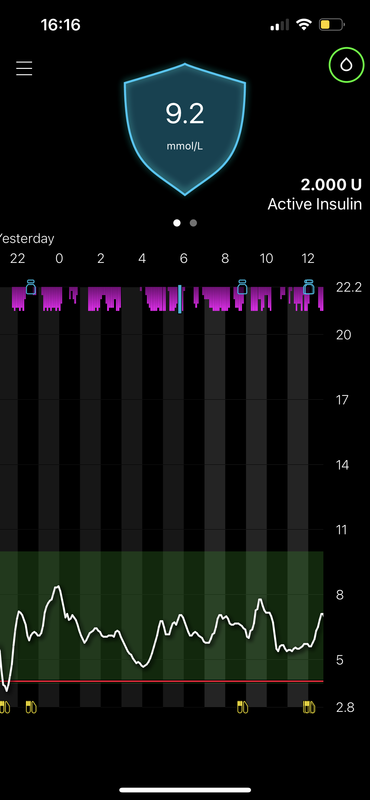
Saw the Libre3 out in the wild this week. Really small.
We're having issues with supply of Libre2 with my son's pharmacy. They owe him 4 (two months supply). Useless they are.

