Surely as soon as it looks even remotely like it's going to go breasts skywards they'll just dump the control rods into the reactor chamber and the problem is solved no?
Or if you read the papers or watch TV,
ZOMG NUCLEAR REACTORZ R EXPLODIGN IN JAPAN ITS CHERNOBBLE ALL OVR AGN WONT SOMEINE THINK OV TEH CHILDREN?!
I'm really, really starting to hate our media services. Bunch of scaremongering, lying bastards.
I think if I lived near a reactor that had just blown up like that one, I wouldn't be staying near it saying it's all media lies.
Looking further ahead, if it does all go tits up, which way is the wind blowing? I remember a load of radiation being dumped all over the world and Scotland when Chernobyl went up.
And if there is another powerful aftershock in that area, would it damage the thing even more?
Surely as soon as it looks even remotely like it's going to go breasts skywards they'll just dump the control rods into the reactor chamber and the problem is solved no?
They have already done that when the quake struck
Full Tech info [url= http://www.tepco.co.jp/en/index-e.html ]HERE These are the statements from The Operators[/url]
As it starts to cool you need to add some water and balance all the pressures while everything chills out.
As the Aux equipment is a bit buggered this is harder. Reactors are designed with failsafes and secondary containments etc. If pressure is released then it will go into the secondary.
A friend who lives 180k away has been advised by a nuclear physicist friend, if the winds continue in the direction they are blowing and if the core was not breached (as it now appears) so possibly only a steam explosion with a localized and relatively small radioactivity, then it is fine to stay where he is. If it does turn out that there has been a core breach (which appears unlikely atm), that is a VERY different situation and he should move 500 kilometers away.
The reactors all automatically shut down when the earthquake hit yesterday, the issue has been that the reactor core is still hot and needs to be cooled (by water) and the coolant systems and backups failed.
Before anyone starts thinking that this is another Chernobyl you need to remember that that power plant had no containment structure around the reactor (no one in the west or japan builds reactors like this because it is fundamentally very dangerous, well, actually its mind bendingly stupid) and the graphite core actually caught fire and exploded, destroying the whole reactor. From what I can see of the images and what the experts seem to be saying is that the Japanese reactor looks to be still ok (ie, intact and not leaking as otherwise you'd see a very large release of radioactive material) but its outer building that surrounds the containment building has been badly damaged by a hydrogen/oxygen gas explosion when they were trying to vent pressurised water/steam from the reactor coolant circuit.
Still, not good though.
Mind you, the Japs should be used to being nuked by now..... 😉
A friend who lives 180k away has been advised by a nuclear physicist friend,
Is his friend's name Pike?
[url= http://www.scientificamerican.com/article.cfm?id=coal-ash-is-more-radioactive-than-nuclear-waste ]Coal ash more radioactive than nuclear waste![/url]
A friend of mine, Kazuko in Sapporo just emailed me. She reckons ????????????????????????????????????????????????
I don't know what it means, but the exclamation marks are a bit worrying.
A friend of mine, Kazuko in Sapporo just emailed me. She reckons ????????????????????????????????????????????????
I don't know what it means, but the exclamation marks are a bit worrying.
Basically she's alright because of where she's located.
Yes, a bit of a downer,this one.
In terms of failure scenarios, it's more like Three Mile Island than Chernobyl, with a loss of coolant in a Boiling Water Reactor. The real issue for the Japanese reactors is that the seismic event (earthquake) and the flooding event (tsunami) are linked, ie in Japan they occur together. It's relatively straightforward to cope with either one separately.
The IAEA website http://www.IAEA.org has reasonably good info, albeit a few hours behind the media.
Hope it turns out ok, not a situation I'd like to be in
its a cld war era reactor, everything from that era broke down, screw you guys i'm getting a radioactive umbrella and a pvc gimp suit with gas mask....
wait wrong situation.
Just a very tricky spot for them to be in, im totoal 1 worker has been been killed ( by explosion but he had traces of radiation at 134 rads?
3 people have been taking to a hospital with radioactive poisoning.
They are trying to save the reactor - they could just let all the water out of the core, which would stop all the pressure build up and explosions (they are having electrical problems, thus the pumps are struggling to keep enough water in the core - so just like a car, it is blowing off steam due to overheating.
If they turned off *all* of the water, then the core would melt (completely safely, inside the containment vessel) but then the reactor would be totally wrecked and unusable. They're trying to cool it down gently so that they can use it again in the future.
It's a boiling water reactor, so it's supposed to have steam in the top part of the core - think of it like a constantly boiling kettle that they collect the steam from to run turbines for power generation. You have to keep adding water or it'll boil dry. If it boils dry you could damage the kettle.
What seems to be happening here is it's nearly boiling dry, some of the fuel elements are breaking open in the heat and these exposed fuel elements are reacting with the water, releasing hydrogen - which then exploded as they tried to release it.
If it ever gets to a serious danger point they can just drain out all the coolant and let it all melt with no danger of gasses building up that could cause blowouts, at the cost of wrecking the reactor totally.
I'm really, really starting to hate our media services. Bunch of scaremongering, lying bastards.
If it isn't exciting they don't get paid, so no incentive to be accurate
I would never defend the UK press (mostly a bunch of clowns) but my friend who lives 180k away has been told there have been changes for the worse. They are unclear of what is happening so his wife and child have now moved further away. He is staying at the moment but ready to go.
Even if it doesn't go into full meltdown it is still being very destructive to a lot of people especially as the earthquake was so damaging. Standard rules do not apply.
it seems that automatic "tripped" shut down in the event of an earth quake might no be the best of safety features. Having to the rely on back up generators has completely failed. Some kind of gradual shut down, keep them running at a level where they are self supporting, until they can be switched off safely might be a better course of action. Though building a nuclear reactor in a known earthquake zone may not be the wisest of decisions.
bassspine - MemberI'm really, really starting to hate our media services. Bunch of scaremongering, lying bastards.
I trust them more than I trust people with a financial interest in the nuclear power industry.
We've got the second worst nuclear accident in history and still, despite the failure of primary and secondary cooling systems and the consequences thereof, we are still being told that nuclear power is safe and controllable.
Given that this has happened in one of the most advanced and organised countries on earth, it doesn't bode well for a fully nuclear powered future, does it?
Sadly, human involvement in a system is a guarantee that the system has the potential to fail.
Combined with the human propensity to refuse to learn from history, an extremely serious nuclear accident is inevitable at some point.
Which is precisely what opponents of nuclear power have been saying for years.
[img]  [/img]
I was down the road when this went up in smoke during a thunderstorm a few years back.
Sizewell powerstation, just up the road from that there London village, and for some reason it didn't even make the news which leads to one of two conclusions.
1) It was assumed that the locals had enough in common with Norfolk and their cousins not to notice a few extra apendages.
2) The powers that be covered it up.
*doffs tinfoil hat*
RustySpanner,
Given that this has happened in one of the most advanced and organised countries on earth, it doesn't bode well for a fully nuclear powered future, does it?
It was cutting edge 30+ years back, modern designs always learn from the errors of the past, since Chernoble they no longer use gravity fed reactors, since Windscale the filtration systems have been altered, and this Japanese reactors 'flaw' of relying on the cooling water has been solved on the current reactors by making them passively cooled.
If you look at the statistics then by kWh nuclear is by far and away the safest power source we've ever used, ironically hydro comes out by far and away the most dangerous.
It's a boiling water reactor, so it's supposed to have steam in the top part of the core - think of it like a constantly boiling kettle that they collect the steam from to run turbines for power generation. You have to keep adding water or it'll boil dry. If it boils dry you could damage the kettle.
Nope. It's a closed system. The water is converted to steam in the reactor core. This steam drives a turbine. It is then converted back to water in a condenser fed by external cold water, then reintroduced to the reactor core to start over again.
If it ever gets to a serious danger point they can just drain out all the coolant and let it all melt with no danger of gasses building up that could cause blowouts, at the cost of wrecking the reactor totally.
I can safely say that we're all glad you're not in charge. You seem to be suggesting that a meltdown situation wouldn't be that bad. Google 'China syndrome'. Whilst melted fuel would hardly reach the opposite side of the globe, the reactor would not be able to contain the fuel as you suggest. It would burn through the base of the reactor and end up in the earth below, contaminating water tables and goodness knows what else.
We've got the second worst nuclear accident in history
[url= http://en.wikipedia.org/wiki/Kyshtym_Disaster ]Not quite[/url], Captain Panic. A lot of guff is being spouted about this across the internet and via the news networks. Don't just take it as gospel. A bit of background reading goes a long way. What's happening at the moment is worst-case scenario from a financial viewpoint. The Fukushima I plant will probably never operate again. At the very least, the affected reactors won't.
I'm not saying it isn't bad, cos it clearly is. It's nothing like a Chernobyl though. 3 Mile Island is the best comparison.
We've got the second worst nuclear accident in history and still, despite the failure of primary and secondary cooling systems and the consequences thereof, we are still being told that nuclear power is safe and controllable.
Is it dangerous and out of control, then?
Yes and after Chernobyl and Three Mile Island, this is the biggest commercial nuclear incident we've yet been told about.
It was cutting edge 30+ years back, modern designs always learn from the errors of the past, since Chernoble they no longer use gravity fed reactors, since Windscale the filtration systems have been altered, and this Japanese reactors 'flaw' of relying on the cooling water has been solved on the current reactors by making them passively cooled.If you look at the statistics then by kWh nuclear is by far and away the safest power source we've ever used, ironically hydro comes out by far and away the most dangerous.
Ok.
I'll put it another way:
Every single system designed by human beings, thus far, has, at some point, failed.
Humans make mistakes - it's in our nature.
Up until the 20th century, the consequences of these mistakes and the subsequent system failures have been on a very small scale.
With nuclear power however, the consequences of our mistakes obviously have a far greater impact and significance, one that has the potential to fundamentally change the relationship between our species and our planet.
So, unless the humans now designing power station safety systems are fundamentally different from every other human that has ever existed, there will be more serious nuclear incidents.
It is inevitable.
And that is why, despite all the reassurances in the world, many people are very, very suspicious about nuclear power.
Rusty Spanner,
There's a good book called [url= http://www.amazon.co.uk/gp/product/0753515539/ref=as_li_tf_tl?ie=UTF8&tag=polwart-21&linkCode=as2&camp=1634&creative=6738&creativeASIN=0753515539 ]"Risk: the science and politics of fear"[/url] by Dan Gardner which you might enjoy - it turns on its head scary kneejerk reactions to incidents like this.
poly, that looks like a really good read.
More info [url= http://www.dangardner.ca/index.php/books/item/16-risk-the-science-and-politics-of-fear ]here [/url]if anyone wants to read more about it.
[i]If you look at the statistics then by kWh nuclear is by far and away the safest power source we've ever used, ironically hydro comes out by far and away the most dangerous. [/i]
How many people have died from hydro power stations exploding?
chernobly UN report claims 9000 cancer related deaths as aresult of the radiation. Greeenpeace 250,000 and i think the use of the term per KWh may be very important in that unreferenced statistics quoted above
i was wondering how many died as a result of solar panels collecting electricity hence my belief that the kwh is the critical - any chance of a source and actuall numbers?
Coal and gas are presumably high due to themining of the raw material rather than the generation per se I assume hence mis leading??
How many people have died from hydro power stations exploding?
There are many ways that people can be killed in an industrial setting that don't involve explosions. Given that the total death toll from Chernobyl is estimated at about 60 it's not actually that big a claim. The death toll from Piper Alpha was three times that, but I've never heard of that being a reason to stop exploring or producing oil and gas.
Well whatever happens, tomorrow night after work I'm having a 'nuclear supper'.
Fission chips.
Could try this:
[img]  [/img]
I was also surprised when I read that hydro power has the greatest number of fatalities per kWh, but then I read about several nasty accidents, eg one in Russia where about 70 people were killed due to a phenomenon known as "water hammer", caused by blockage of one of the inlet ducts (see link to BBC website):
http://news.bbc.co.uk/1/hi/8216138.stm
From memory, one of the reasons why the death toll was so high was that some visitors were having a plant tour at the same time.
Also, haven't heard much about the Japanese oil refinery that seemed to be burning uncontrollably just after the quake / tsunami.
Back to the Japanese reactors, the US Nuclear Energy Institute has a lot of details on their website, eg:
And a nice cutaway picture of the Fukushima Daiichi Unit 1 station
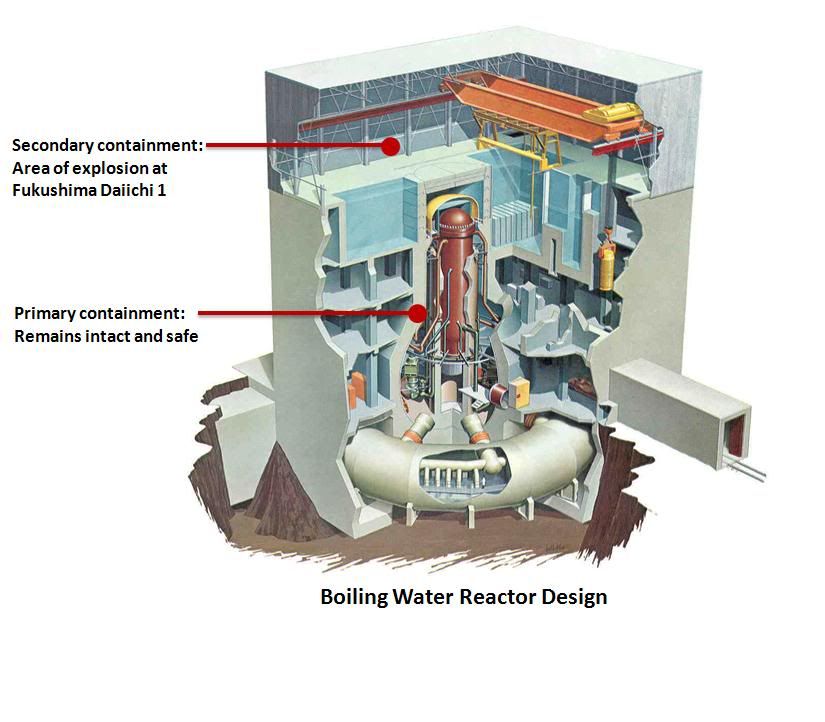
More problems at nuclear plants.
http://www.bbc.co.uk/news/world-asia-pacific-12729138
Plus all the cancer caused by the radiation and of course lots of other ill health.gonefishin - MemberGiven that the total death toll from Chernobyl is estimated at about 60 it's not actually that big a claim.
http://www.who.int/mediacentre/news/releases/2005/pr38/en/index.html
Another vented hydrogen ignition. But the vicinity seems safe thanks to the designers for building such good filtering and strong containment. More injures to plant operators though 🙁
Despite how it looks, it seems better managed that 3 mile island where the core boiled-dry. They at least have a means to manage the decay-heat of the cores. I guess the IAEA will be looking at more redundancy in pump-driven cooling systems and also at pressure venting. I wonder if the designers realised that these venting scenarios would be so dangerous to perform.
Anyone got any idea how many times any other sort of power station has had to have a 30 mile radius evacuated?
Seems to me the penalty for failure is pretty severe, so probably worth taking into account in the decsion making process on how much to invest into alternative energies.
Seems to me the penalty for failure is pretty severe, so probably worth taking into account in the decsion making process on how much to invest into alternative energies.
[url= http://manhaz.cyf.gov.pl/manhaz/strona_konferencja_EAE-2001/15%20-%20Polenp~1.pdf ]http://manhaz.cyf.gov.pl/manhaz/strona_konferencja_EAE-2001/15%20-%20Polenp~1.pdf[/url]
[url= http://nextbigfuture.com/2008/03/deaths-per-twh-for-all-energy-sources.html ]http://nextbigfuture.com/2008/03/deaths-per-twh-for-all-energy-sources.html[/url]
had to do it.....
I doesn't seem like core breach would happen with this design - it's not Chernobyl. The local evac is to completely prevent any risk from radioactive Iodine and Cesium, very small amounts of which have been released by the steam venting.
How many people have died from hydro power stations exploding?
Not exploding, but dams ocasionaly burst, which is bad especialy when historicaly people live near rivers, on which dams tend to be built upstream in the mountains. Theres a film you might have seen, it's called Dambusters, it involves a lot of people dying.
Nuclear power tends to be in the arse end of nowhere.
Add into that the greater day to day danger of accidents arround hydro plants which are more often in less developed countries with lower HSE standards and youve got a gentle drip drip drip of fatalities, compared the once a decade nuclear problem.
There were a lot of deaths involved in the building of UK hydro schemes back in the day when H&S didn't exist, there was quite an interesting program about it on telly not too long ago. It is very different these days though someone did die in a construction incident a year or two ago iirc. I think its fair to say there is a lot more disruption from nuclear power going pete tong.
Olly - Membera so called "melt down" should be impossible, if it isnt, someone is going to have to answer some questions with some damn good answers.
In Chernobyl, the rods were lowered into the reactor, in order to make the heat. when the control systems failed, the weight of the rods, held them in the reactor under gravity, and they could be pulled out.
since chernobyl, its been flipped.
the rods default position (due to gravity mainly) is OUT, not IN.
the rods have to be actively held into the core, and if anything goes wiggy, they should fall out due to gravity.a high tech dead mans handle arrangement.
if they pump that moves the water around the reactor has failed, no one is getting power ANYWAY, so they will just shut it down and it will begin to cool.
surely?!
Yes, the main reaction was stopped, it is the (significant amount of!) residual heat which is causing problems.
Have a read of this:
http://bravenewclimate.com/2011/03/13/fukushima-simple-explanation/
1. Likely timeline of incident is:a. Reactors 1, 2 and 3 were in operation at Fukushima Daiichi nuclear power plant when the earthquake struck.
b. all three reactors were shut down and control rods were inserted when earthquake struck.
c. Cooling was maintained to remove decay heat
d. decay heat drops rapidly on reactor shut down (e.g a 3GW reactor will reduce to 200MW decay heat after 1s and 50MW after 1 hour… But takes long time (3-6months!) to reduce to negligible levels)
e. sometime (?1hr) later tsunami struck and mains power was lost to coolant circuit on Unit 1
f. Diesel generators also failed when tsunami hit so cooling was run by backup batteries for 7-8 hours
g. Other emergency diesel generators brought in but insufficient to run pumps
h. loss of coolant leads to fuel rods no longer being cooled by two phase flow (it is a Boiing water Reactor) and eventually get hot enough to recat with steam to produce Hydrogen.
I think its fair to say there is a lot more disruption from nuclear power going pete tong.
Assuming the absolute worst case scenario statistics, how many deaths from Chernoble? I seem to remember 10,000 being banded about? And we're unlikely to repeat that.
How many people live downstream of the Hoover dam? 10x that? 100x that?
My point is that nuclear has a very good safety record, and if it goes wrong it's not quite as horrific as you might be lead to believe and the consequences of other forms of generation going wrong are just as bad.

