UPDATE: Reviews section refreshed, redesigned, searchable: Go take a look
It takes time for an anchor to bite (and that varies significantly depending on what the seabed is like) and then it also takes time for the massive chain to pull tight*. There might not have been anyone near the mechanism to actually drop it too, so (especially on something that size) add in more time for that too.
Safe guess is that the current (and possibly wind as even in calm conditions these things are huge sails) took them towards the bridge and the anchor was too little too late
*in normal use the chain would be fairly relaxed sitting on the bottom and actually doing a lot of the work
That video above on twitter/X/whatever looks like the ship was starting to initiate a turn under the bridge when it lost power. Assume this locked the rudder etc so the turn continued, past the point it should be straightening up. Power came back on, everything fired up, tried to correct it but too late and then the power went again...
@daveyboywonder read Cougars thread link, it explains it all. They would still have had emergency power but only once the blackout generator kicked in.
I'm amazed this doesn't happen more often. The sheer volume of worldwide shipping and state of some boats is asking for trouble.
Also, you have to appreciate big ships can take a mile or so to stop!
Dropping an anchor like that, is an action of last resort.
You wouldn't be keen to do it, it puts crew and equipment at risk.
I doubt anyone would make that call when the ship first blacked out, you expect the back up systems to restore power.
If you did it and the power came back on, then you would have very little control of the ship and the anchor would be controlling your movement.
By the time they made the call it was too late.
The Tay road bridge protection is detailed at https://www.icevirtuallibrary.com/doi/full/10.1680/bren.13.00010 - it only covers the main navigational channel which wouldn't have helped when at out of control tanker tried to take it out in 1983 ( https://www.reddit.com/r/dundee/comments/pdq2x8/tay_road_bridge_almost_hit_by_700_foot_oil_tanker/ and https://www.thecourier.co.uk/fp/past-times/2515193/oil-tanker-tay-bridge/).
Somewhat ironically, Perth Harbour was losing so much money it looks set for closure, and there is not a huge amount of traffic heading under the bridge anymore - the Dundee docks are before the bridge.
@jca
Thanks for posting,I had never heard that story before.
A proper near miss😲
in normal use the chain would be fairly relaxed sitting on the bottom and actually doing a lot of the work
This. Most people think that it's the anchor that holds a boat in position, but a lot of the work is done by the chain, which also means that a certain amount of chain needs to be let out for it to work.
Anyone thinking an anchor, even dug into clay, is going to stop a 90,000 ton ship travelling at about 14kph in short order is going to be very disappointed!
Anyone thinking an anchor, even dug into clay, is going to stop a 90,000 ton ship travelling at about 14kph in short order is going to be very disappointed!
Yeah, but they could have used it to change direction...
It wasn’t clear earlier in the day but fortunately they did manage to stop traffic before the collapse.
Yep, pretty much confirmed that the boat sent a mayday and the bridge authorities were able to stop traffic. Slightly less confirmed is whether all the traffic was off the bridge, but seems fairly likely that it was the maintenance teams on the bridge that were caught- big bridge, not quick for people on foot to get off it.
This seems pretty informative https://www.youtube.com/v/N39w6aQFKSQ
Video embed is no longer working "MV Dali Hitting Key Bridge in Baltimore - Track and Video Analysis"
As for pier protection, can anyone provide examples on bridges which span major shipping channels?

This is the newest of the two Severn Bridges, you can easily see the size of the caissons holding the supporting towers, and as the tide is out, how narrow the main channel is. The biggest ships negotiating the channel are car transport ships and container ships going into Avonmouth and Royal Portbury Docks, which may not be quite as big as the ship involved with the Baltimore collision, but the Severn and Bristol Channel are very difficult to navigate and very dangerous - it has the second highest tidal range in the world at 48 ft/15 m, it’s the longest river in Great Britain and has the greatest voluminous flow of any river in England and Wales by far 107 m3/3800 cu ft/sec.
It’s at this point the Severn becomes the Bristol Channel.
AFAIK, there’s only ever been one accident involving a bridge over the Severn, when two river barges collided in 1960 and hit the Severn Railway Bridge between Sharpness and Lydney, causing two spans to collapse into the river. Repair work was under consideration the following year when another similar accident occurred, so the bridge was demolished between 1967 and 1970.
I don't think the channel upstream of Avonmouth (and downstream of the bridge) is deep enough for the container ships to drift up as far as the bridge if one broke down entering or leaving the docks.
Here’s the first of the modern Severn Bridges, the caissons are a similar size, but the construction was unique, the decision was taken to use a completely new design and technique, it opened in 1966, and my dad took me down to Aust Ferry to see the bridge under construction.
There’s a footpath and cycle path across the bridge, and it’s well worth walking or riding across and back, especially when the tide’s on the run - you really get to see how powerful it is, and how dangerous, because of the large expanses of rock on both sides.

Forth Road Bridge a few months back. Shipping channel beyond the tower.
https://www.geograph.org.uk/photo/7658730
By coincidence, I’m watching ‘Saving Lives At Sea’, and there’s a converted Dutch barge with engine failure drifting in the main channel of the Severn heading directly towards the Prince of Wales bridge at full flood tide, the barge is about 30 tonnes and a lot bigger than the inflatable life boat! They ended up having a Port of Bristol dredger take over the tow, the lifeboat was doing 1.1 kts into the tide, which gives an idea of how fast the tide flows, and how fast shit really does happen!
An aside - from the BBC
The cargo vessel, called the Dali, was built in 2015 and sails under the flag of Singapore. It can carry 10,000 shipping containers (standard 20 foot units). It was carrying 4,679 units.
Where the hell would the other 5321 containers go?
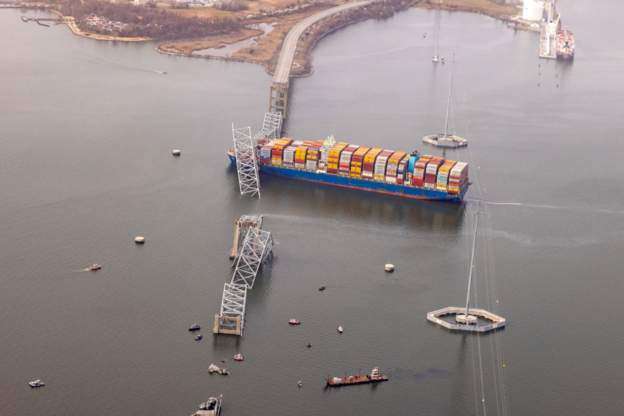

convert
Full MemberAn aside – from the BBC
The cargo vessel, called the Dali, was built in 2015 and sails under the flag of Singapore. It can carry 10,000 shipping containers (standard 20 foot units). It was carrying 4,679 units.
Where the hell would the other 5321 containers go?
I think what they're saying is it has a nominal capacity of 10000 standard 20 footers, but the 4679 on board weren't necessarily 20 footers, they come in 20 30 and 40 foot and also there's a variant which is a foot taller
@jca, thanks for posting those Tay links - I’d not heard of that before, but then I was only 4 at the time it happened.
All those little mult-coloured boxes on the ship will be weighing 30 tonnes each if they are standard shipping containers.
Plus the weight of the boat, you can't just put it into reverse gear... if it's going in one direction, it's going to keep on going in that direction.
Dropping anchor might slow it down, but not enough...not even close to make any difference.
To me, it seems like they were driving to fast for the conditions, at least, that's how it appears on the surface.
If you'll excuse the blunt ananogy.
“they were driving to fast for the conditions…”
Now if the bridge was wearing hi-vis, none of this would have happened…
Bloody bridges getting in the way of ships.. who do they think they are?
It’s not much, but there’s a little bit more background information to the story, which might clarify some points:
Dropping anchor might slow it down, but not enough…not even close to make any difference.
No, not with a ship weighing probably 100,000 tons. I could expect it to drop anchors to get chain out, as the chain is as important if not more than the anchor itself, as its the weight of chain resting on the bottom prevents the ship sliding just as much as the anchor.
But if its running out in an emergency, then its just running free and thats going to do nothing for momentum.
So they would have to run out chain, then brake it and hope theres enough out for a drag effect, al in the space of a few hundred meters.
But run out the anchor and hope it grabs ? thats not going to do anything other than snap the chain, or destroy the handling gear or even tear out the slates surrounding the fairlead
well excactly... it would make no odds. Any anchor would just snap the chain with that much weight and momentum, and cause more problems.
And, thats assuming flat water and no tide.
The boat came in too hot, simple as that.
negative - ghost rider- the pattern is full.
They appear to have just dropped the port anchor. Maybe they were hoping to just change direction enough to get through the pillars rather than actually stop. Most impressive in all of this so far is that during the few minutes it took for this to unfold they managed to get out the mayday call, it got to the bridge and they got the traffic stopped. Doesn't look like anyone was asleep
Dropping an anchor on the run causes massive drag. The "chain" is incredibly heavy and will run out at speed.
A ship like that will typically have about 210 - 250m.
The anchor cable is secured to the collision bulkhead, the strongest bulkhead on the ship, just aft of the cable lockers with a huge fitting.
It is designed to hold the ship in extremis.
It is not a routine operation and could easily damage the ship and equipment. It is also almost impossible to predict what the result of that action to be.
As I posted earlier, it is the last resort but definitely worth trying.
Some interesting comments from a ship's captain 'Stick Legs' on Pistonheads:
There are a lot of comments here speculating about what has happened and why.
I'm only chipping in my 2 cents because I feel that I can at least answer some questions, and provide a little guidance until the final report comes out.
I have worked on Containerships, I have been a Pilot, I have a Master's Qualification and am a Ship's Captain.Caveat: I have only seen the images you have all seen, it has been a VERY long time since I last worked in the US on Containerships so some things have doubtless changed.
My comments here are only designed to answer FAQ's and not to further speculation or claim that somehow 'I am right'.
If there is something I have missed or someone knows more or I am just flat wrong on procedures that may have changed since I last read the regs I will of course defer.PILOTS-
The vessel is under pilotage, I believe 2 pilots, which is normal for a Ultra Large Container Ship (which is how ports classify anything >360m in length).
In the UK the vessel must be under the CONDUCT of a licenced Pilot. Conduct is a funny word, the Master may have the control of the vessel and be 'driving' it themselves but providing they are listening to the Pilot and complying with directions then they have not assumed conduct. This is 'the Conn'. Not as is popularly imagined 'Control'. I cannot imagine the US is different and the myth that it's Master's orders & Pilots advice is out of date.
If the Master is unhappy with the Pilot's direction they can request another Pilot and the ship will be taken to a place of safety and anchored to await another Pilot. Similarly if the Pilot feels the Captain is ignoring them they will warn the Captain and if still ignored will simply state over the Radio to Port Control that the vessel is 'No longer under my conduct'. This has the effect in the UK at least that the vessel is now no longer insured, and the Master has committed an offence under the UK Pilotage act.Big ships (stuff >140m usually) the Pilot gives verbal orders and the bridge team operate the controls. The Captain stands with the Pilot and either translates or confirms the orders given. This Bridge team dynamic is fragile but works well and is respected the world over.
In this case the Senior Pilot would have the Conn, the Master would be monitoring the passage and working with the Bridge team.
The Junior or Second Pilot would be monitoring the actions of the First Pilot and doing things like radio comms and liaising with tugs.In many cases, with a long passage the Pilots will swap roles half way through as Piloting really big stuff is incredibly mentally draining.
THE VESSEL-
Blackouts can occur on vessels and it's deeply unpleasant. In this case, where she appears to lose everything I suspect it's a switchboard fault.
On sea passage a ship like this will be running her main engine at constant revs so a turbo or shaft alternator will provide the electrical power for the ship.
Main engine will be in the 60-80MW range, low speed 2 stroke diesel running on heavy fuel oil. These engines are direct drive and are reversed by stopping them, changing the firing order (by moving the fuel pump cam on the old ships, electronically now) and re starting with the crank running in the opposite direction.On approach to port she will require variable revs and as the propellor is direct drive from the engine, the engine is changed over to gas oil (what you know as diesel) and also a dedicated generator is run to provide electricity for the ship, and another generator is on standby with water & lube oil pre heated and circulating to come on the board asap in the event of a black out. These generators will be in the 4-6MW range.
There is then an emergency generator, in another space to the engine room, that provides enough power to run the winches, lights, steering gear. This should auto start within 15 seconds of a blackout.
There is also a standby 24v battery supply for things like emergency lighting & control systems.
The only engine that provides propulsion is the main engine.
Anchors can be released even when deadship by simply loosening the brake. For port arrival and departure a couple of men should be standing by forward with a radio for this sole purpose.
The length of time this vessel was blacked out suggests to me that either the engine room was set up and manned correctly and the systems failed, or that the systems were operative and the vessel had not been configured correctly for port arrival, generators on standby mode etc etc.
THE PUFF OF BLACK SMOKE / STEERING TOWARDS THE BRIDGE / TRANSVERSE THRUST -
On the video the vessel appears to steer towards the nearest bridge parapet and there is a big cloud of black exhaust smoke.
My best guess is that when the blackout occurred the Pilot ordered, or the Master decided to initiate, an astern command on the main engine to slow the vessel. Single engined ships running ahead exhibit good directional stability, they go in a straight line mostly.When going astern that huge propellor with thousands of horsepower turning it acts like a paddlewheel. It is conventional for ship's to have 'right hand acting' propulsion, most do and these big containerships almost always do, I have never encountered one that doesn't.
Right hand acting implies that when viewed from astern the propellor turns clockwise, so when the propellor direction is reversed it will rotate anti clockwise. Without 360m of hull ahead of it to resist the side forces it causes a sideways moment, this is referred to as transverse thrust and you can use it to your advantage when manoeuvring, even with tugs if you swing the vessel bow to stbd instead of bow to port a kick astern on the main engine will help her round.
The puff of smoke and the subsequent bow to stbd motion says to me that the vessel went astern, a big engine movement, perhaps full astern, at that point. I would have to be convinced that wasn't what happened and is the only thing I am 100% confident on.
The size of the puff of smoke implies that it was the main engine, no 4MW generator is kicking that out on start up. A 60-80MW engine will.
I have a suspicion that if they had not gone astern, and had continued though the bridge and restored power that this wouldn't have been anything other than a near miss report.
ANCHORS -
One should have been released for no other reason than to allow your defence lawyer to prove you did everything in you power to stop the vessel.
In reality it wouldn't have stopped >150000 tonnes moving at 10kts.Thank you for reading.
madeupname
“they were driving to fast for the conditions…”
Now if the bridge was wearing hi-vis, none of this would have happened…
I notice none of the ships were wearing a helmet
That Pistonheads post sounds a bit off, there's no way a ship would be piloting with only one generator running, when I was on the boats we would always run enough generators for the power requirements plus one (or two depending on whether we needed the bow thruster). And that was with cheapskate companies that didn't do things if they didn't have to.
I'd also bloody hope the engine room was manned under manoeuvres!
@convert you're looking at mostly 40' containers in that picture, if you look at the row forward of the funnel you will see the 20' containers. Obviously 1x40' = 2x20'
That Pistonheads post sounds a bit off, there’s no way a ship would be piloting with only one generator running, when I was on the boats we would always run enough generators for the power requirements plus one (or two depending on whether we needed the bow thruster). And that was with cheapskate companies that didn’t do things if they didn’t have to.
I’d also bloody hope the engine room was manned under manoeuvres!
I thought it was insightful anyway 🤷♂️
"In reality it wouldn’t have stopped >150000 tonnes moving at 10kts."
It doesn't weigh 150,000t. No way near that.
It wasn't doing 10kts, more like 8.5.
Her speed dropped from 8.5 to 3.5kts just before the collision. I wonder what did that?
It doesn’t weigh 150,000t. No way near that.
116,000t
Her speed dropped from 8.5 to 3.5kts just before the collision. I wonder what did that?
Umm... no idea where you got that but everything I've seen states it was doing 8kts at the point of collision.
There is a good analysis of the AIS track on "Whats going on with shipping" youtube channel.
Can't post any hyperlinks at the moment.
7-8kts then.
Her speed dropped from 8.5 to 3.5kts just before the collision. I wonder what did that?
Full reverse on the engine? The black plume could lend itself to that.
Just thinking about it though, the only time I've seen black smoke like that was when we tried to start an engine with failed auxy blowers (electrically driven superchargers for low speeds before the turbos have enough gas to work). Performance was, shall we say, sub-optimal.
Full reverse on the engine? The black plume could lend itself to that.
Just to be clear, the ship didn't reduce speed from 8.5-3.5kts..... it hit the bridge at about 7.5 kts so barely any speed reduction at all (do you know just how slow 0.5kt is!)
It's odd though, i looked at the speed trace just after the incident and it was showing gradual reduction to 3 knots or something just before impact. The line was green initially and it went all the way down to red.
Unfortunately it seems you need a paid membership to look back at the old trace.
(do you know just how slow 0.5kt is!)
Nah mate, not a clue 🙄
It’s odd though, i looked at the speed trace just after the incident and it was showing gradual reduction to 3 knots or something just before impact.
Which is what I'm guessing Gobuchul was referring to.
If you look at the AIS replays it shows the ship doing 7.5kts when it was opposite the Yara Baltimore Terminal - which is pretty much 250m before the bridge. The AIS transmitter will take the position from the GPS unit which will be in/around the bridge, which is almost amidships of the [300m long] ship.
So it can be assumed that when the GPS was 250m away from the bridge the bow was about 100m away from the bridge. Chances are the AIS updated [which occurs every 3.5 seconds on a ship like the Dali at that speed] while the ship was actually colliding with the bridge (and coming to a halt).

