UPDATE: Reviews section refreshed, redesigned, searchable: Go take a look
I bought a portable hard drive yesterday. A tiny black rectangle not much bigger than an audio cassette (remember those?), weighs little, but holds a terabyte of data.
A terabyte! I can remember when that was an utterly unfathomable amount of data. Incredible how these things sneak up on you.. the specs of the laptop on which I am typing would have seemed way beyond pure fantasy when I was into computers as a kid. And it's just a part of life now.
Talking last night about memory with my son, and I said pretty much the same - although I do remember when a MB seemed an unreal number...
We do document imaging (scanning) and can convert a warehouse full of archive boxes on pallet racking into a single portable hard drive no bigger than a fag packet.
What's more you can search all the scanned images for a single word/phrase in seconds.
Neat 🙂
Compared to my first PC, I've got sixteen times as much storage capacity on my keyring.
We do document imaging (scanning) and can convert a warehouse full of archive boxes on pallet racking into a single portable hard drive no bigger than a fag packet.
Which, of course, you then back up, right? (-:
I remember my first computer - a BBC B - had 32k of ram.
I'm always struck by the capacity shifts in USB pen drives.
When they launched they were about 2 - 3 inches long and a 32meg one was around £120 (around 2000, 2001)!
I used to load Scan's daily deals page religiously hoping to see them on a bargain day 🙂
Now you can get 32GB for under £20 and it's the size of your thumbnail!
http://www.mymemory.co.uk/USB-Flash-Drives/HP/HP-32GB-v165w-USB-Flash-Drive?affid=47868&awc=1152_1331202684_01a2a42f07f2615712183dd598bcc605
The computing power onboard the Saturn 5 rockets that took humans to the moon and back were roughly the equivalent of what it takes to power a simple electronic calculator.
Which, of course, you then back up, right? (-:
While it's with us, yes of course. But the client can do whatever they want with it - although we never supply a single copy of the data, always two or more so that they can one on-site and another in a [hopefully secure] remote location.
A terabyte! I can remember when that was an utterly unfathomable amount of data.
I maintain an enterprise-grade SAN for a customer which contains sixteen 3.5" SCSI hard disks; the total storage capacity is 2Tb. So even by relatively current terms, you've got eight full-sized hard disks in the palm of your hand there.
Even as a technophobe, even I have to acknowledge that modern computery stuff is fairly impressive.
It's rather depressing knowing that despite it's huge potential and capability, 99% of us just use it for 'Liking' things on FaceBook and watching people fall over on YouTube. Oh, and posting opinions that nobody cares about on forums.
Computers are rather like the human brain - massive potential/ability, but we only really use about 1% of it 🙂
I had a disk drive for my BBC. Held 100k on a disk.
we never supply a single copy of the data
Good good. As you were, then.
I just had a mental image of, "yes, so we've taken your entire filing room and copied it onto this little black box here and, whoops...!" *thud* "oh." (-:
1K of ram on my ZX81, typing basic programs in from magazines, jumpers for goal posts...
I maintain an enterprise-grade SAN for a customer which contains sixteen 3.5" SCSI hard disks; the total storage capacity is 2Tb. So even by relatively current terms, you've got eight full-sized hard disks in the palm of your hand there.
And therein lies my least favourite job - explaining why 4Tb of storage on a Netapp cost them around 40 grand when they can buy 4 of said pocket sized disks for a monkey...
Computers are rather like the human brain - massive potential/ability, but we only really use about 1% of it
Except some of your mundane things use significant amounts of processing power. To do really clever stuff you can usually get away with a lot less power than you need to watch people falling over on YouTube.
Computers are rather like the human brain
Christ I hope I'm not running Windows 😯
I do remember when a MB seemed an unreal number...
Mmmm.. .Zx81...
[img] 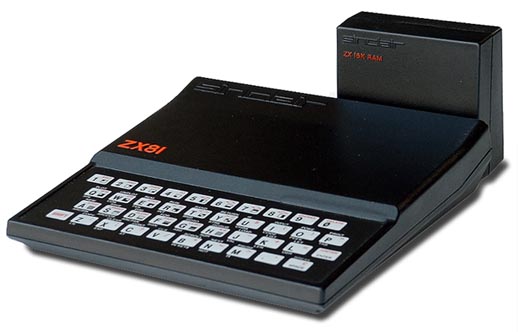 [/img]
Launched in 1981 for £70 (assembled), just 1kB of main memory, with and add-on pack to take it to 16kB.
(For reference the Singletrack text logo at the top of this page is 14kB).
Still very useful today though:
[img] 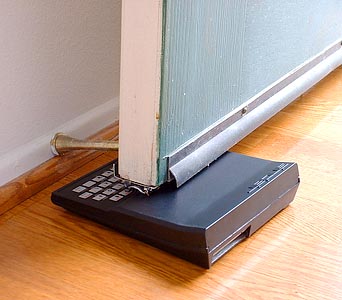 [/img]
http://oldcomputers.net/zx81.html
Remember getting my first 60Mb hard disk for an Atari ST - seemed like a ridiculously large amount of data.
[img]  [/img]
The computing power onboard the Saturn 5 rockets that took humans to the moon and back were roughly the equivalent of what it takes to power a simple electronic calculator.
That's probably unfair to calculators. (-:
The processing 'heavy lifting' for guidance and such was done on the ground (and a lot of that was by clever men and slide rules). The Saturn V's instrumentation computers were something like a 2MHz CPU, 32K of RAM, IIRC.
Sharkbait, out of interest, just how long does it take to scan that amount of data?
I maintain an enterprise-grade SAN for a customer which contains sixteen 3.5" SCSI hard disks; the total storage capacity is 2Tb. So even by relatively current terms, you've got eight full-sized hard disks in the palm of your hand there.
At the risk of geek pedantry here but you're comparing apples to oranges!
The 15k RPM disks in your (i suspect rapidly ageing if they're scsi rather than SAS) enterprise SAN are nothing like the 7.2k RPM disk that'll be in the external HDD.
[url= http://www.infoworld.com/d/storage/infoworld-review-dell-iscsi-san-sizzles-ssd-dynamic-storage-tiering-625 ]This stuff is blowing my mind though - Storage that know where it needs to be...[/url]
4TB drives on the market now, I'll have four of those in a raid 10 array please.
I bought a 512KB expansion for my Amiga back in 1990 for a whopping £89. That meant I could play It Came From The Desert and Dungeon Master. A whopping one megabyte of RAM...as much as eight ZX Spectrum +2s!
The first hardrive I bought for the above cost me an absolute fortune - 420MB. My mates all filled their 200MB drives up and I opted to spend a little more for double the capacity. Within four years, I replaced that with a 4GB drive. Yep, it cost me a small fortune but I figured that it was practically limitless storage...4GB could hold an awful lot of grumble - sorry, I meant Deluxe Paint HAM images and hard drive installable games.
And then along came a PC with Windows 98 installed...4GB suddenly seemed quite tiny.
Remember in my first job, we needed to buy a 1Gb external HDD. That was massive, and was a special order. Now you get that on a camera/phone storage card so small (*too* small) that you really don't want to drop it, and would need at least 4-8x that for a reasonable base OS install on pretty much anything.
a warehouse full of archive boxes on pallet racking into a single portable hard drive no bigger than a fag packet
Brilliant 🙂
When I first moved to London, we ran the Bank of Scotland International Trading system on a system with 16K of memory.
<rant>
What's truly scary is how much of this capacity and power is wasted.
I've now got roughly 20 times the power and capacity that I had in 2000, but I can't really do anything that I couldn't back then.
Editing HD video is probably the only thing that comes close, but there were plenty of people doing that back then too.
Thankfully we're finally getting to a state where we've got single devices to optimize for. Working on iPhone/iPad apps is a joy compared to Windows. Focussing on function/efficiency/innovation rather than just 'more'.
Since the early 90s I've been having arguments with people about why computers aren't more like 'appliances'. 90% of people want 90% of the same things, yet every edition of Windows is limited heavily by the fact that the 10% of people are treated as equal to the 90%.
</rant>
I remember my first computer - a BBC B - had 32k of ram.
the B was hot!
Sharkbait, out of interest, just how long does it take to scan that amount of data
Mos, sort of depends on how much prep needs doing before the docs can be scanned.
In terms of actual scanning, each machine will get through about 200 images/minute in full colour or black and white or both if you want.
When DVD video first appeared they had to be rendered in special mastering labs using dedicated workstations.
They used complicated algorithms to encode a certain number of key frames (about one in every four) and then calculate the differences between the intervening frames and only store the differences.
For the time it was horrendously processor intensive and couldn't be done in real time and required high end hardware
Fast forward to today and your Sky HD Box will happily render HD content in real-time completely seamlessly and without any percievable loss in quality.
So real time video rendering which wasn't possible as few as 15 years ago on top end hardware is now in the realm of inexpensive consumer electronics
the specs of the laptop on which I am typing would have seemed way beyond pure fantasy when I was into computers as a kid.
Quite clearly you were fantasising about the wrong things as a kid 🙂
I can remember fitting 48k RAM expansion chips to our ZX Spectrum when developers started to ignore the 16k version. First ever bit of electronics fiddling - on the most expensive christmas present ever = scary.
It was worth it for Penetrator though 🙂
Found one of these bad boys in my cellar not so long ago
[img] 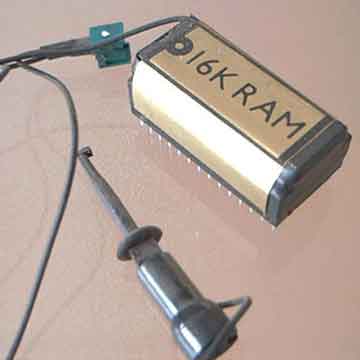 [/img]
[i]1K of ram on my ZX81, typing basic programs in from magazines, jumpers for goal posts... [/i]
yup I remember the ZX81 days very well. My mates brother worked for Memotech and he got hold of a 64k RAM expansion for us both, we thought it would never be possible to use it all.
[img]  [/img]
Kev
What's a terrabyte?
When I was doing my MSc 2001-2002 (which doesn't seem very long ago to me) someone brought in their new MP3 player, which had something like a 64Mb memory and cost about £70. We all thought it was amazing.
A while before that, I remember something on TV where they had this thing that was going to make CD players obsolete, and was for all intents and purposes an MP3 player. But they had it as the April Fool's item!
Those DVD (and BluRay too), would also be downscaling as part of the encoding process. GoPro might be 1080p, but a Red Epic certainly isn't.
What's a terrabyte?
Something to do with dinosaurs I think.
Re: Apollo, there's some incredibly geeky reading about the guidance computer [url= http://en.wikipedia.org/wiki/Apollo_Guidance_Computer ]here[/url] if anyone cares (and can understand 1960's computing terminology).
Yeti it's like a terrapin but nippier.
What's a terrabyte
It's a dinosaur that eats earth
What's a terrabyte?
Going OTB and eating dirt?
IGMC
We're using PetaBytes here now 🙂
I'm amazed what my smart phone is capable of
I remember spending £250 on a 2x write speed CD Burner.
hmmmmm
A while before that, I remember something on TV where they had this thing that was going to make CD players obsolete, and was for all intents and purposes an MP3 player. But they had it as the April Fool's item!
I remember that. It was Philip Schofield and Sarah Green on one of the Saturday morning shows, Going Live or one of its ilk. Albums on little chips that you plugged into the player. They came clean the following week.

