UPDATE: CLASSIFIEDS section refreshed, redesigned, searchable: Go take a look
The main difference between a DSLR and a mirrorless camera (micro 4:3, compact, smartphone, whatever), is that the latter effectively had 2 sensors on the same chip, one set of pixles is recording the live image and the other is switched on/off to take the photo like a shutter.
Not quite sure you've got that quite right. The sensor in the Sony A7r is exactly the same as the one in the Nikon D800 and CSC/mirrorless cameras still have a shutter that opens and closes.
I could be wrong about this but I think the main difference between the two designs is that in order to convey the image that the sensor sees in a mirrorless camera, the sensor does need to remain on in order to provide the EVF or back screen something to display. In a DSLR you have a mirror/pentaprism arrangement that shines the light through the lens into the eye piece. The sensor only needs to be charged when the mirror lifts and the shutter opens.
This is the key reason why mirrorless cameras' battery life is still very poor compared to DSLRs.
A mirrorless camera though still has a shutter (though some now offer the ability to record an image without using the shutter, i.e. in silent mode.
Nice context and info geetee - thanks. good to have some experts to listen to
I think 'reasonably well informed enthusiast' is perhaps more accurate but glad that you appreciate the information.
Interesting - I have been toying with an RX and then looking at son's photos of iP6 and hesitating.Would love to be a better photographer but £000s for something that gets replaced every year is a tough call at the moment.
from what i've seen amongst friends, £300ish on a photography course will do far more for your photography skills than spending the same amount on a camera upgrade 🙂
The difference is between “snaps” that are passed off as photographs and proper photographs. If you want total control over shutter speed, aperture, ISO settings etc then it’s got to be a camera
Give a photographer a mobile and he'll take better photos than somebody who has just bought several grands worth of 'proper' camera.
How do you know the HDR is ever turned off?
The images usually say HDR in the top corner when looked at on the iPhone or the Mac. I've always assumed if it doesn't say that, it's not used HDR to take the photo. I don't know for sure of course, I just point and click 🙂
I took the following shots both on fully auto settings, one with an iPhone 6 and the other with a Lumix TZ40. I've done no editing on these after taking them. I have my own preference as to which I will probably keep (and do a bit of tweaking with) but I'd be interested to hear from the experienced photographers which they think is objectively best.
[url= https://c1.staticflickr.com/8/7525/26764935424_87897d2c79.jp g" target="_blank">https://c1.staticflickr.com/8/7525/26764935424_87897d2c79.jp g"/> [/img][/url][url= https://flic.kr/p/GM8hPS ]Loch Coulin in Torridon[/url] by [url= https://www.flickr.com/photos/stilltortoise/ ]stilltortoise[/url], on Flickr
[url= https://c3.staticflickr.com/8/7624/26764934834_f88a38783d.jp g" target="_blank">https://c3.staticflickr.com/8/7624/26764934834_f88a38783d.jp g"/> [/img][/url][url= https://flic.kr/p/GM8hDG ]Loch Coulin in Torridon[/url] by [url= https://www.flickr.com/photos/stilltortoise/ ]stilltortoise[/url], on Flickr
I like the second one, but I've no idea if it's [i]objectively best.[/i]
great picture BTW 😀
Not quite sure you've got that quite right. The sensor in the Sony A7r is exactly the same as the one in the Nikon D800 and CSC/mirrorless cameras still have a shutter that opens and closes.
Same sensor, but a proportion of the pixels have to do one job or the other IIRC.
Something to do with the physics, you can only record a good image by starting with an 'empty' sensor, filling it with photons, then emptying it again. Hence why the same pixles can't do both very well. There are ways around it (Sony alpha DSLR's with their transparent mirror), but it involves compromises in image quality, which is why DSLR's still have a mechanical shutter. How does the EVF work if the shutter is closed? I'm sure it's different in every camera, but my old bridge camera had a silent mode and all the shutter was, was a shutter 'noise'.
"geetee, all very interesting, I'm sure, I care as much about all that stuff as much as I care about the contents of this month's Marie Claire, or the Tajikistani constitutional referendum..."
that might be the case nickc but a majority of them are the difference between something that you squint at to try and see what the focal point of the picture is and a picture you look at and think - thats cool.
Stilltortoise it's easy to see which is the better image, but you're comparing out of the camera JPEGs, which is effectively less a comparison of the cameras ability to produce an image and more of its ability to process one. The two aren't quite the same. JPEGs are only 'estimations' of what the camera thinks the scene should look like. You could produce the same result or maybe even better with the Lumix.
Same sensor, but a proportion of the pixels have to do one job or the other IIRC.
Honestly this is beyond my knowledge so I will defer to you. What I do know is that by every 'objective' empirical measure of 'image quality', the Sony A7rII performs better than the Nikon D800. That does not mean that it's a better camera and there are many things the A7rII struggles to do that the Nikon won't.
How does the EVF work if the shutter is closed?
So the order in which things happen is:
sensor on, EVF image seen - shutter button pressed, shutter closes - sensor erased - shutter opens - sensor on, image captured - shutter closes - image recorded
Give a photographer a mobile and he'll take better photos than somebody who has just bought several grands worth of 'proper' camera.
True ...(ATGBNI ... same applies to loads of stuff, bikes included :lol:) but
was from the perspective of a photographer!The difference is between “snaps” that are passed off as photographs and proper photographs. If you want total control over shutter speed, aperture, ISO settings etc then it’s got to be a camera
but you're comparing out of the camera JPEGs, which is effectively less a comparison of the cameras ability to produce an image and more of its ability to process one.
For "point and shooters" it's one and the same though. I don't really care how it happens, but I press a button and get an image I can put online, print out or just "archive" on my hard drive for ever. It absolutely is the camera's ability to produce an image and suggesting otherwise is semantics, no?
You could produce the same result or maybe even better with the Lumix.
Maybe, but I'll be buggered if I know how 😆
So which did you prefer and why?
I know two people who have mahoosive SLR type cameras but they are both crap photographers. One even takes portraits with everybody's face in the middle of the frame; she has no idea at all of framing or compositions. Just sayin', like.
Isn't the main difference between those two photos the exposure levels, making one lighter than the other? I think the first one is the best as it shows the different colours of the trees etc, whilst the second just looks drab.
Having said that the mountain and sky looks slightly over exposed. so the top half of one and the bottom half of the other.
It absolutely is the camera's ability to produce an image and suggesting otherwise is semantics, no?
You know I think you put that argument really well and if I think about it for a moment, I have reached the same conclusion myself at various points in the past. Mostly I tried to understand the difference while trying to wrap my head around what a 'RAW' file really was and why it was 'superior' to a JPEG. Once I had done that though, it stopped being semantics, but then that was the transition to wanting something quite different from photography.
As for which image I prefer, actually it's not quite so easy. I prefer the top and bottom of the second image (i.e. the foreground up to the lake and the mountain and sky) but the middle part (i.e. the forrest behind the lake) of the second. That middle part is too dark in the second image for me. Combine those elements and you'd have the best picture available from those two.
One even takes portraits with everybody's face in the middle of the frame
You mean like this?
[url= https://c5.staticflickr.com/2/1655/26222285372_105155afd1_k.jp g" target="_blank">https://c5.staticflickr.com/2/1655/26222285372_105155afd1_k.jp g"/> [/img][/url][url= https://flic.kr/p/FXb4Su ]Kriss Kross[/url] by [url= https://www.flickr.com/photos/geetee1972/ ]Greg Turner[/url], on Flickr
or this:
[url= https://c8.staticflickr.com/2/1486/26056426903_a6e3de8d46_h.jp g" target="_blank">https://c8.staticflickr.com/2/1486/26056426903_a6e3de8d46_h.jp g"/> [/img][/url][url= https://flic.kr/p/FGvZVH ]Eketarina Triptych[/url] by [url= https://www.flickr.com/photos/geetee1972/ ]Greg Turner[/url], on Flickr
It's OK to break rules. Not saying these are anything other than averagely OK pictures but they still work.
Hilariously, the only people who care about a thing Geetee posted are those who already own a DSLR.
Mrs. Snapchat and the Maccers n Celebrity Juice lot don't give a shiiiiiiiiiiiiiiitttttttttt
the difference between something that you squint at to try and see what the focal point of the picture is and a picture you look at and think - thats cool.
actually, not really. I've no interest whatsoever in learning how to take a photo above a few simple rules about basic composition ([s]most[/s] all of the photos I take will go no further than my cloud or facebook). I like photography, don't get me wrong, and a really good image will still make me stop and stare, but I've no real interest in "Why or How" it's either a good image or it's not...Focal point..? not bothered.
One has bluer sky and under exposed the other lighter sky and over exposed. Neither are right or wrong. Just different guesses by the software/firmware for a SOOC jpg. Both would need post processing to go on my G+ photos. Neither would be processed for a straight from camera to facebook.
The average point and shooter would probably complain saying that both the lumix and an iphone/android give better photos than and EOS 750d (or the Nikon equivalent). Which would be true. The DSLR would almost certainly need something doing to the image. And the average point and shooter would be totally confused why the RAW looks so bad, when "it's supposed to be better".
I use phone, cheap P+S, and DSLR. cheap P+S tends to be the one that's in the back pocket of the bike jersey. Always buy the previous model... €80 for similar spec to the most recent model. If it gets dropped, buy a new one. Smartphones are just too huge and fragile for that, so the phone is in the backpack and the P+S in my pocket.
Hilariously, the only people who care about a thing Geetee posted are those who already own a DSLR.
I guess that is why they own said camera.
I do wonder if we'll see more 'collaboration' phones, a bit like the Marshal smartphone.
What, like the Huswei P9 with the dual lens Leica camera built in?
Huswei P9 with the dual lens Leica camera built in
Calling it a 'Leica camera' is stretching it. Actually it's more like a complete fabrication of the truth but it doesn't stop the marketing machine from having that large red dot on every advert.
iphone can take great photos but it lacks a proper zoom, big drawback imo.
But also, you can get a decent phone and a really good compact camera for less than an iphone, it's more durable/longlived, it's not such a slave to battery life, it's generally easier to use...
The main difference between a DSLR and a mirrorless camera (micro 4:3, compact, smartphone, whatever), is that the latter effectively had 2 sensors on the same chip, one set of pixles is recording the live image and the other is switched on/off to take the photo like a shutter. In a DSLR all the pixles are on (recording darkness), the shutter opens, closes, and the sensor is still on. Which is one reason DSLR's are better, they have more space for the useful pixels on the chip.
Something to do with the physics, you can only record a good image by starting with an 'empty' sensor, filling it with photons, then emptying it again. Hence why the same pixles can't do both very well. There are ways around it (Sony alpha DSLR's with their transparent mirror), but it involves compromises in image quality, which is why DSLR's still have a mechanical shutter. How does the EVF work if the shutter is closed? I'm sure it's different in every camera, but my old bridge camera had a silent mode and all the shutter was, was a shutter 'noise'.
Sorry but I'n certain that you are wrong
All modern DSLRs have live view, So my D90 can do continuous read out. On DXOmark the EVF cameras and DSLRs score the same as the sensors are the same
I took the following shots both on fully auto settings, one with an iPhone 6 and the other with a Lumix TZ40. I've done no editing on these after taking them. I have my own preference as to which I will probably keep (and do a bit of tweaking with) but I'd be interested to hear from the experienced photographers which they think is objectively best.
you're comparing a three year old budget camera with a modern device of twice the cost, also I'm not sure all is well with the lumix settings, seems a bit poor.
I also am of the feeling that pictures taken on mobiles look great on mobile devices, which does cover a lot of people's audiences these days, but fall down when viewed on full monitor or if you want it printed.
The photo #2 in this story taken on a compact Panasonic LX100 is superb and simply wouldn't be possible on a phone camera, if you're a premier user you can see a higher resolution image, the detail is fantastic for low light and a compact
http://singletrackworld.com/wp-content/uploads/2016/03/behind-the-lens-nepal-steve-shannon/
Are you comparing images on the computer, or camera on camera screen, phone on phone screen? Must say, even crap photos look reasonable on my phone's screen! It is so much handier though, taking a burst of shots on a phone. Guess that's the point!? I've just taken some "selfies" of my and my daughter pulling stupid faces and the FF camera on my Nexus 6P is pretty decent.
Looking through my Google pics, some of those I've taken with an older phone, which perhaps aren't quite in focus, crap light etc, are some of my favourite memory-invoking images. I care not that the quality is poor because what the pic reminds me of, is worth more. Yeah if I'd got my "big camera" out, faffed with the settings and got it set up just right, that "image" I wanted to keep, or a similar image, would have gone. I'd have a clear, sharp picture of a near memory, not the one I wanted to capture. That quick pic of a mate who's just stacked it face down in a pool of mud, or the stupid face your child has when it's discovered he/she can smother their face in yoghurt, or that quick burst of sunlight through the pine trees as you line up for another run.
Bang! 10 shots with the press of a virtual button on your camera phone screen. Should get a decent one from those!
The best camera is the one you can access quickly to grab that moment. Not the one that has the biggest resolution, the fastest CMOS or the highest ISO.
the FF camera on my Nexus 6P is pretty decent.
The Nexus 6pp has a full frame sensor? 😯
The best camera is the one you can access quickly to grab that moment. Not the one that has the biggest resolution, the fastest CMOS or the highest ISO.
The best camera is the one best suited to the specific job you need it for. Speed isn't needed for landscape work for example.
Are you comparing images on the computer
yes, see my post above for an example.
I'm not sure all is well with the lumix settings, seems a bit poor.
Interesting. I've taken some great pictures on this camera but it's never wowed me as much as I wanted/expected.
you're comparing a three year old budget camera with a modern device of twice the cost
The iPhone 6 is nearly 2 years old and is a convergence device of which camera is only one function. The Lumix's only job is to take photos and videos. What do you think a fair comparison would be? On the subject of video, I've noticed also that video is much better on the iPhone than the Lumix.
but I'd be interested to hear from the experienced photographers which they think is objectively best.
No comparison - the top one is blown out. Though unless you have a decent calibrated monitor I wouldn't say too much about the pictures.
As per the thread title. Phone wins hands down as you're always likely to have it with you. Quality is 'good enough' in most cases.
"The best camera is the one you can access quickly to grab that moment. Not the one that has the biggest resolution, the fastest CMOS or the highest ISO."
which is why my compact lives on the shoulder strap of my pack for riding/running/walking
then i can have good pictures quickly and not pictures i look at and think its good - i think ill get that printed out .... oh its shit when printed out.
On a related but different note, saw this today and was impressed at the resolution
https://m.facebook.com/story.php?story_fbid=1214060501950964&id=642182479138772
trail_rat - Member
which is why my compact lives on the shoulder strap of my pack for riding/running/walking
What case/strap/setup are you using to keep it there and keep it safe?
A cheapo one out of asda. From many moons ago. It has a velcro and button strap to the case plus lanyard back up.
The lanyard from the camera is tied to the case. But its never once fallen out, the rain did woryr me and i used to move it into my pack in heavy rain, but i dont tend to take many photos in the heavy rain.
It was previously a casio exilm now it is an olympus toughcam tg4- rain not so much an issue now.
Im contemplating a new case as the new cameras a tight fit.
I actually understand what geetee means by gamut, I worked in prepress for quite a few years, scanning photos on a Crosfield 6250 drum scanner, working in RGB/CMYK colourspaces, etc, and an iPhone can produce an image that would print perfectly an A4 image perfectly at 300dpi, a 35mm 200ASA/ISO tranny will show grain and other imperfections that will need photoshop work to remove. I've got a panorama taken with my iP5, that I had printed at work on our proofing printer that's around 8"x20", and I'm really pleased with it, it looks stunning.
I still usually carry my Lumix TZ72, as well as the phone though, for one very good reason; zoom. These two photos would have been impossible with the phone:
[IMG]  [/IMG]
[IMG]  [/IMG]
The damselflies were around ten/twelve feet away, so I was using almost the full 20x optical zoom to get the shot, there's no cropping or post-production it's straight off the card to the pad via wifi.
[IMG] 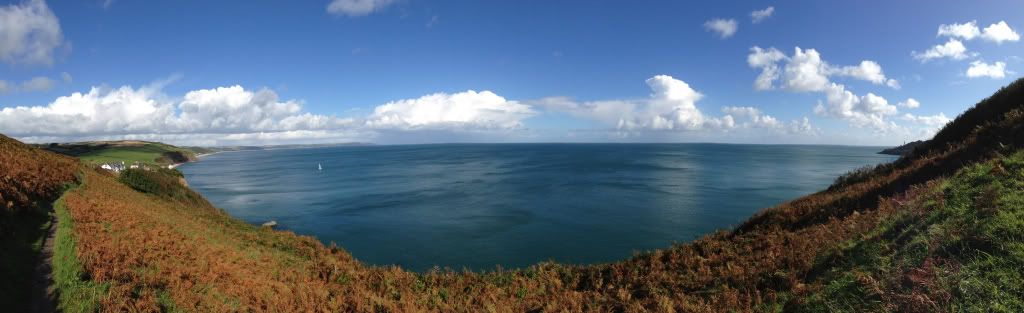 [/IMG]
iPhone panorama.
What case/strap/setup are you using to keep it there and keep it safe?
I use a [url= https://www.lowepro.co.uk/brands/lowepro/dashpoint/dashpoint-10/pd187/ ]LowePro Dashpoint[/url]. It has a great mechanism for attaching securely to the rucksack straps and even unzipped the camera is secure enough to ride with. Perfect for whipping the camera out one-handed and taking a shot whilst riding. Recommended.
The Nokia lumina 1020 has a phenomenal camera that blows most compacts other phones out the water when it comes to image quality and detail. Unfortunately shot to shot time is slow as is initial start up which grew worse and worse. If they could get that camera in a modern smartphone like an S7 it would be unbeatable. Rip Nokia.
I'm a huge fan of smartphone cameras, I too have a DSLR that is currently sitting unloved in its bag with a half full memory card I've yet to download to my Mac..
Thing I really like with my iPhone are the photo Apps, I use these all the time. I'm not too interested in the absolute definition or quality of the shot, more that it conveys the original reason for me taking it.
Then, well then I'll modify the image with the App and obliterate any colour or definition out of it.
But that's how I like my photos.
Right then, I want a robust, compact camera for living in a pack or jersey pocket for decent mtb photos. I'm used to slrs and like an element of control over everything.
Does this camera exist, say up to £100? Or is it likely to be a lot more?
bikebouy - MemberI'm a huge fan of smartphone cameras, I too have a DSLR that is currently sitting unloved in its bag with a half full memory card I've yet to download to my Mac..
Erm.....I missed the bit where a DSLR is a compact camera. It's not, never has been & has never claimed to be... 😀
Yak - MemberRight then, I want a robust, compact camera for living in a pack or jersey pocket for decent mtb photos. I'm used to slrs and like an element of control over everything.
Does this camera exist, say up to £100? Or is it likely to be a lot more?
When I was looking a few years ago, around the £100 point most cameras didn't have much in the way of manual control options. You had to step-up to around £200 for that. Not sure if things have changed now, but most brands do fairly cheap compacts with the normal PASM modes on them.
£200? Ah, ok then. I don't want to miss out on usability, so I will look at 2nd hand stuff then.
Yak - Member£200? Ah, ok then. I don't want to miss out on usability, so I will look at 2nd hand stuff then.
This was several years ago though - I think my Nikon p300 is getting on for 5 years old now and I think that was £200 (down from RRP of £300, which was a tad hopeful of Nikon IMO)!
It's worth looking on Jessops or Argos and seeing what you can get for your money - I think you can filter by price.
stilltortoise - Member
What case/strap/setup are you using to keep it there and keep it safe?
I use a LowePro Dashpoint. It has a great mechanism for attaching securely to the rucksack straps and even unzipped the camera is secure enough to ride with. Perfect for whipping the camera out one-handed and taking a shot whilst riding. Recommended.
Looks good. Ordered. Thanks for the recommendation.
In terms of compact vs phone vs DSLR. As a sometime photography teacher I'm (I think) pretty atypical in that I don't much care for all the tech side of taking photos. Obviously I know it fairly well, but for me the image is everything and as I trained as a painter I tend to heavily process my photos anyway to a degree that might upset a 'pure' photographer. I don't even currently own a DSLR - I have a decent bridge camera with full manual and RAW shooting, a cheap (no manual mode) compact and my (also RAW shooting) phone. The phone gets used more than anything else, but I've smashed a few while riding due to having it in a pocket so bought the compact to ride with. The 'decent' camera really only gets used when I'm going somewhere with the express intention of taking photos or for stuff for print/other people.
Long winded way of saying decide why you take photos, what you want out of them, what you do to them in post processing, and choose a camera based on all that.
I am however, firmly in the 'the best camera is the one you have with you' camp, and that good photography is in the eye and mind and not in the kit. Give Rankin a crappy camera phone and he'll still take a better photo than me if I had thousands of pounds with of gear.
One of my favourite ever cameras was an early Nokia camera phone with a tiny resolution (something like 120 x 180) and fixed focus, but its crude processing did something amazing to colour and contrast in my eyes.
Whats interesting is even though the traditional camera companies have had decades of experience at getting picture processing right the phone companies have come along and nailed it in a matter of years. For the general snap phones I think take far more reliable photos than compact cameras, even ones that are meant to be half decent. I think some of it is that camera companies have always come from the stance of trying to capture the photo exactly as the scene is. The purer the better. Whereas phone companies have come from the stance of a photo that looks the best even if it tweaks the reality.
You can stick your smart phone cameras....!
Just seen this, while having a look about..... 😆
[img]  [/img]
Nikon DL18-50
1.8-2.8 lens with a 1" sensor
Bit spendy though 🙁
"I know two people who have mahoosive SLR type cameras but they are both crap photographers."
I've seen plenty of people on £5k+ bikes mincing gingerly down relatively easy trails. Etc. In our wonderful capitalist society, the limit to ownership is your bank balance, not your ability.
"I'm a huge fan of smartphone cameras, I too have a DSLR that is currently sitting unloved in its bag with a half full memory card I've yet to download to my Mac.."
Maybe a smartphone is sufficient, and the DSLR overkill for your needs/requirements. Most of us own/use computers that are way more powerful than we actually 'need'. But see my point above; since when was it about need?
My compact camera is less than half the price of a decent smartphone, but does take better pictures. I have a RAW file from which I can get a pretty good image, and the lens is of vastly superior quality. I think people forget about lenses; it is much easier and cheaper to make a reasonably sharp lens for a tiny 'phone sensor, than it is for anything larger like 1", 4/3rds etc. I concede that at the lower end, it might not seem worthwhile buying a separate camera if you already have a high-end smartphone, but then a cheap camera can cost as little as £70, whereas a 'phone with comparable image quality will be several times more plus the added monthly contract cost etc. I don't think we're far off from even cheaper 'phones having the image quality of low end cameras, but the smartphone hasn't replaced the cheap compact camera just yet.
Nikon DL18-50
1.8-2.8 lens with a 1" sensor
Another thing for the "what I'll buy when I win the lottery" list 😆
remind me of the benefits of a 1" sensor? My camera has one and Ive forgotten! 🙄

