
Looks like I'm going to have enough spare cash to finally invest in a DSLR in the next couple of months, but I've been thinking about lenses...
Probably going for one of the lower level canon ones (2nd hand) but, to match the versatility of my current camera, I'm going to need a range of lenses to cover macro shots, as well as being able to get a decent zoom.
Currently got one of these http://fujifilm.co.uk/consumer/digital/digital-cameras/d-slr-long-zoom/finepix-s1500 so can focus on things around 5cm with the macro but then have 12x zoom to play with! So what lenses would you recommend?
don't know whether you only want to look at Canon lenses, but you might be interested in a Sigma macro (e.g. 50mm which is pretty cheap) that could double up as a portrait lens.
depending on your budget you could look at versions of 18-200 zoom lenses, which rate pretty well these days, or go for the likes of a 17-40 with either 70-300L or 70-200F4L. Going above 300 to compare to your superzoom will start to get expensive and heavy.
You will struggle to match that with DSLR kit. Quite a different experience doing macro with a DSLR. A fair bit harder tbh.
You'd actually find it easier and cheaper to match the flexibility of your bridge camera with a m4/3 camera (or a 4/3). Used bodies are stupidly cheap right now and actually use the same generation hardware as the current stuff (which is odd).
SLRs are pretty much the opposite of versatile, not without a packpack full of gear at least.
I love my Olympus E600, and there are some bargains about. Got the excellent 35mm macro for £180 too.
You are mostly limited to the selection of Olympus standard lenses but they are all excellent and very cheap.
Great value for £420!
Cheers molgrips, that is rather good value!
I guess I'll use the standard lens it comes with for a while, and can buy lenses as I need them - not too fussed about having to own multiple lenses if it means I can take better photos, especially as I tend to go out with a subject in mind so won't need to go out with a huge bag of kit!
Best things about the Olympus is very small size and weight for the features and the zoom lenses are tiny. Worst thing is noise at high ISO.
I've got the 14-42mm kit lens, a 40-150mm zoom (which is the same size as the kit!), a 70-300mm and a 35mm macro. The crop factor is 2 meaning that a 300mm lens is like having a 600mm lens on a film camera.
The 14-42 and the 40-150 cover 10x of zoom (or thereabouts) so similar to your compact, and the macro focuses to 3cm. HOWEVER because it's got a larger sensor than your compact the depth of field when focusing at that range is only a few mm deep. So it's actually quite hard to get stuff in focus hand holding, and can be impossible to get both the front and back of a flower in focus depending.
SLRs are pretty much the opposite of versatile,
I'm at a loss to understand what this means. I'd say an SLR was the definitive versatile camera, but it's true they're useless for knocking in nails or removing tyres.
I'm at a loss to understand what this means. I'd say an SLR was the definitive versatile camera, but it's true they're useless for knocking in nails or removing tyres.
If you'd read the rest of the sentence you might not be so dumbstruck.
but it's true they're useless for knocking in nails or removing tyres.
That's the main problem with Nikon, Canon'll get the nails in for you and who uses tools for removing tyres?
Picked up a copy of this month's "PhotoPlus" magazine a couple of days ago. They've got a round-up on "budget" (£100-£500) Canon / Canon-compatible telephoto lenses. Might be worth a read for you.
I'd say an SLR was the definitive versatile camera
Well a compact can have as above, 12x zoom and macro all in one lens, and the entire camera costs less than the cost of just one lens for an SLR.
That's what he means.
I think some of what 5thElefant is getting at is:
For outright IQ it has to be DSLR, but:
-Its heavy and bulky which means you might take it with you less than a lighter/smaller camera and therefore take less pictures
-For street shooting can you do this discretely with a DSLR? Not so much
-When you go travelling to other countries are you prepared to take the DSLR and the all the lenses (or as many as you'd like to be able to) with you? Are you prepared to take it hiking across mountains ranges or with you biking?
-Do you maximise the potential of what you own? Is a DSLR really more power/costs/weight/size than you need? Are you even maxing out what you have atm?
This is just my opinion: The micro four thirds and NEX cameras represent a good balance/compromise of IQ/cost/weight/size and of course lens options as you can adapt a lot of lenses too
Well a compact can have as above, 12x zoom and macro all in one lens, and the entire camera costs less than the cost of just one lens for an SLR.
Jack of all trades...
Well exactly, DS. I said versatile not perfect 🙂
Conqueror makes very valid points of course. If I ever get around to buying a second camera I'd have to choose carefully between a m4/3 style one or a small ruggedised compact. It'd be nice if they made 'bridge' cameras with the same level of waterproofing and protection as things like the mju tough.
If I get a dslr I'll be choosing my new phone based on something which has a reasonable camera for spur of the moment things. Currently I find my camera is too big to be taking everywhere with me anyway, but although it takes good photos, and my skill most definitely has room for improvement, I feel I need something with features like manual focus.
Its just something I'm thinking about at the moment, want an idea of how many lenses I would need to maintain the same performance, and how much its likely to cost. I also need to develop an understanding of the various focal lengths and what they actually mean (might be useful to know before I start looking at lenses 😛 )
[url= http://www.bhphotovideo.com/c/search?ci=274&N=4288584247+4291570227 ]Get in here and lose yourself.[/url]
want an idea of how many lenses I would need to maintain the same performance
Your current camera has a 33 - 396mm equivalent lens, video and (allegedly) macro capability.
If you want video with AF look at the Sony a33, a55 or Olympus GH2. As far as I'm aware nobody else does video with usable AF.
On the lens front if you want a versatile zoom you're looking at something like a 18-250 (which to confuse things is a 27-375 equivalent lens on most DSLRs).
For macro you'd want a macro lens - they range from 30mm - 200mm typically. It depends on how close you want to get.
You'd also probably feel the need fro something that works well in low light, like a 50mm f1.4.
Realistically you're looking at £150-£200 for each lens for second-hand items, a lot more new.
Realistically you're looking at £150-£200 for each lens for second-hand items, a lot more new.
Where would one go to obtain a second-hand lens? A quick eyeball scan of eBay would suggest that the market is flooded with kit lenses and / or halfwits.
Can I assume that a used lens is a fairly safe purchase so long as there's no physical evidence of damage? Any caveats?
Manual focus is overrated, plus most decent compacts do it anyway.
Cougar - the cheap stuff on eBay is quite possibly the stuff your camera comes with anyway...
I don't think there are any caveats though. People tend to look after camera kit, or they don't take it out anywhere choosing instead to waffle on forums about it 🙂
Lots of 'as new' stuff advertised - bid on that, and if it's damaged it'll either be scratched, or not function properly, in which casse it's not as described and you dispute.
Personally I'm staying away from the do-it-all super zoom lenses, I reckon you get better results from the stuff with narrower ranges.
EDIT: Becky that fujifilm is pretty good actually. You won't notice much difference apart from a much lighter wallet and somewhat better image quality, depending on what you want to do with the pics. Your camera has a lot of things to fiddle with, if you haven't done so already then do, and get a DSLR if/when you reach the limits of your camera AND know what the limits are, so you know if a DSLR will help.
Can I assume that a used lens is a fairly safe purchase so long as there's no physical evidence of damage? Any caveats?
Fungus, dust, blades not working properly, scratches on the lens ... all things to look out for
Oh yeah, forgot about fungus.
the cheap stuff on eBay is quite possibly the stuff your camera comes with anyway...
Yep, exactly my point ("kit lenses").
Cheers for the info. Fungus? Really?!
Yes, google it. Crazy stuff. Grows inside lenses and cannot be eradicated, so the lens has to go in the bin afaik.
Madness.
Seems Amazon carry "used - like new!" lenses too. I think I need to go see a doctor, I'm getting this sudden stabbing pain in my wallet.
Keep it sensible though Cougar.. resist the temptation to get carried away spending 700 quid on a lens because it's slightly sharper in the corners and blablabla.
I take it you bought the camera you were looking at in the end?
To be fair the lenses that come in kit form with most cameras these days are perfectly adequate for the majority of most situations, where they fall down is in contrast, handling glare and focus speed / robustness.
First purchase I always recommend is a decent 50mm prime, with as large an aperture as u can afford. This provides a natural field of view, and decent drop off. If ure going to a smaller sensor size the 35mm provides equivalent fov, but u will sacrifice aperture. On the plus the 50mm becomes an outstanding portrait lens.
For macro, invest in a set of extension tubes.
I've been recommending 4/3 format to a few people of late, purely due to its convenience. The Panasonic GF1 / GF2 is hard to beat, and the 20mm f1.7 is a superb lens.
I currently use this as a backup to a leica system and have been pleasantly surprised as to its quality.
Well, technically, not yet. (-: But I'm going to.
Think I'm going to get [url= http://www.amazon.co.uk/gp/product/B000V9D5LG ]this[/url] to go with it.
@Cougar - Hmm.
I've been recommending 4/3 format to a few people of late
You mean micro 4/3 surely.
First purchase I always recommend is a decent 50mm prime
I wouldn't recommend the same thing to everyone. Depends entirely what you want to do. It's not really on my list - I'll get a pancake lens eventually for portability reasons.
@ molgrips
I assume that post was intended for myself ?
In which case, no, I correctly gave my advice thanks. I recommend the 4/3'rds standard as opposed to the traditional 3/2 due to its benefits in weight advantage, cross platform approach and compactness. My personal investment has been in the GF1 which is a mirrorless 4/3 design (marketed as micro 4/3), and given the original posters interest in retaining a reflex system, not applicable but does carry weight in the similarity of end quality and is part of the 4/3 standardisation.
Regards the 50mm, It wasn't intended for your list, but rather the original poster who expressed an interest in learning about focal lengths, and wasn't concerned about multiple lenses if it would result in better images. Coupled with extension tubes it will also result in reasonable magnification ... hence the recommendation.
I've just bought (ebay) a canon eos 350d, it was an accident to be honest as I was expecting to be outbid but hey, it should be here before next weekend!
I think some sort of zoom lens will probably be first on my list as a good chunk of my photography at the moment is sport and wildlife - in both cases a zoom is pretty handy. I'll definitely look into the 50mm lenses as well!
Well done becky. When ready hunt out the canon EF50mm f1.8, build quality is slightly "light" but the end results are on par with its more expensive brethren. It actually out performs my similar f1.2 version for resolution in some areas. New they are sub £100. It will result in a longer focal length on the 350d (80mm) but becomes a stunning portrait / detail lens.
The 35mm f2.0 would make for a nice everyday standard lens.
Regards longer focal lengths, the Sigma 100-300 f4 is very well regarded, and may provide the extra reach you need over the similar 70-200 range. It may be slightly dark depending on what sports you are shooting though. It can also be used with teleconverters at a push to further extend focal length (but will exacerbate the lack of light issue).
Why hmm?
I think he meant mmm Fungus
My personal investment has been in the GF1 which is a mirrorless 4/3 design (marketed as micro 4/3)
Ah I beg your pardon. I thought the GF1 was actually a m4/3 camera. I must say I am very happy with my small 4/3 camera lenses, although sensor noise is the only down side. I've also found a battery grip to be a good investment, since it improves handling quite a bit, especially with a 'big' zoom or a flash, but can be removed when you want portability.
Cougar - I was thinking hmm about superzooms, but in fact that's not really a super zoom, I wasn't really reading properly. As you were 🙂
I recommend the 4/3'rds standard as opposed to the traditional 3/2 due to its benefits in weight advantage
aren't those ratios from different numbering systems ?
[img] 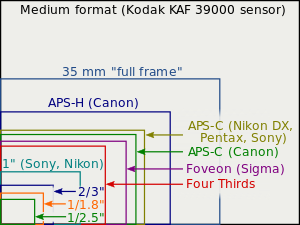 [/img]
He doesn't mean the ratio is significant - the 4/3 system is all sort of specs including a smaller sensor size. Which makes getting long zooms much easier.
Which makes getting long zooms much easier.
but shorter ones harder ?
3/2 isn't a sensor standard it's just an aspect ratio. Bothaps/c and ff are 3/2 but they're not the same size.
Not sure why 4/3 is called 4/3 but I doubt it's because it's 4/3 😯
Wide angle lenses are somewhat harder to build in 4/3 but Oly seem to manage ok actually. Seems that equivalents to 50mm prime are actually hard to make, which is why there are only a few choices and they are much bigger than you'd expect a 50mm prime to be. They have to be made retrofocal apparently.
Not sure why 4/3 is called 4/3 but I doubt it's because it's 4/3
Cos it needed a name I suppose.
Fast lenses seem to be hard to make too (judging by how few are available), which is a shame.
I've got a load of fast c-mount lenses on the way to play with.
Not sure why 4/3 is called 4/3 but I doubt it's because it's 4/3
It's four thirds of an inch, IIRC. I think that's still an equivalence to something rather than an absolute measurement though.
It's four thirds of an inch, IIRC.
yes, measured round the outside of the vacuum tube containing the original vidicon sensor 🙂
Ah, should've done this first.
http://en.wikipedia.org/wiki/Four_Thirds_system
The name of the system stems from the size of the image sensor used in the cameras, which is commonly referred to as a 4/3" type or 4/3 type sensor. The common inch-based sizing system is derived from vacuum image-sensing video camera tubes, which are now obsolete. The imaging area of a Four Thirds sensor is equal to that of a video camera tube of 4/3" diameter.
...
In an interview John Knaur, a Senior Product Manager at Olympus, stated that "The FourThirds refers to both the size of the imager and the aspect ratio of the sensor".[7] He also pointed out the similarities between 4:3 and the standard printing size of 8×10 as well as medium format 6×4.5 and 6×7 cameras, thus explaining Olympus' rationale on choosing 4:3 rather than 3:2.
They should have let the firmware team name it. It would have been called Panther.
Also relates to the aspect ratio of the sensor (or rather has conformed to it). The old 35mm film days the negative size was 36mm x 24mm hence being a ratio of 3x2 or 3/2. Hence this recognised standard being used across the variety of different full frame and smaller sensors (lost count of how many derivatives are floating about now). There is talk of the higher end Canons dropping this aspect and going to a square format to better utilise the light circle.
Hence 4/3 sensor size is 17.3x13 which is a 4x3 ratio or 4/3.
Used to be a popular format of old with 6 x 4.5 medium format cameras (still used in the majority of digital backs).
Never knew about the Video camera Tube background ... interesting.
He also pointed out the similarities between 4:3 and the standard printing size of 8×10 as well as medium format 6×4.5 and 6×7
4/3 = 1.33
6/4.5 = 1.33
7/6 = 1.16
3/2 = 1.5
10/8 = 1.25
so geometrically, full frame is nearer to 4/3 than 6/7 is 🙂
4:3 is slight more square, no? Which means it's using more of the round field of view of the lens I suppose. One of the big deals I think was that the sensor was smaller which means the camera is only using the middle of the field of view which is sharper, has less fall-off, less aberration and so on.
I think that's why all the Oly 4/3 lenses are good.
I think that's why all the Oly 4/3 lenses are good.
Are they? I understand the logic but I'm not sure it applies.
m4/3 lenses need software correction because optically they're poor.
4:3 is slight more square, no?
which only matters if the subject matches the format - and how often is that the case ?
All the reviews I read of the Oly 4/3 lenses (not m43) go on about how good they are. Now I know that Oly have always had a reputation for good glass, but I understood that because it's a system designed purely for digital that helped. I then guessed the above reasons 🙂
Some also has to do with the light path, smaller light circle means less oblique angles at both the element and sensor.
Larger elements are more expensive to manufacture, esp when u start adding flourite etc.
smaller light circle means less oblique angles at both the element and sensor.
only if the lens stays at the same distance - which it doesn't
Larger elements are more expensive to manufacture, esp when u start adding flourite etc
and yet many 4/3rds lenses seem ridiculously expensive ?
Do they? They seem really cheap for the quality actually.