UPDATE: Reviews section refreshed, redesigned, searchable: Go take a look
https://www.independent.co.uk/news/world/asia/china-plane-crash-guangxi-today-b2040259.html
Shocking and tragic. Does anyone know how to tell if this was a MAX version again?
Rip to the crew and passengers.
It was a 737-800NG built in 2015.
The BBC's report is saying that it's a 737-800 - https://www.bbc.co.uk/news/world-asia-china-60819760
Looks like it'll be a difficult one for authorities to get to the crash site given the terrain.
Terrible news
But this isn’t one of the dodgy new max variants. I had to google it
I haven't watched the documentary that's been doing the rounds but not sure the MAX is 'dodgy' now the 'new but not different enough to require type conversion training' MCAS systems are well understood.
https://www.netflix.com/gb/title/81272421
There's cctv and dashcam footage on SM of its last few seconds and it's plunging almost vertically towards the ground.
ADS-B data suggests a vertical descent speed of 31000ft/min (350mph), which matches a nose dive into the mountains.
Certainly the last 90 seconds must have been truly horrifying. Thoughts and prayers to all those involved.
Exactly not the post I needed to read just before I switch to flight mode. While sitting on a 737 😬
Certainly the last 90 seconds must have been truly horrifying. Thoughts and prayers to all those involved
Aye, poor buggers ☹
I think the MAX has been back in the air for a while now, understandably there wasn't much fanfare about it.
Exactly not the post I needed to read
Sorry! You'll be fine!
singletrackworld.com/forum/topic/another-boeing-737-crash/#post-12297060
Yikes - I’m not great with flying at the best of times, in your position I’d be dribbling with fear like a complete lunatic as the pilot gunned the engines….
You’ll be fine.
I haven’t watched the documentary that’s been doing the rounds but not sure the MAX is ‘dodgy’ now the ‘new but not different enough to require type conversion training’ MCAS systems are well understood.
It's certainly worth understanding the reason why Boeing did what it did and company ethos since the merger with McDonnell Douglas. Absolute shit show of a company.
Oh, did you also know that the UK government is buying very heavily from... guess who?
To quote Billy Connolly that hit the ground like a ****ing dart.
Is this a pilot murder/suicide?
Surely even total engines / hydraulics failures wouldn't invoke this attitude?
Before the MAX debacle 737s suffered from rapid uncommanded rudder movement problems. That can easily send a plane into a nosedive. We’ll, that and an anti aircraft missile like Russia used on Malaysian MH12.
I know there's a few aviation geeks on here
any thoughts on wtf is going on here?
https://youtube.com/shorts/2RpxNWIIXWs?si=KiRXgTj8qQneMoxB
That must have been ****ing terrifying!! 😳
If you’ve not watched the Netflix documentary about Boeing then it’s well worth a viewing.
It exposes a completely rotten corporate culture of corner-cutting and subsequent cover up, told by whistle-blowers who’s concerns were ignored. It’s pretty damning.
Downfall: The Case Against Boeing
Been discussed on the other thread. Seems it was a factory replaced panel that used to hold a door, I don't know the details but it sounds like they build them as standard and then "plug" them if the operator doesn't want them. Someone has completely Liz Trussed this one.
I'm going with substandard fastening that has failed where they have replaced the skin. There is history with this, Aloha 243 lost an entire section of the upper fuselage aft of the cockpit back in the late 80s due to fatigue and poor maintenance.
https://en.m.wikipedia.org/wiki/Aloha_Airlines_Flight_243
From what I’ve read so far, the Aloha jet appears to be the panel fixings, one of which seems to have been found…
one of which seems to have been found…
(Sir Michael Caine voice) Yeah, they found it when they blew the bloody doors off. mid flight.
Here’s the most up to date report I could find. The door plug in question is used when the aircraft is reconfigured for capacity reasons, and is really only an American thing.
https://www.nbcnews.com/business/business-news/alaska-air-flight-ntsb-rcna132714
It’s neither an American, nor a Boeing thing. Airbus do the same thing on A321 and A220 aircraft. More seats need more exit doors and more crew. That extra cost/capacity may not be needed but having the capability to have it increases the resale value of the aircraft and enables fleet commonality, TUI, EasyJet and others all run with plug doors.
The Aloha flight has nothing in common with the Alaska flight. The former was a fatigue/corrosion issue which was almost unique to Aloha/Hawaiian operations of many many many rapid pressure cycles a day caused by island hopping.
This is either a design or manufacturing fault.
Here’s the most up to date report I could find. The door plug in question is used when the aircraft is reconfigured for capacity reasons, and is really only an American thing.
It's no excuse though...
I apreciate when buying a car, for example, I can specify a better sound system, 7 speakers rather than 5, or whatever, but I'd expect the chassis and body pannels to be of the same high quality, and the door pannels to be the same.
It seems in the case of the boeing 737, they are made as cheaply as possible, and for the most part, they don't crash because they are very well designed, but that little bit of extra budget/cost doesn't look good for the shareholders/investors, when you have a 'custom' plane blocking out doors, etc.
AIUI, the door plug is because the highest seating capacity versions need an extra door to meet safety requirements. On lower capacity versions, that door is not needed and the seat pitch is different so the exit is blanked off and looks just like a regular seat with a window from the inside.
Based on stuff on Twitter, the fuselage sections and door plugs are built by a subcontractor called Spirit Aerosystems (which is not the same company as Spirit Airlines). Apparently, the door plugs are fitted into the door opening by Spirit before the fuselage sections are transported to the Boeing factory, but they are supposed to be removed and then refitted by Boeing later. In other words, it's Boeings responsibility to fit the door plugs properly.
Based on pictures on Twitter, there are tabs on the door and fuselage to hold the door plug. It looks like the tabs on the door fit inside the tabs on the fuselage, so air pressure holds the door against the fuselage. There are four bolts holding the door plug in place, but these seem to only be locating bolts to ensure that the tabs on the door are properly lined up with the tabs on the fuselage.
It seems likely that either the locating bolts were fitted incorrectly or not fitted at all on that aircraft. Without the bolts, air pressure would still keep the door in place as long as the tabs were lined up properly. However, on previous flights with that aircraft, there had been loss of pressurization warnings so it seems likely that the door plug had moved out of alignment and was leaking, then finally failed.
If all that somewhat speculative description is correct, the basic design is perfectly safe, but it relies on the door plug being fitted correctly. It also relies on the airline investigating warnings about loss of pressurization and not flying the aircraft until the fault is found.
for the most part, they don’t crash because they are very well designed,
I wouldn't go that far.
if i drop my phone off the kitchen table it cracks
this one falls 5km and its pristine!
https://twitter.com/SeanSafyre/status/1744138937239822685?t=a1EakTbigTIUZkPN747K7g&s=19
Good to see Boeing are wanting more exemptions to get these things flying.
Requirement for pilots to make sure they turn off the deicing equipment promptly to avoid damaging the engine nacelle.
"...if all that somewhat speculative description is correct, the basic design is perfectly safe,..."
Well....no. It's not a perfectly safe design. It is completely foreseeable that fasteners can be incorrectly fitted, or not be fitted at all. As it happens in all industries, all the time. (See cockpit window missing due to about 90 incorrect bolts and pilot half out of the plane, for an aero example).
A Perfectly Safe design would recognise that and be done in a way that prevents such a foreseeable **** up.
The design is cost effective maybe (maybe not ! As this failure Will provably cost more to rectify than it saved.
(and I have no problem with a planned door area being plugged to give future flexibility / modual build).
It’s not a perfectly safe design. It is completely foreseeable that fasteners can be incorrectly fitted, or not be fitted at all.
Have you ever seen how wheels are fitted to cars? They're perfectly safe if the wheel nuts are tightened correctly. If the wheel nuts aren't fitted, the wheel falls off. Same goes with any component attached by fasteners - if the fasteners aren't correctly fitted, failure is likely. It's not possible to build aircraft without using fasteners so I don't see what solution you expect to see.
AFAIK, aircraft assembly and maintenance uses a double checklist system where each item is listed and must be checked off when fitted, then checked off again by a second person. In this case, it seems very likely that the problem is with assembly workers not following the correct procedures rather than it being a design fault. No design is safe if the assembly workers don't actually fit the bolts that hold things together.
In this case, it seems very likely that the problem is with assembly workers not following the correct procedures rather than it being a design fault.
We don't know that right now.
There could be a latent error in the design.
There could be a latent error in the procedure.
There could be a supply chain issue that meant the wrong spec parts were used.
The person fitting the bit is the very last barrier in a whole series of things that could lead to an event.
Nice pic of one of the plug doors undergoing inspection. Instead of a release mechanism it has static feet that rest against the airframe aperture. I don’t think the dome head screws actually screw into the airframe - they look like they’re there for adjustment with the locking performed by a false release mechanism. As in all pressurised aircraft doors* the lock actually prevents the door from opening into the cabin - air pressure generally holding it all shut while in flight. It should, in theory, be fail safe mechanically. I wonder if it’s fatigued?
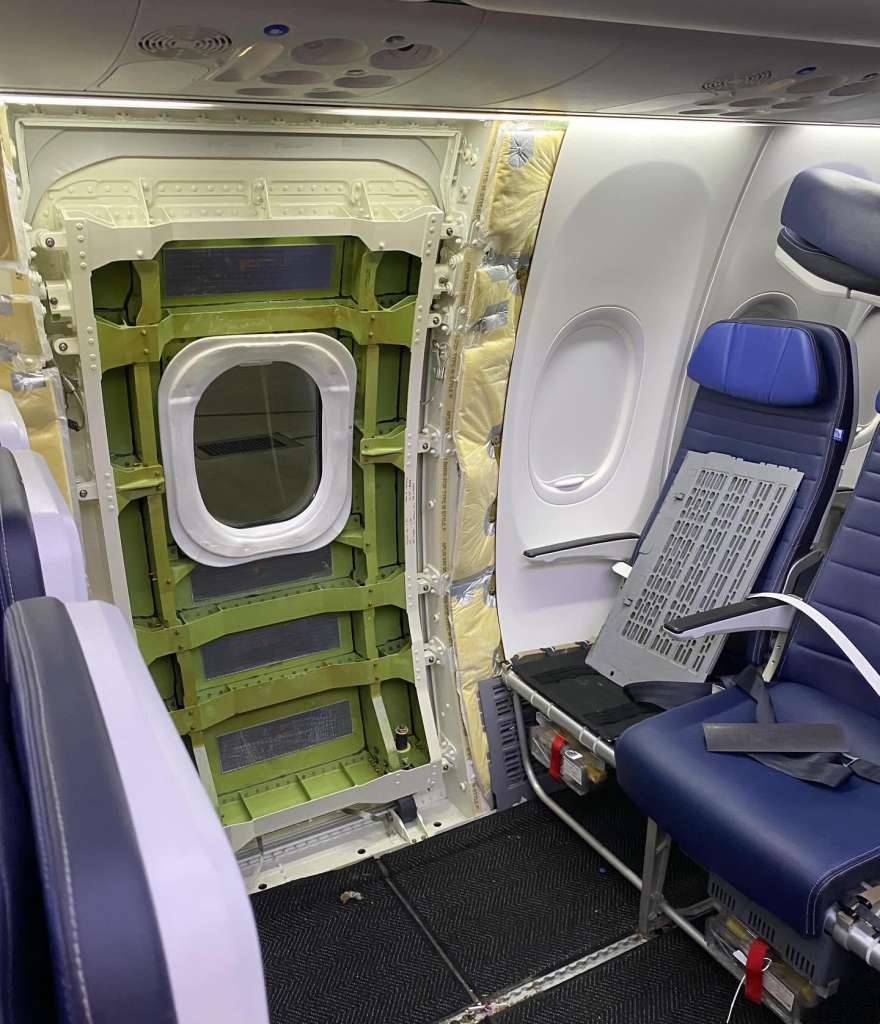
*infamous dc-10 excepted.
Shot of the outside. It looks like the aperture fixings are intact, but there appears to be some sort of hinge mechanism at the base which I assume used to belong to the door. At a guess, the thing failed right in the middle and folded itself in two?
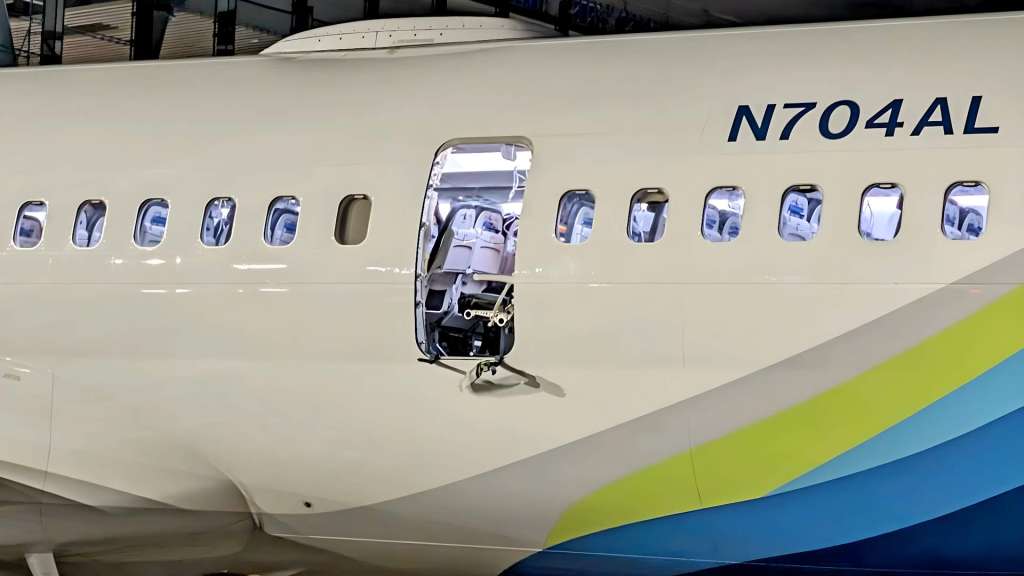
A Perfectly Safe design would recognise that and be done in a way that prevents such a foreseeable **** up.
Tell me you know little to nothing about Human Factors in a safety environment without telling me you know little to nothing about Human Factors in a safety environment...
As I explained above, there are four bolts that hold it in place. Air pressure hold the tabs on the plug against the tabs on the fuselage, the bolts just ensure that the plug is properly located. On that aircraft, they'd had several warnings of loss of pressurization so the problem had been developing over time. The design itself seems to be fundamentally safe, hundreds of these doors have made thousands of flights with this being the first instance of failure, but on a nearly new aircraft. That makes it likely that it was either a manufacturing fault with the door plug or it simply wasn't fitted properly. Because the door plug blew out in one piece and the fuselage seems to be undamaged, I'm guessing that the assembly workers just forgot to fit the locating bolts and it slowly worked loose over time until it blew out.
At a guess, the thing failed right in the middle and folded itself in two?
It wouldn't fail like that if the tabs were intact. For it to fold in the middle, the tabs would have to fail.
If the locating bolts weren't fitted, it could work loose as the airframe flexed until the tabs on the door and fuselage weren't aligned, then it would blow out. That would explain the previous incidents of loss of pressurization.
having been involved in instigations of issues that grounded a fleet of small passenger jets a few years ago, (significant fume incidents of toxic smoke entering cabins causing emergency landings) this is typical head in the sand stuff from an Aerospace company.
The serious issues we were looking at were "resolved" by changes to pilots operating manual, not actually fixing the underlying issues as that would be too costly and cause reputational damage to the manufacturer.
suffice to say my colleagues and I all recorded the tail numbers of all the planes we investigated so we we could keep an eye on things
This Bob had a good look but no doors in my back(garden)yard. Ya all.
A Perfectly Safe design would recognise that and be done in a way that prevents such a foreseeable **** up.
Yes but the problem is a perfectly safe design is pretty much impossible to do. You can minimise the risk but rarely eliminate it entirely hence why you have checklists and doublechecks.
There are some exceptions such as the already mentioned DC-10 which was appalling bad design and so pretty much impossible to routinely do safely.
I was thinking the structure of the door itself failed. It's basically a series of 6 bridges that span the gap between the tabs. From the photo of the one under inspection one of those bridges is interrupted by the window and another takes a route around the window. If it were to bend in two vertically due to fatigue there's nothing to keep it in place in the top or bottom of the aperture - it'd just flow over the tabs and pop out. (The top is basically a movable draft seal and the bottom is where a slide would be mounted in the "real door" scenario).
Its not a flawed design, I can see why you'd do this as it gives leasors great flexibility for the future. Both boeing & airbus have used them for years (A321 iirc has them and I think some of the longer 757s and the 738/9s.)
Anyone sat near these before? I bet they're cold and draughty. If they find the door the I reckon the preliminary NTSB report will be out in days.
Whilst FindMy may find a phone, it won't find a door, the door will have had a decent radar signal, so I imagine the authorities have a very good idea where to look. I wonder whether the two empty seats in an almost full plane were a precaution against a suspected fault. I mean 171/178 seats full and the TWO next to the non-door left empty, what are the chances? As always, PPRUNE has gone to town on this. Son2 starts on A320s next month, and I am not sad about that choice!
thols2
However, on previous flights with that aircraft, there had been loss of pressurization warnings so it seems likely that the door plug had moved out of alignment and was leaking, then finally failed.
Bloody hell, i hadn't read that before now.
I don't know how common it is to get a spurious error light on an aeroplane but multiple instances of a warning regarding pressurisation you would think would result in grounding the plane for investigation at least! 😬
Fantastic tech video describing the operation of the plug doors.
Jeebus, there's a lot of experts in aircraft design, maintenance and failure mechanisms on this thread the last couple of days. It genuinely sounded like Hot Fiat might have some actual knowledge until...
Anyone sat near these before? I bet they’re cold and draughty.
🤣🤣🙄🙄
lol, no, pure armchair expert and bit of an avgeek here. However as a frequent flyer IME aircraft doors leak, not inwards, but outwards causing draughts. There's also insulation gaps so the panels feel cold around door frames and overwing exits. Generally I'll avoid row 1 shorthaul as a result. Longhaul I'll use seatguru and try not to get near any additional doors.

