UPDATE: Reviews section refreshed, redesigned, searchable: Go take a look
thinking of buying a digital slr will be my first slr so need something basic to start and help advice please thanks
I have a D60 though I wished I had bought something more like the d90 as I have quickly 'out grown' it. I didnt have the money at the time!
I have a Nikon D60 too and really like it, although I can understand it has it's limitations. The new version (D5000 I believe) is supposed to be very good indeed.
It isn't technically a DSLR but i bought a Panasonic GF1 and am very happy with it, far more discreet than most DSLRs with most of the advantages.
It isn't technically a DSLR but i bought a Panasonic GF1
in fact it isn't one at all...
sfb did i say it was a DSLR? no thought not, As i said something to consider, why is the OP after a DSLR, do they need a DLSR or are they using the term as a generic for a camera where the user has control and the lenses can be changed?
sfb did i say it was a DSLR? no thought not
you said "technically isn't" which implies "tenuously is"
you said "technically isn't" which implies "tenuously is"
I'm given to pedantry but Jesus H. Christ....
Considering one too (yes DSLR as I fancy being able to change lenses and recapturing the glory days of my old OM10).
Are Olympus e450s any good? Reviews suggest so, though no image stabilisation. Prices seem pretty good too.
GF1 +1.
SFB -1.
Mondays! 🙄
mollski - just about to ebay my Nikon D50 c/w 18-55mm, drop me an email if its any good to you?
I like the Olympus DSLRs.
I've an e330 and an e620.
Both are well made, the e330 especially, and the starter lenses that come with the cameras are pretty good.
The Olympus Pro lenses are superb but quite expansive though.
Go to a shop and play. The Canon vs Nikon debate is the same as the Cavalier(or whatever it's called now) vs Mondeo, both very competent and perfect for your needs.
I prefer Canon for the range of lenses and feel, I have an EOS10d and EOS20d. They are bigger that the [s]toy[/s] entry level EOS1000d etc.
I also believe there are other brands which function well but Canon and Nikon have market share for a reason.
You're not going to go wrong with either.
Ask yourself what you want from the camera + how 'into' photography you're going to get / anticipate getting?
Buying an SLR is all about lenses and the option to change them, so look into the lenses you wish to use (and why) vs the actual make and body model. Choosing the lenses first - which you will keep for a very long time, will answer what type of DSLR you're looking for, which will most likely be a canon or nikon as they have the greatest range of lenses, both with options to use adaptors to run older / other make lenses.
Full frame sensors (in camera body) are far superior to anything else (better end result, better low light performance, sharper images), yet if you're doing sports or fast motion photography you may benefit from a crop sensor with fast auto focus.
A note on lenses: Zoom lenses are pretty poor unless you're going for a constant aperture Canon L or equivalent nikon with high F-Stop - like 2.8. Image stabilisation is a very good investment too. I'd avoid zooms without one or both of these features and get a fixed focal length prime lens instead (cheaper + better end result).
The most important in camera feature is high image quality at Low iso performance. As for ergonomics, try one out in the local shop or hire one for the day (easy if you're in a big city) - very much like bikes in that sense. The camera should feel good in the hand + balanced. Look for how easy it is to change aperture in manual mode, followed by iso, these are the 2 things you will be doing constantly when using the camera.
Hope that helps + you're going to need to get brushed up on photoshop / aperture etc... to make the most if it.
binno has regurgitated "conventional wisdom" (if such a thing exists) and I would take issue with every point except the feel of the camera 🙂
Sony FTW.
They are good and well specced, and amazing value for money.
The most important in camera feature is high image quality at Low iso performance
The most important feature of a camera is the one you value the most. That kind of talk is counter-productive mate.
you're going to need to get brushed up on photoshop / aperture etc...
No, you're not! You can have a great time taking pictures without going near photoshop. Don't prescribe stuff to the OP!
This is ending up like the car forum spoof thread that was linked to the other day.
Are Olympus e450s any good? Reviews suggest so, though no image stabilisation.
I like my Olympus but I have an E620 which I got knock-down cheap, and it does have in-body IS. The small size really is a major plus for me.
Because of the small size I'd have loved a micro 4/3 camera but they were pretty expensive when I looked.
I was in a similar position a few months ago. Went for the Nikon D5000.
Very pleased with it, though I don't know how i would have felt with a Canon. Most reviews came down to Canon vs Nikon with some scope for Sony.
The Live View mode was the sticking point for me. Most enthusiasts insisted that it was pointless for taking 'proper' photos, but when learning, sometimes you just want to point and shoot.
but when learning, sometimes you just want to point and shoot.
and doesn't the eyelevel viewfinder allow you to do exactly that ?
Live view ... pointless for taking 'proper' photos
I confess I do not understand why. Surely if you can see the edges of the frame it doesn't matter if the image is in a little hole on the back or on a little screeen on the back. The only advantage I can see is that when the camera is touching your head head you have a further stabilising factor to reduce wobble.
Is there something I am missing or is it just buyers justifying their preference based investment?
Live view is great when coupled with a flip-out angled screen, because you can hold the camera high above your head or way down low and still be able to frame the shot.
Most reviews came down to Canon vs Nikon with some scope for Sony
Most reviews I read said that they are pretty much all good, and to go for the one that you a) like the look of, b) has a few features you find useful and c) is on special offer 🙂 People get far too hung up over almost imperceptible changes in image quality in certain extreme conditions (read the Sony reviews for an example) but in real terms a newbie buying a £400 camera isn't going to give a flying fig. However, if you can for example get a 300mm equivalent zoom lens for £99 that could be very useful.
The only advantage I can see is that when the camera is touching your head head you have a further stabilising factor to reduce wobble.
at arms' length is bound to be far wobblier, never mind that most EVF screens are not real time but slightly lagging and possibly torn too 🙁
What do you mean by torn?
One advantage, as I understand it, that has not been mentioned for EVF technology is that companies like Canon and Nikon whose specialisation is high quality engineering of shutters and flappy mirrors and the like are going to have to cede a little ground to the electronics folks like Panasonic and Sony as they are now able to build cameras much closer to a purely electronic system.
"torn" means when the subject is moving fast across the field of view it can't keep up so you see discontinuities in the viewfinder image. This cannot happen with a mirror.
If you read the review for the new Sony pseudo-reflex designs on http://www.dpreview.com you'll also see the viewfinder just blanks at high frame rates when it just can't keep up 🙁
As I see it, EVF screens:
Cons:
Struggle to keep up with fast action meaning you may mistime your shot.
Big drain on the battery.
Typically very hard to judge focus on.
Kill your night vision when trying to take shots in the dark.
Generally useless in low light.
Pros:
Useful when looking through the viewfinder is physically awkward (camera over your head or on the ground)
Usually come with video ability.
[i]May[/i] not black out when taking the picture.
Big drain on the battery.
good point! I never turn my D300 off and it'll last a week/1000+ shots before needing to be charged. Most of the EVF cameras I've read about manage about 300 exposures before the battery is flat 🙁 [ie typically mid ride for me]
I find live view pretty useful when taking considered landscapes on a tripod. The live histogram and 100% coverage (something my viewfinder doesn't have) are pretty handy. Horses for courses.
Dudie: yep that would fit my Pros/Cons. Landscape isn't going anywhere, doesn't require fine focus and is usually taken in daylight - so works well on a LiveView/EVF.
100% coverage and Live Histogram are definitely Pros I forgot.
Full frame sensors (in camera body) are far superior to anything else
And cameras with such things cost loads of money. £1700 for the Nikon D700 body only, and the Canon Eos 5D Mk2 body only. And upwards for higher spec bodies.
Just set yourself a budget, allowing for cam body, lens, bag, lens filter and a memory card. 4-8GB should be fine unless you want to take thousands of pics before you upload to a computer.
For example less than £500 gets you this decent starter bundle:
http://www.jessops.com/online.store/products/77481/show.html
Try a couple out, see which one feels the most comfortable and intuitive to use. Try not to pay too much attention to camera shop staff; they might be keen amateurs, but they're sales assistants, not pro photographers. They'll have little more experience of using all the cams than you do. Go with your own instincts and your own budget Don't let them 'sell up' a more expensive cam than you really need.
Basically, this, really:
Most reviews I read said that they are pretty much all good, and to go for the one that you a) like the look of, b) has a few features you find useful and c) is on special offer People get far too hung up over almost imperceptible changes in image quality in certain extreme conditions (read the Sony reviews for an example) but in real terms a newbie buying a £400 camera isn't going to give a flying fig. However, if you can for example get a 300mm equivalent zoom lens for £99 that could be very useful.
Lens' are the most important factor when buying an SLR.
If you are going to get teh most out of it, then you will want/need to put a few lens' together over time to cover everything you want to use it for. If your not flush then Secondhand prices/availability is important - Canon/Nikon is by far the best option.
Personally Canon i think have by far the best lens'/selection available.
Probably the most important thing you can have when you've bought your SLR is training. If you don't and you don't know what your doing - your very unlikely to really see any benefit of an SLR over a bridge/compact.
The Training sold/offered through Jessops is very good (it's not actually Jessops) and I should know as I trained some of them (but am nothing to do with the company and have no affiliation to them)
Oh and lastly - my advice get a basic body (450D/500D/550D) and a lens around the 18-135 mark so it covers a good range comparible to most compacts if that's what your used to. Canon 17-85 or 15-85 isn't a bad place to start. If your using it for sport make sure if possible it's a USM lens (which means fast acurate focusing)
Personally Canon I think have by far the best lens'/selection available.
Canon and Nikon have comparable extensive lens selections. More than other brands. They do tend to cost more than other brands though, and at the pro end of the ranges, it could be argued their lenses are better than others. But at the budget end, most lenses are pretty much similar really.
Buy some kit that allows you to take pics. Don't worry about the ultimate in quality etc until the level of your pics demands 'upgrades'. Budget stuff will still deliver very good results if your know what yer doing.
I'm waiting for a sub-£1000 smallish Nikon DSLR with full-frame sensor. Hurry up Nikon. 🙁
got a nikon d50 with the fabulous nikkor 18-70 lense, takes great pictures despite me. Some of my pics are used in graphics stock for brochures etc.
99% of people really don't need full frame, it's a bit of a status symbol - to me it's like having to have XO shifters over X.9 shifters, just about no real practical reason to have it, it's just "bling"
And before anyone says anything, i know technically in certain situations Full frame is "technically" better image quality, but I'd challenge anyone to actually spot the difference.
I'd agree that anyone buying a kit lens' will not notice any difference between brands - but if they knew enough, they'd not be using a very basic kit lens. It's more about upgradeability (not sure that's a word) your buying into a system, not just a one off purchase.
99% of people really don't need full frame, it's a bit of a status symbol - to me it's like having to have XO shifters over X.9 shifters, just about no real practical reason to have it, it's just "bling"And before anyone says anything, i know technically in certain situations Full frame is "technically" better image quality, but I'd challenge anyone to actually spot the difference.
Nothing to do with 'status'. [url= http://en.wikipedia.org/wiki/Full-frame_digital_SLR ]Full frame = superior picture quality.[/url] As well as the ability to use my old Nikkor manual focus lenses. So for me, a full frame DSLR makes sense, and the absence of an 'affordable' FF sensor cam is why I've not gone digital yet. Plus a D700 is still a bit of a lump to schlepp about with. I'd ideally like a DFM2 really!
you can still use the old manual focus lenses, I use an old nikkor telephoto on my d50? Whats the problem?
So why does full frame = superior quality? Please feel free to enlighten me! 😉
I suspect "full frame lust" is as much about wide-angles and shallow depth of field as it is absolute quality.
But it is an illusory concept anyway, since it is only really "full frame" in the context of one particular historical film format (i.e. 35mm).
Personally I'm happy enough with the extra reach and smaller, lighter lenses of APS-C.
So why does full frame = superior quality?
I believe it is to do with the resolution of the lens and the fact that larger sensors suffer less noise. So in theory "full-frame" is sharper and less noisy.
Well said GrahamS - couldn't agree more (although you can pretty much get as wide with something like a 10-22 on a crop sensor.
You've gotta love how we all like to hijack a sensible thread! Appologies to the OP (who probably gave up on the thread some time ago!), but if you get into this photography lark - you'll come to realise!
Resolution of the lens?
The only reason for better noise control in low light is that pixels on a full frame camera are less tightly packed together and therefore are able to gather more light! Not really anything to do with the lens.
Remember that you can use high end lens' on low end cameras, where any fall off in edge sharpness will often be irrelevant as it doesn't cover the smaller sensor
Some good explanations of the pros and cons of sensor size here:
http://www.cambridgeincolour.com/tutorials/digital-camera-sensor-size.htm
{double post removed}
Resolution of the lens?
Yep, smaller sensor means the lens has to make a smaller focal image, which means you hit the diffraction limits of the lens sooner.
The only reason for better noise control in low light is that pixels on a full frame camera are less tightly packed together and therefore are able to gather more light!
Yep for two sensors that offer the same pixel resolution, the larger sensor will be able to use larger photosites which can gather more light.
Not really anything to
do with the lens.
Didn't meant to imply it was.
Am I right in thinking that a full frame camera would mean that a 100mm focal length lens would be equivalent to a 100mm lens on a 35mm camera? So this would make it much more expensive to get say 300mm worth of zoom on a full frame camera? Not to mention heavier and larger?
On the subject of Nikon/Canon vs other cameras - I've noticed with my Olympus that there is less choice in new and second hand lens. There are basically three or four 'budget' options. They are pretty good options mind, but that's really it. However on the plus side, the lenses themselves are wonderfully small and light. I'm amazed when I see the size of other people's (fnarr).
[img] 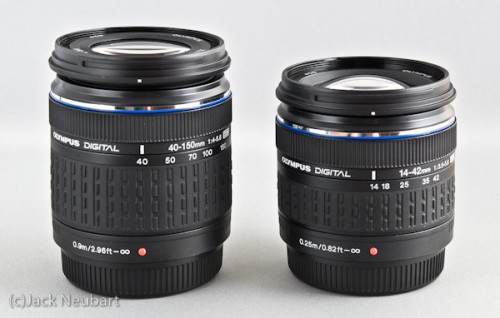 [/img]
40-150mm (equivalent to 80-300mm) on the left, standard kit 14-42 on the right (equiv 28-84mm)
The full review is [url= http://www.photocrati.com/olympus-e-620-four-thirds-dslr-two-lens-kit-review/ ]here[/url]. Bear in mind I paid £300 for the camera + 14-42 and £99 for the 40-150, but I think I was lucky. I do however think that non-Canon or Nikon are discounted far more often, since everyone wants those two brands.

