UPDATE: Reviews section refreshed, redesigned, searchable: Go take a look
Been reading up on this as I was interested in what they did. From what I can gather the batteries only power the movement of the foils under the water and the grinders pump up the hydraulics for anything above the waterline including the bits that move the foils in and out of the water, anything that moves the sails etc.
link don't work
When the bow rises, the top of the rig is pushing hard towards the mast – which now is laid back some – so creating an upward movement it seems.
But the wind is still horizontal, so I don't think the angle of the mast matters.
Go past a point of no return, add in hull lift and foils now at an angle, and that thing will just take off…
Agreed.
Why would the rudder foil hold the stern down….the foils provide lift
the likes of I14s and 18ft skiffs use a t foil on the rudder to keep the bow down going upwind and bow up going downwind. I would guess that the elevator on the AC75 does a similar thing, but also controls the ride height like the elevator on a plane controls pitch.
Above link from dannybgoode should be: Link
Edit: but note that the article is from the previous event with the catamarans - rules may have changed
Here's one I found with quick Google on the Harken approach for AC75s: https://yachtracing.life/americas-cup-living-life-at-80-rpm/
I'm sure there was something with a bit more detail I read a while back.
T foils do all kinds of things depending on the boat, the application, and the situation. A million miles away from the ACs, but here's a brief rundown of what it does to a restricted development (Box rule, defined max sail area) dinghy class: https://www.national12.org/forum/index.php?topic=13085.0
I've experienced several moments of complete cognitive dissonance watching the 75s going through a gybe. All of the crew evolutions and foil changes scream 'gybe', but it's all done close hauled or near as damnit because of the apparent. And no spin or gennaker gybe involved either. It's just so otherwordly.
I’ve experienced several moments of complete cognitive dissonance watching the 75s going through a gybe.
Agreed, they just don't work on the same level of physics as a Laser....
Good bit here about T foil cavitation on American Magic during that incident: https://www.tvnz.co.nz/one-news/sport/other/analysis-peter-lester-breaks-down-moment-and-aftermath-american-magics-capsize?auto=6223626287001
That's some big hole.
Not just the hole they need to worry about. Looking at the photos there are cracks running meters in every direction around the hole. I think Hutch said that the electrics are stuffed, the canting system is stuffed and all needs replacing. They hydraulic system appears to be ok though and they have spares of everything in the shed. Its going to be a long few days for them. All the time the others can look at their data and get better again.
Apparently, they are going to chop their other boat up to repair the hull.
It will probably be quicker as they probably need to remove about 25% of the hull to fix the hole and all the associated damage.
The hulls may be slightly different shape but it will be close enough to allow then to get into the water in a reasonable timeframe - massive job though.
The hulls may be slightly different shape but it will be close enough to allow then to get into the water in a reasonable timeframe
😆
America will probably come back and win it now, hmm.
anyone know what happens if prada and ineos finish on a score of 6 to 6 each ?
Who goes straight into final of two Pravda cup ?
Cumulative times or something I guess..
I'd expect a tie-break race @jerome, however race schedule now taken down from the website. I wonder if the teams will forfeit races against US to keep the playing field level and give them some time? There are all sorts of things to unfold before we're at a tie-break stage I guess, but I'm pretty sure prospective challengers will be wanting to get as much racing in as possible before they line up against the kiwis.
I've got an image in my head of them taking a chunk out of one side of the old boat and it ending up like asymmetric wave boards from windsurfing. Carving turns to port and sharp ones to starboard? 🙂
Although I assume they're going to "cut and shut" a full width section in where the hole is.
It's not like there's not precedent for sawing hulls in half and adding/removing/changing stretches of hull. A number of the old IOR boats had this done to them and I'm sure others since.
.
There's a part of me that thinks that if the Americans can't complete the round robins then they should be booted out - it would be very unfair on Ineos or the Italians if the US sat out the remaining round robin races, but managed to get repaired and then sailed and won the Prada semi-final, and then went on to win the Prada final (and on into the cup proper).
We will see I guess . Frustrating for all . America looked favourite of the three of the boats in those breezes, so would have been a great set of road robins. I need to find a video of how these boats do 30knt plus in 5-10 not winds. I race on a boat that does 5-10 knots in 30 knots of wind, and that feels fast..
asymmetric wave boards from windsurfing
yeah..there's a reason you don't see those anymore 🙂
however race schedule now taken down from the website.
Well, basically, AM have no chance of winning the round robins, so they are going to have to sail in the semi-finals starting next Friday. Therefore they will be aiming to spend all that time fixing the boat as best they can. I guess the organizers are waiting to confirm that before they release an updated schedule. There will only be two races if AM don't show up.
I race on a boat that does 5-10 knots in 30 knots of wind, and that feels fast.
you need to change "boats"..I can do 20+kts on my foiling windsurfer in 10-12kts...:-)
what happens if Prada and INEOS finish on a score of 6 to 6 each
Count back, the Italians go through assuming they win the last race...So we need to beat them once more in the next two races to go through without countback.
If it’s a tie, the winner of the last race between the 2 goes through.
Ineos win 1 of last 2 to progress to final.
LR need to win both.
I race on a boat that does 5-10 knots in 30 knots of wind, and that feels fast.
Been at 20-25knts planning in a couple of different designed boats both about 30ft long, that felt very fast indeed and very very wet, and yet nothing in comparison to these boats.
unfair on Ineos or the Italians
I think that if the US boat gets back in the water and wins, they will have proved themselves as a team, boat builders and sailors.
Seems like it.
Anyway, if Alex can do it by headtorch in the middle of the Atlantic, this huge shore crew (and I suspect a lot of volunteer helpers & goodwill) will have that boat back up and sailing one way or another.
There’s a part of me that thinks that if the Americans can’t complete the round robins then they should be booted out
I don't think crashing and nearly sinking your boat gives any competitive benefit. If they can come back from this and win the Cup, the other teams would only have themselves to blame.
but what if Prada or Ineos destroy their boat in the last race of the round robins and don't have time to rebuild it, and US go through without having completed the qualifying rounds?
I don’t think crashing and nearly sinking your boat
maybe they should learn to sail without doing that? It's not good being quick if you can't finish....
yeah..there’s a reason you don’t see those anymore 🙂
I had three. Definite one trick ponies. But on the right day they did work. My Tinkler tails were both better all round. Once I got all that out of my system a good conventional board was better. Because by then we’d learned how to shape windsurfers properly, oh, and the rigs had improved too.
My Tinkler tails
jeez...haven't heard that for years....you must be as old as me...I had a Mistral Challenge Flex 🙂 (I think it might still be in my attic)
maybe they should learn to sail without doing that?
I think there was a fair dose of bad luck with the wind there. I'm sure all the other teams are just glad it wasn't them that got unlucky.
but what if Prada or Ineos destroy their boat in the last race of the round robins and don’t have time to rebuild it,
They should probably include "not crashing and sinking" in their race strategy then.
They should probably include “not crashing and sinking” in their race strategy then.
why? if US can crash and sink and still be allowed to compete, why shouldn't Italy or UK? you can't have one rule for one team and another for the rest!
I think there was a fair dose of bad luck with the wind there
also a fair amount of bad decision making..you could hear the tactician saying "this (the tack into a gybe) is going to be a very hard manoeuvre", "the gybe the other way would be safer"...and the helm overruled him
If there were a dozen competitors then the US challenge would be sunk (excuse the pun!). As there are only three, they have devised a way to maximise the TV revenue stream/time exposed for sponsors.
RYA doctrine for Youth Squad / L4 back in the day was 'To finish first, first finish' - very appropriate bearing in mind how fine the cutting edge is with these things. The margins for error are a lot skinnier than, say, a Laser 3.
I’ve got an image in my head of them taking a chunk out of one side of the old boat and it ending up like asymmetric wave boards from windsurfing.
My (comprehensive) school used to get sailing boats from wherever it could to compete in the Surrey Schools against very well-funded teams from the local private schools. One wooden Enterprise we rescued from a field, Mr Incredible, was astonishingly competitive on Olympic courses. This may or may not have been due to it being about 3/4" narrower on one side at one of the key class measurement points. Until we found that out, I thought I'd been finally getting half good...
I expect there has been quite a lot of discussion in all three teams about the best way to cope with gusts during a bear-away. The focus in manoeuvres has been to keep the boat foiling, but in the stronger winds they can afford to lose a bit of power to keep control. I think Terry Hutchinson said that the traveller was right out, which I took to mean it was directly below the boom so minimising the mainsail twist. If it had been further inboard, with the sheet eased more it would have taken some of the power out (according to my 30 years out date dinghy sailing knowledge!).
jeez…haven’t heard that for years….you must be as old as me…I had a Mistral Challenge Flex 🙂 (I think it might still be in my attic)
Yep, I had a Challenge Flex with both tails. I still dont think it was as flexible as my old Mistral Tarifa. Now that really did bend in the corners.
My custom Tinkler was a Lodey I smashed the tail off in the Canaries and had a new flexing tail fitted by Alan Neighbour. Flex was controlled by wedging different sized bits of rubber from car exhaust hangers in there.
i used to race Larks at Uni. We had a couple of boats which were somewhat amended from the original measurement and were very fast in light winds. Half the fleet infact had big holes in them from time to time, bumper cars have less collisions than team racing boats.
If it had been further inboard, with the sheet eased more it would have taken some of the power out
I think that in these boats, during the bear away, easing the main to create twist, when your apparent wind is not on the nose, powers the rig up more, until the apparent wind has got back off the beam and in the right place, unless you really let it go, which these boats don't/cant.
Yep, I had a Challenge Flex with both tails. I still dont think it was as flexible as my old Mistral Tarifa
Yep I had both tails..not sure I ever used the long one..maybe once. Also had a Tarifa bought from my sister when she moved onto a hookipa (or diamond head)
maybe they should learn to sail without doing that?
Aye, because no-one else has had this happen.
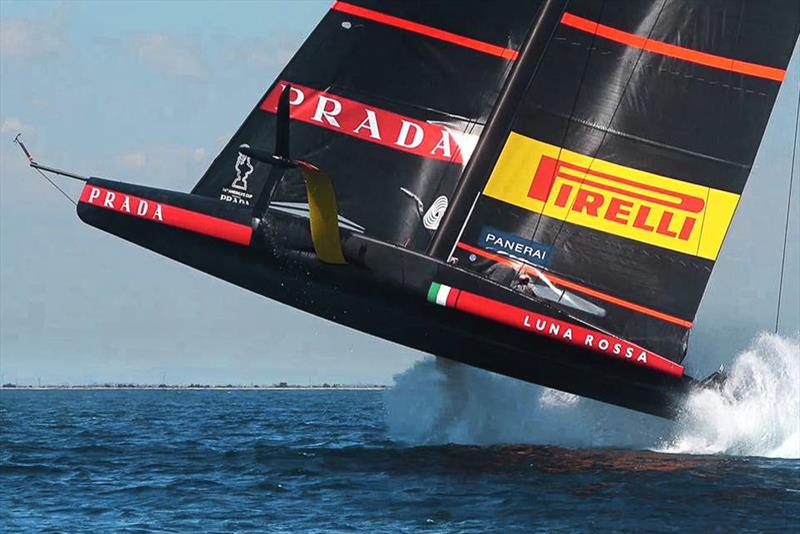
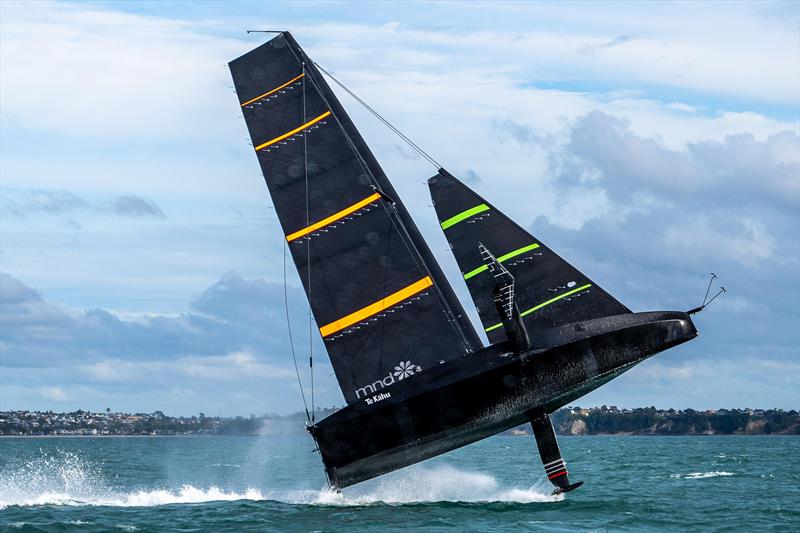

I think Terry Hutchinson said that the traveller was right out, which I took to mean it was directly below the boom so minimising the mainsail twist. If it had been further inboard, with the sheet eased more it would have taken some of the power out (according to my 30 years out date dinghy sailing knowledge!).
American Magic also have backstay that interferes with the sail. There is a lot of chat on SailingAnarchy about the fact that they rushed into the turn and the backstay was not eased enough as well - so keeping the top of the sail hauled in hard. They are also discussing that to ease the sail slows the boat down and *increases* loads as you go around the corner, whereas keeping the thing sheeted in leads to fast acceleration and a reduction in loads. It seems fast, level and low is more consistent but with a narrower margin for (bigger) crashy....
This is also combined with a mother of all gusts and a desire to not take the foot of the gas...I am sure i had the same gust issue in a Tempest in 1991 leading to a broach and concussed me after headbutting the keel having been on the wire a moment earlier....
The physics of these things is totally different from any other dinghy and boat I can think of - that said it seems the dinghy sailors are coming to the fore driving them, so clearly some parallel or other.
There is a quote I like about this crash - "it was like an airplane loosing it's tail in flight...." and perhaps thinking more as a pilot than a sailor is what is needed.
Interesting photos, Matt. Looking at them, I don't see much difference between how the other boats flew and how Patriot did, but they didn't hole on impact, and (I don't know) did they capsize? Maybe my earlier hypothesis was right, that the backstay wasn't the primary cause of the initial airtime, but after they landed and slowed it became significant - having the power wasn't enough to get them foiling before they capsized. Maybe the hole was scooping up water and preventing them accelerating?
to ease the sail slows the boat down and *increases* loads as you go around the corner
True - downwind you want to be going as fast as possible when gybing as loads on the rig are lower, but they're sailing faster than the wind anyway so I'd have to think about this.
whereas keeping the thing sheeted in leads to fast acceleration and a reduction in loads.
Well I dare you try this in a blow. If you try to bear away without easing the main you stand a very good chance of the the rudder losing grip.... especially one with a high aspect foil section. If they lost grip (or had cavitation) then they would lose the ability to control the back of the boat.
The running backstay's job is to control the forestay tension - not to adjust the power in the main.... they have other systems for controlling the depth of the sail within the sail itself. So I'm not sure of the importance of the runner not being released other than holding the boom inboard - but then the boom doesn't go very far outboard on these things anyway. If you want to dump power from the main quickly you dump the vang (or whatever system they use to controll the leach tension) - open the upper leach and the power leaves the top of the sail.
If you look at your pictures above, in the top two the leeward runner is very eased and yet the boat has taken off - I don't even think either were at a mark roundings/bear away either which may point to it being more of a rudder cavitation issue.
but they didn’t hole on impact
Indeed, but all the boats are built differently - the only thing that's the same is the foil arm system which is delivered/installed as a standard hydraulic/framework/arms package.
Other than that they can do what they want within the measurement rules.
So there's a decent chance that exactly the same crash might not have holed the other boats.

