I've been reading up on the issue that came to light way back in 2004 re QR wheels being loosened by disc braking forces. there was a lot of debate and it seemed that one accepted solution was to put the mounts on the front of the RHS fork leg. just wondered why this solution was generally not taken up?.even today's offerings are the same way round ? I presume they modified the dropout orientation to increase safety and not force people to have to buy new wheels/hubs .
If anyone can also help me to understand why the forces would be different between the right and left legs as well as front and back positioning it would be very helpful and perhaps soothe my throbbing brainache! Cheers
why were disc caliper mounts put on the left fork leg and still are even on QR?
Because the disc rotor is on the left side of the hub
HTH
Easy enough to swap the hub around though...remove from fork, spin it 180 so disc is on drive side and put back in...
Whoosh!
I seem to remember a review of disc brake road bikes on the gadget show one time. They complained that the front brake wasn't very good on one of them.
Could have been because the front wheel was in back to front do the rotor was the wrong side for the caliper.
Easy enough to swap the hub around though…remove from fork, spin it 180 so disc is on drive side and put back in…
No that wouldn't work, tyre's have a particular direction of rotation and that would put it backwards
No that wouldn’t work, tyre’s have a particular direction of rotation and that would put it backwards
Not if you also put it back in upside-down
Because then they're the same side front and rear.
Oops re-read your post and I'm talking nonsense - ignore the above.
Opportunity to create needless new hub standards so it "looks right".
Oh - caster effect.
Weight on on the underside/rear of the fork leg makes steering more stable.
Weight on the top/front of the fork leg makes steering less stable.
Also - caliper bolts. If mounted on the front, you're basically trying to rip the caliper off every time you brake. Mounted on the rear, you're "pushing" the caliper onto its mount (assuming Post Mount/Flat Mount of course).
We really need a treadmill....
OK .I forgot the wheel could just be turned round but the main question is still valid ..if a RHS forward caliper mount makes for a safer QR setup why is it still produced on the left?
The real answer? Looks.
And why are the forces different on RHS ?
Wasn't always that way...
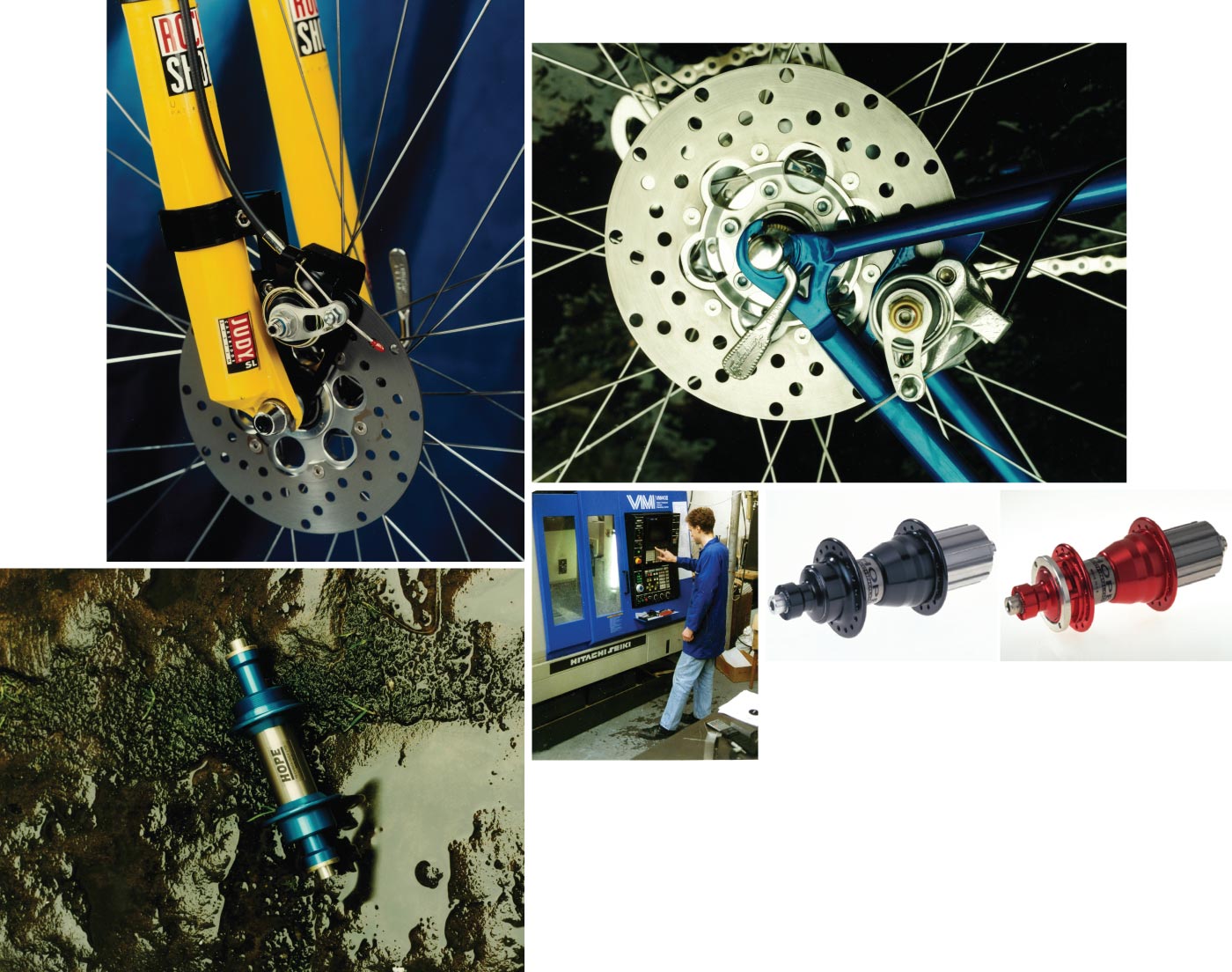
http://www.ne.jp/asahi/julesandjames/home/disk_and_quick_release /">article if interested
There was also a twin disc Bomber in '96, but both mounts were on the rear of the leg.
Caster effect
Balances out the weight of the chainset being on the right hand side, otherwise you'd be turning gently to the right the whole time.
On the back, the left hand side looks neater, so may as well have them both on the same side
You know you can put the QR in the other way round right?
Druid are you having a laugh re the castor effect?
200gm of caliper?
And tension on bolts...have you any idea how strong steel is? (obvs not)
Good trolling
On the back, the left hand side looks neater, so may as well have them both on the same side
Ah but if you ran your derailleur upside down you could run your drive train as a left hand drive meaning you could have your right hand caliper.
Altering the angle of the dropout slot deals with the issue of wheel ejecting forces in the same way as running the caliper in front of the RH fork leg, and looks sooooo much better.
As far as I know this was pretty much universally adopted a few years back, and the scarcity of QR and disc combinations these days means there’s little to worry about.
Ah but if you ran your derailleur upside down you could run your drive train as a left hand drive meaning you could have your right hand caliper.
You'd get fewer rock strikes that way too
Cotic have always been concerned about this and therefore used to mount the caliper in front of the drop out. It's also the reason why they were early adopters of the thru axle
<div class="bbp-reply-author">squirrelking
<div class="bbp-author-role">
<div class="">Member</div>
</div>
</div>
<div class="bbp-reply-content">On the back, the left hand side looks neater, so may as well have them both on the same side
</div>
<div class="bbp-reply-content">
Ah but if you ran your derailleur upside down you could run your drive train as a left hand drive meaning you could have your right hand caliper.
</div>
Wouldn't that mean you would go backwards when you pedal though?
Wouldn’t that mean you would go backwards when you pedal though?
Only if you forget to turn your chainring round.
It can also give you toe-overlap issues if you have the mount on the right

I've got the Cotic road rat with the rotor on the front. It's ugly.
Was the QR/Disc thing a real problem for most people. It's definitely not an optimal design but never something I'm personally aware of someone having an issue with.
I suspect:
1: Industry not wanting to admit there is a problem, by changing the design it potentially opens up litigation claims for accidents as it implies the previous design was poor.
2: Aesthetics.
Well...I found a fascinating discussion re the forces involved if anyone is interested further..also includes why some people put the caliper on the front of the RH fork rather than left to improve safety with QR wheels. The front position reduces likelihood of wheel ejection whilst the change in fork leg is to do with the practicalities of fitting the caliper itself.Here
Was the QR/Disc thing a real problem for most people.
Nope, Reading between the lines of the rambling old toss on t'interwebz, the odd mechanically inept/negligent type managed to spanner themselves, one of which eventually engaged in some indeterminate legal action... And settled out of court.
Didn't someone else on here solve this very same problem by putting their forks in upside down 🤔
Motorbikes always had the calliper in the front til the mid to late 70s.
cynic-al
And tension on bolts…have you any idea how strong steel is? (obvs not)
Threads in magnesium lowers are less strong though
QRs coming loose were an american litigation thing.
anyway, why not just swap the qr around? problem solved.
Was the QR/Disc thing a real problem for most people.
IIRC, it was never a problem for good quality QRs that were properly fastened. The first problem was that many beginners didn't know how to fasten a QR, so they would wingnut it up. Also, a lot of cheap skewers had exposed cams that would get full of dirt and rubbish and corrode, so they wouldn't clamp properly.
The steel Shimano skewers were the benchmark, I don't think anyone ever had a problem with them. Another problem was that people would buy silly lightweight titanium skewers to save a few grams or to pimp out their bikes with expensive anodized stuff. Those skewers often didn't clamp as firmly as the cheap Shimano ones.
Apparently, people also ground down the lips on the dropouts to make it easier to change wheels in a hurry (I've never seen this, but there were rumours about it). I can understand someone racing at the world cup level wanting to save five seconds on fixing a flat tyre, but anyone who did this because unscrewing a skewer a few turns to clear the dropout was too much trouble really deserved to lose their teeth.
Those things didn't matter so much with rim brakes because the braking force wasn't trying to rip the wheel out of the dropout, but it was potentially problematic with disk brakes. Hence the general switch to through axles.
incompetent / not normal person ....def had to wind up front QR on my old disk braked cx/drop bar hybrid a lot tighter than i'd ever ever done before to avoid a tinkling noise after hard braking...swopped the QR for a DT Swiss ratchet thing for piece of mind
the logic for the cotic road rat right hand caliper is still on their website need to scroll down a couple of articles
https://www.cotic.co.uk/geek/page/archive
personally i like Cannondale's solution no debate about which fork to put the caliper on...
whatever happened to back pedal brakes? as in why no technical advances? would love to see some aero coaster back pedalling in the peloton
Early disc brakes, such as the, Sachs Power Disc were on the leftside but in front instead of behind the dropout.
Apparently, people also ground down the lips on the dropouts to make it easier to change wheels in a hurry (I’ve never seen this, but there were rumours about it).
also to make it easy to put a bike in a front wheel off roof rack ?
"Apparently, people also ground down the lips on the dropouts to make it easier to change wheels in a hurry"
Relevant section of the PDF linked to above:
It is essential that the equipment used in competition meets the prevailing quality and safety standards for bicycles. Mechanics and riders should also be aware of the ISO 4210 Standard on safety that applies to cycling equipment. They should refer to this Standard before modifying or adjusting any bicycle component. From 2019, all the frames and forks submitted to the UCI for approval will have to join a certification confirming the compliance with the ISO 4210 security norm. The certification template is available in the section « Equipment » of the UCI website.
Modifying equipment used in competition in relation to products supplied by the manufacturer is prohibited for obvious safety reasons. Whether it is a matter of modifying the length of the saddle, adapting approved wheels, filing off fork drop-out safety lugs or meeting the 3:1 rule by adding tape to handlebars. No modification of equipment that is not conducted by the manufacturer is authorised by the UCI without prior approval.
Strange this is that doping and a bunch of other things are also prohibited, but people still do it if they think they can get away with it.