In my continuing quest to understand the effect of head angle on handling I've been looking at what happens when you add in a larger wheel.
Initially I thought the reason you wanted a slacker HA for going downhill was so that you didn't go OTB when it got steep. If that were the case then it should apply equally to 26 and 29 inch wheels. Also the difference is only a couple of degrees which is pretty small compared with the difference in steepness of various parts of a trail.
Now, I'm tending to think that it has more to do with keeping the front wheel on line as you hit bumps. The caster effect of a slacker HA achieves this, but so does a larger wheel. Hence a steeper HA is required on a 29er, otherwise it never turns.
I notice that GaryLake mentioned taking the Orange Gyro (with its 69 degree HA) down the FOD downhill course. So that would suggest that a 69 degree 29er is as capable as a slacker 26" bike downhill. But then we have the Five29; a 29er with a 66 degree HA, which kind of ruins my theory (unless it rides like a 64 degree 26" bike or something).
Usually shorter travel, so less steepening of the head angle at full travel requires less slackening to compensate.
Blimey, is it really as simple as that 😳
Cheers,
Andy
🙄 No it's not.
"if you don't know, don't make it up"
My (poor) understanding is that it also brings the front wheel in tighter, thereby reducing the wheelbase to quicken the handling.
What happens if you put 26" wheels on a 29er ?
What happens if you put 26" wheels on a 29er ?
Your pedals drag on the floor and the wheels implode
there mostly for mincing round on 😉
To keep trail the same going from a 26" and a 29" (with equal travel, ie a 5 26 and 29) you'd steepen things up a couple of degrees. 29ers behave a little differently for the same trail figure as a 26", less floppy-steering (tricky to explain the reason) and can feel naturally a bit more stable at speed (easier - std big-wheel marketing rule). So the idea of trying to make a 29 ride like a 26 seems odd, there's just traits that may or may not work.
66 on a 29er should feel very stable, but less floppy into corners or when climbing than a similarly-slack / stable feeling 26". ie, Orange aren't stupid )
The greater gyroscopic effect and longer thinner contact patch (more pneumatic trail) of a 29" wheel requires less trail for equivalent steering response, all else being equal.
Nah, not really that simple, nothing ever is, but it makes sense to me 🙂
I reckon on 0.5deg per inch wheelsize difference. Aka 1.5deg steeper on 29ers to maintain similar handling traits.
But you can then throw in more fork rake to quicken things a bit and wahey...
That 66deg 29er will be a riot.
It's so you can trim yer beard just by leaning a little more forward..
"Like this..."
But then (race) BMX's have tiny wheels and steep head angles...
Because 29 inch bikes are pretty much all for xc type quick steering riding, which Steeper head angles traditionally favour. If there were such a thing as 29 inch downhill bikes then I guess they'd be slacker too?
I'm with coatesy on this one... if you look at the vast majority of bikes, the head angles for a given travel are very similar: the best way to demonstrate this is looking at a hardtail which can accommodate a wide range of forks~ say it is 66 deg at 160mm travel, it will be 69 deg at 100mm of travel; beyond all the smoke and mirrors, this means that with a rigid fork (or at bottom out) it will be around the traditional 71 deg that all bikes were once upon a time.
But then (race) BMX's have tiny wheels and steep head angles...
And BMX tracks are much smoother than MTB trails!
Isn't the reduced steering flop from having a less slack head angle as the larger wheel radius increases the trail?
.. if you look at the vast majority of bikes, the head angles for a given travel are very similar
But it really isn't like that at all.
The greater gyroscopic effect and longer thinner contact patch (more pneumatic trail) of a 29" wheel requires less trail for equivalent steering response, all else being equal.
I hadn't considered pneumatic trail - that makes a lot of sense as the contact patch is of finite size and isn't just a point. So the lower your tyre pressure for a given rider weight, the more the actual trail is increased.
FFS! a slacker head angle is simply more stable in a straight line at speed the downside is that it doesn't turn quite so easily.
29ers could be built with the same head angles as proper mtbs if only someone bothered to adjust the offset on 29er forks when they designed them.. (ran out of room on their fag packet I'd imagine)
BMXs (not just race) are generally ridden by people who actually spend time developing an iota of skill so even hitting huge jumps at 40mph the quick steering and reduced stability doesn't phase them.
"if you don't know, don't make it up"
e's making it up! You're making it up!
It's "if you don't know, make it up". 🙂
So, if the 26 and 29 have the same head angle the steering will not feel the same? What's all this custom fork offset stuff mean in relation to 29ers?
Brant - Why does more rake quicken things up a bit? Surely more rake puts the front wheel further in front of the headset line ie increasing trail, thereby lengthening the wheelbase and slowing steering?
More rake decreases trail.
Bmx's have steep head angles as the riders need to dart around the track and so need fast steering.
Lots more offset on suspension forks would make them heavier and more bendy and stuff.
Rake and trail and head angle are odd things. But juggling them gives interesting results.
I have a new road bike sample landing today with a 1.5 deg slacker head angle and a 10mm longer fork rake. Interested to see how it rides. I think it might tank-slap at high speed.
I hadn't considered pneumatic trail - that makes a lot of sense as the contact patch is of finite size and isn't just a point. So the lower your tyre pressure for a given rider weight, the more the actual trail is increased.
Riding into a muddy section your trail decreases as contact patch moves.
It's all a moving thing. Lots of fun and compromises to work with.
We did some fun things with Fatty with head angle and fork rake. Nobody seems to have noticed :-/
?or less, if the lower pressure means the radius effectively decreases a little. But longer contact patches and pneumatic trail aren't a big part of all this really, with knobbly tyres on loose ground. Longer trail also means any minor effect of pneumatic trail has minimal leverage on steering axis.So the lower your tyre pressure for a given rider weight, the more the actual trail is increased.
Custom offsets - get the trail you want as well as the bar-front axle relationship / weight distribution you want, you're less tied to a particular head angle. More rake puts the contact patch closer to the steering axis = less trail.
Hmmm! So do I believe the 2 frame designers or do I believe the guy who thinks all BMX riders have awesomez skills?
Brand hasn't actually disagreed.
You'd think good reading skillz would figure somewhere in the job description of moderator.. Oh, well..
Hmm, interesting, thanks Brant. I was looking at your fatty fork for a fat front project as, in my head, the 55mm rake would slacken things out compared to the 45mm rake of a Salsa Enabler, but it seems it would be the opposite.
Gotama, have a look at the wiki link further up the thread that explains trail and rake, it's got a good diagram that shows exactly the situation you are looking at.
Right, I think I've got it now, thanks.
"Coatesy's rule" is part of the story. There is a limit to how steep the HA can be on a suspension fork before you risk it folding under as it compresses. That limit gets lower as travel increases.
However, most (non-XC-Race) mountain bikes have a HA lower than this limit. The reason being to increase stability. By which we mean reducing the effect that inputs at the wheel (i.e. bumps) have on steering.
To increase stability you increase trail. The trail is determined by HA, but also by fork offset, wheel size etc and there are some second order dynamic effects caused by the fact that the contact patch isn't a single point and moves around a bit. But it is the trail that matters, not the HA on its own.
Note that we are talking about sensitivity to inputs at the wheel here. Sensitivity to steering inputs (i.e. the moves you make) is related to trail, but is also affected by bar and stem length.
It's a bit confusing with 29ers at the moment as there doesn't appear to be a standard for fork offset yet.
So, I guess that explains why everyone is talking about the Five29 as a gravity enduro bike. It should have a massive trail, which is great if you want to ride fast down steep rocky stuff (just let go of the brakes and steamroller through like a hooligan), but it's probably not going to figure highly on anybody's do-it-all bike list.
Right, that's the front end sorted out. The back end is just a big spring right 🙂
the wheel is bigger so there is more trail for the same headangle. simple as that.
No issues like that on a Jones on tarmac with smooth tyres, frame and fork are stiff which helps but the handling's fine up to 50ish. Can't be that far off considering tyre size and HA, 55 fork etc. Not a long way from old roadsters .. no bad thing. Got a 71.5 deg / 50mm rake steel road bike here, feels good, 'light-loose' but stable, goes along tracks on 28cs well. 71.5 deg with 50 rake feels good on a flat-bar city bike too. Interested.. Never was much of a fan of trad 73/43 road bikes.I have a new road bike sample landing today with a 1.5 deg slacker head angle and a 10mm longer fork rake. Interested to see how it rides. I think it might tank-slap at high speed.
Sorry, distracted.. OP, you got it )
FFS! a slacker head angle is simply more stable in a straight line at speed the downside is that it doesn't turn quite so easily.
That's not necessarily the case, you also need to consider offset as above.
29ers could be built with the same head angles as proper mtbs if only someone bothered to adjust the offset on 29er forks when they designed them.. (ran out of room on their fag packet I'd imagine)
The question is whether you'd want them to have the same head angle, or even the same amount of trail - my view is you don't. Most 29er forks do now have greater amounts of offset than the equivalent 26" forks. The reason original suspension forks had the same offset as 26" forks was because the fork manufacturers were reluctant to make different crowns for what was at the time an uncertain new standard.
BMXs (not just race) are generally ridden by people who actually spend time developing an iota of skill so even hitting huge jumps at 40mph the quick steering and reduced stability doesn't phase them.
BMX design is not something I know a huge deal about, but I believe that race BMXs tend to use forks with more offset, while jump/stunt BMXs use less offset and there are even some zero offset BMX forks around. Typical BMX race front end is about 74 HA, 32mm of offset, giving around 40mm of trail. This sounds ridiculously short, but reinforces how you need to consider the bike as a whole package. BMXs have BB rise, rather than drop, and typically use very short stems - both of these factors are going to influence what feels like an optimum amount of trail. Then of course most BMXs aren't ridden down steep rough hills... To make a sweeping statement that 'BMX guys have skills, therefore they can cope with short trail' is a quite simplistic view.
We did some fun things with Fatty with head angle and fork rake. Nobody seems to have noticed :-/
I did and I'd come to the same sort of conclusion. If you want to keep the handling reasonably responsive, due to the weight of the wheel, the amount of rotational inertia and the size of the contact patch you really need very little trail indeed.
Will be interested to hear your thoughts on the slack/high offset road bike. I have a low trail fork for my Ospreys which is specifically designed for when carrying a front load so as to keep the steering light.
Using that site, my three bikes:
MTB = 96mm trail
BMX = 40mm trail
Brompton = 24mm trail
Sam, No. I purposely didn't consider offset as I was talking solely about head angle. (on the assumtion HA/offset remaining constant)
There was no "question" regarding what is wanted, I have simply stated a fact about what 'could' be done
Ever hit a 40ft double on a BMX? If you had you'd already be aware that few mm difference in offset makes very little difference to those who will.
So - I'm not really sure what point you are trying to make? Head angle, offset, trail and how a bike handles doesn't matter if you are a good enough rider?
Point is, (for the OP) just ride your ****ing bike..
Wouldn't hurt for you and Brant to also follow this advice.
Something everyone seems to be missing is whats going on above the frame... the overall steering response is going to be affected by the position of the bars in relation to both the steering axis and the axle of the wheel...
Part of the reason head angles have been getting slacker is due to shorter stems (which quicken the steering to counter the slacker head angle) becoming more viable due to wider bars (which provide increased leverage, whilst the increased turning radius provides more controlled feedback)
Looking at BMX and Brompton, the elevation and offset are obviously going to contribute to the overall system, but there is so many variables, my mortal bonce is beginning to melt... I think so much of current geometry has come about by trial and error, rather than a tangible mathematical equation.
You may be able to calculate the physics of the aforementioned 40ft double, but to hit it is the only way to prove the equation!!
Not missed, purposely ignored.. There's quite enough shite been typed in this thread already
[b][u]duirdh:[/u][/b] Point is, (for the OP) just ride your **** bike..Wouldn't hurt for you and Brant to also follow this advice.
We're all different mate. That's what makes the world interesting.
Some folks like to leave design to the designers and just ride the finished product. Others like to try and understand why a bike feels the way it does.
Live and let live.
Point is, (for the OP) just ride your **** bike..Wouldn't hurt for you and Brant to also follow this advice.
Personally I'd rather that those who design frames thought about it as well as rode their bikes (and probably did a lot of thinking before, during and after bike rides).
Trail matters most when riding rough ground at speed - it matters far less when hitting and landing big jumps and matters nought when you're in the air.
Hand forward offset vs steering axis (stem length minus bar backsweep) gives a self-centreing effect from the rider, so shortening stems reduces that effect counterbalancing the increase in self-centreing from the wheel when you increase the trail.
Riding my BMX I notice how you can have much bigger steering angles whilst still going in a roughly straight line, compared to my MTB. Presumably this is due to the smaller contact patch of the small high pressure tyre allowing much larger scrub angles?
Already been out for a couple of hours this morning thanks 🙂 I don't see what your problem is with people wanting a discussion about the finer points of bike design and handling, if it doesn't interest you, or you don't think it matters - don't post.
Nowt wrong with trying to understand why Sam, Brant et al take certain elements into account when designing a frame is there? Its also one of the more interesting threads as we're getting input from those who know what they're talking about rather than the usual finger in the air guesswork.
Discussion does interest me Sam, Reading absolute bollocks not so much, (yes, that does include you chief)
Gotama, for Brant, it's 99% sales.. Sam seems to genuinely want to progress in his particular slant on how his bikes ride.
[img] 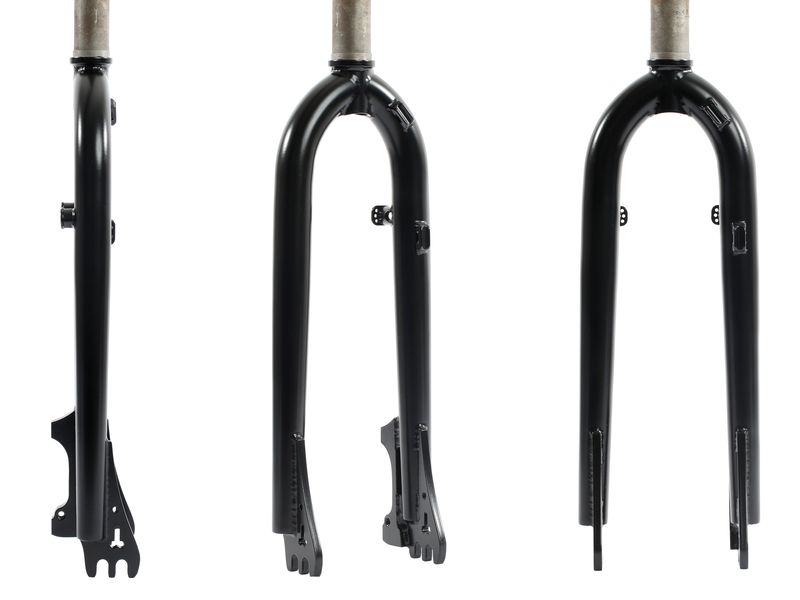 [/img]
I have set of these. They have a cock in the dropout (and two rake options)
...that is all.
Perhaps that is the case but maybe, just maybe they both also like contributing to something which they're obviously keenly interested in. As a byproduct of posting insightful comments regarding design, Sam to use your example, will increase the public respect for the Singular brand and hopefully along with it sales. As a swift owner i certainly appreciate the thought he's put into the frame. Same goes for Brant really. I'm trying to bodge together a fat front in the style of the Jones for a frame that's probably not suited to it and the fork rake of 55mm on the On One fatty, which matches the Jones, piqued my interest. Question was asked and answered which has potentially added more food for thought. To be honest i would rather pay beers/cash etc to someone that knows what they're doing to have a look at the frame i propose using and tell me if its going handle like a pig but that's besides the point. Your presumably unqualified hissy fits about other comments and vitriol towards designers don't really help anyone though do they?
blimey, the vitriol is strong in duirdh this morning.
Has the art of thinking for ones self truly died?
[i]Has the art of thinking for ones self truly died?
[/i]
Is it thinking that led to this?
[i]Wouldn't hurt for you and Brant to also follow this advice. [/i]
?
And if we really want to muddy the waters, maybe should also consider how the bike works as a whole r.e. saddle position, weight distribution between the wheels, chainstay length etc.....
I've got my own views and handbuilt them into frames I'm very happy with (e.g. 69 deg head sagged on a 100mm mid-rake fork or 70 rigid on a 55mm rake, 16" chainstays etc). Unfortunately too busy at work to get dragged deep into this discussion 🙂
The art of listening to someone who knows what they're talking about, is clearly dead.
I found these two vids an interesting watch:
Brant and Sam have both designed and sold bikes successfully, that others like to ride. I think their thoughts on the matter hold more weight than most...
Agreed hippy
Some angry puppies on here this morning 😉
I guess my one off-topic post was a little disengenuous and rather pointless in a subject I'm quite interested in. I'd also like to say, I'm not trying to pick holes but am interested in your point of view.
I have read in a number of places that due to the low weight of a bicycles front wheel (as opposed to something like a motorcycle) the gyroscopic effect was negligible and that it only really affects (perhaps) bicycles while airborne? Do you think differently to this?
The greater gyroscopic effect and longer thinner contact patch (more pneumatic trail) of a 29" wheel requires less trail for equivalent steering response, all else being equal.
I'm so glad I brought BMX's into this, and amazed it was taken seriously.
Isn't part of the reason for slacker angles with suspension about the way the bike will handle the horizontal component of hitting obstacles with the front wheel? And don't bigger wheels make these forces less prevalent?