UPDATE: CLASSIFIEDS section refreshed, redesigned, searchable: Go take a look
I tried taking the aero wheels off the Propel and fitting low profile climbing wheels, and a very noticeable difference in having to work harder to hold high speed on the flat compared to aero wheels.
Just shows how much of the aero benefit actually comes from the wheels. Get the same thing fitting proper deep section wheels to any bike. Stick a set of 404's on my TCR and the bike is noticeably quicker pretty much everywhere than when on the shallow wheels that came with it.
However, a smaller rider can have issues getting an aggressive drop on the Propel advanced pro models with their OD2 steerer / stem due to a lack of aftermarket stem beyond 8/10 +/- degrees; and this can negate the aero advantage
I can see why they persevere, but OD2 is a bit of a PITA. Already on a M/L TCR (the smaller of the sizes that fit) with a slammed 140mm -10% stem, about as long and low as I can get it. At least there are a few more options now on OD2 stems than there use to be.
I keep looking at aero frames but seriously, **** that, you're talking about £1500+ for negligible gains. Raced at the weekend and seeing one smashed up carbonz frame was enough to stop my wants for another 12 months. Deep wheels and aero bars (probably my next purchase) will get you 99% of the equipment gains, add a skinsuit and a decent position and you're there. Still not got an aero helmet, I'm not ready to look like a pleb 😛
I'll stick with an alu TCR.
I thought Giant had ditched OD2? Just bought the Mrs the lower end Envie and just assumed the higher ones would also have a normal stem.
Still OD2 on the Propel SL frame and the 2016 TCR.
Envie claims to have a Hybrid Overdrive... no idea what that means.
Still not got an aero helmet, I'm not ready to look like a pleb
😳 I do rather like my Air Attack though. Again noticeable difference and I didn't like going back to a normal vented helmet.
Ha, that's the problem, I considered an Evade but I've clearly got a bulbous head, it doesn't fit right at all! I think the Evade looks decent but unfortunately I've got a Giro head, the Air Attack is particularly wrong looking IMO, and no doubt with the above bulb heeed it'll look worse 😆
I'm sure you look lovely in yours though 😉
I'm sure you look lovely in yours though
I'm pretty sure I don't 🙂
😆
I want to try one of those Lazer's with the aeroshell cover but there's no data around at all about 'em. It looks aero but that doesn't mean it is.
the Advanced Pro road frames all use a OD2 full carbon fork with 1.5" steerer which requires a OS (1.5") stem - you could get these from Giant, Canyon, Ritchey, Syntace, Pro and now Zipp but limited in supply and choice of degrees / length
[img] 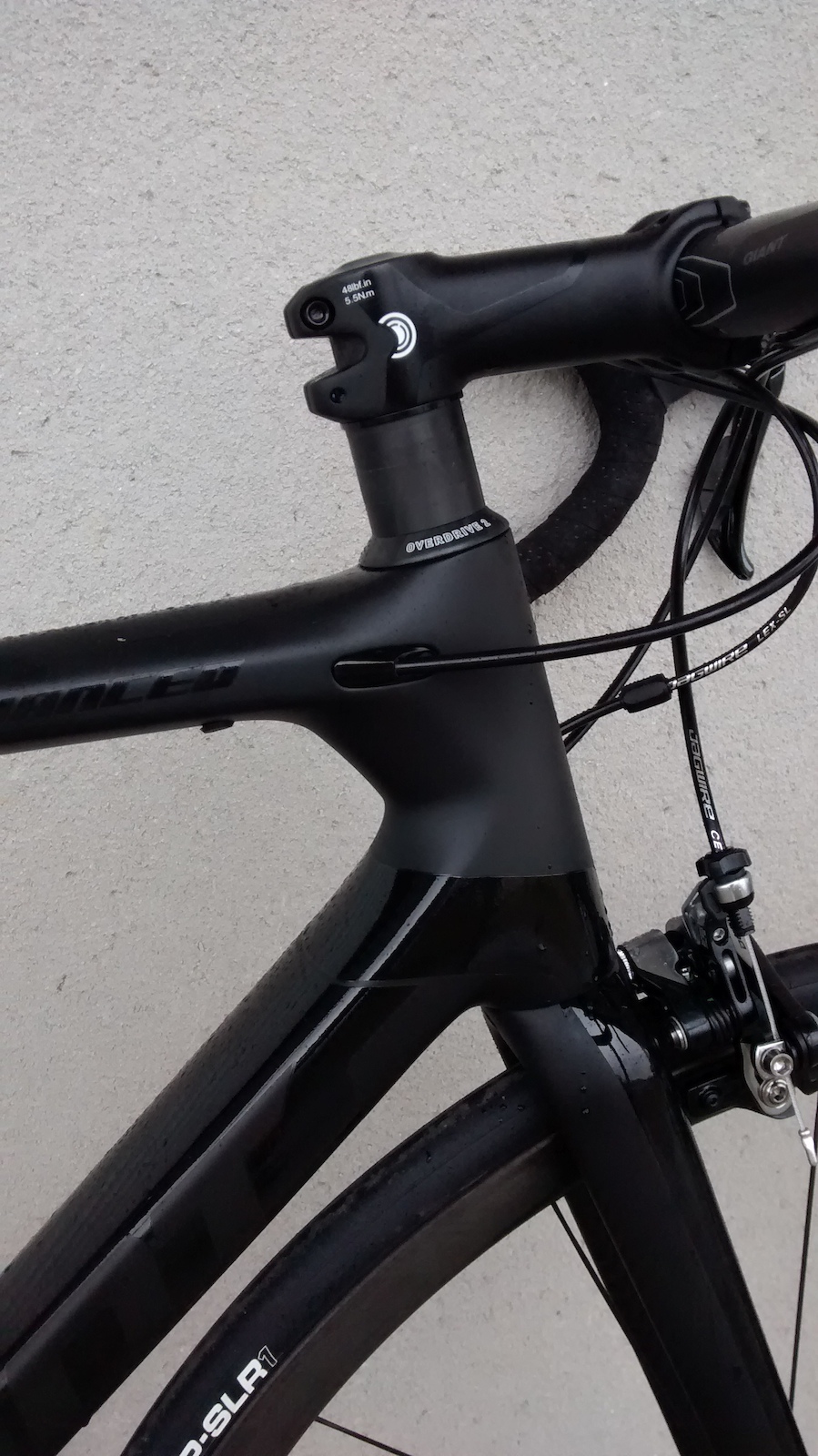 [/img]
the Advanced road frames use the 'hybrid' fork which is a carbon crown and blade, with aluminium alloy taper / 1.125" steerer
This slimmer steerer can be a benefit for riders wanting a more aerodynamic position as you can get aftermarket stems with very aggressive angle (i.e. -17) for a low aero position
If you look at the Envie / Propel Advanced the head tube is also a slimmer frontal cross section(from having the smaller steerer inside), but I'd guess you'd see more aero advantage from being to run a lower drop front end for the rider, than the actual head tube front area?
I've been lucky enough for the past year to have access to Giant Defy Advanced Pro, Giant Propel Advanced Pro and Giant TCR Advanced Pro bikes
And I am fortunate enough to have two of these three. My Defy and Propel are very different rides indeed. The Propel does feel faster, it is heavier and it handles a little quicker. The Defy is lighter, slightly less fatiguing and mine shifts better (Dura Ace). If I had to keep just one, it would be the... TCR Advanced SL - with aero SL wheels. It slots in the middle so would be a good compromise.
At this price and technology point there are no bad bikes, and it's just subtle flavour changes, depending on conditions. All that said, I'M GOING RACING TOMORROW!!! The siren call of vets racing on the New shiny white Propel is too hard to resist 😀
EDIT: As for the OD2, it's a pain as stem choice was limited to Giant and Ritchey and the 5mm options are not cheap. Degenkolb runs -17 degree slammed stems, and previously the team ran Shimano PRO stems despite them not being available to the public. I believe they are now.
[quote=njee20 ]Right. So they're all the same? BSO to R5Ca? As long as you have the same tyres, saddle and seatpost?
Given the same geometry as well, yep a diamond frame in any material is stiff enough in the vertical direction to have no effect on comfort. Different geometry makes a difference, but we're discussing race bikes where that is pretty constant.
I think aracer actually needs to go ride these bikes, working in the trade means I've test ridden quite a few bikes over the years. The last generation of aero bikes were a lot stiffer than their endurance or conventional race frame stable mates.
Ive ridden the older Scott Foil, Spec Venge and Ridley Noah Fast in recent months and I wouldn't want to do big distances on any of them (not in this country at any rate). The Noah Fast was so harsh, I reckon you could tell what day of the week the tarmac was laid. But I could see why Griepel used it, stiff as a stiff thing when you got on the gas, brakes were appalling though!
The new Noah SL and Canyon Aeromax are a lot better and I can imagine doing a days ride on those worth too many issues.
Given the same geometry as well, yep a diamond frame in any material is stiff enough in the vertical direction to have no effect on comfort.
Mad.
So do Pro's literally get an 'off the peg' bike?
I'm from a skiing back ground where even at national level you could get factory skis that were very different to the same badged stuff you could buy in the shops. If you got to World Cup level you could even specify how the ski was made.
Ie when Salomon first started producing skis and their marketing was all about foam core skis, their pro racers were having wood cores.
In the old days I thought Pro's used steal frames made to measure, and I just assumed this was still the case now?
Also are pro frames not filled with a heavy substance around the BB to make them meet minimum UCI weight?
it depends on the rider and the factory producing their frame?
I've seen pro frames broken (that I was asked to strip and rebuild with a new frame from the supplier / sponsor) and some were completely stock, others were obviously heavier than stock with thicker tubing or reinforcement in key areas. Other had custom geometry like small seat tube frames with longer top tubes and custom head tubes?
I'd assume the heavier frames had that done to stiffen a frame in a beneficial way to meet the UCI minimum weight rather than just adding ballast!
Also seen factory wheels that looked stock but had different spokes / lacing, reinforced spoke beds and higher tension to the regular aftermarket wheel, again I assume in an effort to stiffen the wheels, typically on deeper section aero wheels for sprinters which even us mortals can get to flex, let along someone like Kittel or Cav going full gas?
[img]  [/img]
I think aracer actually needs to go ride these bikes
Why would he want to do that when he's got his lovely theories?
They're facts! Not theories!
Could those who are suggesting that deep section wheels are not as stiff as shallow wheels please explain why?
I'd always assumed that deep wheels were stiffer as the spokes were shorter (proper carbon wheels, not shallow rims with fairings).
Lower spoke count may create some flex
Said it many times:
handling = geometry
stiffness = tubing diameter
weight = material
Bikes with the same geometry will handle the same, but comfort and stiffness are big factors in how a bike will feel. Bikes have almost no vertical compliance but a 0.5cm flex in a steel-framed BB is not hard to achieve. Also cornering, which is where most handling changes are felt, will load a frame laterally - hence stiffness will come into play.
Most modern road race bikes are now settled on 73 degrees parallel for medium frames. It is however pretty rare to find two bikes with IDENTICAL geometry (all tubes the same length). Boardmann, Merida and Giant TCRs had. Propel and TCR do too, but stiffness will provide real world differences.
Bikes with the same geometry will handle the same, but comfort and stiffness are big factors in how a bike will feel. Bikes have almost no vertical compliance but a 0.5cm flex in a steel-framed BB is not hard to achieve.
I agree to an extent but that's not to say you can't maximise lateral stiffness and vertical compliance, even if that means there's till more movement sideways than vertically. In fact some sideways movement is probably good, it keeps the tyre on the road rather than skipping off it.
Depends where you measure too. Cannondale stereotypically had large downtubes and skinny seatstays and top tubes to keep the BB and headtube aligned, but the thinner tubes in the stays and top tube let the wheel move up and down. Then you have to decide how you define vertical stiffness, is it relative to the saddle (which will move even further as the seatpost will flex) or the headtube, which may be similar if the top tube is bending a comparable amount to the seatpost but the effect isn't additive.
Reading Mick Burrow's thoughts on vertical compliance (basically even a fork has negligible flex compared to the tyre when you actually test it), I've got to say tyres, saddle and perhaps seatpost/bars may have an effect. Flexy frames are just going to sap your power.
It may (I don't think it is, but I'm not so sure) be that some materials and arrangements give more harshness due to less damping of the road "noise", or even a resonance with it. Certainly when you hear a TT bike going along a road it makes a racket, perhaps this resonance gives discomfort in the saddle.
[quote=cynic-al ]They're facts! Not theories!
They're physics. But then we know that doesn't apply to bicycles.
I did structural analysis of a diamond frame a while ago - unfortunately can't find the numbers now, but there was about 1mm of vertical movement at the top of the seat tube when under enough vertical load to bottom out a 23mm tyre. That was for a steel frame with standard tube sizes, which I presume those people who measure vertical compliance by riding bikes (which is clearly a more accurate way of measuring) would describe as being nice and comfortable.
[quote=thisisnotaspoon ]I agree to an extent but that's not to say you can't maximise lateral stiffness and vertical compliance
http://bikesnobnyc.blogspot.co.uk/2007/08/bsnyc-2008-dream-bike-shootout.html
I think your analyis is oversimplified.
I suspect it's got more to do with how vibration is damped and dispersed throughout a frame than straight forward flex. As a rough guess, the shapes required for the first gen aero bikes have meant far more was transferred to the rider than more conventional frame shapes.
[quote=cynic-al ]I think your analyis is oversimplified.
You've seen my analysis? Could you forward it on, as I mentioned above I've mislaid it.
[quote=PeteG55 ]I suspect it's got more to do with how vibration is
damped and dispersed throughout a frame than straight forward flex.
With the amount of flex involved, there isn't going to be much in the way of vibration damping. For that you need flex.
I'm really struggling with this I must say.
A bike made from steel girders will feel just the same as one from balsa wood, you're saying? There is no difference whatsoever, and it's all in the minds of folk? Every person who's ever ridden a bike.
Flex and vibration damping aren't the same at all. However, do you really need small vibrations damped? Do you simply want the edges taken off the hits, perhaps? In which case vibration damping might do that, by damping out the higher harmonics.
Seems to me that the physics brigade aren't sure what they are actually modelling...
[quote=njee20 ]A bike made from steel girders will feel just the same as one from balsa wood, you're saying?
No, that isn't what I'm saying at all. Firstly the one made from balsa wood will have vertical flex, but then all materials actually used for bike frames are a lot stiffer than that. Secondly there is a significant difference in the lateral flex between different bike frames which can be felt.
[quote=molgrips ]Flex and vibration damping aren't the same at all.
Did I suggest they were? However in order to have vibration damping you have to have flex. An infinitely rigid structure obviously won't damp any vibrations at all.
Eh? You proferred your opinion to demonstrate that aero bikes feel no different to non-aero bikes assuming the same seatpost, geometry, tyres and saddle. you then said this was the case entirely regardless of material. Now you're not?
You said:
Given the same geometry as well, yep a diamond frame in any material is stiff enough in the vertical direction to have no effect on comfort.
Where does that end? Why does the balsa wood/girder example not count?
Or are you now saying that differences in lateral stiffness make a difference to the comfort? In which case we can just ignore your last few posts and move on.
Regardless of any material bikes are actually made from which is stiff enough to avoid awkward things like tyre rub - apologies for not specifying that. Which wouldn't be the case for one made from balsa wood. I was trying to avoid simply pointing out that it was a poor example - of course if you're going to use unrealistic extremes then yes there will be a difference.
No I'm not suggesting lateral flex will make a difference to the comfort - though thanks for agreeing with that one. Simply that it makes a difference to the way the bike feels when riding, hence people can tell the difference even if they're not detecting what they think they are.
Cervelo reckon an aero frame is worth 1m in a 200m sprint. Sounds ok, but in reality it is such a tiny time difference. In the past most sprinters on Cervelo teams have tended to use the R5 style bike. They also reckon frame flex/ stiffness and the effect on sprint output/ efficiency is impossible to quantify it is so small. If this is true you have to wonder why 2 frames of similar geo and build can feel so different and also why manufacturers bother to make (or at least market) a bike that is stiff/ aero/ comfortable/ whatever. Breaking news is that all bike are the same! 😕
I think Aero bikes are becoming the "do it all" bike of the industry. That TREK I looked at last week will be up for testing soon and I'm looking forward to taking it out for a spin..
If I have it for a couple of days I'll ride it in Hampshire and also take it north for some Yorkshire air too 😀
However in order to have vibration damping you have to have flex
Disagree. Vibration energy can be dissipated without actual flex.
Er, how? The bit you snipped just after the bit you quoted - how does an infinitely stiff frame dissipate energy?
Can we talk proper Engineering and back it all up with pretty pictures instead of cyclic arguments? 😀 If you've done some tests or modelling you must have some idea roughly what was done and roughly what was shown and roughly what the assumptions/ limitations were. As above, Cervelo seem to support Aracer's argument wrt frame stiffness in a blog although I still can't get my head around it completely as there was any detail to explain why they take the position they do. Are we making the assumption of only considering the vertical direction for example?
You talk about movement of the seattube but what about 6DOF of the rear axle relative to the BB for various realistic loads applied to the BB or axle area? I'm sure we've all seen some frames cleary, visually flex and a cheapy carbon Ribble I had was so floppy it almost felt like a full sus MTB on the rough roads! Was it my imagination?
aracer - Member
cynic-al » I think your analyis is oversimplified.
You've seen my analysis? Could you forward it on, as I mentioned above I've mislaid it.
To say that it's just about vertical movement at the seat tube is oversimplified, how on earth could I be commenting on anything further(atcha, yawn, etc)
Sorry, I've lost the calcs I did - was simply a force diagram for a frame to work out the typical forces in the tubes for a given load, and then using typical dimensions for a steel frame I worked out the flex.
[quote=DanW ]You talk about movement of the seattube but what about 6DOF of the rear axle relative to the BB for various realistic loads applied to the BB or axle area? I'm sure we've all seen some frames cleary, visually flex and a cheapy carbon Ribble I had was so floppy it almost felt like a full sus MTB on the rough roads! Was it my imagination?
Not your imagination at all - lots of difference in the way frames I own flex around the BB under pedalling loads. However we are actually only interested in the vertical direction if we want to know what happens when you hit a bump (or just rough road surfaces) as that's the direction the forces act in.
@al - it's about vertical movement at the saddle - given your weight is acting downwards at that point how could it be about anything else? If you want to remove the influence of the seatpost, then that's basically vertical movement at the top of the seat tube.
Where else do you think I should be determining movement?
I'm happy to continue this discussion, but to be honest I don't care at all if you all disagree with me - not when it seems both Mike Burrows and the engineers at Cervelo do agree with me.
I'm happy to continue this discussion, but to be honest I don't care at all if you all disagree with me - not when it seems both Mike Burrows and the engineers at Cervelo do agree with me.
They find the same things with the same assumptions as you. That isn't surprising. I'll need some convincing that forces acting across an entire frame/ fork are in one direction only though and important only at one point. The bike doesn't sit bolt upright all the time and just by virtue of being able to feel a BB twist under load tells you there are forces acting in other directions.... how about sprinting with the bike being tossed from side to side, cornering, even normal pedaling will have some degree of movement in other directions which influences efficiency, handling and comfort 😕 The truth is probably that it is too difficult to model accurately, rather than other directions being completely unimportant. If you ask a simple question you tend to get simple answers
how does an infinitely stiff frame dissipate energy?
I would have thought that vibrations or sound waves in a solid would dissipate energy despite the material being effectively rigid on a macroscopic scale, which is what your tests would measure.
Rather than talking about perfectly stiff materials, my thought was that a frame doesn't have to be flexing measurably to still damp vibrations. It's not suspension - it's suppressing the higher order harmonics.
aracer - Member
@al - it's about vertical movement at the saddle - given your weight is acting downwards at that point how could it be about anything else? If you want to remove the influence of the seatpost, then that's basically vertical movement at the top of the seat tube.Where else do you think I should be determining movement?
You really didn't think about seat tube flex? And you claim to know what you are talking about?
Ah, why didn't you say al instead of beating around the bush? I calculated that separately, and the answer is that it is negligible - less effect on vertical movement at the saddle than the vertical movement at the top of the seattube. Because a normal seattube actually has very high bending stiffness and is also pinned at both ends. A seatpost is different as it is only pinned at one end and also smaller in diameter - bending stiffness is proportional to the 4th power of diameter so even a small difference in diameter has a relatively large effect on stiffness.
I thought it was obvious...so that was on a round tubed steel frame?
Will the flattened top tubes on modern alu frames be the same
<backs out and goes in search of the more harmonious environment of a JHJ thread>
[quote=molgrips ]Rather than talking about perfectly stiff materials, my thought was that a frame doesn't have to be flexing measurably to still damp vibrations. It's not suspension - it's suppressing the higher order harmonics.
Ah, so you don't think "vibration energy can be dissipated without actual flex" you're simply arguing about how much flex there has to be? The question then is, if there's 5mm of vibration at your higher order harmonic, how exactly is a frame with only 1mm of flex damping that out?
Or to look at it another way, check out the materials typically used for vibration damping purposes. Then have a look at the materials between you and the ground when riding a bicycle - which is most similar to those?

