UPDATE: CLASSIFIEDS section refreshed, redesigned, searchable: Go take a look
How did you do that to the frame?
And isn't the flux the super silly light job with a rider weight limit?
I look forward to seeing how you progress with this: the TD is on my in-my-head-one-day-maybe list.
While past-TD racers are here, I'd be interested in how much training/prep you did beforehand.
Alright, well I'll keep you posted.
First thing I need is an appropiate bike, I reckon. Mine [s]aren't niche enough[/s] are all FS.
I bought a Lurcher in the recent Lurcher sale that will be my "endurance" (12 hour, 24 hour, multi-day unsupported events) bike.
Much lighter than my P7, more sensible than my Five, not too racy for long days in the saddle and 29er which we all know rolls better. 😛 😆 😛 No rack mounts though so I'll be using my saddle bag and wild cat harness. Thinking of going the alpkit frame bag route as well.
It will go between a 100mm and rigid fork depending upon the terrain it needs to be ridden on. Going for one of those exposure lights with dynamo hub that will also power a GPS and phone.
Hmm.. I wish I still had my P7 - although it was 26".
When's your lurcher being put to the test?
Hoping to have the Lurcher built by the end of the year... it's a project. Maybe first proper test will be El-an Back.
I'll be at BB200 with the current P7 setup and testing out some other gear.
[img] 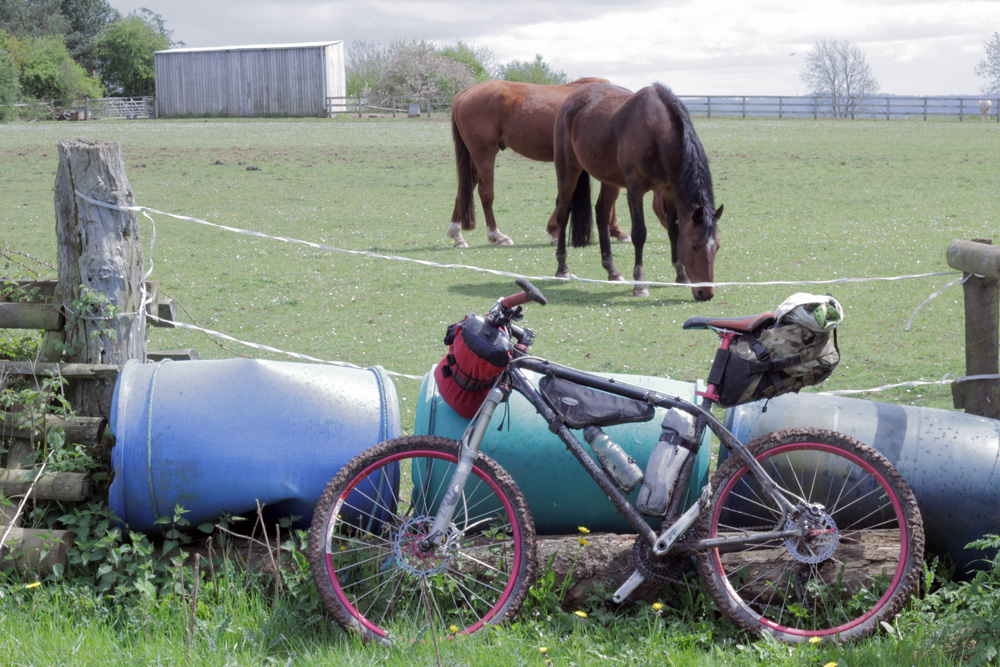 [/img]
Ethan Stewart, a Brit living in Switzerland, did well on his Whippet this year. 26" wheels, well niche ) he finished 12th. We bivied in the same spot after the first day (where Alex Harris later told me he saw 2 bears strolling around as we set up camp, so he promptly f-ed off to the cabin at Corbin, 40 miles further!) and I saw him again at the services just over the border when I was fixing my frame bag. Saw another Brit in an o-o / planet x jersey at the start too. You just can't get away from Brits with o-o / PX kit : )
I bet you didn't see anyone on an Orange 5 or a Kona Heihei (the FS one) 🙂
Nope! And I wasn't the only one on a Jones, or with a ti truss fork (a black sheep rider had a 'fake' jones fork hehe) so no niche points for me.
Maybe I can get anti-niche points by riding something really mainstream.
Re the weight - serious question - has anyone weighed their frame bag, saddle bag etc all together?
I went out last weekend with a base gear weight of about 2.5kg (excl. food and water). Admittedly that was a deliberate attempt to get my total set up (bike plus gear) as close to 25lbs as I could, but I was still adequately prepared. http://www.geargrams.com/list?id=14119
I had three bags strapped ALL over my bike - they weighed 450g on their own, split evenly over the bike. Nothing on my back.
Your mate's wife owns Wildcat Gear - why don't you go an see him? 😉
I might just do that Ian, I have an idea.. 🙂
For me it's about bunny hops (which are way easier than with panniers and getting airborne on a fully laden bike is exceedingly satisfying), balance (weight spread more evenly, heavy stuff in the frame and lighter stuff elsewhere) and bouncy bikes (no hassle with fitting a rack to the same mountain bike I normally ride on day to day that has no mounts for one).
Nowt wrong with panniers, but once heathery singletrack and tight rocky stuff appears I know which I prefer. Worth borrowing some bags/harnesses and seeing if you get on with them anyway.
I think you just need to try it to find out. But don't find out 'live' on something like the Tour Divide! Try it first.
I have used a rear Old Man Mountain rack with a drybag (or two) on the top of it for three main expeditions, including an 8 day bikepack tour with packraft, and latest being half of the Highland 400 race. I am going to move away from the rack, for two main reasons - 1) I have a new bike with bigger wheels, and so I have to redo my carrying equipment anyway, and 2) the rack encourages more stuff to be carried, and this extra stuff and weight really really sucks once you are into day two / three...
The idea of carrying less is the right one. Even a light rack is half a kilo, that is too much extra weight. A good rack is about 800 grams, way too much. A trailer is 10 kilos, you may as well get a boat anchor and tie it to the seatpost!
So, I am going to go with the 'standard' kit - seatmount bag, framebag, handlebar bag, and a small backpack. All the people (winners included) that use that setup can't be wrong.
Also note there will be nothing close to 10 kilos in the rear bag, more like 2 or 3.
I have used a rear Old Man Mountain rack with a drybag (or two) on the top of it for three main expeditions
I was thinking this might be a good option. Rear rack with an Alpkit Gourdon on it (as someone mentioned above). If the rack breaks or it gets rocky, I can put it on my back. That could be tried out easily enough.
the rack encourages more stuff to be carried
Not in this case 🙂 The reason I mentioned 10kg is that I thought 10l of water might be nice to have in the middle of a burning desert. Although the TDR folk don't seem to be carrying that much water so maybe there's more on the route than I thought - must buy those maps and start properly examining it.
I was thinking this might be a good option. Rear rack with an Alpkit Gourdon on it (as someone mentioned above). If the rack breaks or it gets rocky, I can put it on my back. That could be tried out easily enough.
Try it out, but I don't think it is optimal. otherwise a bunch of other people would be doing that.
The reason I mentioned 10kg is that I thought 10l of water might be nice to have in the middle of a burning desert. Although the TDR folk don't seem to be carrying that much water so maybe there's more on the route than I thought - must buy those maps and start properly examining it.
That is a lot of water / a lot of weight. I'd seriously research what the route is like and what other riders have done. I really don't see anyone carrying 10l of water on that race. And carrying too much could break your bike / race. Seriously. All that weight swinging out the back sucks on MTBs. The frame flexes a lot with that in panniers. And you go slower. Fast and light... fast and light.
Try it out, but I don't think it is optimal. otherwise a bunch of other people would be doing that.
I think it's all marginal, so personal preference comes into it.
That is a lot of water / a lot of weight.
Yep, and it's very hot and dry in deserts too 🙂
Seriously - read the thread. I do a lot of riding with panniers, I like how the bike handles, so not concerned about that. And I will of course be doing a lot of research, don't worry 🙂
This year was as dry as it's ever been on the Divide apparently, N Mexico was in full drought conditions with record low rainfall. I don't think I ever had more than 5.5l on me and generally that was a litre or so spare. At a reasonable pace you're never more than about 8 hours from water. Streams are common in the northern 3/4 of the route and you can drink a litre or more at a tap stop to help get you through, before filling up carriers. I think I drank from taps 85% or more of the time. So I'm still not seeing any good reason for panniers .. )
My frame bags and seat / bar packs weigh 1.5lb/650g. Sleeping system w/o tarp is 800g and really comfy down to near freezing. I debated over taking a 150g camera. So an 800g pannier rack has no chance )
Bloody hell, what's your sleeping kit at 800g?
On the topic of suspension, I think you'd be mad to ride the Divide with suspension. Extra weight, extra point of failure, very little trail that needs it. The washboard is brutal, but I don't think suspension will help you very much with that.
You might think it will be fine because you've done more than 2800 miles without it failure, but have you done that distance with no servicing? With riding in whatever the weather throws up because you're compelled to keep moving along in the race? Think how busted people get their bikes at Mayhem.... There is clay mud on the Divide which will also clog your wheels to the point where they won't go round, even when you're pushing. That's going to make a hell of a mess of a suspension bike.
When I asked another rider on year on the Divide whether he found his suspension fork useful, he said it had been locked out for almost the entire distance and he wished he had gone with rigid.
Bloody hell, what's your sleeping kit at 800g?
PHD minim ultra bag, 340g (brilliant bit of kit, rated), Terra Nova Bivi, 180g, Neoair short mat, 250g.
The bag is rated to 8 deg but a down gilet used as a filler made it cosy down to frost-point for me. tbh could have done it on a foam mat as there was often quite soft ground to sleep on but I was aching enough as it was so glad of the neoair most nights, my main luxury item really. I also had a 130g mini-tarp that covers my top 1/2 that was enough extra cover to sleep out comfortably on the only properly stormy night I had, other wet nights weren't raining hard enough to need more than sleeping face-down with the bivi opening downward.
@jamesso Aahhh, understood. So add in the gilet and its nearer ~1kg. Which Terra Nova bivvy bag is it at 180g? Is it breathable? My AMK crisp packet survival bag is 115g so that bivy bag is seriously light.
I thought my PHD minim was light at @~500g. Harrrumphh! 🙂
It's the Moonlight bag cover. Not a fully sealed bivi but breathable and works fine, my older Rab Survival Zone was a draw-cord closure too and that did me fine for years of bike and mtn bivies. The down gilet's approx 180g I guess you could count as part of the sleep system, it's a double-up item that I wore on the bike, used in the sleeping bag maybe 40% of the time, sometimes as a pillow, etc.
I don't think I ever had more than 5.5l on me and generally that was a litre or so spare.
That's good info, but I'd be a bit concerned about safety. If I had an accident and got stuck or something. But I dunno - more research and testing required.
You might think it will be fine because you've done more than 2800 miles without it failure, but have you done that distance with no servicing?
Next to none, but in any case all I'm doing is thinking about possibilities. I have pretty much already decided to go for a fully rigid 29er.
it's a double-up item that I wore on the bike
What weather necessitated a down gilet when riding?
About safety Moly, I think James said he carries a SPOT. The big yellow taxi is never far away assuming clear view of sky (i.e. no 127 hours stuff) and capacity to press a button.
The big yellow taxi is never far away assuming clear view of sky (i.e. no 127 hours stuff) and capacity to press a button
Fair enough, that's good to know. Doesn't seem to be a lot about this on the website.
Bit of a thread hijack, but new to "lightweight" bikepacking and previously would just use a 1 man tent and sleeping bag and would stuff them uncomfortably into a rusac, which was fine for short non-technical rides.
Would it be OK to just attach the Alpkit dry bags with the external load loops (Airlok Xtra) on straight to the bars with straps or bungees or does this still move around to much? I've 13l for the bars and 8l for under the seatpost, but trying not to now have to fork out for harness system to attach to the bars?
What weather necessitated a down gilet when riding?
10,000ft or more up, 4.30-5am in Wyoming and Idaho area can be pretty damn cold, especially when you have a long downhill after a bivi high up where it's around freezing. Calories burned keeping warm aren't going into fwd motion either.
Is the reliability thang the reason a lot of TD riders are on single speed? Or is it just because it's what they're used to?
Would it be OK to just attach the Alpkit dry bags with the external load loops (Airlok Xtra) on straight to the bars with straps or bungees or does this still move around to much? I've 13l for the bars and 8l for under the seatpost, but trying not to now have to fork out for harness system to attach to the bars?
It'll work okay. It won't be as secure as a harness but you won't die. A little ingenious strapping will be required for the rear one though ... really needs attaching in 2 planes, eg seat post and seat rails.
Do people use a harness for both bars and saddle? If so, what's the flavour du jour? Had a quick look at Wildcat and Revelate and they seem awfully expensive for what they are...
I love this how jameso has actually raced the td and done pretty bloody well (nice one chap!) yet the experts on here are telling him he's wrong. As has Aidan.
If you're so bloody clever molgrips, why asked for advice?
If you're so bloody clever molgrips, why asked for advice?
I've not told anyone they're wrong.
I'm thinking about the issues and gathering viewpoints. If you want to highlight a particular post I'd gladly explain what I actually mean.
10,000ft or more up, 4.30-5am in Wyoming and Idaho area can be pretty damn cold
That reminds me the time we went on a trip from Wisconsin in September where it was 30 odd degrees and sunny to Yellowstone where it snowed overnight!
Would it be OK to just attach the Alpkit dry bags with the external load loops (Airlok Xtra) on straight to the bars with straps or bungees or does this still move around to much? I've 13l for the bars and 8l for under the seatpost, but trying not to now have to fork out for harness system to attach to the bars?
I've fastened a 13l Alkit bag to my bars with a couple of bungees a few times. Struggled a bit, because the bag was a bit overfull with a sleeping and bivy bags inside so there was no squish. Alpkit usually recomend a 20l bag, which I think would give a bit of movement to deform around controls and bars. I think straps would be easier/better than bungees.
The harnesses seem to be more for racers, because you can quickly get the drybag out. One of the past racers of the TD (Aidan?) said this meant he dried/aired out his bag more frequently when stopping during the day.
Not cheap but the Wildcat Tiger seatpack is a brilliant bit of kit, worth every penny. Takes some practice to use quicky but very well designed and the most stable seat pack by a large margin. Almost none of that bag sway you see with over-filled standard seat packs (limited capacity helps, and is a wise move). I picked up an older style Revelate bar harness for £30 SH, used a MYOG version before that for a few trips.Had a quick look at Wildcat and Revelate and they seem awfully expensive for what they are...
I used Airlok Extra bags lashed both front and rear before I got my Wildcat harnesses.
Just strapped on with 2 straps front, 3 straps rear (and a bit of double-sided velcro around the seatpost). I was happy with them for short trips. Stability was pretty good at the front. Acceptable at the rear. Items in the rear tended to settle off-road and create slack in the straps in places, meaning a quick re-tighten.
For longer trips I would have got the sewing machine out and made a bit of a sling for the rear, but the Wildcat Tiger arrived in time to mean I didn't have to do that 🙂
However, I did manage to bodge the old rear so that it would work with the Joplin seatpost. Now I've got the Wildcat and a longer-travel Reverb, I haven't been able to make it work.
The most important difference between the lashing and Wildcat solutions is that one made me check it every gate/stop, and also constantly leave me thinking I could do a slightly better job, whereas the other leaves me relaxed.

