Just a bit of random musings...
I was noticing last night when riding up Butser, one of the guys from the local kids club was out too, he set off at the same time as my 2nd ride up it... But soon left me for dead..
Now, i think i'm not too shabby on the bike, but he was GONE...
So my question is... Lets assume he weighs 70kg and i weigh 94kg, is it a massive factor...? Is there a calculation on for example a 10 minute consistent climb at a set power, how much quicker you'd be if you weighed say 25% less for example. OK, i accept it's an extreme figure... but it may help put into context for me easier if we use extremes.
I totally accept he's faster than me because he's fitter... don't get me wrong there....
But i guess the question is... If we were equal weights at 70kg, how far behind would i expect to be ?
I don't know what the specifics are but if you take a road sprinter and a road climber - both are more than fit enough to complete the tour de France in a good time - but to go up hill quickest you need to look like you haven't eaten in months it would seem.
JonV, that's an awesome if slightly baffling answer...
The figures near the bottom where Rider B is 30s quicker on the 18min climb for the same power and 5kg lighter implies that say I was 20kg lighter and same power as myself over a 10 minute climb, i'd expect to be 1min 30 give or take quicker...
Depends on the gradient and surface, but on a steep smooth climb it really is ALL about the weight.
I did [url= http://www.climbbybike.com/profile.asp?Climbprofile=Col-de-la-Bonette&MountainID=6062 ]Col de la Bonette[/url] 2 years ago and put an hour into a guy with an FTP 60W higher than mine.
Edit: I can't find the link, but there was a coach did a study with one of his riders in training and found ~1min per kg on alpe d'huez
Most of it is about the power needed to ride at the same speed (so wind / rolling resistance cancel out) up different gradients - in short every 3.5-4% of gradient increases the effort by a factor - so if it takes you 200W to climb a 5% gradient at speed X, to climb an 8.5-9% gradient at the same speed would take 400W, or a 13% gradient takes 600W - which is out of the relams of most of us for any period above a few seconds.
But there is also the calculations in there for weight, albeit he only does it for 5kg difference, you could plug in 10 or 15 easily enough.
And then you have the fact that when climbing you're probably ekeing out effort to stay at or under your FTP (unless smashing out intervals, or racing to stay with a group on a climb, etc.) so even a few w extra to compensate the w/kg equation will put you over FTP and that becomes 'exponentially' harder to maintain beyond a short period.
I think it's all about weight too. At my lightest last year 70kgs, I was fastest I've ever been up some of local South Downs hills, mind I did target them to get the best results. I've 7 hills I train on, 6 of them are gits if you hit them hard, during a 4 month period of both trying to loose weight and still maintain strength I noticed jumps in time/distance/effort.. I started out fit though, so just targeted loosing weight and effectively sprinting up hills. I vommed many times during Feb/Mar/April last year, but you have to put the effort in.
I'm now back to 78kgs and feeling far better for it.
I am a rouleur by nature, so targeting hills like i did was a bit alien and a task I'll probably not do again for some time.
Yeah i get that, i get the fact that at the lower weight fatigue may play less of a factor etc... I was not thinking in complete and utter detail really, just simply put, if person A rode up the hill today and then rode up it tomorrow with a 20kg backpack, assuming all things equal, how much slower would he be... The answer seems to be... quite a bit on say a 10 min hill.
Obviously Butser for example is a 'gearing' thing or a difficulty at a couple of bits as your stem is nearly hitting you in the face on pedal strokes.... But was more generic thinking than a particular climb.
It makes me think really as i've dropped some weight from myself over the course of the last 6-7 months, but looking at my power outputs in Zwift etc i'm not really finding much in the way of gains if at all now. So to make the next step within myself speed wise, i either need to make more power, or less weight. Clearly, neither are easy for me... but i think realistically, less weight is potentially easier than more power.
I am a rouleur by nature, so targeting hills like i did was a bit alien and a task I'll probably not do again for some time.
I think i'd likely put myself into that context, i'm a big lad and liekly to always be fairly big, i don't do the climbing with ease compared to the lightweights, but i can stick a decent chunk of power down and maintain it for a reasonable time.. Sprinting isn't my forte, i'm just a plodder really.
Surely it's power to weight ratio that's important. If you are assuming fitness=power (fitness is key to sustaining power, that's for sure)and your fitness improvement has plateaued, then I guess weight is going to help. I doubt you have really reached the peak of possible human performance though, so both power and weight can be improved (then there's technique etc).....
I doubt you have really reached the peak of possible human performance though
Of that there's no doubt 🙂
But things like power get harder as we age, technique, again something that's not necessarily that easy to improve, especially from a climbing context... So decreasing weight is potentially the simplest way of looking at the scenario for a likely solution.
Have you [i][b]any[/b][/i] idea who you're talking to ?! I refer the honourable gentleman/lady to weeksys epic zpalmaresI doubt you have really reached the peak of possible human performance though
Its also about physiology e.g. the ration of fast twitch vs slow twitch. As an example, two riders of the same power and the same weight and same fitness will not necessarily climb at the same speed.
The set of fibres need to excel at climbing is different for those needed to put power out on the flat. Explained here:
https://cyclingtips.com/2013/09/climbing-and-time-trialling-how-power-outputs-are-affected/
So you need to find out where your strengths and weakness lie, what your physiology is etc. This last Giro is a classic - Quintana pulling away on climbing but Doumilin TT'ing his way to success.
It does seem to make a huge difference, and if you think about how much effort has gone into making lighter bikes for climbing, then a few kilos off your body (assuming you retain power) will make life a lot easier/faster. Of course, you then lack the weight required for a fast descent 🙂
Kryton57 - MemberIts also about physiology e.g. the ration of fast twitch vs slow twitch. As an example, two riders of the same power and the same weight and same fitness will not necessarily climb at the same speed.
The set of fibres need to excel at climbing is different for those needed to put power out on the flat. Explained here:
https://cyclingtips.com/2013/09/climbing-and-time-trialling-how-power-outputs-are-affected/
So you need to find out where your strengths and weakness lie, what your physiology is etc. This last Giro is a classic - Quintana pulling away on climbing but Doumilin TT'ing his way to success.
Of course... but in the context of the question we're not talking 2 different riders, or 2 different techniques.
I was thinking more in the context of 1 particular rider, 2 different weights, but nothing else changing apart from the weight.
Obviously there's all the other factors to consider, even things like tyres, pressure, riding gear, etc etc.... But wasn't quite wanting that level of answer.
Weight is clearly a factor but how hard were you trying versus how hard was he trying?
I typically leave other riders behind on climbs but I have ridden mostly fixed gear for last 15 years so have a different approach to climbs. I am probably not fitter than those I leave behind but I have no option than to put more effort in to keep to a speed I can pedal at whereas they will typically change down through their gears getting slower as they do so.
These are the same riders that will then pass me when on the flat as I am topping out at 20mph...
Sorry Weeksy I misunderstood.
So my question is... Lets assume he weighs 70kg and i weigh 94kg, is it a massive factor...? Is there a calculation on for example a 10 minute consistent climb at a set power, how much quicker you'd be if you weighed say 25% less for example
So I think there is a calculation - isn't it 1kg=1min per 1000ft of climbing?
20kg or more difference, that's huge. If 2 riders of equal power have that much weight difference I'd expect an almost instant gap opening and growing on any climb.
I notice how much better I climb when dropping just 4-5% off my average weight. So much so that I barely care what my bike weighs, a kilo there makes so little difference unless I'm lean and fit. Training with 3-4kg weight on the bike seems to help as you never escape the added effort needed but I could just push a bigger gear for much of the same effect.
Weight is clearly a factor but how hard were you trying versus how hard was he trying?
Bloody hard for myself, by the way he was panting.... bloody hard 😉
This thread depresses me as I know I am about 5kg heavier than I should be 🙁
ah well, I don't have any hilly races left anyway.
p.s no need for apologies or even moving slightly off context, it's all interesting bike discussions on a bike website, whether it holds completely true to the question or not 🙂
So I think there is a calculation - isn't it 1kg=1min per 1000[s]ft[/s][b]m[/b] of climbing?
This thread depresses me as I know I am about 5kg heavier than I should beah well, I don't have any hilly races left anyway.
Ha ha me too Ferrals - off the bike time has allowed me to enjoyed a few too many curries/beers/belgian buns...
It came up as i was chatting to Yak on Sunday and i think he's 65kg he said... i'm 93-95kg.... which is obviously a MASSIVE difference.
It does depend a lot on weight. Most climbers look to improve their power to weight ratio. You can get more power and begin to look like a track sprinter but it will also increase weight so you won't get any faster. Equally if you don't eat properly your weight will drop but so will your power.
You would also want to consider how long you can sustain your power output. Sprinters only put out bursts measured in seconds. In thuk most climbs are short and punchy so you need to be able to sustain your effort for a few minutes. Head to the alps and the climbs go on for miles so you put out less power but for longer. Think spring classics riders like Sagan vs. Grand Tour climbers like Quintana.
There are websites out there that will let you work out how much of a difference weight makes. As a competitive hill climber I do train to be fast on a hill for 4-5 minutes. However, the vast majority of my performance gains come from losing weight (off me) in the run up to the hill climb season. Normally try to get sub 70kg which is still pretty big for a pure climber but I can sustain a high power output for the required time unlike the skinny yoof.
weeksy - Member
I think i'd likely put myself into that context, i'm a big lad and liekly to always be fairly big, i don't do the climbing with ease compared to the lightweights, but i can stick a decent chunk of power down and maintain it for a reasonable time.. Sprinting isn't my forte, i'm just a plodder really.
"If you're not and climber and you're not a sprinter, you're a domestique."
Joking aside why don't you go and try the same climb twice with some added weight on the second run? Have a good rest in between and if you have a power meter then hold the same power or the same heart rate with a hr monitor. Won't be the most accurate experiment but would be interesting to try.
I think a lot of hill climbing comes down to pacing. Some of my fastest times have been set when not trying. Last week for instance I rode a local steep climb which is about 5 mins long. I sat down and easily spun up it without any intentions of going fast and I was only 13s off my best on which I gave it everything and felt sick by the end.
Kryton57 - Member
Can't find a single mention of climbing in that article?
Weeksy races. I felt it may be a useful read. I know this thread is about climbing but should that then translate into Weeksy's racing its worth him know where he should apply his effort.
If not feel free to ignore it.
Joking aside why don't you go and try the same climb twice with some added weight on the second run? Have a good rest in between and if you have a power meter then hold the same power or the same heart rate with a hr monitor. Won't be the most accurate experiment but would be interesting to try.
Indeed it would.... I don't have a PM, but i have a HRM so i could do it via HR. Won't have time this week, but when i get back from holidays i may well have a try.
Its all here, power to weight.
Using Trailwaggers is quite eye opening.
From a Zwift perspective i'm a (pretty much ) 300w rider for say a 20min FTP, which gives me currently 3.2w/kg.... If i were 70kg instead that would be 4.3w/kg and i'd be doing well in A races....
Of course in the real world, that's unlikley... but if we went for the middle ground of that as being 80kg target weight keeping power the same, we'd be looking at 3.8w/kg as being my power... How much in actual time that would equate to, we'd have to see... but it's a chunk of change.
I think we know where this winters training plan needs to head here. lol
Weeksy- like all these things, it's not black and white.
If you can lose a lot of weight and not lose power then yes the same rider would be faster uphill. The steeper the climb, the bigger the effect too.
If you lost all your power in the quest for lightness- then the steeper the climb would need to be to show an advantage.
Hence why Fifeandy is always bemoaning the lack of Hilly courses 😉
On the flat of course, it comes back to w/CDA which can also only be enhanced by being smaller physically.
There really aren't many downsides to losing mass for cycling in our weight category.
Couldn't you Zwift it to get an idea?
Ride the mountain loop one week at your actual weight & the next week stick 20kg onto your profile & ride it again.
I know it won't be 100% accurate, but should give you an idea.....
Hence why Fifeandy is always bemoaning the lack of Hilly courses
Indeed, stupid flat country!
I'm actually in the slightly odd position of actually working to [u]gain[/u] weight (as muscle mass obviously) as for riding in the UK, i'll take the increased power over the risk of a slight drop in W/Kg. I mean its nice being able to float up climbs giggling at all the normal sized people for the week in the mountains each year, but that comes at the expense of being the runt getting his legs torn off the other 51 weeks of the year.
Kryton makes a good point.
& when you combine your physiology with an optimum weight then you can really fly!
I've never had great power but I've always had good stamina. At my best I was finishing in the top 10 at Brass Monkeys 4hrs & top 5 at Bristol Oktoberfest. The thing is I was never that quick - my lap times over those races were just consistent. My coach & I did try to up my peak power by doing shorter XC races.....I got totally dusted at those!
It's about playing to your strengths.
Power to weight ratio.
With a nod to the relative ratios over the duration of a given climb.
GCN to the rescue 🙂
same road climb (0.4 miles, 11% grade) last night on mtb. according to strava me & mate were outputting ~200W each.
i'm 85kg, he's 70kg, I did in 6 mins, he did in in 5min.
I need to lose some weight.
Interesting vid !
I've 7 hills I train on, 6 of them are gits if you hit them hard
Which are they? I quite like riding up hills.
On club runs I tend to be waiting at the top of the hills for others to arrive. On the flat I can be desperately trying to hang on to the same peoples wheels. I weigh 55kg which I'm guessing has a lot more to do with both situations than any difference in fitness. It's fitness for purpose maybe.
It's fitness for purpose maybe.
Without a doubt...
At my level of propping up the back 1/3rd of Open class in XC racing, any improvememnt in fitness or weight will potentially see me finishing a bit higher.... Whilst i prefer longer events like the SDW, the reality of a family/job etc means i'm more likely to be found on a Sunday at an XC race (or on Zwift lol), so whilst my preference may be for 50km events, it's far more likely it will be a 20km XC race.
It's [s]fitness for purpose maybe[/s] power to weight
Just anecdotal, for those coming up to hill climb season in a few months maybe?
I went vegetarian a couple of years back.
Prior to then I was 74kgs, and had been for 20 years (+/- 500g)
Nothing changed other than giving up the meat but I'm now 72kgs, again +/- 500g.
No drop off in power, just more PBs on climbs... 🙂
Easy way to lose 2kg!
Somewhere on the web there is a 'what if' table based on the ADH climb, Power, Time and Weight.
Here you go..
[img] 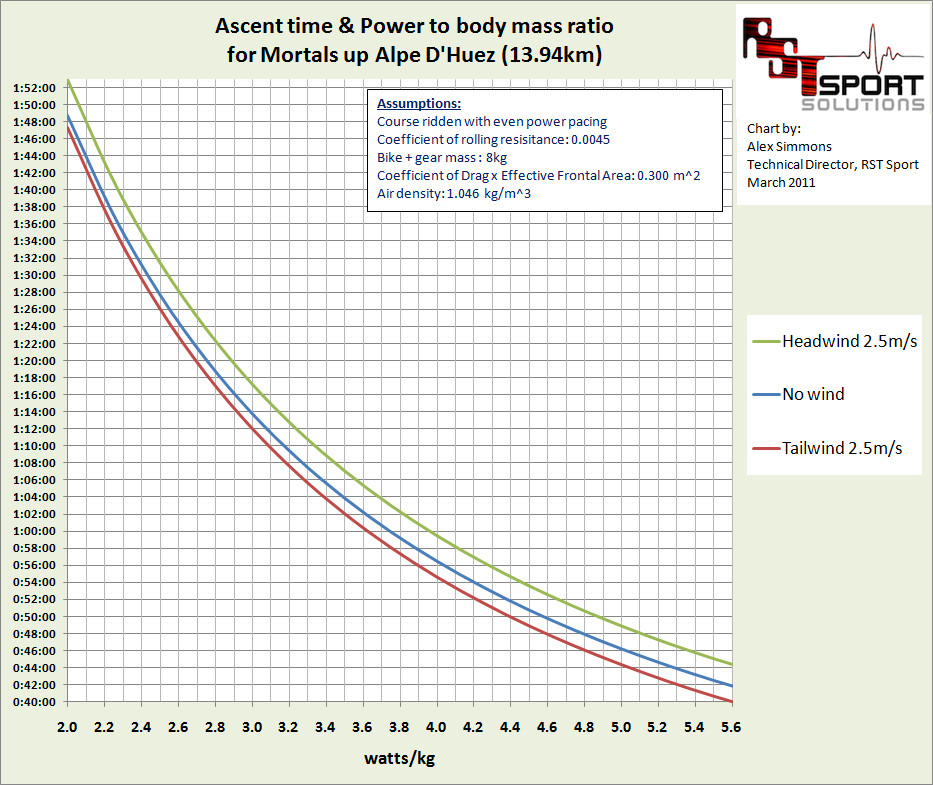 [/img]
LOL give up meat.... i'd rather finish 45th.
Kryton57 - MemberExplained here:
https://cyclingtips.com/2013/09/climbing-and-time-trialling-how-power-outputs-are-affected/
THAT is something I've been wondering about for ages, and was reminded of last week riding with a mate in Sardinia, which was hilly and flat. Thanks for the link...
Was going to link to the same GCN vid.
Is this the on or off-road route up Butser? From which side? I did an experiment last year when I rode up (off-road) on my heavier bike and my lighter bike. About 6 or 7lbs difference in it. It was a pretty negligible difference (something like 20 secs I recall) or about 3% quicker... I definitely feel faster when I lose 6lbs of bodyweight but as the GCN video shows, it doesn't necessarily mean that I'm much quicker. However, difference of 20kg is whole other matter.
if it wasn't for the promise of a guilt free bacon sanger, I'd never have raced a Gorrick in my life.
Nairo Quintana weighs 58kg, if that helps.
My weight varies between 76-80kg, and I certainly [i]feel[/i] much quicker at 76kg, so much so that I always aim to get down to that if I have a race coming up. It might just be about finding a reason to feel positive though! 🙂
I am assuming a lot of this also applies to running? Or at least the general principle.
Although I suspect the disadvantage of being lighter on a bike and putting out watts is not as bad when running?
Asking as I an plateauing a bit and getting more long distance hill training in is not really an option at the moment but losing weight a bit and shorter leg stuff/gym/cycling is.
Note fell running, proper hills, long climbs, none of this small tarmac stuff. Currently hefting 80kg around with me
I reckon the effect will be even more in running, as the part of the equation with air resistance can almost be removed; this is due to the speeds being much lower.
So even if you drop some power when losing weight providing it's not proportional to the % weight loss then less weight will mean run faster (for distances not sprinting of course)
https://www.medibank.com.au/livebetter/welcome-to-the-cadel-evans-gymbetter-bike-training-guide/
https://cyclingtips.com/2014/03/the-rok-of-monaco-what-it-takes-to-train-the-worlds-best-cyclists/
https://cyclingtips.com/2009/01/plyometrics_for_cycling/
http://www.trainingbible.com/joesblog/2007/02/plyometrics-research.html
https://breakingmuscle.com/learn/preseason-strength-training-for-cyclists-gaining-power-off-the-bike
http://www.redbull.com/en/bike/stories/1331777674589/nino-schurter-xc-training-red-bull
http://fullsus.co.za/the-ins-and-outs-of-strength-training/
using this website http://bikecalculator.com/ and only changing rider weight from 94kg to 70kg up a 1km 10% climb, power the same at 150 watts, time changes from 12.3 minutes to 9.5 minutes
@weeksy, had a think about this a bit more while out for a recovery spin this evening (yes, i'm that sad).
Whilst weight is still a big part of the equation, i reckon you've still got a lot of scope for improvement through fitness/power too. There's plenty of big units on the time trialling scene churning out 350W+ FTP. Got to bear in mind your quite new to 'training', you've probably gobbled up the easy gains, but still plenty more to come by sticking at it.
Off-road, coming from QECP up through the mid-way gate.Is this the on or off-road route up Butser? From which side?
i reckon you've still got a lot of scope for improvement through fitness/power too. There's plenty of big units on the time trialling scene churning out 350W+ FTP. Got to bear in mind your quite new to 'training', you've probably gobbled up the easy gains, but still plenty more to come by sticking at
Oh don't get me wrong, i'm well aware of that buddy, well aware. But i also feel as you say, i've taken the easy gains and any other power increase is going to get exponentionally harder to drag in. When i looked at the Photos from Southern XC race they were in 'race order' and i saw a couple of guys ahead of me by 10 places who i was 10-20kg lighter than ! So clearly it's not just weight holding me back currently.
Don't get me wrong, i'm not looking for an easy way out or the easy option, it was more just a gauge of where i could be if i dropped another 5-10kg but didn't increase anything else.
In my ideal winter plan this year i'll Zwift like a lunatic and both increase power and decrease weight for next year... Whether or not that can be realistic we'll have to wait and see.
Weeksy- The trouble with doing lots of similar length Zwift races at your Threshold is that you get really good at....... riding a Zwift race at your Threshold.
To actually improve it, you need to Push it or Pull it up now. Push it by doing longer efforts slightly under Threshold and pull it on other days by doing shorter intervals over Threshold.
The longer steadier rides would help with the fat burning too. Of course high intensity stuff burns more calories but it also raids your glycogen stores and makes you hungry.
As I said the other day, I'm quite taken with that '10% improvement every 20 weeks' rule as it seems very accurate.
That should help focus your mind on an achievable level of progress- you only need to improve 0.5% each week to reach the maximum sustainable progress.
I weighed 74kg in January 2016 and upping my monthly mileage and using my fitness pal as a calorie counter dropped to 65Kg by November 2016, unsurprisingly I am better at climbing. However I have noticed that since switching to a compact from a triple I have moved on again, I'm assuming that it's because I don't have the luxury to spin smaller gears and have had to develop the strength to pull the slightly taller gearing?
jwt technique and right gearing will have an affect. Spinning and locking your core will help.
Without a power meter its hard to say if you've lost power which is down to training not weight loss.
Ultimately its power to weight ratio and being light makes you faster up hill for the same power output, gears technique.
Also a lot of mileage may just be junk miles. Structured training and working on hills will also improve your climbing ability. If you have a power meter then you will have a better idea of your true fitness. They are better than a HRM for this sort of thing