UPDATE: Reviews section refreshed, redesigned, searchable: Go take a look
Honestly there is no need for cycle lanes in cities. Education would be much better. With the 3 foot rule and some proper targeting on people breaking this rule.
Once drivers will learn that overtaking to be the first to queue at a traffic light is useless things will move forward. On the other hand, cyclist flitering to be the first at the traffic light is IMHO very stupid.
As for lack of space-make space ,take it from the cars. Holland did and it is on of the most crowded countries in Europe. And as for cost,make the money available.We just splurged £9 billion on the Olympics whos elegacy is supposed to be more participation in sport and exercise.
Th eproblem is the vested interests big business car manufacturers etc have a bigger voice than us so win out,hence the reason why CM in the other thread try and reclaim the roads.
[i]In a few locations.[/i] Go into the centre of the cities and it's shared use. Head out of the cities and it's normal roads just like we have.nick1962 - Member - Quote
As for lack of space-make space ,take it from the cars. Holland did and it
population density is high
As it is in the Netherlands. They are right behind England in the top 10.
http://en.wikipedia.org/wiki/Population_density
but crucially CAR density is very high
Circular argument. Car [i]density[/i] is high, because car [i]dependency[/i] is high, because cycling (and walking) is not a serious alternative.
To reverse that you need to build cycling and walking infrastructure.
Our road network is not made from planned modern roads mostly, it's ancient tracks that have been surfaced. These are major problems both in terms of planning and cost.
As there were in other countries. Our history is not unique.
NOT the answer
So what is then?
There's no point in saying suggestions for improvements are no good but not suggesting alternatives.
Try reading the rest of the thread 🙄wisepranker - Member - Quote
> NOT the answer
So what is then?There's no point in saying suggestions for improvements are no good but not suggesting alternatives.
What we need is a massive war that destroys much or our current city infrastructure....GrahamS - Member
Our road network is not made from planned modern roads mostly, it's ancient tracks that have been surfaced. These are major problems both in terms of planning and cost.
As there were in other countries. Our history is not unique.
What we need is a massive war that destroys much or our current city infrastructure....
We have fought in the same wars as the rest of Europe.
cycle lane provisions were started after most of the rebuilding work had been done in Holland and Germany, and the towns and cities are still much the same as the UK, they generally were not planned with cycling in mind then, although it takes a greater planning priority now.
I think America can help with the war, they seem to pick on everyone else, why not us
Look at the infrastructure photos on this page:
http://www.hembrowcyclingholidays.com/photos.html
Watch this video:
Almost every single child at that school cycles there. Why?
At this secondary school they have 850 parking spaces for the 725 pupils.
[img] 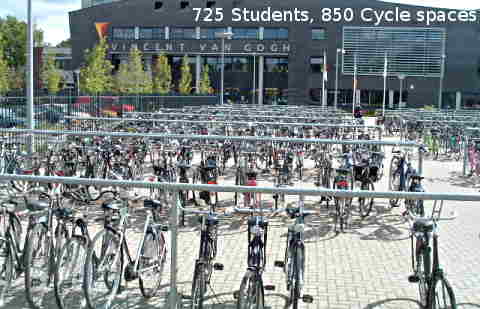 [/img]
In winter the rate of pupils cycling sometimes drops to 95%!
Bike paths are good for the family pootle to the park etc.
Some how I dont see them practical for the roadies..
I think that stiffer sentences for drivers found guilty of killing/injuring cyclist through reckless driving.
How many times do you read about a person killing a cyclist and getting off because they claimed a SMIDSY ... a cruel one was recently when a driver forced a cyclist off the road coming into a traffic island and then got off because the cyclist wasnt wearing a helmet ... insane 🙁
Bike paths are good for the family pootle to the park etc.
Some how I dont see them practical for the roadies..
Roadies are not the target audience. They cycle already.
How many times do you read about a person killing a cyclist and getting off because they claimed a SMIDSY ..
Elizabeth Brown: an experienced triathlete cycling to work along a long straight road, wearing high-viz and helmet, on a clear day, she was struck from behind by a van at 60mph and killed.
[url= http://www.chroniclelive.co.uk/north-east-news/evening-chronicle-news/2012/06/29/van-driver-cleared-of-causing-death-of-cyclist-elizabeth-brown-72703-31288958/ ]SMIDSY. Van driver acquitted of "death by careless driving".[/url] 😡
Grahams hits the nail on the head.
That school probably has about 1000+ less car school runs every day.
druidh
War not required to destroy a city's transport infrastucture just look at Edinburgh 😉
Actually Edinburgh is a great example. They've somehow, against public will and at huge expense, made room for a tram through medieval streets.
That space could have been dedicated, segregated cycle lane at a tiny fraction of the cost.
grahams
you read my next post.Similar thing in MCR and Sheffield.They managed to fit trams there too elbowing out the cars.
At the end of the day the majority of the road infrastructure in the UK was paid for by all taxpayers not just by drivers and certainly not by car manufacturers.Lets reclaim some of that road space back for cyclists and spend a bit of cash on making our journeys safer.
Not much to ask imho
Honestly there is no need for cycle lanes in cities. Education would be much better
For sure, the Dutch have it completely wrong yah? It just doesn't seem to have had any impact on cycle use or safety there does it?
Yet increasing numbers on the London roads leading to increasing casualties.
There are still sport cyclists in Holland. They still seem to have world class riders winning medals. You don't need to worry about not being able to have your weekend club run.
It just doesn't seem to have had any impact on cycle use or safety there does it?
Difficult to say. Do people cycle because of the facilities, or are the facilities there because people cycle?
Our history is not unique.
Nothing to do with the war, it's about social history.
In Helsinki for instance, most of roads are really wide and have cycle paths alongside the pavements, or are dual use. The centre of the city was only built in the 18th century, when wide boulevards were popular, and the suburbs were built in the 1950s onwards, because before that most people lived in the countryside and it was only after the war that people migrated en masse to the cities.
I'm not saying nothing can be done in the UK, but we have a unique set of circumstances because our social and economic history is different, like most countries. Not all European cities are cycling paradises, are they?
Where else is bad for cycling?
Yet increasing numbers on the London roads leading to increasing casualties
Dunno about London but:
Year kms cycled (billion) Deaths Deaths per billion km
1990 5.3 256 48.3
1991 5.2 242 46.8
1992 4.7 204 43.1
1993 4.0 186 46.4
1994 4.0 172 42.8
1995 4.1 213 51.4
1996 4.1 203 49.8
1997 4.1 183 44.8
1998 4.0 158 40.0
1999 4.1 172 42.2
2000 4.2 127 30.5
2001 4.2 138 32.6
2002 4.4 130 29.4
2003 4.5 114 25.3
2004 4.2 134 31.8
2005 4.4 148 33.4
2006 4.6 146 31.7
2007 4.2 136 32.4
2008 4.7 115 24.5
2009 5.0 104 20.8
2010 5.0 111 22.2
The trams have not elbowed out cars here in Sheffield, they run in traffic. In fact very little room has been made for them, they've just been plonked on top of the existing network adding to busier roads
Difficult to say. Do people cycle because of the facilities, or are the facilities there because people cycle?
They built new facilities, from the mid-1970s onwards on the back of the [url= http://www.aviewfromthecyclepath.com/search/label/stop%20the%20child%20murder ]"Stop de Kindermoord" ("Stop the Child Murder") campaign[/url], and rates of cycling sky-rocketed.
Interested to see how they did that.
Did they already have the space? Or did they have to compulsorily purchase strips of land?
Interested to see how they did that.
Potted history:
Did they already have the space? Or did they have to compulsorily purchase strips of land?
Bit of everything I think. Compulsory purchases. Car space sacrificed. Roads redesigned and rebuilt.
That was in the 70s though, far less car pressure.
Do you really think it's at all feasible to create cycling facilities like that across Britain? The cost would be astronomical. I can't imagine how it would happen really.
That was in the 70s though, far less car pressure.
They are still building new ones now though.
Do you really think it's at all feasible to create cycling facilities like that across Britain?
Yes. But not in the current political climate. It requires a major change of attitude.
The cost would be astronomical.
It would. But more than high-speed rail link? More than the Channel Tunnel? More than is spent on new roads every year? More than health care bill for the 200,000 injured on our roads every year + the rising obesity epidemic?
More than *whisper* the Olympics?
Do you really think it's at all feasible to create cycling facilities like that across Britain? The cost would be astronomical. I can't imagine how it would happen really.
I don't think you should let a lack of imagination work against you. There are [url= http://cyclelondoncity.blogspot.co.uk/2012/01/communities-of-color-like-east-harlem.html ]better cycle facilities[/url] being put in [url= http://greatergreaterwashington.org/post/15729/new-jersey-avenue-will-become-2-way-with-bike-lanes/ ]American[/url] [url= http://www.nyc.gov/html/dot/downloads/pdf/stratplan_intro.pdf ]Cities [/url]than in the UK
Yes - a LOT more. Some road in the UK haven't been upgraded to two-carraigeway yet.
Yes. But not in the current political climate. It requires a major change of attitude.
Oh yeah, that.
Whilst we're at it we can redistribute wealth, make growth sustainable and re-populate Britain's forests.
It'd be nice, wouldn't it?
More than *whisper* the Olympics?
Much much more, probably. And as for obesity - this wouldn't cure obesity, not by a long shot. You're talking about changing the personal attitudes of a nation. Massive challenge, and it'll take decades if not centuries.
There are better cycle facilities being put in American Cities than in the UK
How many American cities have you been to? If you think cyclists have it bad here, you'd be stunned at people's attitudes in the US.
There are miles and miles of cycle tracks in Livingston. As a New Town, it was possible to incorporate them from day 1 and they've (generally) kept that up as it has expanded. When I cycle through Livingston, I see far fewer cyclists than I do in Edinburgh. I can only conclude that there is something other than cycle-lane provision influencing the population.
Incidentally, I saw very few cyclists on the lovely cycle facilities in Helsinki. Some, but no more than you'd see in any UK city.
In Munich there were a fair few, mostly tootling grannies.
When I cycle through Livingston, I see far fewer cyclists than I do in Edinburgh. I can only conclude that there is something other than cycle-lane provision influencing the population.
I worked in Livingston for a while. Used to get the train there (with bike) then cycle from the train station to work.
My (probably unfair) impression was the town was just one big industrial estate with a hundred roundabouts.
You'll obviously see more cyclists in Edinburgh because the population is far higher (~450,000). The resident population of Livingston is fairly small (27,000) and it's not an easy place for non-residents to cycle to.
That's not a great comparison druidh.....for a start what's the population difference between the two places? How difficult is it to get from one side of Livingston to the other by car during peak traffic periods? Is there a huge student population in Livingston?
Oh yeah, that.Whilst we're at it we can redistribute wealth, make growth sustainable and re-populate Britain's forests.
It'd be nice, wouldn't it?
Ah always the cynic. 😀
That change of attitude did happen in the Netherlands. It can happen here. People just need to be shown the choice and given a chance to make their voice heard.
Close 🙂 But there are lots and lots of houses and there are schools and shopping areas and sports facilities.GrahamS - Member - Quote
My (probably unfair) impression was the town was just one big industrial estate with a hundred roundabouts.
The resident population of Livingston is fairly small ([s]27,000[/s]) (60,000) and it's not an easy place for non-residents to cycle to.
Read the Delft Study. It shows that accident rates on non-segregated roads actually increased after the increase in cycle lane provision.GrahamS - Member
That change of attitude did happen in the Netherlands. It can happen here. People just need to be shown the choice and given a chance to make their voice heard.
Read the Delft Study. It shows that accident rates on non-segregated roads actually increased after the increase in cycle lane provision.
Linky? Did the study account for any increase in cycling? Was there any increase?
Our roads are pretty safe on a global scale. But guess who beats us?
[img] 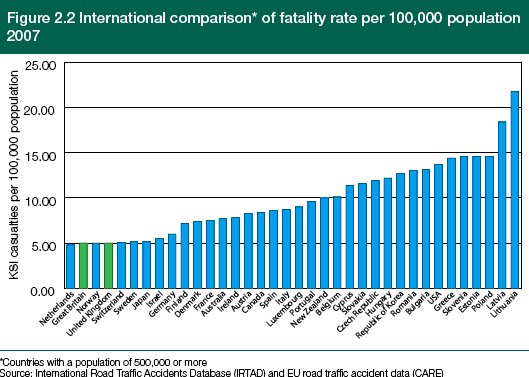 [/img]
They certainly seem to have got something right in the 1970's when they started introducing their segregated paths:
[img] 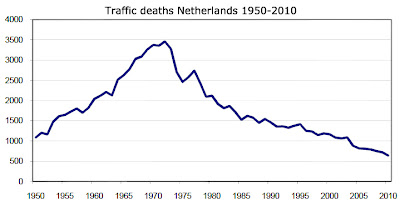 [/img]
Our roads are pretty safe on a global scale. But guess who beats us?
And that's 'all road traffic' - ie includes the large number of multi-car motorway pileups and pedestrians being run over.
Strip out Cyclists injured and base it by km travelled by bike (rather than by head of population) and the Netherlands kicks us into touch (will look for the linky)
[img]  [/img]
Oh look. A graph showing accident rates in the UK falling [i]despite the relatively poor provision of cycling facilities[/i]
Strip out Cyclists injured and base it by km travelled by bike (rather than by head of population) and the Netherlands kicks us into touch (will look for the linky)
Don't have that figure, but I can tell you that in 2010 the Netherlands had 162 cyclist deaths and the UK had 111.
Given how many more cyclists they have than us and how often people cycle there (in some places are 45% of journeys are by bike) - that puts them light years ahead of us.
GrahamS - Member - Quote
Read the Delft Study. It shows that accident rates on non-segregated roads actually increased after the increase in cycle lane provision.
Linky? Did the study account for any increase in cycling? Was there any increase?
(that should keep you busy for a wee while 🙂 )
Considering type of road, the decrease of bicycle accidents is observed only on bicycle lanes. There was no change in accident numbers on bicycle paths and roads with mixed traffic. However, because of the large changes in bicycle traffic volumes on the different kind of roads, one could better compare the risk of involvement in an accident per million km. This risk decreased significantly on bicycle paths and bicycle lanes and [b]increased a little on roads with mixed traffic.[/b] Bicycle paths, which were already the safest kind of link, strengthened their position as safest facility for cycling, and [b]bicycle lanes, which were by far the most unsafe kinds of cycling facility[/b], came close to the safety level of roads with mixed traffic, but [b]remained the most unsafe kind of cycling facility[/b]
Anyone got any idea what the reason for the massive plummet in deaths over the last 5 years is?
Improved car safety?
Better emergency response?
Something else?
Hmm.. can I change your emphasis druidh...
[b]This risk decreased significantly on bicycle paths and bicycle lanes[/b] and increased a little on roads with mixed traffic. [b]Bicycle paths, which were already the safest kind of link, strengthened their position as safest facility for cycling[/b], and bicycle lanes, which were by far the most unsafe kinds of cycling facility, came close to the safety level of roads with mixed traffic, but remained the most unsafe kind of cycling facility
Emphasised like that it is a good case for segregated bicycle paths, no?
I'll read the full study later (promise) but this bit also caught my eye:
On the basis of the Dutch case studies some general recommendations can be given for promoting cycling in an efficient way:• The promotion of bicycle use is only credible and successful if cycling is a practical, relatively fast and convenient mode of transport. The main requirements for planning and designing bicycle infrastructure should be satisfied: coherence, directness, attractiveness, safety, and comfort.
• Promotion of the bicycle should include improving the perception of the conditions by (potential) cyclists. Improving the perception of conditions results in increased bicycle use beyond the increases associated with improving the actual conditions.
• Minimizing travel times between origins and destinations is important in designing bicycle infrastructure.
• Urban bicycle routes should preferably be traced through traffic-restrained areas because cyclists prefer cycling conditions involving less traffic stress and interaction.
• Segregation is preferred when there are large differences between the speeds of the different road users and traffic volumes are fairly high. In the urban context bicycle and motorized modes can be mixed on condition that traffic volume is not too high and speeds are harmonized.
• Good design of intersections is essential. Intersections are the most important cause for delays, and most cycling accidents happen at intersections.
Which covers a lot of the things we've been talking about.
GrahamS - on the basis of an e-Petition, even allowing for the Wiggo factor, and in light of the constrained nature of most of our towns and cities, what sort of cycle provision are we most likely to get?
thepodge - MemberThe trams have not elbowed out cars here in Sheffield, they run in traffic. In fact very little room has been made for them, they've just been plonked on top of the existing network adding to busier roads
I know the roads are shared which why is I said elbowed out.Trams take priority don't they,unless a Mini Metro really wants to try and take on a tram :-).Because there is less room and little perceived benefit for travelling by car rather than tram it makes it less attractive to do so.Or that's the thinking behind it isn't it?FWIW worth the easy quick fix solution to free up road space in built up areas is congestion charging or prohibitve parking charges including on private provision.And for all those who sya they have to commute a long way to work introduce park and ride (a bike)and bus/tram on the outskirts of conurbations with cycle specific or friendly routes.
Actually Edinburgh is a great example. They've somehow, against public will and at huge expense, made room for a tram through medieval streets.
Not sure that this is a great example, really, as the trams aren't going into the Old Town, AFAIK, and the New Town dates from no older than the late 18th century, so hardly mediaeval. Mostly the trams seem to be going into the city centre along big wide streets such as Princes Street and Shandwick Place.

