UPDATE: Reviews section refreshed, redesigned, searchable: Go take a look
Have you got a vernier caliper? I wonder if the steerer might be a bit skinny
Since my bike and I are the common factors
The third one being the stem. I'd say you're right- don't buy another! 🙂
I've just been looking at a few of the stems I have, and a couple of things have caught my eye, which might be relevant.
Firstly, the Ritchey stem uses an angled offset split in the stem clamp, which is intended to spread the load more evenly on the steerer than a vertical split. Trek's/Bontrager's stems are similar, but the two bolts are much closer together (further away from the top and bottom of the stem), as this photo from [url= http://singletrackworld.com/forum/topic/new-and-unused-bontrager-stem-bar-seatpost-and-saddle-new-xt-triple-rings ]this ad[/url] shows
[img] 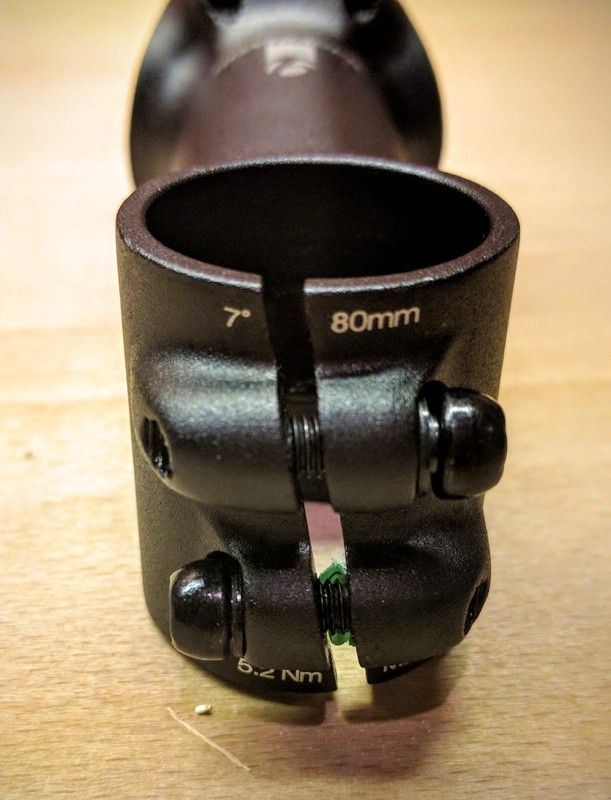 [/img]
Secondly, based admittedly only on a comparison of a Bontrager stem with an angled split with a couple of stems with vertical splits, it appears that the angled design enables the two bolts to be quite a bit closer to the steerer. I've measured the distance from the front of the stems to the bolts using a vernier calliper and the measurements are as follows:
Bontrager - 30.6mm
Deda - 31.4mm
FSA - 31.5mm
So the thickness of metal in the stem clamping area between the bolt and a 28.6mm diameter steerer is only 2mm for the Bontrager, compared with 2.8mm and 2.9mm for the other two stems. I would be interested to know the thickness at that point of the Ritchey stems that cracked.
A response from Ritchey:
Hi Rob,
Thanks for the email. Looks like there was not enough steerer tube for that stem to clamp onto. It is best to have the stem clamp the entire steerer with a small spacer on top but if that is not possible you should not exceed 2mm between the top of the steerer and the top of the stem. I will forward your email to my colleagues in Europe who Wiggle would contact should there be any questions.
Best Regards,
Ritchey Design
Info & Warranty Line
Ritchey Design
www.ritcheylogic.com
Their own literature says 2-3mm and its 3mm - we'll see whether I actually get the refund, sent back to Wiggle yesterday.
@slowster the bolts on yours look further away from the top/bottom maybe it is the proximity of the bolt to the end of the steerer tube.
I think that Ritchey have shot themselves in the foot with that email. They are now saying it's best to have the stem clamp the entire steerer with a small spacer on top, which is what Trek/Bontrager says, but which is NOT what Ritchey's own manual published on its website says, e.g.
"You have installed the correct number of spacers, when the steerer tube ends 2mm below the top edge of the stem"
and
"The space between the steerer tube and the upper edge of the stem should not exceed 2mm-3mm."
At no point in the manual do they indicate that really what is best is that the steerer protrudes above the stem with a spacer on top.
Back [url= http://singletrackworld.com/forum/topic/stem-slippage-on-carbon-steerer-user-or-equipment-error ]on this thread[/url] I posted the following links to Trek's guidance etc. on this issue. The focus of that guidance was on not damaging/crushing carbon stems, but I guess if the steerer is steel, then if there is overtightening of the stem or a design/casting flaw in the stem, it is the aluminium stem that is likely to fail rather than the steel steerer (so the issue is the same, just a different failure mode).
Trek/Bontrager detailed a few years ago what they considered essential for stems used with carbon steerers in this document:[I can't get this link to work using the Preview function, so you may need to copy and paste it into your browser]
which was referred to in the cycling press following a catastrophic failure involving a road racer in the USA (see links below). I suspect the failure was caused by incorrect installation, such as way overtightening the stem bolts, rather than (as Trek suggest) a flawed stem design, but even so Trek's guidance concerning suitable stems and installation does seem to make good sense to me.
http://www.bikerumor.com/2010/06/23/broken-trek-carbon-steerer-tubes-result-of-the-wrong-stems/
I note that Ritchey's manual is dated 2012, and they have not updated it to match the guidance issued by Trek regarding steerer height (although evidently they agree with it based on their email), and the use of carbon paste on steerers etc., even though they will be aware of their competitors' guidance and the reasons for it (including the documented reports of accidents).
@slowster the bolts on yours look further away from the top/bottom maybe it is the proximity of the bolt to the end of the steerer tube.
I'm not sure about that, although it could be a factor. Like I said, I would be interested to know the thickness of your stems between the bolt hole and the inside surface of the stem. I am not a metallurgist or an engineer, but from a layman's perspective the more I think about it, the more it seems to me that this is logically where the cracks must have started (the thinnest and most stressed part of the stem around the steerer). The cracks then propagated diagonally in the same fashion each time, and I suspect those diagonals are similarly the lines of greatest weakness. In other words, the cracks were not vertical because although more stressed, the metal is thickest in that direction; and not horizontal because although the metal is thinnest in that line, it is less stressed in that direction.
Isn't it the stress riser caused by the recess for the bolt causing it?
(An aside - dangerously little steerer engaged with the top/front part of the stem).
I've got to admit I wouldn't trust one of them stems again.
Isn't it the stress riser caused by the recess for the bolt causing it?
Looking at the photographs again I think you're right. That said, the angled split design allows the bolt head recess to be positioned closer to the steerer (with correspondingly less metal between the bolt shoulder and the steerer). If you look at the photograph of the Bontrager stem I posted above, you can see that if the bolts were rotated 180 degrees, the bolt heads would be further away from the steerer tube.
(An aside - dangerously little steerer engaged with the top/front part of the stem).
If you mean the big cut out in the front of the stem clamping area, this was something Trek highlighted about other manufacturers' stems in their warning notice. Trek's stems used to have similar large cut outs, but now they are much smaller.
Get a nitto.
I think that as well as getting in touch with Wiggle, I would be emailing the link to the manual stating 2-3mm clearance at the top of the stem is correct.
FWIW, I don't think this fully explains the failure.
On another note, my uncle fell off his bike due to a handlebar failure and broke his neck the other week. For the sake of literally couple of grams of extra material there it seems to be pushing the boundaries of durability quite severely, to put it mildly.

