Cue pictures of Chopper bikes.
Having ridden my LLS MTB for almost everywhere for the past 18 months and recently hopping back on my road bike for a bit I'm coming to the conclusion that I prefer the slack feel of the MTB everywhere, even on the road. I don't need to fight for position in a sprint finish, so don't really see any advantages to the steep road geometry any more (even on the road). I can carve the type of corner you get on most roads much faster (and find it more fun) on the slack MTB so I'm wondering if it's possible to get a road/gravel/touring bike that recreates that steering feel (at least to some extent)?
It's still very much a thought-experiment at the moment, but my wish-list for a road/gravel bike would be:
Slack
Long
Steel if possible
Dropper ready (routing and seat tube diameter)
Vintage pathracer

plus
Check out the Trek in this video:
Whyte Friston/Gisburn is, relatively speaking, long and slack. The Gisburn comes as standard with a dropper although a crotch-grab style one.
I've got a Friston which is great, they're definitely grav bikes aimed at MTBers looking for some drop bar action. It's aluminium but is far from a harsh ride especially with 42c Resolutes on.
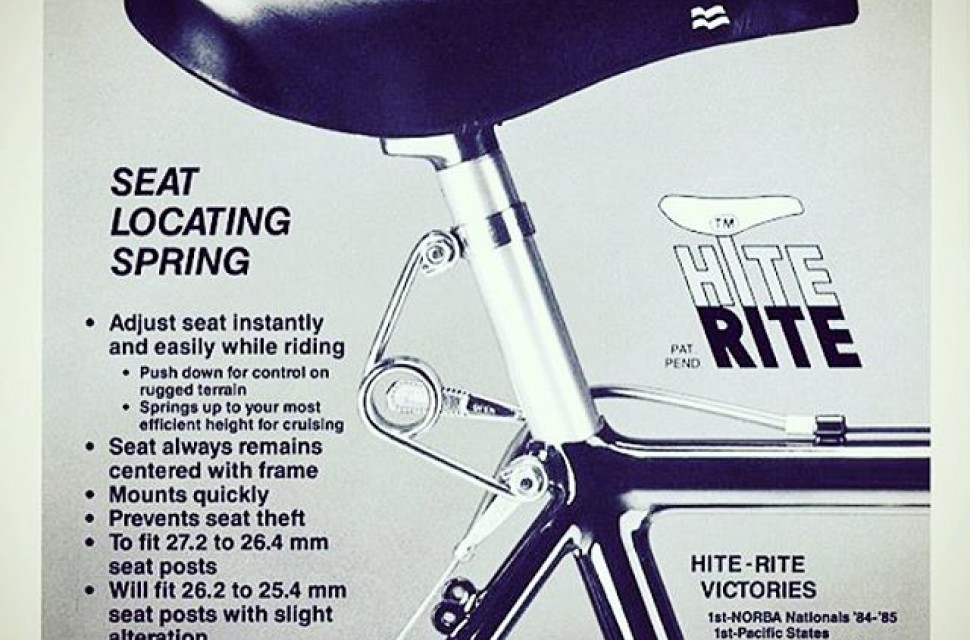
I have a vintage path racer like the one shown above.
Slack is shite and floppy.
Slack is shite and floppy
Care to expand on that a bit ? I can see that optimum road/gravel geometry will be different to optimum off-road, but modern MTBs seem to have geometry that would have been dismissed as crazy slack a few years ago, but is now accepted as a better option for many people. I certainly found my FlareMax to be strange (yes, even floppy) at first but now I'm surprised to find that I actually prefer that chopper feel even on the road. Combine it with drop bars and maybe it's terrible, but those old tourers were presumably built that way for a reason.
Slack
Long
slack yes, compared to a road bike but not to a MTB but long? not really as most are based on road bikes so will be short to counter the out front hoods. try a test ride on one first. tech terrain on a gravel bike is not good with a long top tube and a short stem, it gets all twitchy and you bang your knees on the bars.
for this effect try drop bars on a hardtail mtb. the reach will be longer and lower and a short stem and narrow bars will make it an "engaging" ride.
I has one of those Hite Rite springs back in the 80s, was on a Fisher Hoo-Koo-E-Koo IIRC....
tech terrain on a gravel bike is not good with a long top tube and a short stem, it gets all twitchy and you bang your knees on the bars.
Isn't that an argument for making it slacker then ?
Don't know about slack, but if its' long you want, just buy an XL rather than a L like I did...
The only reason I can see for road bikes being short and steep with long stems is to maximise aero advantages, particularly when slipstreaming. I'm curious to hear others!
Salsa Cutthroat? Although it's carbon frame iirc.
tech terrain on a gravel bike is not good with a long top tube and a short stem, it gets all twitchy and you bang your knees on the bars.
I'd disagree with that to a certain extent as like all things bike related its a mix of geometry, wheel size, riders body proportions etc. I love tech on a longtop tubed short stem drop bar beastie with a pretty mad geometry, but then I run massively wide drop bars, and hooligan over stuff, so probably a lot closer to the sort of bike the op was on about rather than a trad gravel/tourer. definitely agree about testing lots and finding one that works for you, it may be a surprise as there some very capable gravel bikes out there even if they have a more "traditional" geometry
@tazzymtb Do you find that you are much slower on the road with such a beat though? I guess you're getting more into "monstercross" territory than "gravel" (if either of those terms actually mean anything).
@chiefgrooveguru I don't know about slipstreaming, but I think aero may be the flaw in my logic. Narrow bars are probably required for aerodynamic efficiency and anything without them may be a fair bit slower on the road, where speeds are higher. Once you accept a narrow bar it does seem that a long stem and steep head angle have to follow.
Isn’t that an argument for making it slacker then ?
Slack on the road would make fast cornering horrible & no handers harder. Compromise needed for gravel especially in the UK as most routes will involve tarmac at some point
@tazzymtb Do you find that you are much slower on the road with such a beat though? I guess
If you are worried about ultimate speed, watts & aero etc I think a gravel bike isn't what you want. But they will go a lot faster than an MTB so again compromise between on road & off road efficiency
@roverpig Its more monster truck than monster cross, (titanium, 29+, 675mm wide dropbars, booze holders, and extra "look at meeeee flange" but happily moshes along big old gravel events and out descends pretty much every other gravel bike and the rougher, looser and gnarlier the better. Yes its a bit slower on the road**, but that's more a function of me usually being a sodding singlespeed luddite, although I am currently on a 6spd home made system that mounts onto my ss rear hub for a laugh.
** any slacker, fatter, knobblier thing will be slower on the road, but then road riding is grim and something to be endured to get to the fun bits, so the ability to make tractor noises, wheelie, do endos and generally muck about in a way that would make the spandex chaps have an attack of the vapors, clutch their pearls and worry about their VO2Max is a win for me.
Slack on the road would make fast cornering horrible & no handers harder
My FlareMax with its slack head angle is the easiest bike I've ever had for riding no handed. I'd pretty much given up riding bikes no handed to be honest. Then I was riding the FlareMax on the road one time and just did it and though "this is easy, must be the slack head angle". But I've heard a few people say that slack head angles make it harder to ride no handed, so I'm not really sure what's going on. Not that no handers are a big thing on my wish list, but it's strange that I find them (along with track stands) so much easier on my FlareMax than any other bike I've ever owned.
After trying out a few gravelcxy bikes I’ve decided to have a custom steel one done based around Whyte Gisburn/Friston’s geometry. 70* head angle with 180mm headtube and slammed 100mm stem, 74 seat tube and 595mm ett seems to work well for me at 6’2” with the body of an ape.
The best gravel bike I’ve ever had a pleasure to find myself on, I can’t imagine going back to a steeper and shorter geo. Couldn’t care less about KOMs though and only bimble on one gear so I’m not worried about lack of speed and or aero position.
LLSFTW!
Thanks @tazzymtb 29+ ? Yes, that's another itch that needs scratching one day 🙂
"Slack on the road would make fast cornering horrible & no handers harder"
Why do you think that? Steering geometry theory says that slacker equals more stability when going in straight lines or constant radius turns.
Not understanding the less aero aspect. It is still a road bike with drops and if the fit is the same in regards to saddle to bar distance it will make no difference other than change the steering feel/response.
Less aero would occur if you raise the bar height, which is not being suggested here.
I am out anyway as I love the feel of a responsive and nimble road bike on road and off road.
True, but a slacker head angle probably does require a shorter stem and wider bars to make it work and wider bars are less aerodynamic
cervelo aspero is probably a good bike for you as it's labelled as a "racing" gravel bike, so fast every where apparently. might be difficult to load up for bike packing/touring as it has minimal mounting points but sounds like a lot of fun to ride

cervelo aspero is probably a good bike for you as it’s labelled as a “racing” gravel bike,
It probably is but is that deemed long and slack as certainly doesn't look any of those. It actually looks pretty short as rear wheel is right against seat tube and very little gap between front tyre and downtime. Hard to tell head tube angle but again doesn't look any different from a roadish bike.
I've just bought this Specialized Sequoia. Swapped to 650B as soon as it was out of the box, with 47c WTB Senderos. Steel, 70deg head angle.
It's a blast to ride... Like a rigid MTB but still fast enough of the road. Billions of mounting points if you want to add racks etc.
Only thing missing of your list is dropper capability but that's fairly easily fixed.
[img]  [/img]
Damn double post
Ragley Trig is steel, dropper compatible and has a 70 degree head angle.
http://ragleybikes.com/products/trig-adventure-complete-bike-2019/
Marin Gestalt X11 also looks good and has dropper compatibility too
https://www.marinbikes.com/gb/bikes/20-gestalt-x11
Perter Verdone is designing and prototyping some amazing bikes that are really pushing the boundaries. The detailing is just incredible.
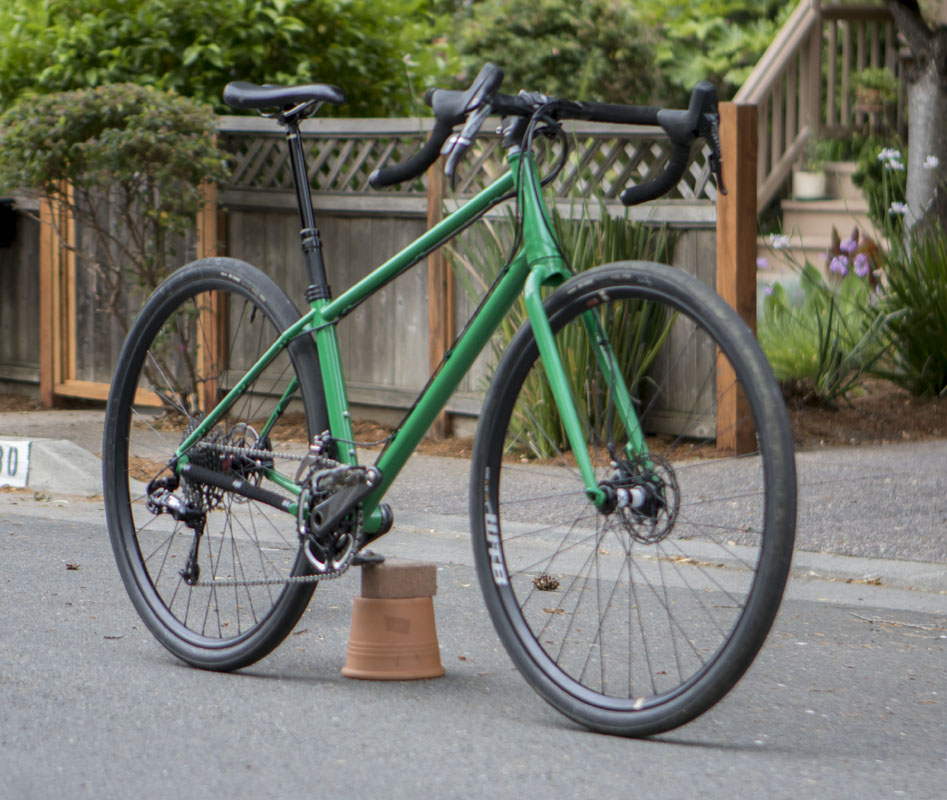
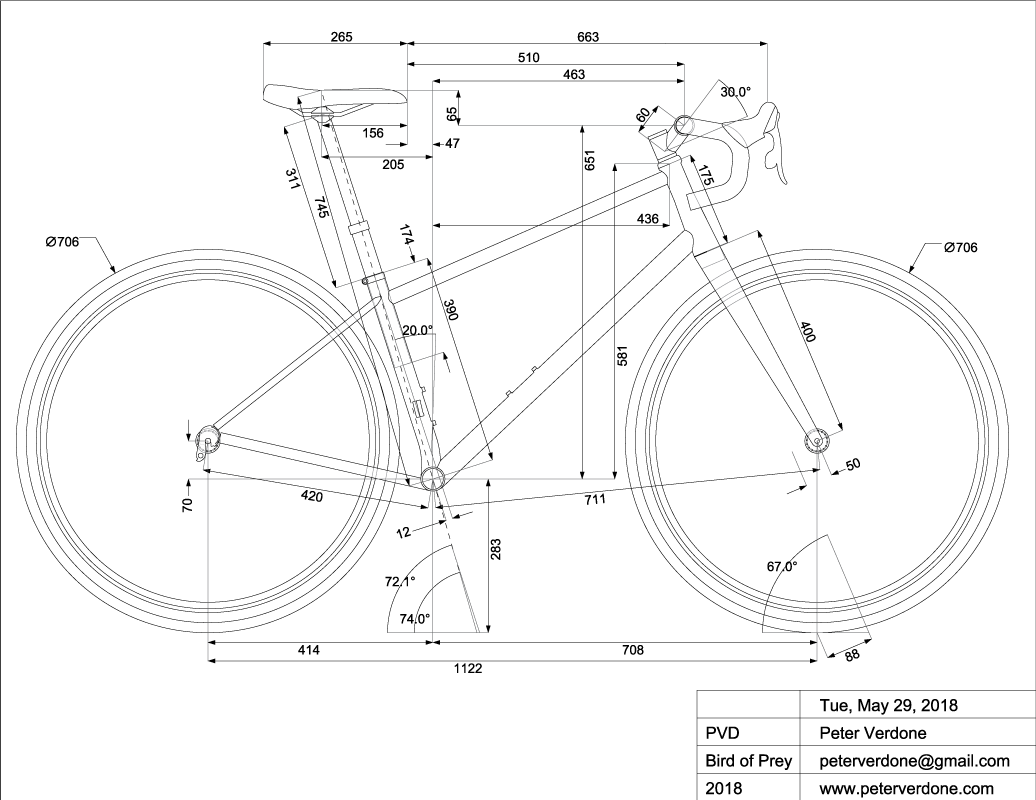
Check out his thoughts http://www.peterverdone.com/2018-pvd-bird-of-prey/
He goes on to make his own bars https://www.peterverdone.com/bi-planes-are-the-future/
Thanks folks. So it looks a though 70 degrees is considered slack in the gravel market. Well by everyone except Peter Verdone that is 🙂
That PVD bike is the first drop bar bike I actually want to ride!
That PVD is odd/interesting looking. Proper drop bar for a mountain biker!
That PVD bike is the first drop bar bike I actually want to ride!
Same thought here
roverpig
Care to expand on that a bit ?
The proof of the pudding is in the riding thereof. Shite and floppy.
It's an entirely different thing from mtb geometry.
1. Rigid fork v suspension. Telescopics work better at an angle in the mid 60s, it helps reduce stiction and stutter compared to a steeper angle.
2, Usage. Slack mtbs are aimed at descents, ...
I could go on about trail, offsets etc, but it is really better for you to try a slack rigid bike rather than me pontificate. (Always bearing in mind that unicycles make a nonsense of most steering geometry ideas and the human body can adapt to some quite wold geometries 🙂 )
I could go on about trail, offsets etc, but it is really better for you to try a slack rigid bike rather than me pontificate.
Agree. Guess the whole point about needing a slack road bike is missed on me but I don't get why anyone would want a bike to ride on tarmac roads that handles slowly and has floppy steering.
But then people ride touring bikes I suppose and they are longer and slacker but that is to bring stability when loaded isn't it?
that PVD is doing similar things to some of the bikepacky folk have done with stooge mk2's etc... If you want mental stuff have a look at the stooge dirt tracker (a bit normal) or the stooge gravel bastard (total nutter, long top tube, short stem, 650b+ rags around trail centres and launches tabletops in a manner that is really rather surprising)
This is something I've dabbled fairly extensively in.
I'm pretty close to sending my numbers off to Waltly Ti for my third custom frame.
This one is a 29er primarily for rigid bikepacking / gravel riding.
I've tried a very slack HA, but for this type of riding, prefer a good old fashioned 69HA but with very long reach and short stem.
This keeps the wheel well out in front for secure descending, but keeps handling snappy. It also means you can use readily available forks, instead of having to get custom ones made with 100mm offset like my current ones.
It's worth lengthening the chainstays a bit to keep a bit more weight on the front wheel, without having to push through your hands.
High front end is preferable IMO, but appreciate concerns with that if aero is important.
I could go on about trail, offsets etc, but it is really better for you to try a slack rigid bike rather than me pontificate.
It wasn't until I read this that I realised I (kind-of) have. I've ridden "trail" rigid fatbikes for a few years with head angles around 68 degrees. It's notable that whenever I've done anything to make them slacker (such as running a smaller rear tyre) I've found it improved the feel (for me), even on road. But, of course, a bike with a 3Kg wheel is going to feel very different to a gravel type bike.
the stem on that PVD is awful, why not make the headtube taller then run a normal stem instead of a skyscraper?
“don’t get why anyone would want a bike to ride on tarmac roads that handles slowly and has floppy steering.”
Because on roads you basically ride in straight lines compared to what we do on our far slacker mountain bikes! Why wouldn’t you want massive stability so you can relax and pedal or coast at very high speed, without distracting steering nervousness?
That's basically my logic too. I make far more frequent and more extreme changes of direction off-road that I do on (due to twisty trails and the need to go round, over or under obstacles). Yet I'm happier doing that with a slack head angle. In fact I now seem to prefer that steering feel even when I'm on road. Mainly because it feels so stable in the bends, so I can really weight the front and carve the turn. On a road bike, even in the middle of a turn, it just feels too light to feel confident leaning into it. For a skilled rider I'm sure that ability to make small corrections to the line mid-corner is an advantage. But for me, I'm much happier if I can just trust that it will hold its line.
Of course, if the whole world yings and you want to yang, you have to accept that you might be wrong. There may be a good reasons why road/gravel bikes are better with steeper head angles. I just don't understand why (yet).
the stem on that PVD is awful, why not make the headtube taller then run a normal stem instead of a skyscraper?
If you read the rest of his writings he is building a custom wing bar for it.
Also he seemingly has little concern for aesthetics, pure function led design.
Care to expand on that a bit ? I can see that optimum road/gravel geometry will be different to optimum off-road, but modern MTBs seem to have geometry that would have been dismissed as crazy slack a few years ago, but is now accepted as a better option for many people. I certainly found my FlareMax to be strange (yes, even floppy) at first but now I’m surprised to find that I actually prefer that chopper feel even on the road. Combine it with drop bars and maybe it’s terrible, but those old tourers were presumably built that way for a reason.
For the OP, I'd agree with the above. Tourers weren't meant for giving you the best chance of avoiding a wheel touch when things get twitchy in a bunch. Just for ploughing on without a fuss, loaded up, potentially on fairly lumpy ground.
The steep angles on many gravel bikes strike me very much as a marketing thing - making it "feel"/handle like a racer, but it's pointless unless you're going to find yourself using it for that purpose, which nobody is. My current commuter handles like an absolute barge but that's fine, I'm not riding it in a twitchy bunch. Similarly for most people a road bike isn't going to be raced in a bunch (me included to be honest, only raced in a bunch on the track), so if you prefer the feel, go slack.
And sure, anything you'd want to ride off road, a dropper is going to make the descents far more enjoyable. Some suspension forks may be a good idea, too?
Why wouldn’t you want massive stability so you can relax and pedal or coast at very high speed, without distracting steering nervousness?
Personally, I am more likely to get nervous on the road with a bike that's slow to react to my steering inputs.
But it's not really that slow to react is it? Sudden unexpected events happen far more frequently off-road than on and yet we're all happy riding slack bikes off road now. If I can dodge that rock, hole, root etc that I didn't see until the last minute on the trail then I should be able to cope with anything I encounter on a road.
As I said earlier, I'm quite happy to accept that I may well be wrong. There may be a good reason why a road/gravel bike is better with a steep head angle, but I've yet to hear a reason that makes sense for me.
Yes, it allows you to get closer to the rider in front and if you spend a lot of time in a bunch that's probably reason enough. But I don't, I mostly ride on my own.
Yes, if you compete for bunch sprints, but again that's not a situation I even find myself in.
Other than that, all I've really come up with is that "it feels faster", which is fair enough. If a faster feel makes the ride more fun then that's a decent reason. But set against that, I've been watching the carnage in Yorkshire. It seems to me that quite a lot of crashes (particularly when the rider is out on their own in the wet) are just a result of losing control of the front end. So, if it's just a case of feel and it's not actually any slower in reality I think I'd accept it feeling slower in return for more chance of staying rubber side down.
^ I think the crashes are zero to do with HTA and all to do with bunch riding. Race bikes are a tad lighter steering / lower trail than I like for general road use but I've found only negatives by going much slacker or more out-front on the front wheel - you lose front wheel weight distribution and that also causes bad crashes (as I have found). You can correct that f wheel weighting with a longer CS or a steeper STA but this is a road-ish bike and all those things have negatives or are solutions to problems that are marginal, eg corrected with half to a degree HTA or 5mm offset change, subtle stuff. By all mean go way out on numbers simply if you like the feel though. I've tried a load of stuff in this area and come back to both a renewed respect for Italian road bike design as well as not liking slack drop bar bikes in any way (or the lower trail opposites tbh).
As I said earlier, I’m quite happy to accept that I may well be wrong. There may be a good reason why a road/gravel bike is better with a steep head angle, but I’ve yet to hear a reason that makes sense for me.
I'm simply giving you my opinion based on riding road bikes with traditional "racing" geometry. I don't find them unstable or twitchy to ride - quite the opposite. I think there's a risk of getting too hung up on the numbers - notionally my gravel and road bikes have similar geometry but they don't ride anything like the same.
"I don’t find them unstable or twitchy to ride"
That may be, but can you stop anywhere near as quickly on a road bike as on a longer wheelbase mountain bike with a dropper post? This is what I dislike about road bikes when commuting, they're simply not as safe!
That may be, but can you stop anywhere near as quickly on a road bike as on a longer wheelbase mountain bike with a dropper post?
Eh? I don't see how brakes are affected by dropper posts.
Eh? I don’t see how brakes are affected by dropper posts.
Really? I hate dropper posts and even I can see how they'd let you brake harder. It's simple physics.
The numbers don't necessarily match those above, but the Bombtrack Hook EXT is a lot of fun in the way you describe
Fun
The main reason for why a road bike doesn't stop as quick is simply down to the size of the tyres, particularly skinny 23mm tyres pumped-up rock hard. I've ridden and raced all bikes, from road bikes, criteriums, CX, MTB and multi-day endurance events - you simply get used to the handling traits of each.
Really? I hate dropper posts and even I can see how they’d let you brake harder. It’s simple physics.
Please explain.
Really? I hate dropper posts and even I can see how they’d let you brake harder. It’s simple physics.
This assumes that you drop the saddle each time you want to brake. Not sure that process is going to shorten the braking distance.
“This assumes that you drop the saddle each time you want to brake. Not sure that process is going to shorten the braking distance.”
The only time you’re going seriously fast on a bike is downhill. I drop my saddle for going downhill, whether I’m commuting on the road or MTBing. It’s safer on the road and more fun off-road.
“Eh? I don’t see how brakes are affected by dropper posts.”
If you lower the centre of mass on a vehicle you increase the max deceleration before the rear tyre lifts and before the whole vehicle flips over the front wheel (if there’s enough tyre grip). Lengthening the front centre helps too.
I’ve become very much aware of this because I got my old Brompton out of retirement last week. Now that is even shorter and steeper than a road bike with an undroppable saddle. The hills of Brighton are far scarier than on my usual (inappropriate) commuting bikes (well maybe the motorised Levo isn’t inappropriate despite the six inches of suspension and big knobbly tyres, but my equally gnarly hardtail certainly is!)
If you lower the centre of mass on a vehicle you increase the max deceleration before the rear tyre lifts and before the whole vehicle flips over the front wheel (if there’s enough tyre grip). Lengthening the front centre helps too.
No, I get why dropping the post to get your weight back is helpful off-road, it's just that I don't think it's remotely relevant to road riding. I can brake very hard from the drops without any fear of going otb.
Thanks for keeping this going folks. Some very interesting points. @chiefgrooveguru is basically making similar arguments to me, with more experience to back it up 🙂 I’m still on the fence a bit though. I totally agree that increasing the front centre requires an increase at the rear too in order to stop the front getting too light. I don’t mind longer chainstays really though as they improve comfort. But the consensus is that power delivery isn’t as good (although I’ve not seen proof of that) so maybe that is the limiting factor. You don’t want the chainstays getting too long (for efficiency) which limits how long/slack you can go at the front. Well it’s a hypothesis I guess :j
But the consensus is that power delivery isn’t as good
Fair hypothesis .. I think that's mostly misconceptions from the road racers though tbh. It's like the stiffer frame vs the more flexible frame, the response time and feedback from a longer rear may feel different but overall power delivery needn't be affected in a way you could measure. Adjust your riding to the bike and it's still efficient. A racer wants a snappy response but that's about racing responses more than any power losses. And a lot of small gains do add up so it's part of race bike design.
I'd say you don't want the CS to be too long in balancing that longer front as it just doesn't follow tighter road corners well. Means you need to really commit and force the front round more, and that's more likely to mean a slide in the wet or on gravel - the thing you're trying to avoid by going longer and slacker if I understand the OP. Let's say you went to 660mm front centre, it's not that long. By road bike front/rear centre proportions of (eg) 59%/41% you need a 458mm CS to balance it up (assuming the same rider position over the BB). I've ridden a drop bar all-road bike with ~those dimensions, as you'd expect it's great in a straight line on a choppy byway but useless in the hairpins. You could adjust the rider position to reduce CS length and still keep weight on the front wheel but then you're getting close to the 'just get the light rigid 29er out' stage since you'll need to adjust how you corner etc anyway.
It's like the bars and tyres compromises all-road bikes force us to make - how we ride and corner is also different between road and off-road bikes and a middle-ground design's validity is subjective, varies by rider preference.
I’d say you don’t want the CS to be too long in balancing that longer front as it just doesn’t follow tighter road corners well. Means you need to really commit and force the front round more, and that’s more likely to mean a slide in the wet or on gravel – the thing you’re trying to avoid by going longer and slacker if I understand the OP. Let’s say you went to 660mm front centre, it’s not that long. By road bike front/rear centre proportions of (eg) 59%/41% you need a 458mm CS to balance it up (assuming the same rider position over the BB). I’ve ridden a drop bar all-road bike with ~those dimensions, as you’d expect it’s great in a straight line on a choppy byway but useless in the hairpins. You could adjust the rider position to reduce CS length and still keep weight on the front wheel but then you’re getting close to the ‘just get the light rigid 29er out’ stage since you’ll need to adjust how you corner etc anyway.
It’s like the bars and tyres compromises all-road bikes force us to make – how we ride and corner is also different between road and off-road bikes and a middle-ground design’s validity is subjective, varies by rider preference.
i'm sure that's exactly what i said on page one but with much less eloquence 🙂
btw i rode an Arkose yesterday and it's not far off what the OP wants, slack compared to a road machine but not upright like a hybrid. very nice off road with 42mm resolutes on it
RD - yes - balance is the thing isn't it. But who's less eloquent? : )
So what is it that makes the fundamentals of road bike handling so different to MTBs? Is it the high saddle and drop bars so you lean in unison with the bike, is it the skinny tyres, or is it something else?
having seen one in my LBS i really fancy a Rondo Ruut CF2 but then i also want a Ribble Ht Ti, and a new motorbike!
So what is it that makes the fundamentals of road bike handling so different to MTBs? Is it the high saddle and drop bars so you lean in unison with the bike, is it the skinny tyres, or is it something else?
The handling is quicker due to the geometry (angles and bar height). I had an MTB which was made for a 100mm fork and I fitted a rigid carbon fork that was shorter. It ended up feeling very much like a road bike as saddle to bar drop was large and head tube angle was around 73 degrees.
I actually ride a track bike with risers and it felt the same as that as far as steering was concerned apart from one thing, the tyres. Narrow tyres make the steering lighter and quicker due to less friction onto road combined with lower forces side to side due to less weight.
I recently changed from 28c to 23c (same model of tyre) and even that difference is noticeable and the bike feels more agile.
“The handling is quicker due to the geometry (angles and bar height).“
That’s not what I’m talking about. Show me any road and I’ll show you a million bits of singletrack which are far more twisty - yet with MTBs we’ve seen a shift to much more stable slower steering behaviour. Why is that a good thing on a MTB but a bad thing on a road bike?
What is the fundamental difference in how you ride the bike or the effect of the other unchangeable characteristics (narrow bars for aero, narrow tyre for rolling resistance, etc)?
On a road bike, even in the middle of a turn, it just feels too light to feel confident leaning into it.
Maybe your brain has adapted to the heavier input needed to steer a lomg, slack mountain bike and you have trouble modulating your input to a quicker steering road bike. Relativity is an odd thing. In a previous life I road-tested motorcycles. To begin with, I found it really hard to swap between different types of bike - trail bikes, race replicas, hideous chopper-styled, raked out Harley replicas etc. After a year or so, I got really good at it.
Similarly, I rode a borrowed Trek Full Stache for a day on local trails. It's like a monster truck. Before I rode it my Sonder Transmitter felt long and slack. After I swapped back, the Sonder felt like a BMX. Go figure.
Finally, yes there are slower steering road and gravel bikes because tourers and sportive riders don't need the sort of reflex-sharp steering that pro racers do, but they don't need to be as slack as a mountain bike to be appreciably more relaxed, there's a smaller envelope. Oh, and some people just prefer a sharper steering feel because the bike feels lively and fast on a subjective level.
Also, how would relatively narrow drop handlebars cope with the steering input potentially required for slacker geometry or would you just fit 800mm flat bars?
Why doesn't everyone drive a slow, steady, stable, Volvo estate? Why aren't all running shoes massively cushioned? Why wpuld anyone eat chips when you could have rice, which is easier to cook?
Ultimately, I guess the answer, if you want such a thing, is to get a road/gravel frame custom made to your favoured mtb geometry and see how it rides.
I think a lot of it is to do with body position onnthe bike as well.
On a road \ gravel bike your body is much more stretched out, with more weight further forward compared to an mtb. So turning and direction changes are much more subtle, I think this would lead to 'oversteering' with a really slack head angle. As the front would pitch over due the weight distribution.
Hopefully someone else can explain this better than me 😂
Show me any road and I’ll show you a million bits of singletrack which are far more twisty – yet with MTBs we’ve seen a shift to much more stable slower steering behaviour. Why is that a good thing on a MTB but a bad thing on a road bike?
Because the terrain is rougher, throws steering off etc,. On the road the movements are small and it is nicer to have quicker responses to them. And by the way I preferred riding an mtb with quicker steering on twisty single track hence the short fork I put on my bike.
That’s not what I’m talking about. Show me any road and I’ll show you a million bits of singletrack which are far more twisty – yet with MTBs we’ve seen a shift to much more stable slower steering behaviour. Why is that a good thing on a MTB but a bad thing on a road bike?
I'm not convinced that it is a good thing on a mtb in twisty singletrack.
The problem I have with these sort of threads (no offence OP) is that I am happy to accept that some people have different preferences when it comes to bikes. Maybe road bikes don’t suit you, which is fair enough. But suggesting that all road bikes are therefore wrong is ridiculous. I can still remember getting on my first road bike over 15 years ago and thinking ‘My god. What have I done?’ You get used to them. A nimble, precise handling road bike is a joy to ride.
And by the way I preferred riding an mtb with quicker steering on twisty single
Every time, LLS comes into its own the rougher and steeper it gets. If your not riding that quicker handling bikes can be more fun.
I am happy to accept that some people have different preferences when it comes to bikes.
Exactly. There is no real right or wrong, just preferences within boundaries. I love the bike I ride for road, gravel and small bits of single track whereas most people would probably get off it in a few hundred metres and put it down and never want to ride it again!
Lots of really interesting comments and bike suggestions here. I’d be here all day trying to respond to them all but I have read, reflected on and appreciated them all. Thanks.
I did spend over 30 years as a roadie and enjoyed nice tight handling road bikes. But I’ve spent the past five years riding almost exclusively off road on bikes that have got progressively longer and slacker. Now I’m looking for a bike that can do a bit of road and a bit of trail and find myself questioning why gravel bikes seem to mainly adopt road geometry. Not saying it is wrong, just questioning.
So, lots of the points about it being what you are used to are very valid.
We’ve also had the rise of gps and apps like Strava over the past few years which have highlighted (to me at least) that feeling fast isn’t always the same as being fast. Although feeling fast/fun is a perfectly good reason to choose a bike.
Finally, for now, there is nothing new under the sun of course. Those rough stuff people were taking “touring” bikes off road before I was born and I suspect that all my thinking would just bring me back to a bike with touring geometry and disk brakes in the end. But I’m one if those weird people that enjoy a good think 🙂
Show me any road and I’ll show you a million bits of singletrack which are far more twisty – yet with MTBs we’ve seen a shift to much more stable slower steering behaviour. Why is that a good thing on a MTB but a bad thing on a road bike?
(edit - as posted above as I was typing - ) Arguably a modern LLS MTB isn't much better (as good as?) an early 90s XC bike on twisty lower-tech singletrack and early 90s MTBs were still developing, the era when MTBs were designed by a lot of roadies with low fronts, long stems and steeper angles. Anyway, roads aren't that twisty as you say but a road bike works well when you can corner hard from close to the seated pedalling position. You pedal along, lean into the corner and pedal out, repeat. Cornering an MTB is far more active and dynamic. No reason for a road bike not to use that off-saddle, body adjusted committed cornering technique but the all-road bikes I've had that can benefit from that still get a bit wearing to ride on road. eg the PvD bike (which is an all-roader and prob a riot on loose gravel) will be amazing on some roads if you ride it like a mountain bike. But on a longer road ride that's not what I'd want. And cornering on an MTB is partly about the edge of grip and how to push it and you don't want to / can't do that on road. Slide a tyre and you're down.
That's one big difference - steering methods, geometry, all around how an MTB is designed to handle sliding tyre/s. On a road bike you have huge amounts of grip (in the dry) and you really don't want to lose that at either end. The way you corner them (road bike is a lean with minimal bar steer and reliant on the short wheelbase for tighter turns vs MTBs from-hips / opposite lock tendency, potentially lot of bar steering to force a longer wheelbase round and slide where needed), the weight distribution, need for aerodynamics and efficient pedalling, etc. They're polar opposites in every area I can think of that would affect steering geo or general design?
What is the fundamental difference in how you ride the bike
So I'd say it's the way we interact with the bike as they're cornered, which is fundamental to a bike's design brief.
Relativity is an odd thing.
This is a really valid point. I make a point of jumping on my road bike straight after a 2 week loaded tour on my fat-tyred all-roader, or onto the all-roader after a longer period of just riding the MTB, since the adaptation to one bike makes some aspects of another stand out. The best bikes seem to also be ones that are natural and fast to adapt to from a muscle memory of something quite different. I do think what we talk about in these threads is as much feedback loops, preferences and muscle memory as the design and handling tech we think it is. Good geek-out topics..
Now I’m looking for a bike that can do a bit of road and a bit of trail and find myself questioning why gravel bikes seem to mainly adopt road geometry. Not saying it is wrong, just questioning.
In short, gravel bikes are simply fatter-tyres road bikes with a slight geometry adjustment to suit comfort and easy off-road terrain - though they still behave much like road (or CX) bikes in most ways. That's right imo, as any light drop bar bike should be capable of making a good road bike esp with some 28mm tyres on.
It’s funny thou the subtle change in a bike and the perception feel.
I have a fancy gravel bike for fun and it’s Chinese clone for commuting duties, the geometries and setup are the same on both but the commuter has a narrower width version of the handlebars and feels so much better although the usual sizing guidelines would edge towards a larger width in relation to shoulder width.
Yes, I guess that’s the sort of thing I had in mind when I started this thread. Not so sure now I’ve seen it though 🙂

(image via LFGSS)