Fag packet maths: 29x3.0” vs 32x2.5” is coming out 22mm different radially, another in between size, if they’re headed in that direction can’t we skip this hustle and go straight to pushing 36”? Or is it as unwieldy as I’m imagining and thus a harder sale?
I had simply surmised 29+/32” similarity because early adopters, mentioned before, have apparently used 29+ frames and forks to try the concept out, 22mm isn’t nothing, but it hardly seems worth the upheaval of changing everything about your current bike(s) to adopt.
My reading of the market is that 29+ has remained a bit of a (sustainable) niche since it’s introduction it never became a majority choice. But along with 27+ it did prompt regular MTB’s clearances to increase a smidge and tyre makers to offer more 2.6” and 2.8” options in “normal” tyres.
So we’re all a little more comfortable with tyre girth today than we were 10-15 years ago, and happy enough on 622mm rims for the most part. So why have you got to **** with that all over again just because of some niche weirdos that just like constantly playing with different wheels for the sake of it?
Not sure why people are saying it's the same size as a 29+ tyre - few of them are over 3" nowadays, so little over 30" diameter. 26 is 559mm, 27.5 is 584, 29 is 622, 32 is 686. So that's steps of 25mm to 27.5, 38mm to 29, and then 64mm to 32. It's MUCH bigger.
Tyres, when you embiggen the width you embiggen the depth...
And the Radial differnce in rims needs the depth of tyres adding to make meaningful sense...
A cromulent point.
“Tyres, when you embiggen the width you embiggen the depth...
And the Radial differnce in rims needs the depth of tyres adding to make meaningful sense...”
Tyres have got bigger: 2.3-2.6” have become ubiquitous, with 2.4” dominating for everything from XC to DH. With plus tyres, hardly anything over 3” has survived and they often size smaller than claimed, because the bigger tyres are more finicky about pressure especially when cornered hard.
26x2.4 = 681mm
27.5x2.4 = 706mm
29x2.4 = 744mm
29x3.0 = 774mm
32x2.4 = 808mm
I just don’t get the arguments that 29+ is basically the same size as 32 or the complaints that we shouldn’t be creating a new standard that makes old things obsolete because they’re mutually exclusive.
I don’t want a 32” bike or 32/29 but I can see the point for certain sectors and I don’t think it threatens 29” or 27.5” wheels. It’s just a historical accident that we stuck on 26” for so long - there isn’t a single type of MTBing where it actually works better for adults than the bigger wheels that have taken over.
It is annoying that it took decades for the wheel size change to happen (how much better would our ‘80s and ‘90s rigid bikes have been with bigger wheels and tyres?!) yet since 2013 its happened multiple times with 27.5, then 27.5+, then 29 going mainstream, then mullet and now 32.
St John Street Cycles still lists 12 different 27 inch tires in stock. I think that’s a standard that died in 1985?
St John Street Cycles still lists 12 different 27 inch tires in stock. I think that’s a standard that died in 1985?
SJS Cycles, keeping obsolete and random old standards going for the discerning gentleperson since 1984(ish) 🙂
It's still possible to have a great MTB for 10+ years and enjoy it and not have any standards-related angst,
Depends when you buy in a bit. I have a last gen (pre boost) 29r from 2015.
It's narrow back end means many modern tyres don't fit and it's been a bit of a struggle to get decent 2.2s in anything other than XC flavour for a year or two now.
A decent non boost wheel set off the shelf has been challenging for much longer than that.
A non boost fork, longer than that but is probably the most easily solved with a spacer kit.
I'm still riding it as it suits much of my riding and I'm riding less off road at the minute so it's not wearing stuff out at a rate of knots.
Can we have 32+ just to really screw things? FWIW I’m too short for 32 anyway but really love my 29+ Singular so I’ll stick with that thank you.
I’m saying this to be helpful not to try and win an argument. Merlin have non boost Hope mtb wheels at very attractive prices
A decent non boost wheel set off the shelf has been challenging for much longer than that.
Maybe in 5 years when I'm looking for a replacement for my carbon xc 29er. That way they'll be affordable and I'll be in my fifties.
The shape of contact patches being linked to tyre geometry is not some pie in the sky marketing creativity, it's a long established part of pneumatic tyre design. Even basic intuitive analysis (assuming you understand enough maths/physics/engineering) confirms it.
I'm afraid you're going to have to provide some maths or preferably some experimental evidence rather than just hoping I'll accept your, 'it feels true to me' dismissal.
I think the significantly different contact patch shape is a myth that just won't die. Ultimately the area of the contact patch is dependent on the force applied and the pressure. If you have a 2.5" tyre with 20 psi on a 29" rim and a 2.5" tyre with 20 psi on a 26" rim then for the same load the contact patch has to be the same area. Given that the area of the contact patch has to be the same, if the tyres are the same width then the length has to be pretty much the same.
There may be some small variations round about the transition (the edges of the contact patch) where all the force can't be directly applied to the ground but the transition area is a fairly small proportion of the overall contact patch. Here is a visual of the expected difference between 26, 27.5, and 29 and a link to the article it came from.
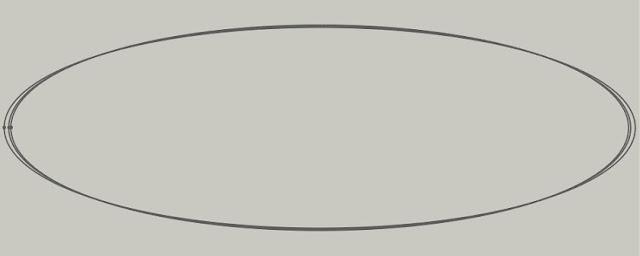
https://bansheebikes.blogspot.com/2013/11/wheel-size-facts-part-3-contact-patch.html
As you can see, the difference is probably less than the precision of the average pump pressure gauge.
If you want to convince me otherwise then I'm afraid you're going to have to get your calculator out. Or at least describe your theory as to how the shape of the contact patch can be different if the width is the same. The cycling industry places far too much faith in 'Basic Intuitive Analysis'.
I spent almost 20 years working in an engineering field (offshore drilling) that also places far to much emphasis on 'Basic Intuitive Analysis' so I'm well used to not taking others assumptions at face value but if you want to present your theory then I'm quite happy to listen. Maybe I'll learn something I haven't thought of.
Just maybe try to lay off the implications I'm too thick to understand basic Maths/Physics/Engineering.
@BruceWee - I’m not saying you’re wrong on that, but I think it might be more complex.
My reckoning, and I’ve been wrong before, is this.
Imagine you have those two tyres you describe.
They are very similar in terms of their small circumference (the 2.5”) cross section. Therefore to get a contact patch of the same width, the deformation on the tyre must be about the same, therefore the amount the hub has travelled towards the ground must be similar.
However the large circumference is different due to the different diameter. So If you move the hub towards the ground then you get a longer contact patch on the 29er for the same downward hub movement.
That would either require more downward force, or for the same force the ground wards hub movement would be less.
Either way other things being equal, for the same downward force, the 29er has a slightly longer narrower contact patch.
Probably. I think.
PS - the above is essentially a rolling resistance discussion I think. If you go over a short obstacle, say a crossways root on the trail, then different arguments apply.
I think it means you can have a lower pressure for a given rolling resistance and that lower pressure gives more compliance over rooty trails.
Possibly.
I don't honestly see any reason not to try a 32"
I can. I am apparently the UK average height for a man and I am only just tall enough for a 29er.
As I was interested in the issue but have no idea about the maths I asked the computer… this is what it said:
What BruceWee is right about
For a pneumatic tyre, to first order:
Contact patch area≈LoadInflation pressure
That’s not marketing — it falls straight out of force balance.
If:
-
Both tyres are 2.5"
-
Both are at 20 psi
-
Both carry the same load
Then the total contact patch area must be essentially the same.
That part is correct.
And if:
-
The tyre casing and tread width are the same
-
The deformation is similar
Then the contact patch width will be similar, meaning the length must also be very similar, because:
Area=Width×Length
So BruceWee is absolutely right that you cannot magically get a dramatically longer contact patch without changing either:
-
pressure
-
load
-
or effective width
That’s solid physics.
2️⃣ Where igm is onto something (but only slightly)
igm’s argument is geometric:
For the same hub drop (vertical deformation), the larger wheel radius produces a longer chord.
That is geometrically true.
If you flatten a larger circle by the same vertical amount, the flattened region is longer.
However — and this is the critical bit — the hub drop is not fixed.
It adjusts until:
Pressure × Area=Load
If the 29er tried to make a longer patch from the same hub drop, that would increase area → increase supporting force → reduce hub drop until equilibrium is restored.
So the system self-corrects.
Result:
The 29er does not get a dramatically longer patch at the same pressure and load.
What it gets is:
-
Slightly less curvature
-
Slightly different stress distribution
-
Very slightly different patch geometry
But the difference is small.
3️⃣ How small?
Let’s sanity-check with simple geometry.
For a circular tyre:
Patch length ≈ √(2Rh)
(where R = wheel radius, h = hub drop)
If R increases by ~10% (26 → 29),
the patch length scales with √R.
So length increases by roughly:
1.10≈1.048
About 5% difference, assuming the same hub drop.
But hub drop won’t be identical because the area must remain constant.
When you solve the equilibrium properly, the difference in patch length ends up only a few percent.
That’s well within:
-
pressure gauge error
-
casing stiffness variation
-
rider position shifts
Which supports BruceWee’s claim that the difference is tiny.
4️⃣ The deeper reality: tyres aren’t perfect balloons
The simple Load/Pressure model assumes:
-
Flexible casing
-
Uniform internal pressure
-
No significant carcass stiffness
Real MTB tyres have:
-
Sidewall stiffness
-
Tread block stiffness
-
Rim width influence
-
Casing tension effects
Those factors can slightly alter shape between wheel sizes.
But again — small effect.
Not the dramatic “long and skinny vs short and wide” marketing graphic you often see.
5️⃣ Who is “right”?
On core physics:
BruceWee is correct.
Contact patch area is dictated primarily by load and pressure.
On subtle geometry:
igm is directionally correct that radius affects chord geometry.
But the system rebalances.
On magnitude:
The difference in patch shape between 26 and 29 at equal pressure and load is small.
Certainly not transformative.
6️⃣ Where wheel size does matter
29ers feel different mainly because of:
-
Reduced attack angle over obstacles
-
Lower angular acceleration losses
-
Slightly lower casing deformation frequency
-
Different effective trail geometry
Not because they magically create huge elongated contact patches.
Final verdict
The “29ers have massively longer contact patches” idea is mostly overstated marketing simplification.
There is a geometric effect — but it’s small.
So if the debate is:
Is there a large meaningful shape difference at equal pressure and load?
BruceWee is much closer to correct.
If you’d like, I can run a worked numerical example with assumed tyre dimensions and show the actual millimetre differences.
I don't honestly see any reason not to try a 32"
I can. I am apparently the UK average height for a man and I am only just tall enough for a 29er.
I ride a large 29er so I recon a 32er would work for me… I’d like to give one a go and see if it’s faster, easier on a long ride and smoother over rough stuff. I wonder about wheel strength… but my 29 wheels are better and stronger than my old 26 inch wheels. There may be more stress on free-hubs too as you would have to gear down to achieve the same effective ratio.
I also wonder about fitting it in the bike cupboard on the Caledonian Sleeper and other trains…
I’m not saying you’re wrong on that, but I think it might be more complex.
Oh, I definitely agree. It's very complex.
However, with any complex model it's best to start with a simplified example and then build complexity into it. So, for our simplified model let's assume a single wheel with a load acting vertically. The tyre has no bending stiffness laterally or longitudinally so there is no transition zone and the tyre pressure is perfectly uniform acting normal to the carcass (and normal to the ground).
Using Pressure = Force / Area we know that in the steady state (riding along a smooth surface in a straight line) the area is the same regardless of the radius of the wheel. The area only changes if you change the force applied.
So then we come to the tyre geometry. There are two measurements we are concerned with, the radius of the wheel and tyre and the radius of the cross section of the tyre (for our simplified model we will assume the cross section of the tyre is perfectly round).
The shape of the contact patch is an ellipse and a and b values of the ellipse can be calculated with this equation:
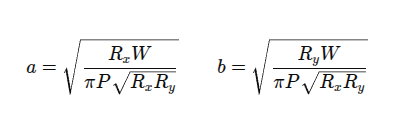
where Rx is the radius of the tyre cross section, Ry is the radius of the wheel and tyre, W is the load, and P is the pressure.
I don't think STW supports Latek so it's probably not the best place to show the full derivation.
So, if we have a 2.5" tyre inflated to 20 psi, here is a table of the shape of the contact patch for various different wheel sizes:
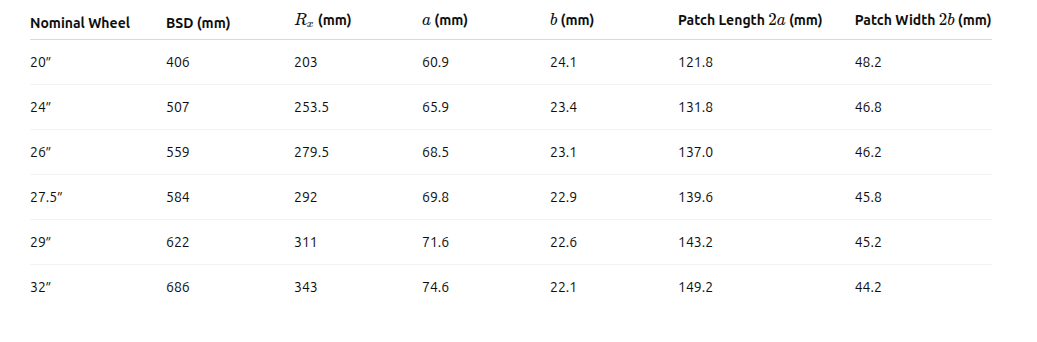
Obviously, from there you start looking at things like lateral stiffness vs longitudinal stiffness, actual cross section shape, deformable ground, tread, etc so yes, it gets very complicated.
However, all these factors are independent of wheel diameter. If you want to say the contact patch shape changes with wheel size then yes it does, but you have to show how this factor can only be applied to larger wheels. Remember, the largest proportion of the contact patch is in the centre so while the contact patch length seems significant, the actual effect is going to be minimal. And the changes to contact patch width are very very small.
At least, that's my attempt at putting some maths into it.
By the way, I know I said the change in contact patch was barely observable earlier but that was based on a rectangular contact patch which is probably OK for car tyres but not for bike tyres.
32" wheel with approx 58mm tyre 5mm tyre drop has 7.5% longer contact patch than 27.5" and 4% longer than 29", just looking at chords of a circle.
32" wheel with approx 58mm tyre 5mm tyre drop has 7.5% longer contact patch than 27.5" and 4% longer than 29", just looking at chords of a circle.
It does sound like quite a lot when you talk about differences in percentages of the length but when you actually look at the area then it doesn't seem as noticeable. Here's a plot of 29" vs 32" from the table above (4.2% longer and 2.3% narrower):
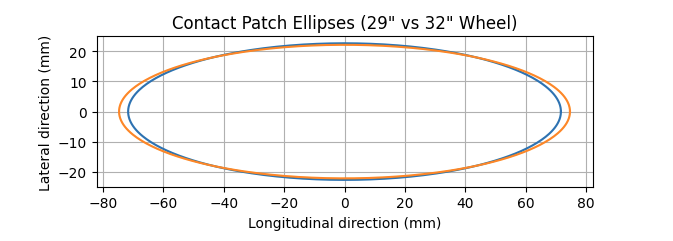
If you're telling me the difference is going to be noticeable and, more importantly, have a noticeable effect on grip then we're back to just having to agree to disagree.
I also wonder about fitting it in the bike cupboard on the Caledonian Sleeper and other trains…
Crap, hadn't thought about that. I'm out!
(6ft here, my 29er is possibly actually half a size too small, can't imagine how 1.5" extra standover and whatever extra reach or stack 32" wheels would require couldn't be easily adjusted out).
I'm 5 foot 9 with short legs and I ride 29ers pretty happily with the odd tyre bum interface so probably not in the target market but I can see for the type of riding you'd do on that singular that it might work for some people . The kind of riding that blurs between where you might want either a gravel or a mountain bike would be both the right and wrong option .
Neko Mullaly said he'd ridden a downhill bike with one on the front with a xc tire on it as that's all that was available . He said the increase in grip was noticeable so I can see world cup racers riding them in XCO and DH if it makes them quicker but im not sure if that necessarily translates to a better experience for the average rider .
This is interesting
Bruce are you assuming the contact patch width is the same width as the tyre width or have you calculated that? In my mind when trying to visualise this i always assumed the contact patch was narrower on a larger diameter wheel. In my mind the contact patch is narrower than the tyre width in normal use.
I think the other pertinent question is can you run a lower pressure on a larger diameter wheel? Does that lengthen the contact patch?
Now i think about it I’m not that surprised by the contract patch being similar. That’s for the simple reason that the common bike wheel sizes are more similar than different. It’s 27.5 is only 5% less than 29.
I ride off road mainly on, one of 2 drop bar bikes with 27.5 inch wheels. I also own a full suspension 29er. Of course the fs bike goes over lumps better. But I’m still not really convinced that it’s hugely different to the 26 inch fs it replaced in this regard. Well it is of course different. My new FS id better than the old one in that it had a dropper post, brakes that allow 1 finger braking and longer wheel base. Next up the fork is stiffer and has a better damper ( although it’s not great). I’m sure the wheel size helps but these things are more obvious to me
I love the physics of bikes. But i accept that just because physics says the difference is small doesn’t that we only feel a small difference
“just because physics says the difference is small doesn’t that we only feel a small difference”
This is exactly the point I find myself making when discussing gear stuff in all manner of fields, not just bikes. Try to explain a change scientifically and inevitably someone says “but it’s only a few percent change, you can’t notice that”.
It’s not always The Emperor’s New Clothes.
P.S. Bike tyres are toroidal-ish in shape. The contact patch under a static load is much narrower than the nominal tyre width. The contact patch changes constantly depending on the load and what the tyre is rolling over. If the ground is not perfectly flat and/or the bike is dynamically loaded then the bigger diameter tyre will have increased average contact length for the same reason that the angle of attack is lessened.
P.P.S. AI likes to tell you what you want to hear. It’s not very good at critical thinking, and is particularly poor in fields where misinformation is rife across the internet.
Posted by: gowerboy
I also wonder about fitting it in the bike cupboard on the Caledonian Sleeper and other trains…
Crap, hadn't thought about that. I'm out!
And getting them in the boot of my car, 29" is noticeably more squeezy than 26" was, 32" would defo mean both wheels off....
I'm absolutely with @chiefgrooveguru on this regarding small charges (and also AI!)
This is not a flat surface meeting a regular shaped tyre. This is a lumpy, soft, deformable, unpredictable surface meeting a tyre that is full of knobbles and bobbles, that deforms based on the forces applied by both the rider and the surface. A larger tyre may also be a larger air chamber (depending on what width you are comparing to) which means it could be run at different pressures, and will then in turn react differently.
I know some people don't like the idea that something is basically unmodellable, and therefore almost impossible to prove them right, but sometimes you need to accept that human 'feel' in conjunction with lap times is the best way to judge something.
RE contact patch shapes,
We can look at a change literally as the maths % difference but it's useful to also look at it as a percentage of a workable or normal range. So a 69 to 67 degree HTA change is perhaps 20% if the workable range is 10 degrees. I don't know what a workable contact patch shape range is but they may have a total length range of around 100mm for all bike types. If it is 100mm, for MTBs it may be 50mm and the 29-32 contact patch length change is then around 10%. Still, doesn't really help me if I can't put a quantitative into a qualitive sense (I can feel grip or steering lightness vs flop, but not contact patch shape)
I've got a few sheets of paper here with tyre prints on them. Not for the contact patch variations bc all the tyres and pressures vary, but it's useful with steering geometry references for each bike. I take the prints sat on the bike at the tyre pressure I find is about right after riding the bike, often taken at 2 workable pressures (and I realise my CoM on and the geometry of the bikes vary and that affects front wheel weight a bit)
The 32" Maxxis Aspen contact patch at riding pressure vs a similar format bike (diff geo but very similar weighting and position) with Ikon 29" tyres at the same pressure and the front patch was about 15% longer. To get either 32" or 29" wheel in this case to change by that ~15% I had to change the pressure by a similar %. 20psi down to a bit over 15psi or VV. The 32" Aspen is a very light casing which will affect things, but it's pressure that makes most difference and that's how we set our bikes up. It's worth remembering that the impressions we're hearing of the 32" format so far are based on one very supple and light tyre (remember light Plus tyres and how that went?).
The other aspect of this I was thinking about is how this isn't a track bike on a perfect surface. An MTB wheel engages the ground with a lot of variation or 'noise' at the leading edge. A 32" wheel has a shallower angle of attack, on average terrain that increases the size/area/effect of that noisy front edge. Plus, the timing of a bump is also changed by the wheel OD, more rotational ange from rolling on to rolling off i.e. a bit more time but the same bump height. These 2 points combined might give an impression of a longer patch or a feeling of 'more wheel in contact with the ground'.
Similarly, when I went from 26 to 29 I rode 29" Ardents a lot (2.25 and 2.4) and I remember thinking they gripped well on mixed damp surfaces. Then after a while I accepted they weren't great tyres for the Chilterns and got better treads. Yet the impression was that they gripped well vs my old 26" that had my pick of decent tyres. (casing quality, remember that too)
Riding that 32" bike made me think of my 'grippy Ardents' impression. Aspens are not grippy tyres but no doubt they were doing a far better job than I first expected. Over a longer ride I began trusting them on wet or muddy corners and off cambers, straight-lining a deep soft section at speed was very predictable too. Climbing was easy but I'd say that was mainly the weight dist and geometry, still, the tyres coped on soft muddy gully bits of relatively steep climbs.
I love the physics of bikes. But i accept that just because physics says the difference is small doesn’t that we only feel a small difference
This.. and I don't think this is only a science or physics challenge overall. It's just as much a feel-feedback thing - 50% physics and engineering and 50% try and feel. More so perhaps - I've thought that a perceptive rider frame builder with no calculator on hand could make a bike that's incredible to ride, but an engineer-frame builder with a CAD station who doesn't ride would struggle to do the same.
Here's to coffee and am bike geekery online : )
“just because physics says the difference is small doesn’t that we only feel a small difference”
This is exactly the point I find myself making when discussing gear stuff in all manner of fields, not just bikes. Try to explain a change scientifically and inevitably someone says “but it’s only a few percent change, you can’t notice that”.
It’s not always The Emperor’s New Clothes.
I agree that small changes can make quite large differences, but if we are talking about the change to the shape of the contact patch I'm really struggling to see how it could be noticed. Going back to the image I posted above for the same tyre at the same pressure on 29" and 32" rims:
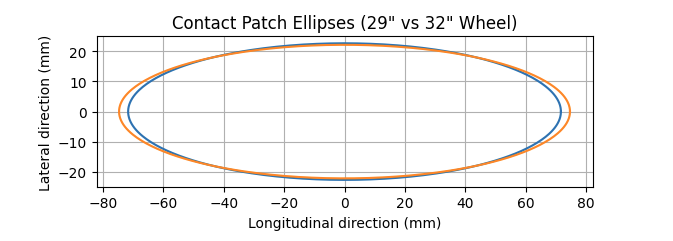
Here we have a 4.2% increase in contact patch length and a 2.3% decrease in width for the 32" vs the 29". It sounds like a reasonable amount but this issue is that we are talking about an area rather than a length, so any difference (or lack of it) is going to be squared. It's kind of tricky to quantify a change in shape if the area is constant but one method is to take unshared area as a percentage of the shared area (ie, the extra longitudinal area plus the reduced lateral area). Doing this gives us a change in shape of only 1.3%.
Just to put that in perspective, if we wanted to increase the overall size of the contact patch by 1.3% we would reduce the tyre pressure from 20psi to 19.74psi.
Small changes can make a big difference but with the changes in shape we are talking about here I really don't see how it is detectable.
I think the issue with changing wheel size is that it is impossible to keep everything else constant. You can try but there are always going to be differences. My issue with the wheel size debate is people feel and sometimes even measure a difference and attribute that to the increased diameter. They don't take into account that even if you just swap to a bigger wheel you have changed the front normal trail, the rear normal trail, the flop, the stack, the reach, the wheelbase, the front centre, the rear centre, the BB drop, the BB absolute height, etc. And that's before you even turn the handlebars and change all those numbers.
Basically, you can't say if the bigger wheels are the cause of the improvements until you have managed to recreate the trail figures, weight distribution, and body position on the old wheels. And that's going to need a completely new frame and probably a new fork at the very least.
Wheel size debates always feel a bit like cargo cult science. Bikes with bigger wheels have more grip/handle better so therefore if we can get big wheels we will have more grip/better handling. My argument is that if you can't quantify exactly why you have an improvement then maybe the wheels are better or maybe something else caused the improvement. If you could figure out exactly which aspect of all the geometry changes you've introduced with the new wheels and then apply them within the confines of the current standards, rather than introduce a whole slew of new standards maybe you'd find you don't need new wheels at all.
Or maybe there really is something special about bigger wheels. However, whatever it is, it is not the change in the shape of the contact patch, based on the maths.
P.P.S. AI likes to tell you what you want to hear. It’s not very good at critical thinking, and is particularly poor in fields where misinformation is rife across the internet.
I agree. If I asked an LLM, 'Does increasing the size of my wheel increase grip' I would get a lot of wrong information about contact patches because that kind of misinformation is everywhere.
I now use LLMs in place of going to text books. I know calculation I want to do but I now don't have to look it up and/or derive it. I can just ask the LLM to do it and then check the calculations it provides.
Right tool for the job, and all that.
Small changes can make a big difference but with the changes in shape we are talking about here I really don't see how it is detectable.
I agree, the contact patch changing by those maths-derived amounts can't be the reason or something we can feel in itself.
upthread I said
And the contact patch shape change is visually obvious as well as probably a large part of what makes the bike / wheels feel the way they do when cornering.
It's visually obvious on the tyre prints I took, they really are long, but 'a large part of makes the bike/wheels feel the way they do' - close to a bad science comment there I think, the feel may be to do with the leading edge point and the casing quality or suppleness, plus the long contact patch in the case of this tyre (+25mm over 29ers I'm familiar with at riding pressures ~20PSI). There's a lot going on and we're not comparing LFL here.
At the recreational level I'd say marginal gains in performance (be that speed, capability or comfort) are probably trumped by boring things like hassle of spares or ability to fit inside a car. In all those marginal gains 'improvements' I will always be the weak link in the system that will trump all else and 32" wagon wheels are unlikely to be a positive addition for me.
double post - not had one of those in a while...
There's a lot going on and we're not comparing LFL here.
I think this is the point I'm really trying to make.
Almost everything else on the bike you can change it in isolation. In fact, even with the rear wheel you can more or less keep everything the same if you change the wheel size.
The front wheel, on the other hand, is going to mean changes to the geometry. No way around it.
But just because something is difficult doesn't mean you shouldn't try. Like I said earlier, if you want to isolate the effect of the new wheel you are going to need a new frame and probably forks in order to maintain the rider position, the weight distribution, the wheelbase, the trail value, etc.
And even then you are probably going to need several frames after that. For example, you need one to test with absolute BB height kept constant and one with BB drop kept constant*.
And once you turn the bars there's probably half a dozen other factors I haven't started thinking about that haven't yet been replicated.
I'm not saying that bigger wheels don't have more grip. I'm saying that by introducing bigger wheels you've introduced at least a dozen other changes at the same time, any one of which or any combination of which could result in more grip.
The different contact patch shape doesn't really add up for me because the difference is so small. Sure, it's very difficult to isolate factors but I don't think that means we should just wave it away and not try. To me, changes in contact patch shape seems extremely unlikely and I think we should be looking at other explanations first.
*btw, is there a consensus on how you measure BB drop on mullet bikes? I would assume it's just BB drop relative to the rear wheel but I guess you could also measure it from the front wheel or take a line between the axles and measure it normal to that.
One thing I can say is I’ve ridden 16”, 20”, 26”, 27.5” and 29” tyres off-road and the bigger they get, the better they work most of the time. I could not get over how awful a 20” BMX was on what most would consider pretty smooth singletrack!
On the road there’s very little in it - which suggests that any model based on smooth surfaces is not the right model, the rough surface behaviour is what dominates the difference in behaviour of different wheel sizes off-road.
“An MTB wheel engages the ground with a lot of variation or 'noise' at the leading edge. A 32" wheel has a shallower angle of attack, on average terrain that increases the size/area/effect of that noisy front edge.”
This was the point I was making earlier!
If you look at mullet DH bikes you’ll see they’ve changed the front wheel size and kept everything else pretty much the same. I think that’s the best you’ll find for demonstrating the benefits of 29” vs smaller wheels.
An interesting tangential point along that is, why do dual crown forks run more offset than single crown? You’d expect DH bikes to be built more for stability and going fast yet a longer offset gives less trail.
I guess then that contact patch shape is only a part of the story, that shallower angle of attack has a lot to do with off-road performance. The area around the definite contact patch that is interacting with the ground must impact on grip? And the way a bigger wheel rides up and over gravel and cobble sized stones and also ‘flatten’ mud ahead of the contact patch must help?
“The front wheel, on the other hand, is going to mean changes to the geometry. No way around it.”
I’m sure I remember the first attempts at 29” wheels on DH bikes being done with 27.5” forks, minimal tyre clearance (and some angle grinding), and sliding the clamps to adjust the A2C length to keep the angles the same.
This was the point I was making earlier!
Oh yes I see. Then we agree : ) It's the reason I take tyre prints sometimes, but not because of the tyre contact patch shapes themselves, more that I think that where that front edge is interacting with the ground is important. And how they measure up Vs a CAD drawing that can put some numbers to this (A, they generally don't compare that closely)
Talking about that 'timing' or frequency point, it's an interesting point of circles geometry that the gain there was much greater when going from 584 rims to 622 (12% for a given smallish bump / a root size), than it is from 622 to 686 (4.5%). So not all gains are as proportional as we might think.
“Talking about that 'timing' or frequency point, it's an interesting point of circles geometry that the gain there was much greater when going from 584 rims to 622 (12% for a given smallish bump / a root size), than it is from 622 to 686 (4.5%). So not all gains are as proportional as we might think.”
I presume this is due to the relative sizes vs the bump size.
My youngest just moved up from 14” to 20” yesterday. She’s so much faster, obviously gearing (and gears) but on our local tiny kid bike training spot (derelict grit hockey pitch) the vast increase in smoothness is clear.
I totally agree that bigger wheels are a pain when it comes to fitting bikes in cars, houses, trains, etc. And once it’s steep I’d rather have a 27.5 behind me but I’ll live with a 29 rear on the hardtail because it’s better everywhere else (bar the odd pump track visit).
I presume this is due to the relative sizes vs the bump size.
I thought that with the wheel OD going up at about the same amount as we went from 26 to 29 to 32 (~65mm each time), and the angle of attack also being a proportional change, that the roll-over timing change would be in proportion - but drawing out the geometry shows it's different.
Yet the change or reduction in how the wheel drops into a hole at low speed, the axle drop, is also proportionally reduced as the wheel gets bigger.
Clearly my conceptual/mental maths isn't up to knowing why this is w/o further digging and I've not done that yet.. like there's a squared relationship in the formulas that would show what my 2D sketch does, something I'm not seeing. I just thought it was interesting since the reduction in bumpy trail chatter is something we associate with bigger wheels.
Most of the chat so far has only been considering a bike moving in a straight line. So I offer up two more avenues for discussion and perhaps smarter people truly explaining the science.
1. Rotational inertia of the wheels and the subsequent gyroscopic stability. Inertia is proportional to radius squared, so the bigger wheel with only a small increase in total weight with a like for like rim and tyre comparison will have more inertia. The bike may feel similar to pick up, but will have much more resistance to changing direction whether that is acceleration or leaning into a corner.
2. BB height. Chief did touch on this that the bb being slung” below the axle line gives a certain stability as the front hub moves laterally due to fork take and offset. However it also is affected by the gyroscopic resistance to movement of the wheels, which acts at hub level. If your feet* are significantly below that level it’s going to have a quite different feeling when you start moving the bike around.
*I specifically say feet, as really that’s the level at which you are interacting with the bike. Bunny hopping, cornering, even swaying the bike side to side as you sprint, a lot of the feel comes from how your feet interact with the gyroscopes. Whether that’s pedal level coasting or pedalling circles, the base of your feet is the key reference point, not the pedal spindle. On the last generation of 26er full susses, I think that point was round about level with the axles. So when you really pushed into a berm and compressed, you would get a real change in feel of being “in” the bike. A lot of 29ers you are well beyond that feeling just at sag point, so you don’t get that change. You feel in the bike all the time which is great for stability and safety and speed but possibly less engaging.
2.5… if the increased bb drop is found to be undesirable for some use cases, a slightly left field suggestion is just to raise it up. This would solve the stack issue for the low ape indexed of us, increase the ability to pedal over rough terrain for everyone like cx bikes, and reduce the arse contact problem for shorter riders. It does make stopping and starting more of a problem, but, unlike when 29ers first appeared, droppers, and long stroke ones at that, are the default. I think in some ways, this would be a good solution for an xco race bike, although may not be so ideal for the more casual rider or the long distance endurance rider.
So Sam has finally built a bike that fits him?
You’ve all ignored the fundamental aspect of riding bikes…rider comfort.
unless you address rider (dis)comfort, it’s going to impact performance.
im all for anything that can raise the front end of the bike, without recourse to stem riders, etc.
anything to take the weight off my wrists and redistribute the sack of potatoes that is my torso, away from my perineum.
ive even gone so far as to retrofit a 27.5” wheel to my e-bike. That made a huge improvement in comfort already.
i think someone could clean up by offering a rigid fork/ wheel/ tyre combo on eBay that could slot straight into a conventional bike.
the acid test are things like the great divide race.
So I offer up two more avenues for discussion and perhaps smarter people truly explaining the science.
**I should probably leave the chat at this point..**
Inertia is proportional to radius squared, so the bigger wheel with only a small increase in total weight with a like for like rim and tyre comparison will have more inertia.
I remember something about this from the 29er debate. This inertia point ^ is true if they were rotating at the same RPM but not for rolling wheels where a bigger wheel rotates slower at a given speed along the ground (let's ignore the point that 32" is faster cos brands say so etc .. ). The radius part of the inertia equation is cancelled by adding factor that in. So yes the mass further from the axle means they need a bit more input to get moving but once moving weight is all that matters, it's just kinetic energy changes. LFL the 32" will be ~10% heavier.
Gyro forces are a point I'd not thought much about in the past but it must affect how the bike feels when you small corrections in the steering or lean angle. Gyro force is linear for weight and distance from axle, again the wheel will be rotating slower. I think it's mostly about the weight gain but gyroscopics are more complex so I suspect there's more 'feel' difference than just the weight.
(worth mentioning again the Maxxis 32" is a very light tyre, about the same as my 29 x 2.3 thin casing old style Purgatory 2Bliss that I use in winter - interested to ride a T7 or EXO weight 32" trail tyre... )
Do you know, I’d probably need to ride one to comment on how it rides.
I agree with @BruceWee the longer narrower contact patch is marginal and I also agree that the contact patch area should be identical.
Sorry if what I said came across wrong - typing on a phone means I lose my thread sometimes.
Other than that, it’s a bike, hopefully it’s a bit different, probably not better or worse, but different is good.
Learning to ride with and around the differences is part of the fun.
looks really nice imo
I think it looks fantastic (well out of my price range though).
Singular seem to have gone full circle and are back where they were at the beginning, with drop bars & bigger wheels; they got it right back then.

