Forum menu
Doesn't quite add up in my view 😕
[img]  [/img]
Some said the same regarding disc brakes tho 😉
L shaped cranks have been done before haven't they?
[i]P.M.P. "L" or "bent" cranks of the early 1980's may be one of the most famous bad ideas in cycling.[/i]
[img] 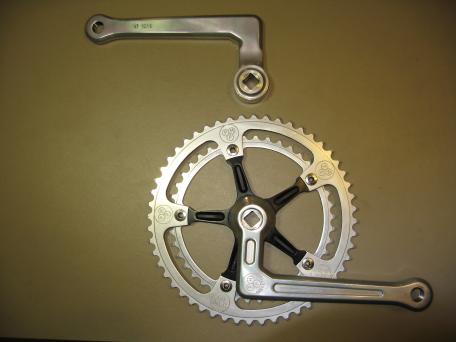 [/img]
http://pardo.net/bike/pic/mobi/d.pmp-cranks/index.html
Uhhh, so if I want to increase the torque I have to increase the length of my cranks? Can't I just change gear?
I don't trust anyone who doesn't look me in the eye when they're talking to me, let alone not open them for the whole of the video. In fact, does that guy even have eyes? 😯
[i]Some said the same regarding disc brakes tho [/i]
My Dad use to sell cars in the 60's, and when discs started to come in folk would say they were dangerous because cars behind would run into you as their brakes weren't as good... 🙄
The only think I'm not convinced about is the pedal being ahead of the crank when at tdc, which I agree will be beneficial when starting the power phase of the stroke but...that means when the pedal is at TDC the crank will be behind, which would not be beneficial.
Why all the cynicism? Wouldn't you like more leverage, and to get rid of the dead spots?
My Dad use to sell cars in the 60's, and when discs started to come in folk would say they were dangerous because cars behind would run into you as their brakes weren't as good...
To be fair, there is a decent bit of logic in that ?
(I think)
Can't access the video but surely the torque produced by those cranks is exactly the same as if you just had a normal crank, from my A' Level physics it's the turning moment around a single point regardless of how many twists and turns you have in between.
Can a proper engineer please explain.
Can't access the video but surely the torque produced by those cranks is exactly the same as if you just had a normal crank, from my A' Level physics it's the turning moment around a single point regardless of how many twists and turns you have in between.
Can a proper engineer please explain.
My thoughts as well
Without watching the vid as I'm on my phone, I think they are trying to eliminate the dead spot but I think all they have achieved is to have moved it .but there is a reason I joined the army straight from school and my grasp of engineering wasn't it 😉
does this mean that your crank arm will be closer to the ground at the bottom of the stroke and more likely to catch the floor
In English please Martinhurtin? 🙂
[img]
 http://www.clochette.co.uk/TTF/Scanned+Articles/1985/85bentcranks.jp g" rel="nofollow" >
They're very clever - the angle of the crank has been carefully optimised to be the perfect angle to separate idiots from their money.
Excellent find [u]trail_rat[/u]... 8)
These z cranks look to be different to the L cranks that others are posting.
The crank length is longer so increasing torque, then they've used the bend to bring the pedal back in, to give the same pedalling diameter as a shorter arm. So you have a longer crank arm distance from the bb without the increased pedal diameter.
All of the cranks in the article above haven't increased the length from the bottom bracket to the outside of the pedal circle, so they have maintained the same stroke diameter (pedal the same distance from the bb) so the torque applied won't have changed.
I think they would work.
but if that WAS true what advantage does it give over changing gears ? or fitting 180mm cranks ?
So the pedal's further away from the BB, giving greater torque, but also the same distance away from the BB, keeping the pedal diameter the same as a normal crank. Gosh that's clever.you have a longer crank arm distance from the bb without the increased pedal diameter.
(This reply may contain sarcasm)
GCSE level physics fail! Like getting a bigger spanner and then putting your hand only 3/4 of the way along it to reduce your arm movement...
trial rat posted a great explanation of why this is rubbish. They are for the hard of thinking.
Why bother with L-shaped cranks when you can have perpetual motion ones?
[img]  [/img]
Ye canna change the laws of physics!
Spent ages to trying to figiure out how they worked.
Then realised that there are two in the picture and it isn't really that shape!
.
The crank length is longer so increasing torque, then they've used the bend to bring the pedal back in, to give the same pedalling diameter as a shorter arm. So you have a longer crank arm distance from the bb without the increased pedal diameter.
Yes, the crank is longer but the BB to pedal distance is the same. Am I mising something? Is lever length inmportant or is just force-to-pivot distance in a straight line which matters?
But any torque gains in the crank will be lost through the square taper interface
Yes, but he's compensated for that by having a large letter Z on the side - in red!
Z is the 2nd fastest letter in the alphabet (X being faster, obviously) and red is the fastest colour there is.
If they flexed through the stroke altering the effectively crank length through the stroke then something might happen.
But
A) not much; and
B) probably not something helpful
Absolutely no advantage to them whatsoever. The point at which force is applied is still only 165/170/175mm from the bottom bracket spindle no matter how much material you add or take away.
Plus I suspect that they would be prone to catastrophic failure given the enormous stress-riser in the "vee".
Close the thread.
this can only be bollocks.
the only advantage that I can see is that it may eliminate the dead spot at the top of the stroke IF (and that's a BIG IF) you are thinking that you are at the top of the stroke when the longer bit of the 'L' is at the top and not where your pedal is... but when I think about it for too long, who is going to do that? and it's therefore a psychological effect rather than a mechanical one.
Spot on. The important length is the [i]virtual[/i] length of the crank; it could be five feet long coiled up like a watch spring but the leverage on the BB axle would be exactly the same.
I think those cranks ilustrate precisely why Engineering should be left to actual Engineers, and not people in Marketing.............. 😉
[img] 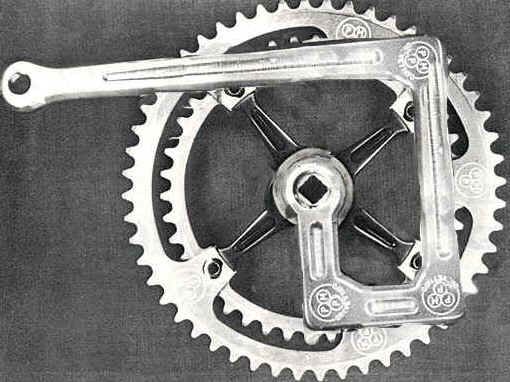 [/img]
Even longer cranks, so even [i]more[/i] torque right?
(Some Biopace chainrings on those would be totally amazeballs!).
boy says they did testing at wise univeristy florida .
by some PHD folks some 10 riders used them in TT and hill climbs..... and reported 20% gains.
once again like my honours project - bullshit baffles brains.
@Oldandpastit - are those for real? What about a sprung spiral to provide suspension when stood on the pedals?
Must the extra springiness of the bent cranks that store up energy on the down stroke and then give it back on the upstroke, or some such BS. So the energy/torque loss in 1 phase gets magically amplified and returned 180degrees later making it 20% more efficient.
(edit: some 😉 😉 😉 are needed here)
I have a pair of Biopace rings if someone wants to enhance the cranks even more.
Last time we dismissed this in 13 posts. Can't believe we're up to 37 this time around...
http://singletrackworld.com/forum/topic/using-the-concepts-of-leverage-and-inertia
A sprung spiral would be even better - the effective length would be even longer so the torque would be that much greater. There would be virtually no hill you could no ride up. That together with the suspension effect you identify would make this ideal for mountain bikers.
(This post may contain sarcasm).
How about fractal cranks, giving you an effective crank length of infinity?
Or hyper-cranks, that exist in 4 dimensions instead of the usual 3?
This guy is just so 19th century in his outlook.
needs more magnets and kineseo tape
You know when you see stuff that's so stupid it baffles you to how anyone would be gullible enough to buy it?
[waves][b]martinhurton[/b][/waves]
I'm genuinely amazed that people (a) built them, (b) bought them and (c) had to publish a full page in a magazine to explain that the people in (a) and (b) were idiots.
Have you seen some of the sheet on Krapstarter??
What about a sprung spiral to provide suspension when stood on the pedals?
That wouldn't work. We established earlier today that compressed springs are heavier, so the bike would weigh a ton if you fitted these.
😆
Chapeau.
I'm thinking cranks woven from a single MysteriumTM nanofibre exactly a gazillion light years long, using Dense Fractal TechnologyTM and a 4D-Optimized Quantum-Weave ContructionTM - with one end attached to the pedal and the other to the bb.
On your right...
Im surprised Crank Bros havent done them yet.
They use the same scientists that bring you hair shampoo and anti aging cream.
The new Crank Bros strapline - "Why use engineering when you can use marketing"
If Crank Bros were to make them they would come in a very pretty box.
[img]  [/img]
Lots of different opinions here regarding the L shaped cranks - but has anyone tried them? I have over quite a long period. At the time they came out I think it was Ian Camish a succesful Time Trialist who used them racing.
All they can possibly do is feel different because they are more flexible. That's it. There is no increase in leverage, removal of dead spots or power transmission advantage. None.
Blimey, thread raised from the dead!
To believe in these you would have to be a bit of a crank! Probably a bent one.
Dear god,
please kill this thread with fire, before I become infected with stupid.
Ta
too late...
edit oops misread your post it read 'it' not 'I' apologies.
Though it now appears I've been infected....
[img] 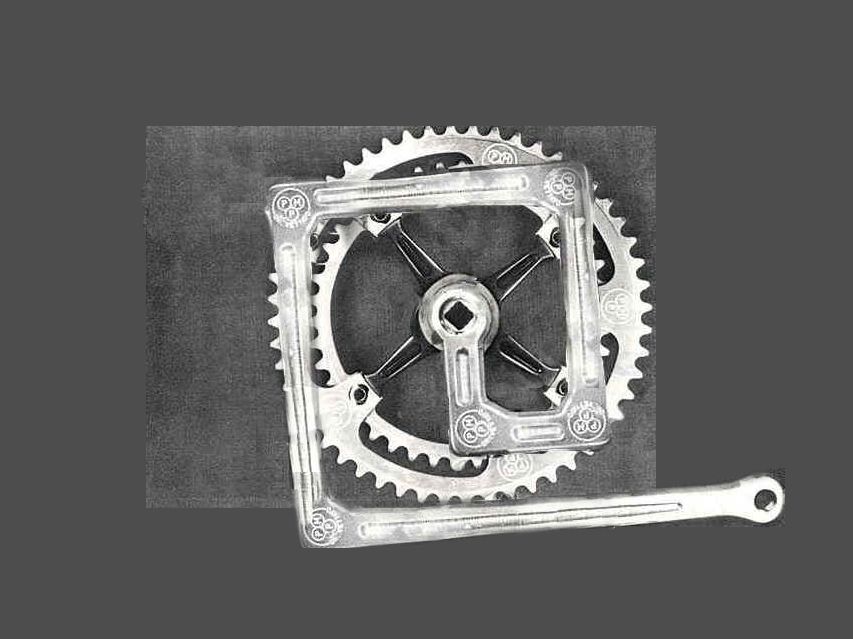 [/img]
See you at next years Tour.
See you at next years Tour.
I'll bring the pig...
[img]  [/img]
But what if they were on a conveyor?
Well they are square taper so that alone means they're better than most of the alternatives. 🙂
its bolox, the torque is a function of length of the lever from the axis, as the z frame is rigid it doesn't matter where the rest of it goes, the leverage distance is still the distance from the applied force (the foot) and the axle.
For example if you continued the Z bend and brought back to 180 degrees so it was lying back against itself, no-one would look twice at it, or if you created one big circle at the end of the lever that described its arc around the axle, no one would consider this to be better than a normal crank arm either.
Pseudo science - anyone know how their team got on in that race they mentioned?
At the time they came out I think it was Ian Camish a succesful Time Trialist who used them racing.
Indeed.
But then again Geriant Thomas wears a power balance band.
[img]  [/img]
And he's faster than me too.
Oh and pig man makes me smile with joy every time I see him 😀
I'm loving the (apparntly too) subtle (for some) photoshopery in this thread 🙂
Unless i have lost my mind. I think it will work. Google torque wrench extension formula and think about it
You have lost your mind