When you tight up the cassette lock ring - how tight do you go? It says 40Nm, but my torque tool is "slightly" too small and it only goes up to 16Nm anyway...
I'm just about to replace a second freehub in a year - both fell apart, I assume I was a bit too keen when fitting the cassette... (body weight over the spanner... 😳 )
The same amount of strength you would use to crush a badgers head as a rule.
I go up to between Pretty Tight and Real Tight on my Sheldon Tork-wrench.
[img] 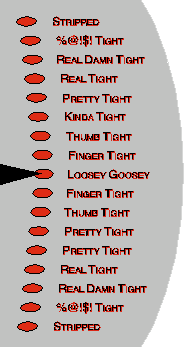 [/img]
In reality I can't believe you're putting enough torque on there that the thread in the freehub isn't stripped but that there's enough pressure across the width of the freehub body to cause it to break.
Maybe use a cassette with an alloy carrier to spread the load across the width of the freehub more?
As much as I would be happy undoing without issue, assuming it got a bit harder to undo over time.
People use Torque wrenches for cassette rings??
Just do it up tight.. but not too tight
set the torque wrench to 16Nm, tighten the cassette lockring 2.5 times. Sorted.
For me, it's tighten it up to 'hand only tightness' and then when you get to that point it won't move any more nip it up a bit more using your biceps and a bit of shoulder force.
I have to admit to googling this bit but apparently "if your wrench is 20cm (15cm at hand pressure point) then 40Nm equates to around 27kg, so you gotta put some force into it"
~I'm sure if your wrench is a different length you could do the math
Alternatively I just use my calibrated elbow...
body weight over the spanner
If your spanner is 10cm and you weigh 40Kg then I can't see a problem.
2nd jsut above pretty tight
If your spanner is 10cm and you weigh 40Kg then I can't see a problem.
Spanner is 300mm, bodyweight 78kg. 😕 I need to re-calibrate the tools then.
Too tights when you can't get it undone with any ease.....so check that way...or buy a bigger toque wrench 😆
If you use a hub with an alloy freehub then it's pretty important to torque the cassette lockring correctly, if it's not tight enough then the cassette cogs can move independently and dig into your freehub, making them a pain in the butt to remove down the line.
If it's steel or ti then it's not quite so vital, still a good idea though.
If your spanner is 10cm and you weigh 40Kg then I can't see a problem.
You have to have your feet off the ground though and then it gets a bit hard to judge how much you are jumping in to it 😉
OP, it it pretty hard to over tighten. 40Nm is pretty damn tight
Torque figures for bike components are very often a maximum measurement, personally I tend to use the lowest torque numbers I can get away with. 40nm is quite a lot.
cassettes kind of click when they get tight don't they
one more click is the answer
With a 300mm spanner I'd be wary of going too ape on it especially if any aluminium threads are involved but I agree 40Nm is pretty tight. I think the highest torqe I have used is 120Nm on a motorcycle rear axle and that is tight.
In what manner did your previous free hubs fail such that it makes you think cassette lock ring tightening is the cause?
I always use a torque wrench & I have to say that 40nm is tighter than I would risk if I didn't have a torque wrench.
I have to say that 40nm is tighter than I would risk if I didn't have a torque wrench.
Which is why so many people undertighten them and end up mashing their nice, lightweight Alu freehubs.
Eurasian or honey badger?
Am upset that Sheldon's wrench appears mis-calibrated for left hand kinda tight.
40nm = hnnnng doesn't it?
Push hard, strain and don't breathe for 2-3 seconds - that should do it.
[edit - sorry wrong thread]
Less than Hnng, more than Oop, about hmph I'd say.
40Nm is just over 4kg at 1m, so to figure out how much weight you need to put into it divide that by the length of your lever in m to get the weight you need to use in kg and then use a bathroom scale to work out your body position/force to get to that value using your arm
Personally I just use a torque wrench or do it up pretty damn tight if I don't have one around. Under tightened cassettes are far more common than overtightened in my experience.
I use the " oh, it's just made that soft clicking noise and got notchy , that should do it" method. 40nm is pretty darn tight.
40Nm is just over 4kg at 1m, so to figure out how much weight you need to put into it divide that by the length of your lever in m to get the weight you need to use in kg and then use a bathroom scale to work out your body position/force to get to that value using your arm
....or give it a good nip
Put your cassette tool in a vice if you have one.
Place wheel flat onto it, and turn in the manner of a steering wheel. Imagine you're turning your car steering with the engine off so the power steering isn't working. Once it gets that tight it's done. It's not really much force at all. It's very easy to over tighten them.
Imagine you're turning your car steering
Unless your bike is a 29er, then imagine you are driving a bus 🙂
Imagine you're opening a jar with a really stick lid to impress a lady. And then do it that tight.
Which is why so many people undertighten them and end up mashing their nice, lightweight Alu freehubs.
Mmmm? How exactly does an under-tightened cassette trash a freehub?
Are you suggesting that 40nm is enough to stop the cassette turning onto the splines under the huge load of pedalling?
Are you suggesting that 40nm is enough to stop the cassette turning onto the splines under the huge load of pedaling?
In short, Yes!
Mashed a DT swiss freehub a few years back, had to hammer the cassette off, not happy, sent DT a snotty mail asking why they didn't use Steel or ti freehub bodies, "did you torque it to 40NM?" was their instant response. I admitted I hadn't and was politely told to RTFM.
Since then I've been careful to torque my lockring properly and I haven't had a problem with a cassette digging into an alloy freehub since.
Tighten it until your elbow clicks.
@hatter 40Nm on the lock ring won't prevent aluminium FH mashing.
You far exceeded that amount of torque when you start heaving on the cranks and putting all that load through a 1.6mm sprocket...
I'm prepared to give it a try...
Tighten until your just about to fart from effort, if you 'Sharted' you went to far on both counts.
I just broke a chain whip getting a block off that I'd over tightened not realising my torque wrench had 'slipped' to about 120nm 😯
40Nm on the lock ring won't prevent aluminium FH mashing.You far exceeded that amount of torque when you start heaving on the cranks and putting all that load through a 1.6mm sprocket...
It's the clamping force generated by tightening the lock ring that's relevant here, rather than the torque on the lock ring itself.
OK, I'm bored:
40 Nm on the lock ring will generate about 3/4 tonne of clamping force on the cassette.
{From F = T/cD use c=0.17 for lubricated threads. Clamping force, F, may well be higher, as the lock ring is quite a fine pitch for its diameter.}
The force required to slip steel over steel under that load is ~ 5900N {static coefficient of friction ~0.75. Aluminium on aluminium will be higher}.
This force is acting through the spacers (say 40mm dia?) on both sides of a sprocket, so translates to a torque of ~230 Nm requed to overcome friction and spin the sprocket through the spacers.
A 75kg rider standing with all their weight on a 175mm crank at the '3 O'Clock' position generates ~130 Nm at the crank which becomes ~190 Nm at the cassette with a 24T chainring and a 36T sprocket (down to 34Nm with 42/11).
So, there might be something in it after all...
*Errors and omissions excepted 🙂
@hatter 40Nm on the lock ring won't prevent aluminium FH mashing.You far exceeded that amount of torque when you start heaving on the cranks and putting all that load through a 1.6mm sprocket
Er have a think about that answer, then have a think about which direction the various forces at play are going in. If you were talking about a screw on fixed gear sprocket you're statement would make sense but on a cassette carrying freehub... Not so much.
The reason you're supposed the torque the lockring up is because when the cassette is squashed tightly together the rotational forces are spread throughout all the parts of the cassette, meaning the pressure upon the freehub is not concentrated enough for the cogs to dig into the freehub body.
If the lockring is insufficiently tight the different parts of the cassette can move independently so the load is not spread and the cog that's being driven by the chain is the only one pressing into the freehub, this is when it can mash the freehub body.
That's what I was told by DT swiss. I've also heard similar from a Hope employee and it's the reason why both shimano and SRAM clearly mark their cassette lockrings with 40nm.
My personal experience bears this out but hey, if you feel that you know more about the freehub\cassette interface than DT Swiss, Hope, Shimano, SRAM and myself, you're entitled to your opinion.
*edit* tillydog's answer was both clearly better informed and considerably less bitchy, well played sir.
The force required to slip steel over steel
Hmm don't some have plastic spacers?
Plus, 75kg, lol yeah right! And the torque would be from more than simple bodyweight because you're pulling down with your arms, also putting some momentum into it by bouncing your body. And pulling up with the other leg.
But that makes me think. Why not glue the sprockets together? Worth it to protect a freehub I think.
tillydog's logic is spot on, although I'm dubious if you'll get 0.75 friction (yes, there are references for it, but pessimistic values when you want it to move aren't pessimistic if you want it to stick). I was thinking that 'hmmfh' is about right - a good pull but not max - and noting that car wheel nuts (in my experience) are supposed to be 80-110Nm. However, from the discussion (and tillydog's post in particular) I think this is one occasion when the torque needs to be right, not somewhere about.
I have never thought too much about the physics but do always use a torque wrench and have never had a problem getting a cassette off an aluminum hope freehub. Maybe there is something to the posts above.
It's all just maths, folks - put in which ever assumptions take your fancy and see how it comes out 😛
I'm not trying to prove anything - just curious to see how the numbers looked, but bear in mind -
Full body weight on a crank in 24:36 means mashing up a 1 in 1 (i.e 100% gradient) hill on a 26" wheel, and even then, you'd only see that torque stalled with the pedal at the 3 O'Clock position - if you're still moving forwards, the torque will be lower.
In more realistic gears (say 32:28) the torque on the cassette is much less - it would need a 140kg / 22 stone rider out of the saddle up a 1 in 2 (i.e 50% gradient) hill to reach the ~230 Nm at the cassette;
Wear comes about from things that happen repeatedly. If a sprocket slipping is marginal in a one off, worst case scenario, then it's unlikely to happen repeatedly in "normal" riding and hence unlikely to be the cause of wear.
FWIW, I use a torque wrench, because I don't trust myself. I tend to be a bit 'agricultural'. My baseline is the rear hubs on bay window VW busses - 340Nm (bent a 3/4" drive tommy bar!).
Working out the rough figures above has convinced me that I should make sure to give it enough beans when tightening the locking ring - YMMV 🙂
"Torque figures for bike components are very often a maximum measurement,"
Not really. Ime they are optimistically under speced or totally irrelevent - ie handlebars with torque values.
If the lockring is insufficiently tight the different parts of the cassette can move independently so the load is not spread and the cog that's being driven by the chain is the only one pressing into the freehub, this is when it can mash the freehub body.
The sprockets also bend if the lock ring is not tight enough. I have an odd shape XT cassette from not having tightened the lock ring properly.
It's one place that torque doesn't really matter that much. I've had a lockring loosen up once, and apart from a bit of a rattle and perhaps less than perfect shifting, I wouldn't have noticed. Was a bit surprised as I always thought it didn't need to be tight at all, since then I've given them a bit of grunt.
Even a one-piece cassette digs into freehub bodies under tandem torque, I have my doubts that tightening more would help much. Just tap with a hammer (or whatever comes to hand), no real problem.
Good thread.
My hunch is that lots of people don't apply enough torque and lots of people moan about the cassette mashing the freehub body. Go figure