Motorbike / MTB mate sent me this (never heard of it) - worth a watch.
Apparently he has form amongst the motorbike modders and hardcore shed engineers.
they have re-built it and refreshed it recently with fox 40`s with their own internals. check out stephen millyards instagram
so good to see something actually different
his motorbike builds are legendary...check out his V12 Kawasaki build on youtube and many others
Well known to motorcyclists the world over. I love the way he gets an idea and then just does it.
A genius of a man. Enjoying his recent videos on building a 6 cylinder Z1, a bike I owned a while back.
I remember the downhill bike at the time in Dirt. Very clever man.
I'd love to attempt something similar but I'm still at the 'browsing tig welders in Aldi' stage.
If only the bike press knew!
IIRC dirt did a review of it back in the day, said it felt awful in the car park, but incredible on the trails.
If only the bike press knew!
There's a website?
Didnt the shock do something clever like having a weak air spring, but the same air was used for the damper so as it absorbed bumps the valving was pumping air from the -ve to the +ve side? So rather than hitting a rock and absorbing the energy immediately it pressurized the spring (so it move about the same as a conventional spring and damper) but then bled off the air pressure before it rebounded. Which meant at lower speeds there was masses of grip because there was no seal friction or trade off between spring rate and bottoming out.
Looking forward to the rest of the series now!
Shock is/was something similar to this (if not an early iteration)
Love this
Working my way through his Kawasaki Super 6 build. A combination of low tech (Swiss Army knife and hacksaw) and higher tech (hand operated milling machine). Great lockdown videos.
Very cool.
Is it an Oleo shock?
Yeah
I almost made myself a gearbox hardtail a few years ago using a Raleigh Activator, Nexus hub and arc welder. Lost interest in the end but wish I'd carried on! Probably would have been cr@p anyway :oD
Does anyone know how the gear system works in the Millyard 001 is it enclosed derailleur and cassette a la Honda RN01? Or does it use a Nexus/Alfine? Doesn't look enough space for the former.
A clever bloke as has been said!
Love it and I'd totally love one.
Can't believe anyone can produce such good quality engineering in their shed and I'd love to see the drawings for this stuff. I can't believe it's all in Alan's head but if it is I'm even more impressed.
The man's a genius and I can't help feeling that the motorcycle stuff is all a bit of a waste of his talents.
Having said that a well run Youtube channel could make him pretty famous and a lot of money.
Does anyone know how the gear system works in the Millyard 001 is it enclosed derailleur and cassette a la Honda RN01? Or does it use a Nexus/Alfine? Doesn’t look enough space for the former.
Modified Nexus 8s hub, chain drive inside the swing arm, oil bath for the chain drive on the first one, grease on the second one.
Its a folding DH Bike as well
2008 Interview
https://www.pinkbike.com/news/allen-millyard-part-1-2008.html
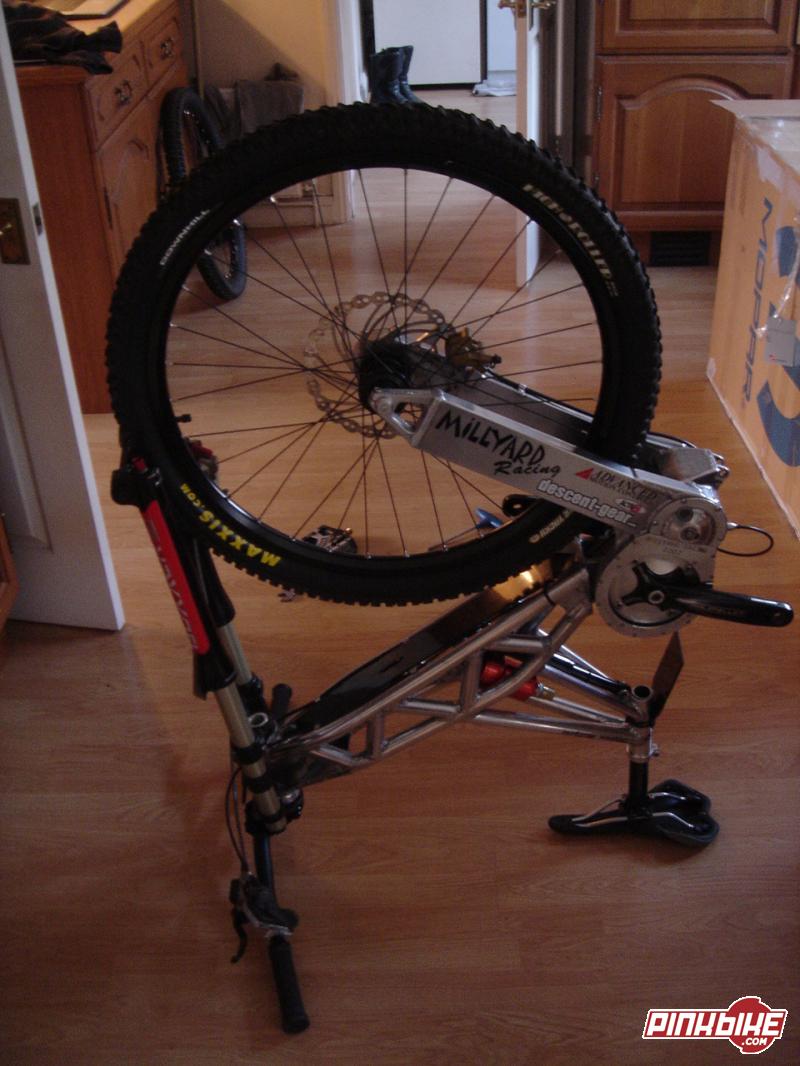
2007 article
https://www.pinkbike.com/news/Millyard-racing-bike-2007.html
Just brilliant!
I've spent a while reading about and thinking about these oleo shocks, and as far as I can work out, having the oil in series with the gas has no functional difference to it in parallel. What is different is that oleo shocks tend to use a single orifice plus needle damper, with the needle making the damping position sensitive, not speed sensitive. You could build a similar damper alongside a conventional air spring and I can't see why it would work differently.
The main thing that's struck me about the oleo shock is that it seems a better way to lay out an air spring plus oil damper shock. You have more oil volume so better behaviour on long runs. You don't need an IFP or bladder or deal with changes in oil volume because the series air spring can do that. If there's an IFP between the oil and gas then I don't see why you need to nitrogen charge it, you could just use a normal shock pump with air. The basic orifice plus needle damper does mean the compression and rebound damping are linked but you could add more valves in parallel in either direction to reduce the damping as needed. I guess you solve the negative spring issue by making the shock air volume much larger than the damper oil stroked volume so it doesn't ramp up too much.
Love the way it folds!
I'm sure I read that his downhill bike was only 130mm rear travel? I think he said everyone assumed it was 8" and he was too embarrassed to fess up that his 130mm travel bike was beating all their much longer travel bikes.
I don’t see why you need to nitrogen charge it.
At a guess, the reason for using nitrogen is that air has water in it which causes problems at high temperatures. Oxygen can also react with rubber seals at high temps. Nitrogen will give more consistant results.
Same reason that f1 tires don't use air but whether it makes any difference in practice will depend on how hot the shock gets. I suspect it makes more difference when fitted to a tanks as the original shockabsorber design was.
Think I read elsewhere that he'd switched to argon, rather than nitrogen.
I’m sure I read that his downhill bike was only 130mm rear travel
I read 150mm
I think airplane and tank oleos are filled with Nitrogen as its inert. longer lasting between services and less corrosion.
It really is a very simple/clever shock design
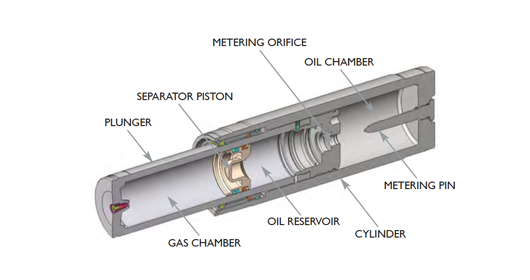
I guess you could swap metering pins like replacing carb needles to tune the damping.
“I guess you could swap metering pins like replacing carb needles to tune the damping.”
Yes but it can only adjust the damping relative to the stroke, not the shaft speed. On aircraft oleo shocks are designed to operate with the fluid flow through the orifice nearly always turbulent so the damping vs shaft speed is exponential. I’m not sure how bike dampers are designed in that manner, but
I do know that all decent shocks have a second set of ports which open when the shaft speed and thus oil pressure opens a check valve or shim stack. Your first set of ports is the low speed damping and the second set is the high speed damping. And usually you have two sets of each, one pair for compression, one pair for rebound.
A single position sensitive orifice is very different. That damper pictured will have increasing damping through the travel, so it’ll take a huge amount of force to bottom out and will rebound very slowly. Perfect for landing a plane without bouncing into the sky again! Perfect for landing a monster drop at Rampage. Not sure what would happen when a racer wants to preload and hop a rock garden - the oleo design should suck out most of the bunny hop energy...
You can add bypass valves, other circuits etc
Some cross sections in this article
https://insights.globalspec.com/article/12954/how-do-oleo-pneumatic-shock-struts-work
Some oleo struts contain valves that restrict hydraulic fluid flow during recoil to prevent rapid piston motion that results in hard bounce-backs. Others have valves that open when the strut encounters an unusual loading force, such as bumps on rough fields. The pressure changes cause the valve to open and pass extra fluid to reduce maximum forces on the airframe.
Other oleo strut design variations include devices in which the piston is located above the cylinder, alternative orifice arrangements, multiple compression and recoil orifices and multiple chambers.
It would be fascinating to have a play with one.
As its not exactly new tech I would have assumed there is a reason they are not in common use for MTB/Moto applications?
Millyard stuff is great. Always fancied an xc version at the time.
Heavy off road vehicle suspensions use nitrogen as the spring medium at very high pressures (typically running up to 300 bar ish at bump but I have seen stuff well over 1000 bar). High pressure = a small spring that can take very large loads. You want something inert and moisture free at those pressures.
Vehicle Air suspensions are typically hitting 10-20 bar.
Not a clue about aero oleo struts. Planes don't tend to drive very far on the ground so more designed for impact loads.