UPDATE: CLASSIFIEDS section refreshed, redesigned, searchable: Go take a look
If you live in the Highlands, you can get all sorts of surfaces on any ride of a decent length.
I am sure you can, but your question specifically states gravel and not mud, fields, rocks. Almost every ride I do contains gravel sections and I have used a lot of different tyres over the last 20 years - 23c, 25c, 28c, 32c, 37c, 43c, 1.95, 2.1, 2.3, 2.4 and more in slick and knobbly varieties.
My conclusion is for hard packed gravel it really doesn't matter - grip is not an issue, speed differs a bit and comfort can differ a lot so choose the tyre that best fits the compromise for you. For me it is down at the 23c/25c end.
I have a Swift with a 2.3 in the back and a 3.0 Knard in the front. I also have a Pickenflick, currently wearing 40c Nanos. If I’m heading out for a long ride that’s mainly off-road on unknown surfaces I’ll take the Swift. If it’s mainly road and I’m confident the off-road will mostly be actual gravel then I’ll take the Pickenflick. You can call either or both of them gravel bikes if you like. Or not. It doesn’t matter. 🙃
kerley
I am sure you can, but your question specifically states gravel and not mud, fields, rocks....
The point of the post was that when riding on gravel roads you can come across severely deteriorated conditions, and your bike becomes luggage unless it is capable of dealing with that.
A gravel bike that can't handle the variety of conditions that occur on a gravel road or do a bit of greenlaning isn't a gravel bike IMO, it's a roadbike.
My experience with narrow tyres on gravel is you spin out on the loose stuff on the climbs, and fast descents are sketchy because braking hard will have you off, and then you have to get through the deep pile of loose gravel at the bottom of the dip.
That's in the dry. When it's wet skinny tyres sink in and become hard work, and it's rare to find a completely dry track.
I've ridden long distances on skinny tyres in all these conditions, and it's a recipe for misery.
If what we're riding up here isn't gravel, what is it? What can we call the Highland roads that have existed for hundreds of years and are unsurfaced?
Here's one built in much the same manner as a Roman road (about 1730) with a fairly typical surface.
[url= https://farm6.staticflickr.com/5690/21338689511_6794734b49_o.jp g" target="_blank">https://farm6.staticflickr.com/5690/21338689511_6794734b49_o.jp g"/> [/img][/url]
EDIT: abbreviated.
My 2015 Plug 3 won't even take a 42c tyre, I struggle with 38c to be honest. I've run a lot smaller too, and it's been fine, you just keep some pressure in them and realise that it's not an ATB, it's a gravel bike. They're quite good for the roads in Lincolnshire and Rutland though, which may as well be gravel in a lot of instances.
[img]  [/img]
But, if you need that much rubber, you could go down a wheel size, or use a different bike.
the faithful Kona is ideal for a lot of stuff, steel, rigid, and I can run either 27+ or 29er for thick sticky mud where you need frame clearance and dig.
[img] 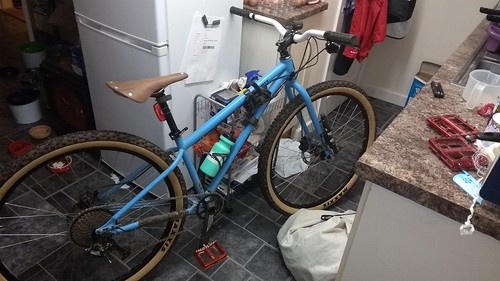 [/img]
I don't do trail centres and extreme stuff so don't really need suspension, but if I did, I'd build a bike for doing that too.
Obviously, I know not everyone has the space to keep three bikes, or the budget for that matter, in which case a Monster Cross type affair is probably ideal, but they're not a gravel bike. 🙂
Things have changed around here in the last 11 months. 🙂
cogwomble
...in which case a Monster Cross type affair is probably ideal, but they’re not a gravel bike.
My opinion is that they are the proto-gravel bike, the rider's solution to a problem for which the market didn't have a category at the time.
Then the manufacturers saw that loads of people were modifying their bikes for that purpose, and produced the first gravel bikes. These were based on the cx model, but were generally limited in tyre size to cx sizes.
Riders continued to modify 29ers, because the cx tyres weren't a patch on the comfort or capability of the much wider mtb tyres.
Now we can get bikes like the Whyte Glencoe or the Kinesis Tripster (650bx52) and it's only a matter of time before the other mainstream manufacturers follow and wide tyres become the standard in the category.
All this seems deja vu. I remember the arguments that no one needed wider than 2" for a mtb, and how many of the racers used 1.9", and then how unsaleable mtbs that could only fit those widths became, almost instant obsolescence.
I’ve recently gone from two bikes
A Cannondale Habit lefty and a Caadx to a one “bike to do it all” (well 1 to suit where I ride now) I chose a Salsa Vaya as I love steel and it can run 700x50 tyres. Recently flirted with 650b wheels but sold them to stick with 700c. Plan to run Specialized Roubaix tubeless for fast tarmac touring style riding and if needed can swap to a gravel tyre quite easily.
A gravel bike that can’t handle the variety of conditions that occur on a gravel road or do a bit of greenlaning isn’t a gravel bike IMO, it’s a roadbike.
Nope, it is a gravel bike designed to ride on gravel road. If your gravel roads include boggy moorland and rocks they are not gravel roads. Not that it matters, you ride the bike that works for those routes and that bike would be more mountain bike than gravel bike.
Nope, it is a gravel bike designed to ride on gravel road. If your gravel roads include boggy moorland and rocks they are not gravel roads. Not that it matters, you ride the bike that works for those routes and that bike would be more mountain bike than gravel bike.
You need to get the word "gravel" out of your head. We don't live in the American mid west. Gravel bike is just the name that stuck because of it. Very few people in the uk that I know ride their gravel bikes purely on road and gravel. Almost every ride will involve some singletrack, stone farmtracks, mud (it is the UK) and various other surfaces. None of which are so rough that they require a mountain bike, and it also does not mean that there "gravel" bike should be called anything else.
While Im here.... I also laugh at the heros spouting about the fact that they ride everywhere on 25mm tyres. That doesnt make you a riding god, it just makes you ill prepared and disadvantaged.
A gravel bike that can’t handle the variety of conditions that occur on a gravel road or do a bit of greenlaning isn’t a gravel bike IMO, it’s a roadbike.
Nope, it is a gravel bike designed to ride on gravel road. If your gravel roads include boggy moorland and rocks they are not gravel roads. Not that it matters, you ride the bike that works for those routes and that bike would be more mountain bike than gravel bike.
This is all getting a bit silly now... I don't see much point in defining gravel bikes in some narrow sense of being a bike designed for well maintained gravel tracks and not much beyond.
If gravel bikes simply fill the gap between mountain and road bikes, in the UK perhaps that gap often requires larger tyres than in say the USA. I would guess that's all epicyclo is getting at.
legometeorology
...in the UK perhaps that gap often requires larger tyres than in say the USA....
I think even there they will trend away from California clearances.
I read a while ago about a ride along the Dalton, one of the great gravel highways in Alaska, and the conditions encountered there are very similar to what we get. It's under constant repair so there's miles of deep loose stuff, mud and deep ruts, and violent weather can transform it overnight.
And if that isn't gravel what is?
^ Tour Divide / GDMTBR is basically a gravel route - some tarmac, a lot of gravel county roads, some natural off-road. Mostly forest access and county roads. Divide racers are mostly on 29ers with drop or MTB bars, sus or rigid forks. Good MTBs for longer rides. You could do a few days of that terrain on a 650B gravel bike but you'd get more beat up. Yet plenty of riders have toured remote areas on 26" ATBS.
I see 'gravel' bikes as just better road bikes for what most of us ride in the UK - bad road surfaces, not racing, like to avoid A/B roads by using byway shortcuts or enjoy a bit of underbiked exploring. But primarily it needs to be a good road bike more than a good MTB.
Similar to the rides round here condition-wise which was perfect for Singular Gryphon. Just got rid it though as ultimately the weight of was a slog after long, muddy rides. Now it's either the rigid Ritchey for all conditions or the Tripster for thrills (and spills) and dryer rides. Too old to feel beat up beyond a certain point now every ride so a little comfort is good!
And if that isn’t gravel what is?
Wait, do you mean gravel race, gravel adventure or gravel-grinding?


I don’t see much point in defining gravel bikes in some narrow sense of being a bike designed for well maintained gravel tracks and not much beyond.
You may not see the point but that is what they were designed for. Just as a road bike is designed for the road and an mountain bike is designed for off road.
It is like asking what are the best tyres to put on my road bike to ride a downhill course, the point is you need to get the bike right first before worrying about what tyres to use.
If you were actually riding on gravel rather than the terrain in your pictures then I find 23c are okay
Really? I thought that fatter tyres rolled faster* and betterer on uneven surfaces?
*Up to a point, factoring in increased weight and decreased aerodynamic efficiency.
^ Exception proving a rule, I think. Or a case of enjoying whatever you ride rather than saying it's optimised (all good). I find 23c rubbish on tarmac compared to a wider tyre, never mind anywhere else 🙂
Kerley
You may not see the point but that is what they were designed for...
Indeed, but the design is primitive, as in early days, for the type.
Just modify your statement for a moment and apply it to mtbs and the demand for wider tyres 20 or so years ago.
Manufacturers have responded to market pressure and mtbs now have clearance for wider tyres - up to 5" in some cases.
Are they not mtbs still?
To test your opinion, let's look look at one, the Whyte Glencoe.
Is that a gravel bike or not?
How about all the other recent gravel bikes with clearance for wide tyres, how about them?
jameso, who knows a thing or two says above:
"I see ‘gravel’ bikes as just better road bikes for what most of us ride in the UK – bad road surfaces, not racing, like to avoid A/B roads by using byway shortcuts or enjoy a bit of underbiked exploring. But primarily it needs to be a good road bike more than a good MTB."
I think we can both agree on that, but I'd just add gravel bikes need clearance for tyres to handle those surfaces.
As riders discover the versatility of a gravel bike with large tyres, the demand for gravel bikes with big tyres will increase, and manufacturers will ignore that demand at their peril.
This will not disadvantage the riders like you who prefer skinny tyres, they will still be able to fit them and ride on smoother surfaces, or fit wider tyres suitable for rough stuff and go exploring.
That sort of bike is an ideal candidate for 2 wheelsets, one for the commute, and one for the weekend.
We had more or less this same discussion a year ago, and I predicted that gravel bike tyre sizes would get larger. Since then we are seeing just that trend.
It will be interesting to check back in another year's time ands see where the trend has gone - it's usually me who is the retrogrouch. 🙂
Really? I thought that fatter tyres rolled faster* and betterer on uneven surfaces?
Yes, wider tyres (than 23c) do roll faster on uneven surfaces, however what I said was that I find 23c "okay" when riding a mix of road and gravel not the they were the fastest. I don't know what the fastest tyre is for a mix of road and gravel but the tyres I enjoy are narrower tyres and find them fine on gravel and lighter on road. On overall rides combining 50/50 road/gravel my fastest times are on narrow tyres.
In the spirit of breezy banter I proclaim NO! Unless you got your 2 in front of your 3 and meant 32c 😉
OP! The answer: 32c-40c tubeless FTW. On gravel.
Boggy bridleways and humongous clarty rock gardens need bigger nobblier. Dust-dry summer trails are a free for all depending on the state of your fillings.
I don’t see much point in defining gravel bikes in some narrow sense of being [b]
a bike designed for well maintained gravel tracks and not much beyond.[/b]You may not see the point but that is what they were designed for. Just as a road bike is
Actually no, Seven Cycles suggest that you need a [url= https://www.sevencycles.com/discipline/road-mid-reach.php ]Mid-Reach road bike[/url] for that; when the gravel track becomes a little less well manicured (but not gnarly enough for a proper [url= https://www.sevencycles.com/discipline/mountain-race.php ]mountain bike[/url], and yes they'll sell you one of those too), then you need a [url= https://www.sevencycles.com/discipline/gravel-road.php ]gravel bike[/url]!
Seven's mid-reach road bikes straddle the space between traditional road bikes and mixed-terrain bikes [Gravel Bikes].
Personally I think it's a deliberately vague and amorphous term created by the bike industry to sell you more bikes than you need. When fat bikes caught on and became the 'must have' trend, they rapidly went from being fully rigid with cable brakes to full sus. with hydros and droppers; gravel bikes have done the same and now also come in full sus./dropper flavours (which I'd argue probably aren't best suited to road work); we may well end up with Plus and/or Fat gravel bikes too at some point if the industry thinks they can sell them.
I've always ridden a mix of (mostly country roads) & off-road on semi-slick equipped hardtails and continue to do so (in the meantime Gnarmac came and went without catching on). Technically, I suppose, it's a hybrid (or perhaps a rigid mountain bike) but I ride 'gravel' in today's parlance. It's probably more bike than I need but I'm happy with it.
Personally I don't get too hung up on definitions (such as where a full sus. gravel bike with wide tyres officially becomes a mountain bike), I just enjoy pootling about on my bike.
I see ‘gravel’ bikes as just better road bikes for what most of us ride in the UK – bad road surfaces, not racing, like to avoid A/B roads by using byway shortcuts or enjoy a bit of underbiked exploring. But primarily it needs to be a good road bike more than a good MTB.
That's pretty much what I use my Arkose for, though I think in some ways it's more capable off road than the mtbs I was riding in the early '90s. Tubeless and hydro brakes are big advantages, and bridleways are a lot more interesting when you need to pick a line rather than just ploughing through. I have 28s on my road bike these days, much better than being beaten up on 23s and they don't feel any slower. I have 37s on the Arkose but may go up to 40s.
I don’t see much point in defining gravel bikes in some narrow sense of being a bike designed for well maintained gravel tracks and not much beyond.
You may not see the point but that is what they were designed for.
Some yes, but not all of them are designed just for well maintained gravel roads.
Thinking about this more, I wonder if it's worth thinking about trail topology and trail surface separately.
Epicyclo's final picture above (copied below) is certainly a gravel road. And because that track is the 'topology' of a road, i.e. gentle bends and inclines (no drops, jumps, berms, steep chutes, rooty off cambers or anything), there's no need need at all for mountain bike geometry. But with a surface like that I'd much rather have tyres at least 2" wide, and even slick 650b+ tyres wouldn't be overkill.
On the other hand, there are red sections at trail centres and jump lines at a bike parks where the trail surface is much smoother. But because of the windy topology, you want the large standover, the high front end, the wide bars, etc, of an MTB. But 2" tyres may be perfectly fine.
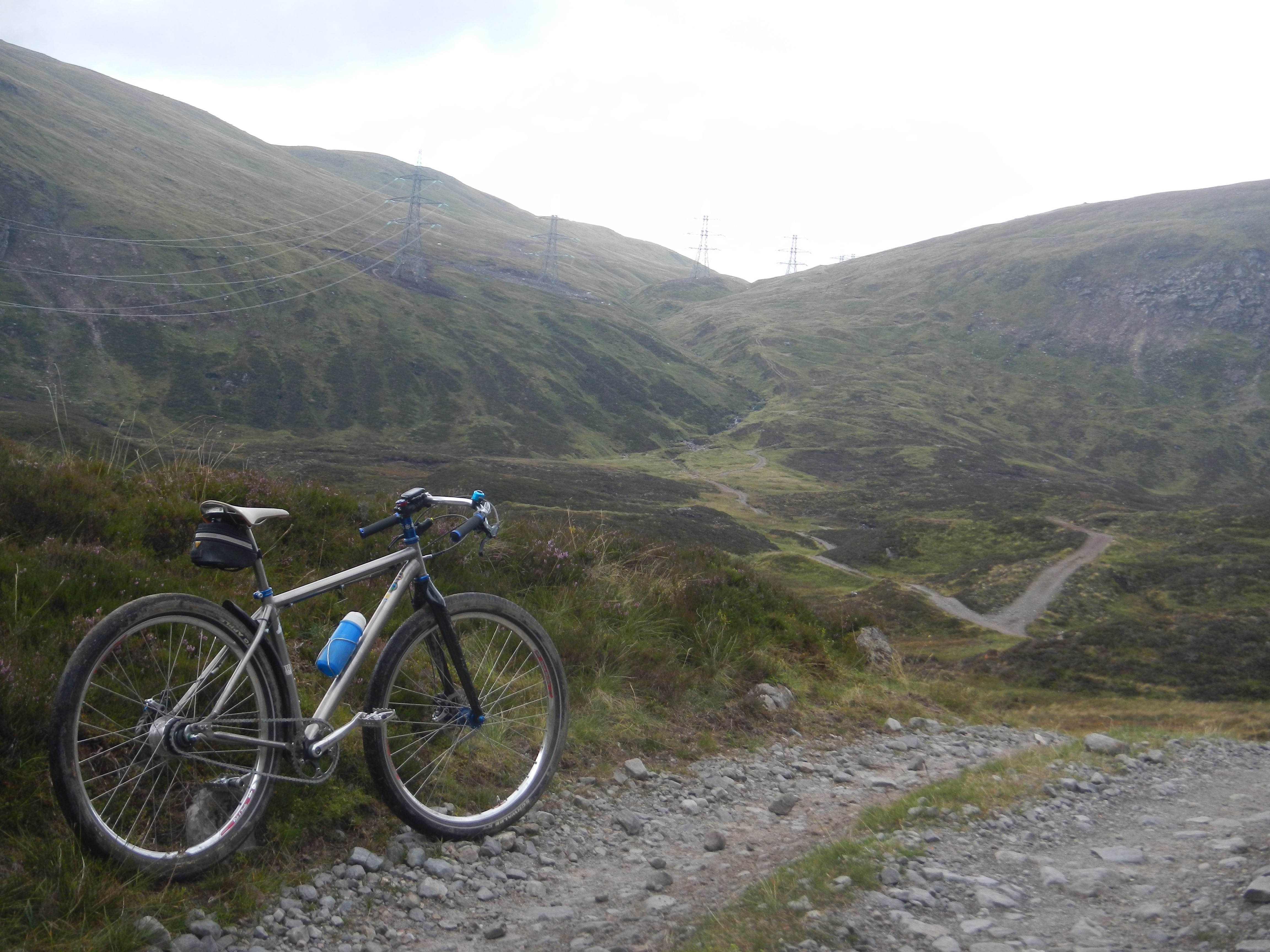
I'd like to make it clear I'm not saying that you can't ride on gravel roads with skinny tyres, because I do that quite often on a variety of bikes.
What I am saying is you are greatly disadvantaged if you do.
For example braking.
This part of the HT550 (steeper than it looks) is a hazard on narrow tyres if you don't get on your brakes early.
The gravel near the bottom is loose and you risk losing the front end if you brake heavily there. Plus the stream crossing is full of loose rocks which will more easily deflect a narrow tyre and bring you to grief.
It's the sort of risk that you can take at a trail centre maybe, but here if you get it wrong there's no one to come and pick you up, it's a long long walk to anywhere, and no phone reception. There's lots of these sorts of descents on any gravel road up here.
On wide tyres you can treat it as you would on an mtb.
[url= https://farm1.staticflickr.com/911/41277724685_b2b9fabe88_o.jp g" target="_blank">https://farm1.staticflickr.com/911/41277724685_b2b9fabe88_o.jp g"/> [/img][/url]
Another example is climbing. (Same stretch of HT550, but further along.)
It's pretty obvious that's a hefty climb, and with it being steep the gravel tends to get the soil washed away, so the climb is often on a very loose surface even on a good day like I had here.
On skinny tyres, you are now facing the opposite problem, trying to maintain any sort of pace on the climb. The back wheel will spin out and it's too steep to regain traction, so then it's push the bike uphill a bit further, remount and ride until the next bit of the too frequent loose gravel, and repeat ad nauseum.
[url= https://farm1.staticflickr.com/963/40371292480_936fcf87a8_o.jp g" target="_blank">https://farm1.staticflickr.com/963/40371292480_936fcf87a8_o.jp g"/> [/img][/url]
Again wide tyres cope much better with this and far more of the ascent is rideable.
(Bike is a Pompino with a 3 speed hub for the info of those gaping at it in stunned admiration at its beauty. It handles very nicely on gravel - its limitations are its tyres and its engine 🙂 )
for the riding pictured I would take this:
[img] 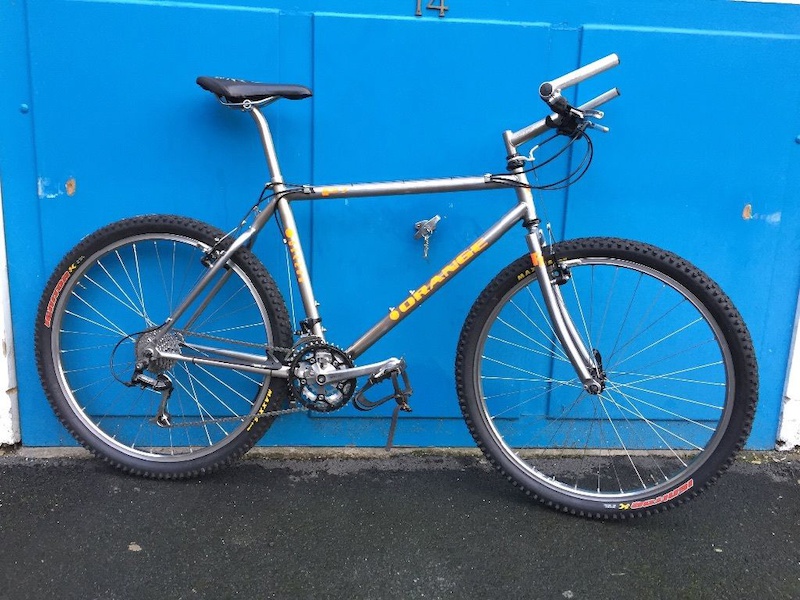 [/img]
Wearing 2.1 WTB nanos
[img]  [/img]
Fast on the road, capable off road.
OK I would probably prefer a rigid 29er with disc brakes, marginal gains and all that, but this question was answered 25 years ago.
wzzz
...but this question was answered 25 years ago.
A 25 year mtb potentially makes a pretty good gravel bike. That Orange looks spot on.
The older mtbs have steeper HAs than current mtbs, but they're perfect for road/gravel; shortish TTs so the reach isn't too great for drop bars, but still ok for other bars; and possibly go up a size on one's normal choice for mtb.
I'd want to get as big wheels on it as possible though.
I'm actually doing that experiment with a Raleigh Ravine right now.
Nice lugged frame, decent butted steel, and it's looking promising. I've sized it up to see if a 650b wheel would fit with a fattish tyre, looks ok, so I'll be building wheels soon.
Fast on the road, capable off road.
OK I would probably prefer a rigid 29er with disc brakes, marginal gains and all that, but this question was answered 25 years ago.
I own a 1992 Breezer. The Arkose is just as capable off road, has much better brakes, and is much quicker on road.
Brian - if you are so certain about what you want, and you have a plethora of wheel/gear/brake options already available to you, why not just get someone to build the frame you want? It needn't be horrendously expensive and you can fund it by selling some of the other bikes.
Bejebus! the arguing on this thread was dull.
Nice pics though.
Dull arguing bit:
Gravel IMO is riding on some sort of surfaced road/path.
CX-adventure, adventure cross, Monster-cross or most stuff on that continuum is what used to be referred to as XC-jeycore*-lite after everyone grew up and decided that misspelling gay didn't make it any less offensive.
So in answer to the OP's original rhetorical question, slicks, or something very close. Because if you need more than slicks then you're just not gravel dahhling.
Bejebus! the arguing on this thread was dull.
Clearly you need to be more emotionally invested then, throw yourself into the fray more fully, work out whatever is holding you back and let go, perhaps you're scared you'll be embarrassed, shamed, dismissed? It happens to us all. And not all us will ever be lucky enough to stand out, to define what a gravel bike really is. But some of us will. That's the hope that keeps me going, helps me find meaning in it all.
(I'm also a bit bored of work today.)
As riders discover the versatility of a gravel bike with large tyres, the demand for gravel bikes with big tyres will increase, and manufacturers will ignore that demand at their peril.
Yes and no. I've got a Vagabond (monstercross), a CAAD-X (CX) and a charge Plug (SS-gravel).
The vagabond is great offroad with 2.1" tyres, but it's a bit of a heavy beast to get upto speed compared to the CAAD-X. So there's a point somewhere between 35mm and 52mm where adding more width aids cushioning but in order to build it light would probably actually make it more puncture prone on rough stuff. The plug I'm building up with ~40mm semi slicks to split the difference (both the caad-x and vagabond have fast rolling knoblies). I'm not sure I'd want to take the Vagabond to something like the Dirty Reiver, but it would be great on the Gravel Dash (never ridden either event, just basing on photos and reports).
The same reason you don't get plus or fat DH bikes. A fat DH bike would be awesome, but would probably need 2kg+ tyres to survive which would make it somewhat less awesome.
So there’s a point somewhere between 35mm and 52mm where adding more width aids cushioning but in order to build it light would probably actually make it more puncture prone on rough stuff. The plug I’m building up with ~40mm semi slicks to split the difference
See the first reply on this thread.
So in answer to the OP’s original rhetorical question, slicks, or something very close. Because if you need more than slicks then you’re just not gravel dahhling.
Agree. At no point on my rides on gravel roads in my area do I need more grip - not up climbs and not on corners. The width chosen is just simply down to comfort if that is a concern.
At no point on my rides on gravel roads in my area do I need more grip – not up climbs and not on corners. The width chosen is just simply down to comfort if that is a concern
That just means you're not going fast enough.

