My first dabble into the world of gravel was a hybridised old-skool(ish) 26" MTB, with rigid forks with 650b wheels running 47mm tyres. It was quite a lot of fun on my local "gravel" riding, some of which is decidedly more lumpy than the graded but unsealed roads the sceptics call gravel. More akin to crap '90s MTBing... (Peak District stuff)
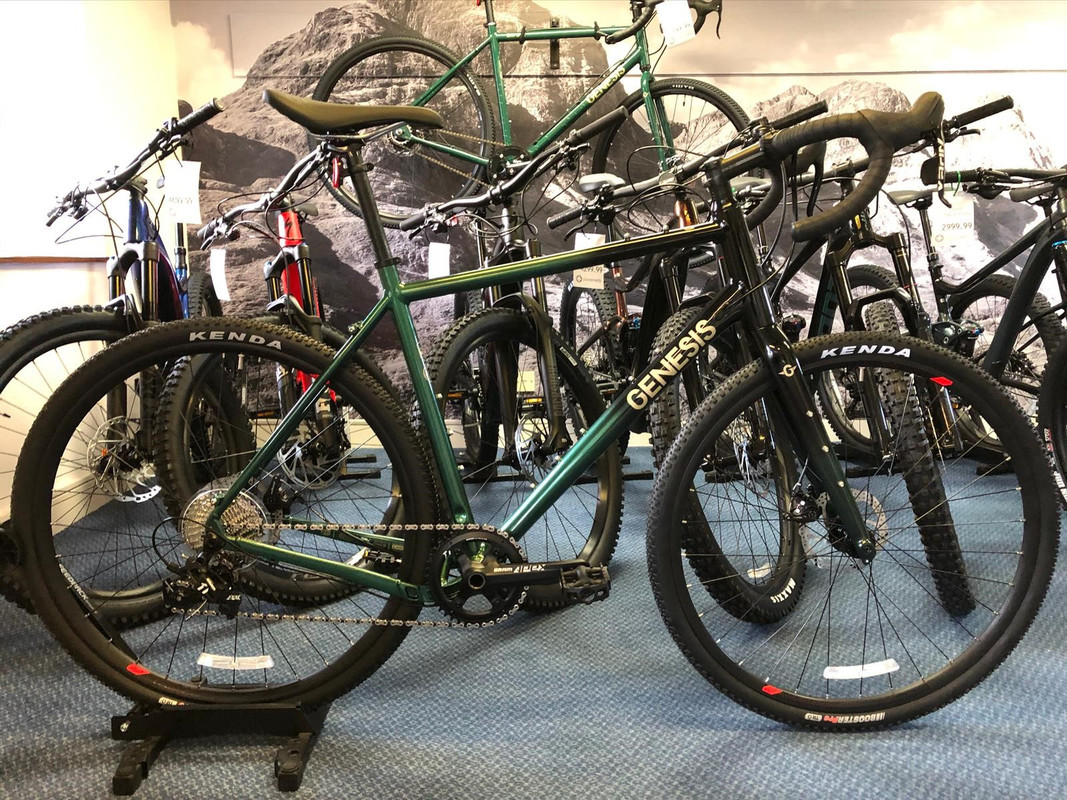
Jump forward a couple of years and I've given in to a proper drop bar gravel bike (Genesis Fugio), which in some ways is a lot better than the hybrid, but in other ways is a bit of a step backwards. Its sold as a 650b bike (which I was aware of) and picked up second hand for a price I couldn't refuse - especially given the scarcity of new bikes and parts at the mo. Ideally I think I'd have preferred 700 capability, but having borrowed a pair of wheels with 40mm tyres on to give it a try, there's no hope of the back fitting.
The big downside. When descending - if its steep enough to just let the bike roll, the bike is pretty good fun until its well into MTB territory - fair enough. However there's a point where it can be a bit rough, but not steep enough to carry speed and even if I try pedalling through the section, the bike just seems to bog down into the rocks. The hybrid MTB was better here as it was much easier to muscle the bike around from a flat bar position and attack the trail. (for the peaks locals - think the steeper bits of Houndkirk, or Coombs Dale as examples)
So the question is how much of a difference do the bigger wheels make? I guess I'd be wanting to stay with a similar tyre volume for both grip and comfort(I pinch flat occasionally and pick up the odd rim ding on the 650x47, but not to excess). I ride 27.5 and 29 MTBs and there's a definite difference between them, but as usual it's not all one way which I prefer.
Thanks!
Hi Jon,
I’d say it makes a big difference, but then I can get 2.25 xc 29er tyres in to my gravel frame which make for a lot of fun (think I’ve said before I’m very local to you and ride Houndkirk, White Edge and the like on my gravel bike).
Perhaps the answer is to keep the Genesis for the lighter local gravel riding (Porter Clough, Stanage Causeway and further afield stuff like Sir William Hill Road or the trails round Linacre Reservoirs) and tinker with the 26er to make that more fun? Add drops to that for example (you’re welcome to have a spare set of nearly new Kona’s off my gravel bike to try if you like?) and run 26 fast rolling MTB tyres on it?
Ive had two Fugios, tried them both with 700c wheels but the limited tyres clearence is crippling. Stick to the 650b`s its what the bike is designed around and TBH is the best way to ride it. I liked my 50mm donnelly MSO Xplor tyres, it was like a gravel fat bike, loads of fun.
Edit -

There's a big grey area in between that's a few pages worth on here but for me 650 x 47/50mm fits well with drop bars, by the time the tyres are a limit the bars feel limiting too. 700x50 is close to MTB tyres up to 65mm, getting into 29er and real off-road ability. A good rigid 29er with the right flat/alt bars is imo a better bike for anything that a 650B gravel bike struggles on.
That doesn't mean I wouldn't like a good 29er drop bar bike, it just fits a narrow gap between those two bikes for me. For others it'll be the one-for-all bike format.
No doubt that 700x50 will be better off-road than 650x50. Main reason for 650 on the drop bar bike seems to be the overall mix of tighter wheelbase and lower wheel weight suiting a road-going drop bar bike. Not exactly strong reasons though and you don't need to get off the tarmac that much to get into that grey area.
Don't know if there's a good answer as far as that rocky section goes, I reckon you need the air volume more than you need the diameter, and as you've found, the diameter's limited in that fame by the frame clearance. Guess the real answer is "Be more Chris Akrigg"!
And maybe a dropper post? Serious suggestion - I drop the saddle on my gravel bike on steep/tech stuff. I'd get the DT dropper if it was cheaper! Being able to move around on the bike would might help you get the bike where you need it, muscle it through and keep your momentum.
However there’s a point where it can be a bit rough, but not steep enough to carry speed and even if I try pedalling through the section, the bike just seems to bog down into the rocks. The hybrid MTB was better here as it was much easier to muscle the bike around from a flat bar position and attack the trail.
Stick a set of flat bars on it.
700c is much better IME, if your frame can fit a decent width tyre.
@trailwagger - snap!
tinker with the 26er to make that more fun? Add drops to that for example (you’re welcome to have a spare set of nearly new Kona’s off my gravel bike to try if you like?) and run 26 fast rolling MTB tyres on it?
Thanks for the offer, but its a bit 1-in, 1-out at the moment, and the justification for the Fugio was that most of the bits on the Soda were dead and needed replacing.
And maybe a dropper post?
Its got one - only 50mm drop, but it does make a bit of a difference.
I kind of agree with what people are saying that they're almost different niches, and @jameso is probably correct that a flat bar rigid 29er would be a better answer to the offroad Q, but how much would it give away on the tarmac...? I never had much issue feeling "slow" on the Soda on road, but I was usually riding solo, so it wasn't an issue. Felt a lot faster than MTB tyres, that's for sure!
I want to try some shorter drop, flatter flared bars next - try and get a bit more weight off the front descending, and ideally lower the hoods/tops position a fraction too. Need to wait until some stuff is actually in stock though!
the bike just seems to bog down into the rocks
that's not gravel, hence why the MTB feels better..
[img] https://d3dupjkkwlat3o.cloudfront.net/957778791379/3599557/1400w?1410983574 [/img]
This is one of the sections that's sub-optimal (fore ground). You wouldn't bother riding it on even an XC hardtail as a "destination" trail, so it must be gravel, right...?
that’s not gravel, hence why the MTB feels better..
Except when it steepens (and techs) up, the Fugio starts feeling good (challenging) to ride again. Its just this middle ground - not buff and flowy, and not gravel-gnadge either - just annoying!
I should say the good bits are the front end is WAAAY more compliant than the Exotic Carbon forks on the Soda, and the (much) lower BB is very noticeable in cornering stability and the ability to hold drifts without dying messily.
^^^ I also have a Fugio 30, after a series of CDF's over the years. I find it way more able than previous bikes, but on that stuff I'd have chosen my Vagabond (now sold) which was effectively a rigid 29er MTB with drop bars, and 2.1 tubeless. But then the Fugio might have been more fun other parts of the route .. 🙂
Its just this middle ground – not buff and flowy, and not gravel-gnadge either – just annoying!
out of interest, are you tubeless and what tyre pressure are you running? The Fugio should float over the terrain in that picture.
Tubeless - of course. Pressure - 32psi F, 40 psi R. (any less and a) it starts feeling bouncy on road, b) flats and rim dinks suddenly become a regular problem again)
First thing is to stop riding Houndkirk, it's the dullest track for any bike on the planet.
I'm more at the road end of gravel than the mountain biking end of gravel but have yet to find anything that I can't take 700x38 down.
Pick better routes, pick better lines, go faster, stop blaming the bike.
If your frame can take large volume 700c then they will win every time - 650b is just a compromise to get large(r) volume tyres in an frame that's incompatible with big volume 700c.
It stems from a few years back when bike companies were changing CX bikes in gravel bikes and need to market them with bigger volume tyres.
Personally my current bike maxes out at 700x45c but I'm fine with that.
If your frame can take large volume 700c then they will win every time – 650b is just a compromise to get large(r) volume tyres in an frame that’s incompatible with big volume 700c.
I think that depends. 650b has other advantages, they are quicker to spin up than large volume 700c, the bike will be more nimble and manoeuvrable and lighter overall.
I'm surprised the rear wheel didn't fit as I tried the 700x40 wheels off the latest CDF on a Fugio 10 when I was ordering my own Fugio and they went on with some room to spare, so I wonder if the steel frames have less clearance than my alloy one for some reason? This is a (not great quality) photo I took.
I also have a Fugio 30, after a series of CDF’s over the years.
Is the CdF dull and lifeless as some have said in comparison?
That trail wouldn't be my idea of fun on anything, really. Hard and chattery. Maybe a shortish travel full sus. Or something in the + range at lowish pressure.
I hadn't actually thought about it before but Jameson and traikwagger have a good point - the 650 will be lighter and more nimble.
Slightly higher bars with a bit more flare on the drops might suit you better.
First thing is to stop riding Houndkirk, it’s the dullest track for any bike on the planet.
Its not taramc, therefore it could be worse. On an MTB with a tailwind heading Foxhouse->Cannings the rocky stuff on the RHS can be quite good fun.
I’m more at the road end of gravel than the mountain biking end of gravel but have yet to find anything that I can’t take 700×38 down.
<<tongue in cheek>>You've ridden Parkin Clough on a gravel bike?? I'd pay to see that.<</tongue in cheek>>
Getting down it isn't a problem. I'd like to understand why it feels harder work/slower/rattlyer on drops rather than flats, despite exactly the same wheels and tyres, and also to understand what difference bigger wheels in this situation would make and where the tradeoff would be elsewhere.
Pick better routes, pick better lines, go faster, stop blaming the bike.
No; I pick interesting ones; I try; I don't.
the 650 will be lighter and more nimble.
I think lighter is very subjective and unlikely to be particularly noticeable.
I’m surprised the rear wheel didn’t fit
Maxxis Rambler 40c (quite well worn) would go in if I deflated it and then blew it up again once the wheel was in, but it was catching on the boss welded onto the back of the chainstay bridge (I guess for mudguard mount). File that off and I'd maybe have 2mm clearance.
JonEdwards
I've not done Parkin Clough on foot, I have however taken the gravel bike down Stanage Plantation when it was on 32c standard gravel kings, didn't smash any records like but it managed fine. Just like I rode lots of the Calderdale stuff in the 80s & 90s on 1.5" tyres long before suspension was mainstream and managed fine, just slower and rattlier than those that now need 150mm each end.
Honestly if you're on a gravel bike then tarmac > Houndkirk, if you need a tailwind and a mountain bike for it to be fun then it's not right is it? Into town the road is much faster, out of town it's more of a legs and lung challenge.
I imagine it's not so much the wheels, flats Vs drops is a whole different body position, more weight on the front so more likely to be rolling into stuff instead of rolling over it, possibly not absorbing as much on the drops through your arms so feeling it bump you around more... Far more going on.
Bigger, narrower wheels will possibly be faster but with less comfort.
I think lighter is very subjective and unlikely to be particularly noticeable.
How can lighter be subjective? It either is or it isnt, and 100gms+ per wheel will be VERY noticeable.
I've got both wheel set ups (Tripster with Lauf Grit forks) and tend to only use the 700x40 when doing more road/lanes or smoother 'gravel'. If I need something more capable, it's an MTB. The 650b's have 2" Non in the front and 1.9" Gravelking rear. There isn't a wheel size/tyre width/bike that will feel ideal on such a range of surfaces. Sit up and enjoy the view. 700 wheels are just an N+1 thing for the situation you describe.
First thing is to stop riding Houndkirk, it’s the dullest track for any bike on the planet.
There are many less fortunately placed riders who would disagree. It's open moorland, with decent views and a pub at the end, which leads from the city to better trails.
@jameso how about I just give you my password and you comment on my behalf? I reckon you've captured everything I'd have to say on the subject, other than that 650 wheels are a better fit for the less tall rider - especially once bikepacking bags are added into the mix.
trailwagger
Because a larger, heavier wheel will carry speed better.
Hill climbers and downhillers both predominantly use 29/700c yet here we're suggesting 650 will be faster. Far too many variables for a blanket statement like that.
It’s all personal preference, but for me 700 works better with narrower (38mm) slicker tyres for rides that are mostly road with a bit of trail. The 650 works better with wider (47mm) tyres and more knobbly tyres for rides that are more off road. The 700s are faster and 650 is more the party size (for me) but both work. I could fit wider 700 tyres but (again for me) you start to lose the snappy handling that makes the gravel bike fun and once I reach terrain where a 29x2” tyre would make sense I’d rather be on the MTB.
There are a huge range of tyres out there though so I wouldn’t get too hung up on the rim diameter. A lighter more supple tyre at the right pressure should float over those rocks.
It’s open moorland, with decent views and a pub at the end
Even better, a pub at either end! I quite like Houndkirk as part of a ride, nice way of linking up bits of singletrack or getting out of the city without having to ride on tarmac. And of course for the cheeky riders it’s a good way of riding the lower part of Burbage or across to Devils Elbow quarry.
Much rather do that than gamble on Hathersage Road thanks.
No doubt that 700×50 will be better off-road than 650×50. Main reason for 650 on the drop bar bike seems to be the overall mix of tighter wheelbase and lower wheel weight suiting a road-going drop bar bike. Not exactly strong reasons though and you don’t need to get off the tarmac that much to get into that grey area
Stating the obvious 650b with 50mm will then allow 700c with more road focused tyre without too much change in bottom bracket height. Presumably 700c 50mm would then have a noticeable drop in bottom bracket height with road tyres
I think lighter is very subjective and unlikely to be particularly noticeable.
It's only about 7% for the same rim and tyre construction. But combined with the shorter wheelbase you can fit it into, shorter forks, the slightly lower intertia around the steering axis etc it can all add up to making the bike feel closer to a road bike than an MTB yet having better off-road ability than the average CX bike or 700x40. That's where I want my 'gravel' bikes to be. Fat tyred road bikes that can handle a few tracks and lots of rough lanes. And why I said they were "Not exactly strong reasons though and you don’t need to get off the tarmac that much to get into that grey area."
Get to 700x45 and it's a wash, volume vs OD pretty much balances up. Riddler 700x45s vs Byway 650x47s for ex - Byways still have a quite a bit more volume for when you hit roots but the OD of 700C Riddlers feel like they have smoother roll-over in general.
This is one of the sections that’s sub-optimal (fore ground).
Loads of sections like that near to me, hard-baked chalk lumps. Bstrd at speed on 650X47 at 27-28PSI but fast and quite easy on 29 x 2.4 at 22PSI. It's ok in small doses on the gravel bike.
jameso how about I just give you my password and you comment on my behalf?
Ha.. You'd be trusting me more than I do 🙂
Yeah, if you want to swap around wheels then 650x47 and 700x32/35 cuts the BB height variance.
Because a larger, heavier wheel will carry speed better.
Hill climbers and downhillers both predominantly use 29/700c yet here we’re suggesting 650 will be faster. Far too many variables for a blanket statement like that.
They may carry speed better but take more effort to get upto that speed. Take a Hutchinson Toureg for example. In 650bx47mm it weighs around 470g but the 700x45 weighs 610g (50mm would be even more) that's a hell of a lot of extra rotational weight to drag up a hill !!
but fast and quite easy on 29 x 2.4 at 22PSI. It’s ok in small doses on the gravel bike.
I'm curious - ever tried it on a 27.5+ (3" ish tyre?)
I’m curious – ever tried it on a 27.5+ (3″ ish tyre?)
Yes, on a the Pinnacle Ramin 3Plus. Mainly on a 2.8 Trailblazer rear and a 3.0 front. That's where B+ ruled, it rolled so easily over fast choppy ground like that.
They may carry speed better but take more effort to get upto that speed.
I hope we're not all recreating the 26 vs 29 debate again for gravel bikes : ) True, though the effort is only in moving the additional weight along or up, since the larger wheel rotates slower than a smaller one at a given speed the effect of additional rotating mass is cancelled out.
I think we feel a little more resistance in that first 1/4 of a pedal rev and that's about it, if we were comparing equal rim and tyre types.
Maintaining momentum seems to be much more about roll-over and tyre volume aiding things than wheel weight when you have a >10kg bike and ~80kg rider helping it along.
The size of a wheel does influence things in bike design/spec I think, no doubt that a 650 x 47 can build a bike that gives the impression of being a bit more lively and quicker to accelerate than a 700C with a similar tyre but I think it's mainly just a sensation from a number of influences adding up, in the same way a stiff steep-angled bike can feel fast due to increased feedback levels. If you could test for wheel OD being the only variable and tested on road I expect you'd struggle to measure any change apart from the wheel weight itself. Feedback is so important in how a bike rides and is hard to quantify, and we struggle to separate feedback from performance indicators.
It does make me laugh this argument - the differences are pretty minimal on a gravel bike but, there is a huge degree of influence based a) what combo of tyres/wheels your bike/frame can take and b) on what surface your riding.
I'd argue that tyre choice and tread pattern prob have a fair bit to do with point b).
My thoughts are if your doing a mix of on & off road, a good 700c tyre will always be better than 650b. If your mainly riding tech off road a big 700c tyre will out perform a 650b and most importantly the correct wheel and tyre combo for your frame. Theres no point squeezing a 700x47c tyre in your frame if clearance becomes an issue. I guess what I'm saying is every users experience and bike will determine the correct combo for that user.
My frame maxes out at 700x45, and I mean MAX. So much so I'm thinking I may change my off-road wheel set to 650b, just to get clearance. Pretty sure I won't notice any real difference in how it rides or feels.
that’s a hell of a lot of extra rotational weight to drag up a hill !!
But you're not always going up hill or accelerating under your own steam.
As Jameso says, lots of differences add up and what if it's OEM 650 Vs borrowed bling 700? The 700 are likely to be heavier. Plus your unlikely to be using a 47 & 45, space restrictions mean it's more 47 & upper 30s.
If your frame can take large volume 700c then they will win every time – 650b is just a compromise to get large(r) volume tyres in an frame that’s incompatible with big volume 700c.
+1
My On One Free Ranger will happily take a 700 x 50c Gravelking on a 25mm internal rim.
And reading the 650 vs 700 'debate', haven't we previously worked out that 29 is best 🙂
Lots of overthinking here. Get bike, ride it. Size of wheels/tyres will be better on some sections than other and they will all cancel each other out.
I use 28c (max for frame) and ride exactly the same routes as I did on an MTB. It is faster on the road and smooth gravel and single track, it is slower on the rough gravel or single track.
Strava tells me there is so little in it that it will be more down to how I I felt on the day than the bike I was using.
Strava tells me there is so little in it that it will be more down to how I I felt on the day than the bike I was using.
This +1.
My frame maxes out at 700×45, and I mean MAX. So much so I’m thinking I may change my off-road wheel set to 650b, just to get clearance. Pretty sure I won’t notice any real difference in how it rides or feels.
You've just contradicted your own argument there
The discussion isnt about 700c vs 650b, its about 700x50mm vs 650bx47mm. Thats different as the tyre volume is the same but the weight difference is significant. I accept that the 700c will roll better on very rough ground, but you will pay a price with all that extra rubber weight on any climbs.
but you will pay a price with all that extra rubber weight on any climbs.
A very small price if we are talking about 200 grams. And while you may notice it in a back to back test the reality is that the difference over a 10 mile route would be negligible, especially as the larger tyre will roll better (even uphill).
but you will pay a price with all that extra rubber weight on any climbs.
6 to 7% difference for the same casing width and construction. Same for rims. 50g per tyre and a bit less per rim for an average gravel/XC spec? Not something I'd worry about from an overall performance pov.
And reading the 650 vs 700 ‘debate’, haven’t we previously worked out that 29 is best 🙂
For MTB terrain yes : ) but the criteria could be quite different here if how the bike rides/feels on tarmac is important? It may not be important to everyone but I'd argue that if it's not, we're into an MTB discussion really so the answer then is 700C, and then where do you draw the line between this and XC MTB.
650B is the randonneur / Original Gravel thing isn't it. 'UK Gravel' can seem more drop bar 29er compatible while CX roots are 700 x 30-odd.
I'll never be able to answer this one with any real logic and I think that's why I always found it interesting.
but you will pay a price with all that extra rubber weight on any climbs.
Posted 2 hours ago
Stop at bottom of hill, remove water bottle, throw as far up hill as you can. Get back on, climb. Stop at bottle. Repeat as necessary. Problem solved.
650B is the randonneur / Original Gravel thing isn’t it. ‘UK Gravel’ can seem more drop bar 29er compatible while CX roots are 700 x 30-odd.
The interesting thing is that quite a number of bikes that used to come with 700c now come with 650. The Marin Nicasio/ally version etc for instance. Might be simply so they can market it as gravel by increasing the tyre volume without having to change the frame or it might be they think it is actually better. They aren't the only ones either.
Might be simply so they can market it as gravel by increasing the tyre volume without having to change the frame or it might be they think it is actually better.
Much truth in this, though it wasn't just marketing. I was involved with WTB's Road Plus from the start and that backward compatibility was what lead them to settle on the 47mm size. The original request was for a fatter 650B than the current tyres eg the 38-42s I had, plus tubeless. Those smaller 650s were on a Pinnacle Pyrolite road disc bike that already had the clearance for larger designed in as that similar OD point was interesting.
WTB decided on 47mm to match the OD of 700c bikes and fit into most CX frames, in the same way that B+ was designed to fit into 29er frames. WTB are a company full of riders, good people, backwards compatibility and upgrades were a priority from a rider pov as well as it helping their sales. Tests on the 1st Horizon tyres showed that the 47mm size worked well, any minor gains in going bigger were negated by difficultly in fitting to many frames out there.
B+ went from 2.8s that fitted 29er frames of the time to 3.0s and 29ers gaining clearance up to 2.6, Wide Trail etc at the same time. I've tried 650Bs up to 60mm (G-One Speeds) and though I'd like a bit bigger than 47mm at times, 42mm still feels really good on road and 60mm only feels good in a straight line, too much roll in the corners on tarmac and self-steer on uneven roads/ground for my liking. A Byway 52mm might be the ideal tyre for me but 47mm is fine, anything it won't handle is better served by a 29er of sorts.
Stop at bottom of hill, remove water bottle, throw as far up hill as you can. Get back on, climb. Stop at bottle. Repeat as necessary. Problem solved.
In my experience (on road as much as off) pedalling a 200g lighter wheelset uphill is significantly easier/faster. That weight difference is just the first example I could find where the same tyre is available in both sizes (700x50 and 650bx47) and was the Hutchinson Toureg. I am sure the difference could be even bigger with other more treaded tyres. Now, my gravel rides have very little flat in them. I am either going uphill or downhill. That means on a 6 hour ride i am spending ~4 hours going uphill. So given the choice of a lighter wheelset or one that rolls slightly better (lets not forget the 650b are high volume, low pressure) on rough ground i know what i will choose.
@jameso you might like the 650x47 Rutlands. Better grip than the Byway but rolls like a Nano 40. Always down to mix of terrain of course but I can usually choose routes avoiding too much tarmac.
In my experience (on road as much as off) pedalling a 200g lighter wheelset uphill is significantly easier/faster.
Could you quantify that with times on climbs?
What do you weigh?
This is how see it
Bike plus rider=60+10=70kg (for me the number is over 100kg)
% difference 200g makes 0.2*100/70=0.3%
Time saved on climb is 1 hour climb=0.3*60*60/100=11 seconds
Now that could win the tour de France but I really don't think I'd notice. Although i accept feel isn't the same thing as time
In my experience (on road as much as off) pedalling a 200g lighter wheelset uphill is significantly easier/faster.
Whereas in my experience in makes no noticeable difference. Quite a different experience from your "significantly easier/faster". I can feel the difference but the actual difference (timed over many miles) is just simply not there.
Could you quantify that with times on climbs?
Unscientifically, yes. Local climb of 1 mile took me 1 minute less to climb with a new wheelset that was 100g per wheel lighter.
Im not bothered if you think its true or not, just trying to make a point that reducing weight of moving parts has a bigger effect than reducing the weight of static ones.
The weight thing does only apply if you're comparing similarly sized tyres though, which is a daft comparison. Going from 29x1.8 to 27.5x1.8 just drops the BB by ~19mm (or vice versa raises it by 19mm).
If a frame is designed for 650b x47mm then the faster/smoother option is 700c x 32mm (approximately the same diameter).
The weights for those sizes work out something like:
WTB ByWay 650*47 564g
700x34 396g
DT G540 650b - 530g
Dt R500 700c - 495g
So overall the 650b option is actually 200g heavier. If you do it in a way that doesn't mess with the geometry.
Personally, I didn't get on with a 700x55mm gravel bike on XC tyres, it was just heavy and incapable. 700x42mm (and light flexy tyres at that) is a much better compromise of grip/cushioning/talent/capability. The exception to that might be riding something like the GDR of GBDuro where you'd probably pick skinny tyres, but need the cushioning for some bits when fully loaded. And would probably prefer a 29er for those bits too but drop bars are the better compromise for comfort and speed. But those are quite a niche set of circumstances.
The other advantage would be aerodynamical, you're lobbing ~40mm off the height of the wheel (for the same tyre size), that's a chunk of watts.
The weight thing does only apply if you’re comparing similarly sized tyres though, which is a daft comparison. Going from 29×1.8 to 27.5×1.8 just drops the BB by ~19mm (or vice versa raises it by 19mm).
If a frame is designed for 650b x47mm then the faster/smoother option is 700c x 32mm (approximately the same diameter).
The weights for those sizes work out something like:
WTB ByWay 650*47 564g
700×34 396gDT G540 650b – 530g
Dt R500 700c – 495gSo overall the 650b option is actually 200g heavier. If you do it in a way that doesn’t mess with the geometry.
Agreed, but the comparisons being made on the first page were big volume 700c like 50mm and 650bx47.
Unscientifically, yes. Local climb of 1 mile took me 1 minute less to climb with a new wheelset that was 100g per wheel lighter.
Im not bothered if you think its true or not, just trying to make a point that reducing weight of moving parts has a bigger effect than reducing the weight of static ones.
That can't be down to weight can it? I've seen a few comparisons that confirmed the sort of calculations I've done but in the real world. They of course used a power meter to make sure that wasn't a variable
Agreed, but the comparisons being made on the first page were big volume 700c like 50mm and 650bx47.
Sorry if I've missed a nuance in the debate, I saw you were. But everyone else seemed to be talking wider 650b vs narrow 700c. This is why I pointed out the weight change is generally in the other direction unless you do as you say and try and keep the same tyre width, which has the knock-on downside of changing geometry too.
I was looking at some frames recently and the manufacturer was making a big deal of it fitting 700x52 tyres and 650x55mm, but looking at the geometry it was pretty close to the "relaxed CX bike" end of things. kinda felt like they were hobbling their own bike a bit by trying to convince users it was even more versatile than it was with a 3rd wheelsize option (650b, 700c and "29er") that really just added weight and raised the BB.
Local climb of 1 mile took me 1 minute less to climb with a new wheelset that was 100g per wheel lighter.
Im not bothered if you think its true or not
You may not be bothered but that is just simply impossible, physics eh.
Is the CdF dull and lifeless as some have said in comparison?
I had 3 of them and never found them to feel that way.
In my experience (on road as much as off) pedalling a 200g lighter wheelset uphill is significantly easier/faster.
Yeah, forgive my joke, I know what you mean. The mass at the extreme of the rotational disc does make a difference. I have certainly felt that the bigger tyres on bigger wheels are harder to spin up to speed. I've never tried to quantify a difference in terms of power or time but I don't have trouble believing it exists. If sprint wheels with sliding weights didn't work, the pros wouldn't have used them.
I had 3 of them and never found them to feel that way.
Interesting, thanks. It seems like it's a marmite thing. Some owners really felt they were dead, others not at all. At the moment the yellow frame, and tyre clearance is holding me back