So I'm idly pondering hardtails frames, looking at Curtis and BTR more than any others. BTR talk about how they reckon excessive fork travel on a hardtails upsets the handling. I've got 140mm on my 650b hardtail and never noticed anything untoward. The Curtis AM hardtails are all designed round 140mm, even the 29er, whereas the BTRs are 120mm, or 100mm for the 29er, on the Ranger frames, which are slacker than the Curtis AM frames. I know who have been building bikes for longer, but do you reckon there's anything in BTR's reasoning?
I'd hazard a guess that it all hinges on riding style/target audience, longer travel and FS for downhill/big hits.
Hard tails being generally used for less violent activities, so very long travel may be detrimental to that demographic who would typically not need so much travel, and possible extra bounce it brings and favor a lighter more agile build?
What they said IMHO hardtails are used more for mincing along stuff* than for full on DH so less travel is generally required
I found my 456 to be a front end light going up hill with 140 and use TALAS if i had to pick i would have gone for 120 mm personally
* i have 100 mm 26 er and yes i could ride the lakes and proper mountains on it but honestly I would be using my FS for such a task
YMMV
[img]  [/img]
160mm on my production shan, wouldn't want any less.
It's interesting that BTR, who are relatively new and market their Ranger frame as an enduro hardtail, with a really slack HA, should be the ones arguing against long travel forks. The concept of the long travel hardtail is pretty well established too.
Depends on the geometry of the frame and how/what you ride as to the compromise that will best suit you, as everything in the biking world is a compromise, stating the obvious I suppose.
The only [b]rough[/b] rule of thumb I can see is slacker head angles with steeper seat posts suit longer travel forks far better than steeper angled established XC geometry frames. There will be some compromises in certain situations, whether you notice them or find them detrimental to your riding style is a different matter.
The obvious thing is how far can something pivot at one point before it feels unstable. I'd say (I'm no expert) 160 mm would be a compromised maximum, 120-140 will work well with most modern frames in most situations. When you get to 140 and above, slacker geo frames with HA's about 66.5-67.5 really help IME.
Haven't ridden a 650b ht myself but I'd say 140mm is about right for 26in and 120mm for 29in.
Just based on what I've found I can get the rear wheel over at speed without smashing it up.
I've got 140 on my 29er hardtail and it feels fine.
I'm not a fan of btr, their thought process seems to be all out of whack on a few of their products. ie let's make a hardcore hardtail for 100mm forks even though you'll struggle to find 100mm hardcore forks
The geometry and quality of travel more important in my opinion.
My riding skillz are also more important than 20mm of travel.
120mm on 26er Sanderson.
Got to be all down to geometry and frame design. Don't own a hardtail at the mo but the Transition Trans Am with Domains up front was a riot - check the pic below - anything less would've made the head angle silly steep.
[img] 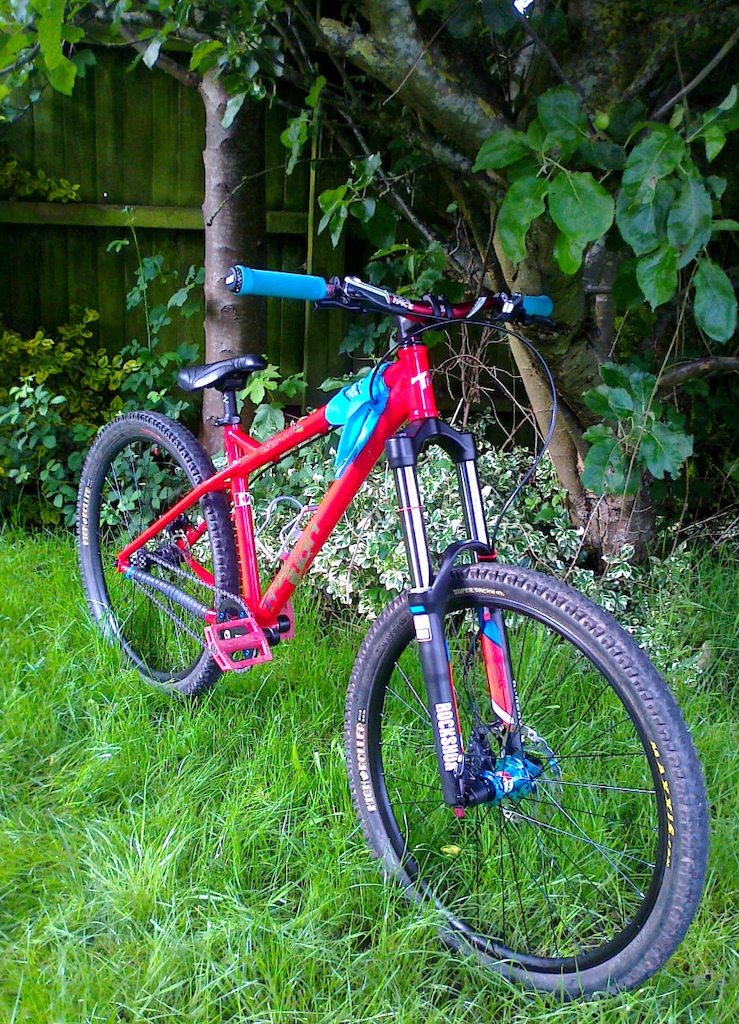 [/img]
That said it went uphill more easily than my old 130mm equipped Cove Stiffees.
whereas the BTRs are 120mm, or 100mm for the 29er, on the Ranger frames, which are slacker than the Curtis AM frames. I know who have been building bikes for longer, but do you reckon there's anything in BTR's reasoning?
'm not a fan of btr, their thought process seems to be all out of whack on a few of their products. ie let's make a hardcore hardtail for 100mm forks even though you'll struggle to find 100mm hardcore forks
Probably something to do with dynamic head angles in full sussers vs hardtails. Less travel on a hardtail = more stable angles.
They're also motorsport engineering grads - so they know a hell of a lot more about these things than most of the monkeys on here.
Tam spent most of his uni years racing hardtails on downhill tracks - so he knows a thing or two about them and he's ****ing quick.
Pikes come in a 100mm flavor btw.
I'm a graduate zoo keeper, I know a hell of a lot more about monkeys than you.
What do you make of those rear post mounts Tom? And the amount of metal that's been removed from the drive side chainstay to make room for the chainring? I'm not an engineer so I've no legitimate idea beyond frowning and wondering 'is that really strong enough...?'
Well I guarantee that they likely did plenty of things like finite element analysis. Tam always struck me as a person who knew his stuff. Never saw or heard of any of their protos breaking either. They were hard on bikes as well.
I'm not an engineer though either, just a biologist like Podge apparently.
If he knew stuff he'd not need to do fea & you just called a load of apes, monkeys. That's proper basic stuff so I'm calling you out on being a biologist too.
http://dirtmountainbike.com/bike-reviews/btr-ranger-the-butch-review.html
As I suspected, short travel fork to aid chassis stability.
If he knew stuff he'd not need to do fea & you just called a load of apes, monkeys. That's proper basic stuff so I'm calling you out on being a biologist too.
I wouldn't demean apes by associating them with STW.
If he knew stuff he'd not need to do fea
Apparently, Airbus, Boeing, Lockheed etc don't know their stuff. Well **** me, I'm never flying again.
Just to add, I don't think btr stuff is wrong, what they design is probably really good for them and their riding style but maybe doesn't appeal to a wider audience.
Like anything podge.
I'd get battered half to death by the Ranger with a 100mm fork. Would like one for the laughs but I have other things to buy really.
160mm on my production shan, wouldn't want any less.
Same on mine. set of Lyrics, was ace and totally suited the bike
I've used a 160mm bike with 160mm forks before and it just felt a bit odd, the bike gets imbalanced as the rear gets smashed despite you thinking you have loads of plush travel. In future if i got another i think I'd go for a 140.
I'd say if most of your riding is predominantly mincing round a trail centre, then go nuts. Longer is better. 160mm preferably.
THis thread might be of interest.
http://singletrackworld.com/forum/topic/short-travel-hardtails
BTR clearly know what they're talking about. I think I remember the guy who started it from the SDH forum days, and like me, he can clearly ride a bike 😉
THe only time I ever used long forks on a hardtail was for downhill holidays in Morzine. Obviously the tracks out there are always ****ed, and half the time it was just a case of hanging on for dear life rather than actually "riding".
Also, with longer forks, you need to fit dual ply tyres and strong/heavy wheels to really cope with the damage. Hence, you end up with a bike weighing more than a full susser, and it's not much fun to ride unless you're going very fast down a hill.
Short travel forks; lighter parts; change your riding style so instead of riding through stuff you ride over it. That's what hardtails are all about imo.
I'm having fun on a 140mm 32.5lbs 29er hardtail riding natural trails at mince to medium speeds. Who do I have to answer to for doing it all wrong?
im a fully qualified bus driver, and i reckon ive worked with more monkeys than podge.
I have 140 on my 26"p7. perfect for me. Don't know about other wheel sizes.
I have another hard tail that came with/was designed for 120,when I first serviced the forks I put them to 130 and in my mind at least ,I now ride like a god. Which is not quite as well as Mr Taylforth 😉
I'm having fun
It sounds like you're doing it all right!
Which is not quite as well as Mr Taylforth
I imagine you ride better than I do; I no longer bother 😀
Also, with longer forks, you need to fit dual ply tyres and strong/heavy wheels to really cope with the damage
None of those is really true though, I used X819 on mine, which are a bit heavier than some, but that's because they're tubless, and I didn't need dual ply tyres either, perhaps I've just got a bit more finesse than you?
😉
[i]I found my 456 to be a front end light going up hill with 140 and use TALAS if i had to pick i would have gone for 120 mm personally[/i]
150mm Revs on my 456Ti, no problem climbing at all, and we've plenty of steep and long climbs around here.
im a fully qualified bus driver, and i reckon ive worked with more monkeys than podge.
I'm a policeman, so congratulations on coming second 🙂
150mm on my c456. With modern forks with proper damping, i can't see a problem tbh!
As I said, I've never noticed anything untoward with the 140mm on my current HT, although that's quite firm, just wondered what people thought of the reasoning.
Depends on the hardtail- give it forks as long as it wants. Maybe longer, not often shorter, there's not many bikes that work better with less fork than they were intended for
All it really comes down to is, if you want a bike with decent non-xc geometry and stiff forks they're almost always designed for longer forks, so you end up with that by default. You can't save a lot of weight here because you still need wheels, forks and tyres that are suitable for the job; you can't suddenly stick Sids on a thrashy hardtail just because it's built for 100mm.
Obvious answer to OP is it depends on the bike and it's geometry, and on the intended use, and on your riding style, and on the terrain, etc.
My BFe was a bit wandery at 150 but is just about right at 130. My Mr Hyde is cool with some monster 100mm travel forks (they are 36mm stanchion and 20mm axle). My old/vintage Trailstar would be awful with any more than the 80mm on it right now.
Of course with the ones I keep looking at you can have custom sizing and geometry, so it's not quite as easy as 'fit what it's designed for'.
150mm 650b Revs on my 26" Transam.
Light front on steep climbs but I love it.
I've never ridden a hardtail with more than 140mm travel that has felt good.
100-130mm is the sweet spot IMO. Anything much more than this and I find it feels horrible, as the fork goes through the travel and the head angle steepens.
This may help.
‘DOES THAT TAKE 160MM FORKS?’ ‘IS THAT 160MM TRAVEL?’ ‘CAN I FIT 160MM FORKS?’ THESE ARE QUESTIONS THAT WE HEAR/READ AT BTR ALMOST DAILY, AND YOU KNOW WHAT? NO; NO IT DOESN’T/NO IT ISN’T/NO YOU CAN’T.
Let me expand. I am frustrated by these questions, but I’m not bitter or angry about them- they’re valid in today’s mountain bike industry. Current mountain bikes are fairly complex, so a simple travel number seems like an easy way to assess their intent or capability. Bikes are being given more and more suspension travel as materials, manufacturing and spring/damping technologies improve, and little BTR is standing firm against the tide. I want to explain why, not so much for my own gain, but for the good of any mountain bike consumers who actually read this…If we were asked these questions about the Belter or the Pinner, the answers would be yes, no but it’s compatible, yes.
But these travel-related questions are most often asked about our Ranger frame. Other bikes aimed at ‘enduro’ riding are most often given ~160mm travel nowadays, so we get asked if the Ranger fits in the same mold. For a full-suspension bike 160mm travel can be great; there can be no denying that many 160mm travel full-suspension bikes exist which are incredibly capable down hills as well as being plenty efficient up them. Brilliant! Several hardtail ‘enduro’ frames exist which can accept 160mm forks; some are even designed around this value, but all are a compromise.
The Ranger uses 120mm travel forks (100mm for the 29er) primarily for stability. Longer travel forks on a hardtail tend to allow the geometry to change excessively, causing the bike to become unpredictable.
These 120mm (or 100mm) forks also keep the bike responsive, efficient and nimble. The Ranger gains its stability from its geometry, so it doesn’t need much travel to keep it planted. Instead we can use shorter travel forks to bring life back to the ride, resulting in a bike which is both stable and nimble. Nope, that’s not a contradiction of terms!
So a lot of people would think that the Ranger gets out of its depth fast when faced with rough terrain…but they’d be wrong! You just need to set up the forks the right way. In order to deal with aggressive riding, ‘short travel’ forks need to be more progressive than their 160mm travel brothers. This is generally as simple as installing a couple of extra ‘bottomless tokens’ in your Pike, or adding some suspension fluid to the positive air chamber on forks without a transfer port, or changing to a firmer spring on a coil fork. Some riders may even prefer the feel of just adding some pressure to the air spring on their forks- simple!
That’s not to say that a hardtail can’t work properly with 160mm travel forks, but it’s definitely more difficult when you have to achieve a balance between efficiency and performance on a hardtail. Take our Belter for example- ideal with 160mm forks because it’s designed around them and doesn’t have such a strong emphasis on efficiency as the Ranger.
So what happens if you put 160mm forks on a Ranger? Well it probably won’t break, but we’re not going to guarantee that. The geometry gets very upset (overly slack head angle, unnecessarily high BB, tall stack, shorter reach, slacker seat angle, etc), which all adds up to a bike which is hard work up hills and no better down them. It’s not rubbish, it’s just worse than it could be and that sucks.
The Ranger is best with 120mm (100mm for the 29er) forks. Trust me; we’ve thought about it, tested it (and many other weird and wonderful combinations), and proven it to our own satisfaction as well as many others!
That's what prompted the question 🙂
I think the issue with getting consensus on this topic is that almost everything you read online from mags etc. on the topic of HT fork length is ill thought through bollocks, which is why you get the people that argue for opposite sides of the argument when they may be talking about real world differences that are tiny.
Personally I think the key to getting the [i]right[/i] travel on your HT bike is:
1. Be honest with yourself about where and what you'll ride. Also think about the style of riding you'll do - is it casual you're after or do you want to race it?
2. Buy the best forks you can. Avoid coil forks and 32mm chassis for 150mm travel HT bikes. You also either want a tuneable air spring or adjustable HSC. If you cant do either of these on your choice of air fork, walk away.
3. Pick a frame that is the way you want it for the travel you want. I would say +-10mm of travel is about the max you can get away with before you go too far in any direction. So if you like the geo at 120mm, don't then stick 150s on it. Its not the same bike. Alhough some things will be the same, some of the critical things will be [i]for average riding[/i] very different. Too many compromises IMHO.
i know ..
it makes no sense..
its unpredictable..
just wrong...
but its a lot of fun !
and perfect for me... 😀
[img]  ?0[/img]
prince albert prototype with 44mm headtube and 150mm marzocchi FR forks
Maybe, just maybe, as just very occasionally happens on STW and elsewhere, there isn't a black and white, right or wrong answer? Just possibly. Like maybe a frame designed to work with a longer travel fork will work better with one than one designed for a shorter travel front end?
And maybe there are pros and cons to both options? And maybe it also depends on the rider, the set-up of the fork, the terrain, riding style and numerous other variables?
Just a thought.
Love the idea that having a motorsport engineering background makes someone an expert on mountain bike frame geometry btw. How does that work? 😉
I can't see any significant difference between HT and FS when it comes to "slackening geo due to fork travel".
In fact, if the front fork is compressing, then it must be taking a larger proportion of your combined mass (due to braking hard, or descending steep terrain), which means (as you haven't actually got any lighter....) the rear must be taking less, which on a FS bike, means the rear suspension is unloading, and hence getting longer, which steepens the head angle even more...............
150mm on my Dartmoor hornet although I've got no idea if this is too much as I've not actually got to ride it in anger yet ha ha ha ha
Love the idea that having a motorsport engineering background makes someone an expert on mountain bike frame geometry btw. How does that work?
I read it as 'technically minded with engineering experience and a good rider = probably capable of thinking through the question and having a sound opinion rather than saying what his mate said or writing it off before trying it' : )
I like what BTR are saying and agree with it, the bike looks like a riot. 120-plenty. I've also have had a lot of fun on a 140mm HT. Had pros and cons, like most bikes.
Analysis fail maxtorque! 😉 It's the dynamic loading that is the issue, not static loading, so the vertical force you're applying to the bike is often greater than your weight.
When you get on a hardtail the geometry always steepens. When you get on a well set up full-sus the geometry usually slackens, especially on bikes that are ridden harder as forks get run with much less sag than shocks.
I can't see any significant difference between HT and FS when it comes to "slackening geo due to fork travel".In fact, if the front fork is compressing, then it must be taking a larger proportion of your combined mass (due to braking hard, or descending steep terrain), which means (as you haven't actually got any lighter....) the rear must be taking less, which on a FS bike, means the rear suspension is unloading, and hence getting longer, which steepens the head angle even more...............
Haven't ridden many hardtails eh?
due to braking hard, or descending steep terrain
ummmm, I leave my front brake well alone when I'm descending, and control my speed almost entirely with the rear brake, I use the front only ever if I need to STOP NOW! (if you see what I mean). I imagine I've developed this technique over the years subconsciously to stop the sort of dramatic angles changes that folk on here talk about. The advantages are steering, grip, fork remains active, and so on. Downsides...well, the obvious..
😆
I know it's a cliché but geometry really is more important than the amount of suspension travel.
Yeah you can have both of course, but experience tells me I'm unlikely to use more than 130mm on a HT anyway.
Those of you riding 160mm forks on a HT, do you manage to get full travel? I can't see how you'd do it without smashing the rear wheel or getting bucked, unless the fork was super soft.
Rode and Orange SubZero for years with 160mm up front and it was mint. Guided in the Alps on it too. Agree that every so often that much travel can feel a weird on a hardtail but I just got used to the quirks and enjoyed riding all the same stuff as on my full-sus, albeit sometimes slower and with less comfort and control. Depends what the frame is designed around really, and how well controlled your fork set-up is.
There is definitely much more of a thing where the bike rotates underneath you with a hardtail compared to a full-sus. I don't think it's all because of the forks either - ride a rigid bike across rough terrain and as the back wheels kicks up on bumps your feet get lifted and you can't always managed to absorb it all with the legs and keep the hips steady, so that then pitches your torso up and forwards which transfers weight onto the bars.
It's very rare for my Soul's fork to go into the last 20mm of its 140mm of travel. I did ride it for quite a few months with 100mm forks but much prefer it with the slacker head angle at 140, despite the higher BB. However, when I'm on my Spitfire the BB height is way lower and the head angle way slacker (about 65 deg vs 68 deg with both at sag), which makes it hard for me to quickly swap between the bikes.
Those of you riding 160mm forks on a HT, do you manage to get full travel? I can't see how you'd do it without smashing the rear wheel or getting bucked, unless the fork was super soft.
Ok, for me, set up of the fork was hugely important, I used to run mine pretty hard. with a LT hardtail, the thing you do is just control the front, big forks are stiffer, and with the likes of a lyrik with 20mm axles it's not going to get deflected, so you're not thinking about what the fork is doing, you can concentrate on the the terrain, leave the front brake alone, let the fork do it's thing, control the speed with the rear (and largely if you stood up, the rear doesn't take that much of a battering), jobs a good 'un.
It's no where near as fast as a FS, but you can't just sit there, and let it happen like you can on a FS, you have to manage it.
Where do you usually ride Nick?
Hebden Bridge
All I know is, my Dialled Prince Albert (mk1) was fantastic fun racing down Fort Bill with 120mm Fox 36s.
Apart from run 9, in which I pitched forward over the bars and ended up breaking my arm.
Just thinking, but the 456 Summer Season was designed as a slack 100mm 'hardcore' HT - I guess the BTR is aiming for the same market.
Those of you riding 160mm forks on a HT, do you manage to get full travel? I can't see how you'd do it without smashing the rear wheel or getting bucked, unless the fork was super soft.
I'm pretty sure I was getting full travel on my 66's; but yeh, the back wheel was fairly hammered. Dinged to hell and needed tweaking a few times. Although it was a Mavic 721 which were quite prone to dings. Didn't puncture though! Although I ran dual ply tyres (a must).
chiefgrooveguru - Member
Analysis fail maxtorque! It's the dynamic loading that is the issue, not static loading, so the vertical force you're applying to the bike is often greater than your weight.
Indeed, but unless the combined CofG height of you and your bike is BELOW the virtual suspension centre, which i'm pretty sure has never yet happened, then more loading the front (dynamic OR static) must result in less loading on the back, and hence a rise in the BB of a full susser and a steeper head angle.
In effect, a HT rotates around the centre (axle) of the rear wheel, whereas a FS rotates around some virtual centre than depends on the geometry, and is generally towards the middle of the frame, at around crank height or a bit higher.
No. When you hammer a hardtail around a berm with your feet heavy and hands light the increased load on the bike steepens the head angle but changes the bottom bracket height only a small amount. This makes the bike more nervous as you go around the berm. If when going around that berm the front wheel hits any bumps then this exacerbates the problem. Likewise if the unsuspended rear wheel hits a bump, the bike and rider will rock forwards, making it more nervous.
Consider a full-sis doing the same: The weight distribution of a heavy feet light hands rider will cause the fork and shock to both compress but the latter by more, so the angles get slacker, wheelbase longer, bottom bracket much lower and the bike more stable. If the front wheel hits a bump then that will have a very similar effect to with a hardtail but from a much more stable starting point. If the rear wheel hits a bump then the suspension will deal with it and the handling change by a negligible amount.
When you get up on the bars, motocross style, you will make a full-sus feel more nervous which is why bikes that benefit from or encourage that riding style are much slacker. But riding a full-sus like that will not feel as nervous as a hardtail with very similar static geometry, and the longer the fork travel, the more the hardtail will diverge from its centred handling behaviour.
YES.
lol
I think we are actually saying the same thing, that it is the difference in the location of the virtual centre that you feel when riding a hardtail vs a FS, and not specifically anything to do with the head angle changing.
And of course, all you need to do to unload the BB on a HT (whilst berming) is move your weight backwards, so more load is carried by the rear wheel and less by the front (and yes, that can cause issues, with traction or balance, especially on rough terrain, which is of course why a FS is a quicker bike on said rough terrain (because it can use it's front and rear tyres more evenly)
😆
I don't think you're understanding what I'm saying. You can't shift your weight any further back than the bottom bracket without starting to actually unweight (ie initiate lifting) the front wheel - which is clearly a bad idea when you want the tyre to grip! And if you load the rear more heavily then it'll buck more and destabilise worse through the rough.
maxtorque
all you need to do to unload the BB on a HT is move your weight backwards, so more load is carried by the rear wheel and less by the front
er, isn't that EXACTLY what i just said?? 😉
Hopefully a Semenuk table on a short travel hardtail will get this thread back on track.....
[img]  [/img]
It's gonna take more than that I fear.
I think this thread is a perfect example of a debate without an answer. There's no right or wrong, as when you actually look at the real numbers, its much ado about nothing.
Assuming you have either a 120 fork at 75% sagged, or a 150mm fork at 70% sagged (a perfectly reasonable assumption that with the extra travel you're longer fork allows you'll run it softer with extra progression or HSC to keep things in check a little), then your [i]head angle deviation from sagged for the remainder of the travel looks like this:[/i]
[img]  [/img]
less than 1 deg difference at full compression.
Factor into that:
This HA variation doesn't happen in normal trail riding where the fork impacts bring the axle to you.
This HA variation is only caused by g-outs and front end impacts, representing a much smaller amount of fork activity, probably less than 5% of all the work your fork does.
This HA variation is often as likely to occur on an FS as it is a hard tail.
Suddenly you're looking at <1deg moderately infrequently, its not seeming nearly the issue you might have thought it was, and most of the time its happening its nothing to do with this graph but the rear wheel movements, which are occurring irrespective of fork length. Control and setup is everything, the actual variations between HA isn't all that much <1deg is not enough to change something from great to terrible. Not even close.
It's gonna take more than that I fear.
😀
Ok; to add balance. Here's someone about to go over the bars on a long travel hardtail
[img]  [/img]
would be OTT on a FS as well. poor technique and low fork pressure would put you OTT not that fact that its a hard tail.
would be OTT on a FS as well. poor technique and low fork pressure would put you OTT not that fact that its a hard tail.
I agree. I was just contrasting a badass table top pic, with a mincing over the bars pic, to highlight just how uncool long travel hard tails are...
would be OTT on a FS as well. poor technique and low fork pressure would put you OTT not that fact that its a hard tail.
Probably more likely on an FS.
I don't think 120mm is particularly "short" travel. I'd say somewhere around the 100mm mark would be closer.
It's not just geometry changes that make the long travel forks poor; it's the fact you've got to wade through 150mm of travel, and then back again, to be able to do anything with the front end/bike in general.
[img] https://lh3.googleusercontent.com/AAoqFjiRxtpgUUVeDQd6yd6jRczk5UkEFEil9skPt__4m7ZVZClDFuiPSl44zakth57K=s114 [/img]
just for balance, not going OTB on a LT hard tail...
Ben, how did you decide on the travel you designed the Zero for? Was the bike designed round the travel you wanted, or was something else the starting point and the travel chosen was what was required to make it work? What's the process for deciding all these things?
I really don't like the feeling of any travel on a HT MTB, can't be dealing with that constant change in geometry, end up running it real hard, they don't end up doing anything anyway.
FS or rigid for me.
just for balance, not going OTB on a LT hard tail...
I dunno; they might be. It's hard to tell from the pic 😀
😆 , I know I dunno why it came out that small!!
I currently have 140mm on my 650b hardtail. I don't think I generally get full travel, it's set fairly hard and the geometry change thing isn't a noticeably huge deal.
The previous bike was a 29er, with 120mm. Same applied.
I'd be very interested to try the BTR if it wasn't a zillion pounds, and hideous, and I didn't have a rad hardtail.
🙂
Ben, how did you decide on the travel you designed the Zero for? Was the bike designed round the travel you wanted, or was something else the starting point and the travel chosen was what was required to make it work? What's the process for deciding all these things?
Mainly built around the forks. When you look at 100 vs. 120 vs 130 - things like increased HA change are actually pretty marginal - we're talking under 1.5 degrees for identical setups, and less than 1 degree if you engage your brain and set your forks up properly. The kind of numbers that on paper look like a real difference, but if I lied to you and said something was + or - 1 degree 9 times out of 10 you'd not notice. What makes a big difference is control. Normally that would mean shorter is better, but on the Zero we wanted to offer the best blend of control and travel we could - At the time, that meant running a 140 Pike as it was delivering the best control of any fork out there with the chassis stiffness to boot. Designing for anything shorter was a compromise on everything else, all the time. We dropped the lower priced forks to 130 to compensate a little for their lack of adjustability and control however, and designed the Zero around 130/140 forks.
With the TR and AM, we had the chance to expand the testing a little. We have Sids, Rebas, pike 130/140/150/160s, Yaris, Lyriks, Streats, Velvets and Sweep HLRs to play with in the test fleet. However, when it came down to it, having tested lots of different combos, we settled on the 130 Pike first for the TR. Thats the fork we'd have probably built the original Zero around if it were available back then. Once we'd decided on the 130 for the TR, its just a question of what to make the AM. We knew we'd want it longer travel - not because that would be 'better', the TR is the better all round bike of the two for sure, but because we wanted to make a bike that replaced the very popular AM build kit of the Zero Mk.1 and the jump from 130 > 150 was too great to make 1 frame alone.
On the AM, we found a budget fork that actually works at 150mm - the Sweep HLR, and then of course Pikes. We wont be offering any other fork options on that model as it just doesn't work well without that level of control. Well, we may add the Yari, but I find the Yari air spring harder to get set up just right than the Pike, so we'll see about that.
The TR will run the 120 forks too, so whether we will offer a 120 forked version now they have become available? Maybe. Depends on volumes at the time and whether its justifiable for us to buy them in too I guess.
There was me thinking it goes something like 'we want this much travel and this head angle, so if the forks this long here's the sums for the rest of it' 🙂
deanfbm - Member
I really don't like the feeling of any travel on a HT MTB, can't be dealing with that constant change in geometry
FS geometry changes as it goes through its travel too, even more so because it's happening at both ends.
I'd be very interested to try the BTR if it wasn't a zillion pounds, and hideous, and I didn't have a rad hardtail.
😆
I think this thread is a perfect example of a debate without an answer. There's no right or wrong, as when you actually look at the real numbers, its much ado about nothing.
Come on man, you've used this forum enough to realise that theory ALWAYS trumps experience.
Ben's point about the actual geometry difference being small, and it'll certainly be minimal when the fork is working, backs up how I think so much of bike set up is about feel and we can be pretty sensitive to that. If 2 bikes have comparible general geometry what I notice about longer forks is the added movement, as DT says, picking the front up out of more travel, that sort of thing (accepting that a longer fork with better damping may feel better there). Some of it will be set up but having ridden very similar frames with forks I've adjusted to suit the 120 to 140/150 step felt quite different, I can see how some will prefer one over the other. The numbers are small but the difference in feel can be more significant.
During testing for the new Iroko with 120 and 130mm forks there were comments saying one felt a bit longer travel. It was noted pretty quickly. It could be a sense of 'this feels a bit softer/longer and I prefer shorter' initiating the comments rather than any real pro/cons, but of interest all the same.