So whilst perusing youtube I happened upon the following comment:
if the fork is open at the bottom you can get a piece of threaded rod that fits in the starnut, then you can put the rod through the fork and at one end you have the star nut and at one end you have a washer and a nut. tighten the nut until the star nut is settled at the correct hight.
Seems simple enough and, on the face of it, rather obvious. Until my engineer brain kicked in that is.
So long as you don't strip the threads that's not a bad idea. The obvious next question would be why that would strip the threads - basically pulling it through would be putting all the force on the threaded part of the nut whilst pushing it using a setting tool puts all the force on the nut face.
Now I know plenty on here have just set theirs with nothing more than a sacrificial bolt of the correct size and a hammer but then people also knock out headsets with screwdrivers and reinstall them with a mallet *twitches*.
Looking at torque tables an M6 8.8 grade stainless steel screw has a maximum torque of just 11.8Nm. From memory star fangled nuts are wedged pretty tight so I reckon it would take a lot more torque to move it. If it was within tolerance then surely people would just screw them in already? So, for science, I'm going to see just how much torque it takes to move a nut. For reference it will be an already set nut inside a rusty old pair of RST's. I'm curious to see if it's as much as I think it is or if it's significantly less.
So what's the verdict, higher or lower?
Wow, that's a whole new level of boredom for a Friday night 🙂
Buy 2.... Tell us if you strip the threads
😲
Since scissor style car jacks lift cars off the ground with relatively small threaded rods and a nut I'm going to say they will withstand more than you think. Although the unknown condition of the old fork and but make the experiment a little invalid. New but into the old fork after you've got the old one out and cleaned up the old fork a bit if necessary would be more meaningful.
Since scissor style car jacks lift cars off the ground with relatively small threaded rods and a nut I’m going to say they will withstand more than you think
It's actually amazing how the max torque for a screw size scales:
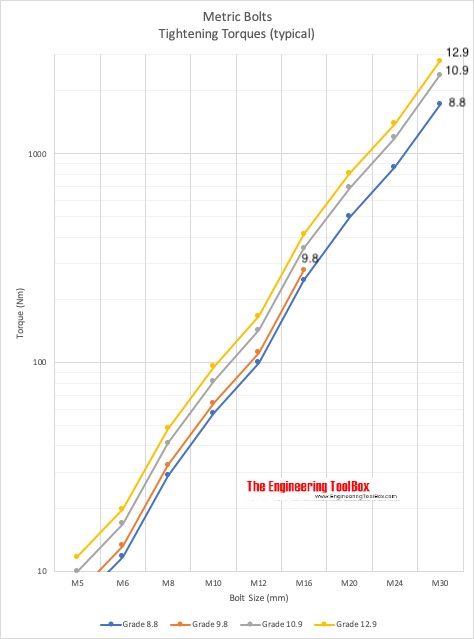
That aside the scissor jack is using levers as well but I take your point.
Although the unknown condition of the old fork and but make the experiment a little invalid. New but into the old fork after you’ve got the old one out and cleaned up the old fork a bit if necessary would be more meaningful.
True, I'll need to have a rummage and see how many spares I have, if I've got a couple I'll try a new one as well.
Wow, that’s a whole new level of boredom for a Friday night 🙂
Nothing better to do, I have work in 3 hours. I could make it even more exciting by using different oils on the thread!
I love a log scale!
Never had this torque malarkey when I wuz a lad.
Not that I bother anyway
Buy the time you mess around buying the threaded rod, you might as well just buy the proper tool from CRC, they aren't expensive.
I did try to work out the stress on the threaded rod and captive nut of a car jack but got lost trying to figure out the leverage and angular stress and so on. Gave up but am firmly convinced that should the nut or bolt fail in some way the car will fall down. Also I've never measured the torque required to turn the bolt to lift the car but it isn't much. Feel tells me it's less than half of what a lug nut gets.
Can also give the example of the bolts which gold the two parts of car/truck calipers together. Those are installed using torque + angle and aren't very big.
Does that graph spec the amount of stretch in the bolt at those torques? It is just typical tightening torque, not failure or X amount of elastic deformation?
<p>Buy the time you mess around buying the threaded rod, you might as well just buy the proper tool from CRC, they aren’t expensive.</p>
<p>I have a load of rods from an old Planet X Head Lock in the spares box already.</p><p></p><p>Not sure on how it's formulated, think it's just a table for general use.</p>
I use a M10 bar with a short bit of M6 welded on the end. Works for star nuts, headsets and PF BBs. Torque required to pull a nut in doesn't feel close to stripping M6 torque.
I have seen a few customers pull a star nut up flush to the top of the fork by attempting to tighten the headset, if that gives you a practical example of the thread strength.
The One Up EDC install uses a bolt and a received cup to pull the star nut back up out the steerer.
A screw can exert a huge axial force compared to the rotational input torque.