by giving a satisfactory answer to why [url= http://www.singletrackworld.com/forum/topic/useless-crp-bike-part-inovations#post-543514 ]this[/url] is the case, or if it's all mumbo jumbo. my brain is coming up with all sorts of wild theories but i'm far too thick to achieve anything scientifically accurate
Without doing any of the maths, I would imagine that the theory being touted is that by loading the crank at TDC, It will compress (bow) slightly and since the crank attaches to the spindle at a slight angle, there's an element of turning moment on the axle.
Sounds like b******ks to me though.
yummy, bendy cranks 🙂
that was my main theory, but i wrote it off as being rather stupid for relying on the flex in a material with not terribly good work hardening characteristics.
i assume that the spiral ratio thingy provides a form of logarithmic mechanical advantage as well so a very small amount of flex is amplified to provide a larger force
thanks
with not terribly good work hardening characteristics
Only relevant if bent beyond elastic deformation - every loaded component bends/flexes when you ride a bike..
i assume that the spiral ratio thingy provides a form of logarithmic mechanical advantage as well so a very small amount of flex is amplified to provide a larger force
Again, I haven't done the maths but I would imagine that's what they're suggesting. Still sounds like b******ks
Maybe rather than think of a single static force diagram involving TDC and BB centre, you think of resolving a series of force diagrams along the crank arm - infinitely close to the force point before it... - a bit like a differential equation?
that's the fibbonaci bit i think, a bit like resolving Pi but with logarithms not straight ratios
What if you did two force diagrams - one at TDC and one at the apex of the crank bend - the resultant force of the first [i]could[/i] lead to a second resultant force that does not pass through the BB centre?
Have I just solved perpetual motion too? 🙂
But what happens at 180 degrees - you'll actually be applying a force that opposes...
It's b*****ks
unlikely, i'd suggest you patent it though just in case.
cluber - yes, that's what i thought. must rely on the crank being stiffer under loading at 180 than it is at 0
top stuff 🙂
at 180 degrees theres no downward force, only an upward one if youre using SPDS.
I'm with Clubber - bobbins, the lot of it, in any real world sense (i.e. everyone else is looking to make crank arms STIFFER, rather than add flexibility)
Wasn't this idea taken to its (il)logical, and very heavy, conclusion a while back with some cranks where the arms were connected to BB shaft by springs, the theory being you put energy in the springs in the 'power' part of the stroke, which was recovered at TDC/BDC pushing your foot through. It did mean that one foot was spinning differently to the other....
at 180 degrees theres no downward force, only an upward one if youre using SPDS.
I almost guarantee there's a downward force there. It's well proven that almost all riders still have a downwards force on the pedal that's not under power while it's coming back up.
i guess that depends very much on how smooth a pedaller you are. there will be a point where there is no force but it is only momentary. at this point the other crank will be (hopefully) applying more force due to the flex characteristics.
i posted that on the wrong thread
either way, i'm convinced, where's my credit card 🙂
Or, alternatively, use Shimano BioPace chainrings
[url= http://www.sheldonbrown.com/biopace.html ]Sheldon says....[/url]
No, they're not the same thing at all.
[img]  [/img]
Now there's actually some logic to those - whether they provide a real world benefit is debateable though. You'll note that no rotork sponsored riders (at least not the high profile ones) are using the cranks above, just the oval chainrings.
No, they're not the same thing at all.
... of course they aren't -
but they claim to be trying to solve the same "problem"???
assuming clubbers comment was aimed at BioPace chainrings...
i guess that depends very much on how smooth a pedaller you are. there will be a point where there is no force but it is only momentary
No there won't. They've measured this, and even pros still have downward force all the time.
Also why not give a more meaningful title to the thread? I posted my thoughts in the other thread.
i guess if you are spinning at a good rate then the 'dead spot' is of minimal influence. if you were grinding at a low cadence then it possibly has more effect. singlespeed? 😉
aracer - my guess was wrong then
rkk01 - not quite - Biopace (to be correct, oval chainrings - biopace were 90 degrees out to where they should have been) was designed to reduce the dead spot at the top by effectively reducing the gearing where you're in the least powerful position (leg compressed).
The L cranks suggest that they actually add power which admittedly would help reduce the deadspot but to my mind, they were advertised on additional power.
Still b*****ks
Spds - you can and do have an upward force on the back part of the pedal stroke - or at least I do when I want to
Two bits of evidence - one I can feel the vertical float being taken up so the cleat hits the top of its retaining cage and two - the muscle at the front of your leg that only lifts the toe up has developed visibly since starting using spds
Spds - you can and do have an upward force on the back part of the pedal stroke - or at least I do when I want to
I think the point that the studies on fast people are making is that whilst you obviously can do this, it doesn't appear to be more efficient than just putting down force on the pedals (and minimizing it on the upstroke). Several possible reasons for this have been suggested - I think one was that upwards pulling is so inefficient compared to downwards pushing that it is a better use of energy to just relax your feet and use the energy to get a bigger downwards push.
Joe
>note that no rotork sponsored riders
I'd guess because there's going to be some weight penalty.
Not to mention the UCI would find some way of banning 'em !
Ah, looks like the new UCI regs effectively do:
"The bicycle must be in “working order” with a steering system acting on the steerable wheel and a propulsion
system acting on the driven wheel by means of a circular movement through a chainset (using a chain) comprising one or more chainwheels and two cranks, arranged opposite each other, one as an extension of the other, in the same plane. "
(from http://www.bentrideronline.com/messageboard/showthread.php?p=503951#poststop)
Looks like cobblers to me.
Keep an eye on these chaps.
[IMG] 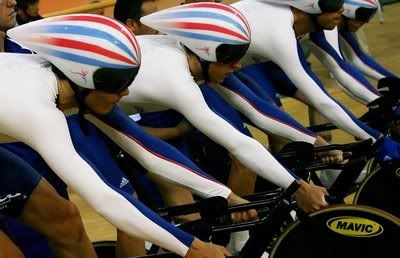 [/IMG]
If they have them in the next 6 months than there may be something in it.
I'd guess because there's going to be some weight penalty.
Unlikely - they could get the bikes down to 0.5kg+ under the weight limit if they tried, and generally end up carrying heavier kit to meet it. Hence the widespread use of heavier SRM power cranks.
Certainly the UCI rule as you found - could almost have been written specifically to ban these...
if they were within regs then i suspect mclaren would have come up with something similar for the BC guys
>heavier SRM power cranks
Ah, I'd vaguely heard of these but hadn't realised they were in much actual race use.
I probably should have qualified that - it may be a case of diminishing returns relative to just using the rotor chainrings, vs using the weight difference on other components/frame, in terms of longevity/handling. I'm pretty sure it's been possible to build a frame below the weight that the regulations imply for some time, whether you'd want to is another matter.
I'm pretty sure it's been possible to build a frame below the weight that the regulations imply for some time, whether you'd want to is another matter.
It's ridiculously easy, and not at all an issue to do so. My road bike weighs ~6.6kg with pretty standard kit on it, and nothing stupidly light (yet "only" cost £2k). The UCI weight limit is 6.8kg 😮