UPDATE: CLASSIFIEDS section refreshed, redesigned, searchable: Go take a look
was wondering how bicycles might have evolved if bike designers e.t.c were allowed to build what they wanted?
i know that bike designers still push the boundaries of design with so many different types of bikes,but had they been allowed to design what they wanted without having to conform to uci rules in road cycling/mtb,i wonder just how much different/more advanced the bikes might have been?
what are your views about this?
Road bike racing in particular is a 'formula' sport, like Formula Ford or F1.
If you want to take part you agree to the formula.
The only real issue currently is the minimum weight requirement (plus the need to get frames 'uci approved' for pro use, I guess [edit] and maybe some aero stuff) but it's probably not a bad thing in itself?
I can't see a Tour de France with the teams running a motley selection of recombants, flat bar hybrids and slicked up mtb's being much of a spectator sport?
there's plenty of innovation goign away from uci sanction events. The whole Enduro scene is non-uci and they don't seem to be radically departing from the bikes you and I can buy (for commercial reasons in part) so maybe what we can buy is the best tool for the job?
I think the UCI is committed to moving bike design forward into the 20th century.
Apparently change is afoot though....
Yes, unquestionably they did. With the new management in place, things are changing now though (probably!)
There are absolutely tons of rules that keep the road bike staying pretty much the same as it has for 60+ years.
Some of them make sense in a sport where there are 150 riders in a bunch.
Some of them make sense in a 'nobody would want to be seen dead riding that' way.
It would be interesting to see where we would have got without those rules though.
Faired recumbents presumably for road racing. It'd be interesting though because that'd mean no real cross over between road bike and mtbs.
The only real limit's are cost and demand, plenty of bikes get built that don't comply with extant UCI regs, these are simply not for UCi accredited competition use...
TBF many of the Regs that do exist are there primarily there for safety or to level playing field and prevent one team/rider gaining too much of an advantage over the rest, making the sport more about the rider(s) than the bike (Hmmmm, where have I heard that sentiment?)...
MTBing generally hasn't had to suffer the level of technical regulation that Road and TT has, the competitive side of MTBing has benefitted from a relatively light touch...
Bicycles for Race use are not the biggest sellers, leisure and commuting use is still the bigger markets.
I don't think the UCi have stifled the "Evolution of the Bicycle" they've helped to define and bound the different forms of competitive cycling, and promote the activity/sport of cycling all over the world, Yes it is still a deeply flawed organisation, but lets not accuse them of stuff just because we don't really like them...
Triathlon tried smaller front wheels in the eighties for a more aero tuck but they're not about now and getting parts for any survivors is difficult. Personally I don't think there are any more quantum leaps to be made in cycling.
Inbetweeny wheel sizes, multiple bottom bracket and headset standards and mainstream manufacturers diving into niche markets (fatbikes) are all evidence that bikes really are about as good as they can be and manufacturers are struggling to come up with anything genuinely new or better.
cookeaa
Cookson
I see right through you!
mtb has stupid regulations like no skin suits for downhill, I mean what the f*** is that about. If the point is going downhill fast why wear a parachute!!!!
No skin suits is a safety issue. Also it helps promote the sport to the general public. Not many skinsuits out on the trails.
No skin suits is a safety issue
Is it? Is it really?
Nowt to do with safety, everything to do with image
[img]Some of them make sense in a 'nobody would want to be seen dead riding that' way.
 [/img]
No skin suits is a safety issue. Also it helps promote the sport to the general public. Not many skinsuits out on the trails.
B*****ks is it a safety issue!
Not many skin suits on the trails, and? sorry what relevance is that? Not many people spend more than a couple hundred quid on a bike, do we say a bike must not cost more than X? I don't see many people using skin suits on the road either, except when racing. I don't see many people using skin suits skiing but that is what racers use because it is fast. I don't see many using skin suits for XC riding, in fact not that many seem to wear lycra at all for XC so should that also be banned?
Tools for the job, why use the wrong thing, if it isn't some kind of statement?
No skin suits is a safety issue. Also it helps promote the sport to the general public. Not many skinsuits out on the trails.
Cow excrement. If it was about safety, it's pretty simple to wear armour under a skinsuit.
It's about looking all of teh radnezzzz for teh kidz.
Look at skiing. Skinsuits for racing, normal kit for those of us who are normal. The skinsuited loons like Bode Miller make me want to ski, not to dress like them.
That's because racing is about winning, not about looking good, and if you're interested in winning in a sport where speed is important, you get aero.
I can't see a Tour de France with the teams running a motley selection of recombants, flat bar hybrids and slicked up mtb's being much of a spectator sport?
Oh, I don't know...
I found myself wondering a similar thing yesterday when I was in Evans, there's a suprising number of road bikes with disc brakes available now, all out road bikes too, not multi-use hybrids CXs etc. Surprising to see a feature that hasn't trickled down from pro level bikes, more of a welling up in response to regular users (presumably).
Also, that bike with no seat tube looks ace to me, probably shows that I'm on a different page to most when it comes to this.
"Fair enough to Tracy if she wants to do that to win, but for the sport and the longevity of the sport, to wear cool race kit and to make an image for yourself is more important than the odd win here and there," said Atherton.
I reckon that Rach probably knows a bit about it.
many of the Regs that do exist are there primarily there for safety
and some of those are total BS.
minimum weight limit? huh? if that was safety or robustness related they'd specify a standard like CEN which the bike has to pass. Mfrs making lighter, stiffer bikes that can pass a standard is called innovation.
If bike teams are adding ballast to meet UCI reg, then something needs to be looked at.
And the price for a UCI compliant sticker to me suggested UCI only wants big brands/companies making UCI compliant bikes. CEN sticker should be more than enough for a grand tour bike IMHO... ie exactly what you or I would buy down at the LBS.
And the only rules on relative position of saddle, bars, etc. should be to distinguish between road bike, and recumbent classes etc.
but [s]for the sport and the longevity of the sport,[/s] to wear cool race kit and to make an image for yourself is more important than the odd win here and there," said Atherton.
FTFY.
If you're interested in image, take part in a sport where the winner isn't just the fastest person down the hill.
Again, back to skiing....If you want to shred teh gnat, get on to slopestyle and wear all the baggy crap you like. If you want to go fast, strap on a pair and get your lycra out. As it were.
The weight limit was intended to limit cost of bikes. The real problem is that it hasn't been updated as bikes have got lighter without having to spend ridiculous money. A sub £3k bike can be comfortably under the limit.
As to the UCI stickers that was very much part of the issue with the UCI as it was being run by McQ and Verbruggen - they were getting involved way past their remit of running the sport.
I don't actually take too much issue with the 'baggy' kit rule - I reckon they're right in that skinsuited riders wouldn't do much for mtbing's extreme image which in turn would make non-bike industry sponsorship harder.
But it's nothing to do with safety. MotoGP riders ride in tight kit and that's fairly robust in terms of abrasion resistance.
cookeaaCookson
I see right through you!
Shhhh!
While I didn't agree with the DH skinsuits ruling (I don't think such Aero options should be off limits for DH when other disciplines take every available advantage of it), TBF I think the UCI recognised some sort of ruling had to be made as people were getting up in arms about it, and I think what they chose was what the larger majority involved in the sport wanted which was about the best they could realistically do.
But it isn't that much of a Rule really...
4.3.011 All lycra-elastane based tight-fitting clothing is not permitted.
There's plenty of scope there for the cut of a "Baggy" garment to give some marginal aero benefits and still comply I reckon, and do the commissaires really check every Jersey/shorts combo for that "Pinch and an Inch"? do they Bollocks, so any rider in a billowing great parachute rather than a nicely [I]fitted[/I] jersey is just robbing Him/herself of valuable 10ths... IMO.
minimum weight limit? huh? if that was safety or robustness related they'd specify a standard like CEN which the bike has to pass.
Minimum weight limit was introduced decades ago when riders were drilling out frames and components to make them lighter - this also dramatically increased the failure rate. Bear in mind this was before carbon fibre, before aero tubes. Back then everyone simply thought lighter = better.
So the rule was put in place to prevent that, ie at the time it was more about safety. Now of course it's possible to buy an off-the-peg bike that's way under the weight limit because the rules haven't kept up with the rate of innovation. And adding ballast to the bikes was also banned a while ago, there's a sub-clause which says the weight has to be "structural" (ie, not lead weights down the seattube).
Not sure they "stifled" innovation as such - bikes can still be made any which way you want (and a lot of manufacturers split their TT bikes into UCI compliant for TTs and non-compliant models for triathlons). For road though, most buyers want something that at least looks like what the Tour winners are riding. And unlike MTBs, road bikes have looked more or less the same since the start so you're up against a very traditionalist market in the first place. Whereas MTBers will accept anything!
Minimum weight limit was introduced decades ago when riders were drilling out frames and components to make them lighter
Not really. That fad had passed by then (2000). It was around the time that bikes were starting to regularly hit that limit (without drilling!) which was perceived as being 'light enough' and more to the point, expensive enough. Don't forget that back then TdF riders were using a down tube shifter for the front mech in the mountains in order to get the bikes down to the limit so it wasn't comfortable as it is now.
If bike teams are adding ballast to meet UCI reg, then something needs to be looked at
You reckon?
People like to Draw parallels with F1, where of course there is also a minimum weight reg...
The main advantage of bikes coming up lighter than regs is that it that the teams can then decide where that extra mass goes for maximum benefit, and you know that your bike will weigh exactly the same as the next fella's...
Negate the advantages of making a bike silly light, and the teams/manufacturers have to start exploring other area's of the bikes performance, Stiffness/compliance, aero features, details of geometry (also within the bounds of the rules)...
you can whinge about rules or you can put your brain to work finding the best ways to work within them.
I quite liked the minimum weight limit. I thought it would allow innovation in other areas, because they would have weight 'to spare'.
haven't seen a lot of it though - perhaps massive BB stiffening is one.
The skinsuit thing is interesting. You could have allowed them and everyone would have used them a year later (so no advantage to any one rider), or you could ban them and have the sponsors happier.
They've been stifling innovation since the 1930's - for almost all road racing, recumbents would be faster and safer, even without fairings. It might be couched in terms of safety or making the sport affordable, but those excuses don't hold water - it's really about a bunch of old blazer-wearing fogies who have a rose-tinted idea of cycling and don't want anything to interfere with that.
If you can, have a look at the IHPVA or BHPC racing - a lot of fun, quite a bit faster than conventional road bikes, and safer too.
Negate the advantages of making a bike silly light, and the teams/manufacturers have to start exploring other area's of the bikes performance, Stiffness/compliance, aero features, details of geometry (also within the bounds of the rules)...
This didn't really happen though. Frames and components have continued to get lighter (800g frames now!) because it's good to market to people buying them even if they're now way lighter than is 'necessary' to achieve the weight limit.
Aero isn't really allowed (fixed max aspect ratios, no extensions, etc) and geometry is generally speaking pretty well sorted. Besides the UCI didn't want to encourage any of that. They were trying to stagnate development to keep the sport relatively cheap (supposedly).
IMO a much better rule is what they have now but with some further restrictions - eg commercially available but unlike say the British track bike which is technically available but stupidly expensive, have a maximum price for components (eg frame, fork, seatpost, wheels, etc). That'd then allow development but prevent people being completely priced out but also encourage development on making bikes more cheaply.
[img]  [/img]
where we were
[img]  [/img]
where we are
for the road.
[img] 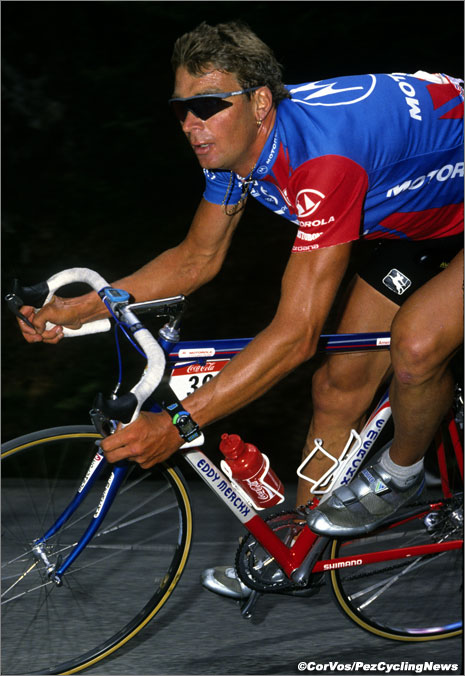 [/img]
where we were
[img]  [/img]
where we are.
what counts as progress, who knows.
"Fair enough to Tracy if she wants to do that to win, but for the sport and the longevity of the sport, to wear cool race kit and to make an image for yourself is more important than the odd win here and there," said Atherton.
Which is about the weakest reason for banning something I've ever heard. I remember thinking at the time that they all talk about all kinds of special tweaks they make to their bikes to be a tiny bit faster then because they don't look teh radz they want certain types of clothing mandated. The irony being that pretty much everyone then started to wear tighter fitting jerseys (but not skin suits okay) for aero benefits.
I remember thinking at the time that they all talk about all kinds of special tweaks they make to their bikes to be a tiny bit faster then because they don't look teh radz they want certain types of clothing mandated
See also SponsoredRiderParaphrasing, "My new (insert wheel size here) bike is so much faster."
If it's about being faster, wear kit that makes you faster. If it's about image, find a sport that isn't about being faster. Or, perhaps add in 'style points' for DH. Like a beauty parade, perhaps, with judges holding up scorecards at the end....
Socks must be no higher than the mid-point between the ankle and the knee.
If they didn't have this rule, just think, the whole world would end up looking like this:
[img]  [/img]
for almost all road racing, recumbents would be faster and safer, even without fairings.
Stage road racing in general is lost and won in the mountains - the tour of Oman being and excellent example of this last week - one hill in the whole race, basically, and the first person to the top of it (Froome) won the whole GC - despite Greipel taking 3 stage wins.
Yet, Recumbents are generally considered to be no faster, or perhaps even less fast once you put them up the kind of steep gradients that stage road racing goes over - and where the races are lost and won - so whilst they might be faster for all road racing, they wouldn't offer any advantage to the bit of road racing that makes the biggest difference, so why bother changing?
The whole baggys for downhill more or less came down to one thing- the athletes didn't look like they were doing the same sport as us. Does that matter? Sure it does, DH isn't a mass market sport, it needs to appeal to riders and frankly it needs to sell things to riders and the less it is like your uplift day or whatever, the worse it does that job.
Safety I don't know... Some folks say that wearing armour under or over a proper skinsuit makes it less effective (whether it does or not might not matter; the perception is probably more important to many). It certainly makes it look even more ridiculous. And either of those things could discourage people from wearing kit they otherwise might.
Road riders like dressing up like weirdos so it's less of an issue.
Stage road racing in general is lost and won in the mountains - the tour of Oman being and excellent example of this last week - one hill in the whole race, basically, and the first person to the top of it (Froome) won the whole GC - despite Greipel taking 3 stage wins.Yet, Recumbents are generally considered to be no faster, or perhaps even less fast once you put them up the kind of steep gradients that stage road racing goes over - and where the races are lost and won - so whilst they might be faster for all road racing, they wouldn't offer any advantage to the bit of road racing that makes the biggest difference, so why bother changing?
I reckon that if you spent several days riding at 40+mph in your recumbent compared to the guys at 10mph less (illustrative figures) on their standard bikes on the flatter stages, you might have a different GC position going into the mountains...
Or you'd just use a standard road bike for the mountain stages.
I reckon that if you spent several days riding at 40+mph in your recumbent compared to the guys at 10mph less (illustrative figures) on their standard bikes on the flatter stages, you might have a different GC position going into the mountains...
Given just how good Britain has become at sports that involve sitting down I think we would become invincible once recumbents are allowed. That should rule out any chance of approval by the UCI.
The "recumbents are slow uphill" thing. I've analysed this quite a bit, and there are a few reasons for it:
- Different muscle groups. Recumbents use different muscles, and it takes time to adapt.
- Weight. Many (most) recumbents are touring machines with suspension, so there's just more weight to get up the hill.
- Stiffness. The rigidity of the seat and seat mountings are vital, frames with straight stays connecting the top of the seat to the dropouts are noticeably stiffer.
Sort those factors out, and recumbents can be very fast uphill - I've ridden recumbents which can leave a normal diamond frame standing uphill. Because get it right and your legs and lungs are working much more efficiently than they are on a diamond frame - you're not hunched over, and you have a solid seat back to push against instead of pulling with your arms and down through your curved back.
Baggy crap for downhilling because because that's what the manufacturers wanted. Atherton just didn't want to show her arse which is a shame really.
Of course the real reason is that MTBers are cool dues who don't want to wear a uniform do they?
So they all dress the same in their rad kit. 😆
I'm looking forward to roadie weights down to 14lbs, position points on TT bikes abolished and a ban on discs on roadies.
Re: Skins.
As someone above said, once everyone is wearing it, the advantages are negated, much like 29ers in racing, and therefore it comes down to how the sport wants to present itself. As downhill already has an established "look", to have the pros dress very differently for no reason whatsoever would alienate much of it's target audience.
I know people drag up comparisons with DH skiing, but their speeds are significantly higher and therefore the effect of drag has a much more marked effect. This could, in turn, make direction changes and control at such high speeds much more difficult, particularly in strong winds.
[devil's advocate] Dh skiing is won by the fattest bloke who can hold an edge [/devil's advocate]
or, to put it another way, the wide open fast courses mean that a skinny short arse doesn't stand a chance - they just haven't got the natural aerodynamics.
back to biking: the 'best' courses (imho) are tight and technical: Champery for example. Won by riding the impossible (see Danny Hart), not by holding an aero tuck.
I don't want to see someone winning a world cup, and then thanking their aerodynamicist, i want to see people winning world cups by sticking a line through a hideous rock garden that no-one else could.
i don't want to hear the comentators talking about how much time aaron Gwin has spent in a wind tunnel during the off season.
the only effect of banning skinsuits has been to narrow the speed gap (between big and little people) on the open sections - meaning the racers have to make it count, where it counts (the difficult bits).
i don't see that as entirely bad.
bikebouy - MemberI'm looking forward to roadie weights down to 14lbs, position points on TT bikes abolished and a ban on discs on roadies.
Posted 3 hours ago # Report-Post
Discs are banned from UCI events for the next 2 years . What a backward looking decision . Why would you want them banned ? Just cos you don't like the idea of them is not a valid reason BTW .
Thank god for Shaun Palmer.
In reality most of this is about road bikes, given the new wheel sizes in DH/XC & Enduro (and an entire new sport called enduro which the UCI have looked the other way on) I reckon as with all of this the UCI knows about road bikes and in some dim dark corner are 2 blokes and a middle manager in a department called Mountain Biking and all that shite
[img]  [/img]
On skin suits there seemed to be a point where people were ditching all the pads and heading out in 1mm of lycra on DH. Great is you make it but not if you don't. If I was racing seriously (Ie not racing to not come last) I would prefer the sport to evolve on rather than knowing at a certain level I'd need a skin suit and it looks ridiculous.

