UPDATE: Reviews section refreshed, redesigned, searchable: Go take a look
That and I'm still not sure you accept that it's possible for a force parallel to a cantilever beam to generate a bending moment if the moment arm is rigidly attached so that it can generate a torque at the end of the beam.
After more thought I'll give you that. I now realise it is actually the shear force on the axle that will be zero (from the applied side load), not the BM. The shear force will only come from the main vertical load. The side load as you have established, effectively applies a pure torque/moment to the axle, but no shear force.
FWIW, the shear is a horizontal line magnitude F, the bending moment is a sloping line, magnitude F.r at one end, magnitude F.(r+x) at the other (where F is magnitude of both the sideways and vertical components of the force at the bottom of the wheel and the downward force in the rod, r is the radius of the wheel, x is the stub axle length from centre of wheel to the leg).
That's not quite right. There is only a shear force from the vertical load, none from the side load. The shear force in the axle is independent of the bending moment from the side load. The BM in the axle is a combination of both the torque from the side load (which will be a constant along the axle). The slope in the BM diagram will only come from the vertical load when integrating the constant shear force it generates. So if F1 is the vertical force and F2 is the side force acting on the wheel, then the shear force along the axle will be a constant F1 and the BM along the axle will be F1.x + F2.r
Think that's correct now. Actually a good reminder of shear force/ BM diagrams! It's been quite some time since I've had to manually calculate them.
Because it is well designed.
Well yes, but the stub axle was never really an inherent weakness of the overall concept which is what started off this side discussion. It's not like the axle has to be massively over-sized and heavy to make it work. There's nothing special about that part of the design. To be "well designed" it just had to be a common or garden stub axle, which is exactly what it is. The only clever part of the design really is the needle bearing/ square section strut as already discussed to death.
The square section lower leg is also the forks greatest weakness, in that until recently they couldn't find a way to seal it hence the need for a rubber boot. However the rubber boot is not sealed eiither as there is a small hole, I guess to prevent it from inflating as the fork is compressed. I nver had a problem with this, but I guess in particularly wet and shitty conditions moisture can get in and start to corrode the innards and bearings.
However the latest lefty Supermax has now got around this. They seem to have encased the lower square section in a metal tube so it's a bit more like a conventional stanction, added a wiper seal/bush to that to seal the unit like a conventional fork, and deleted the rubber boot. They've also changed the needle bearing arrangement to take away the issue of bearing drift and the need to reset the bearings. It's a nice bit of kit which they've beefed up further added to their over mountain range of bikes (All Mountain) and retained the lighter conventional Lefty for their racier, lighter XC bikes.
The new 650b Jeckyl with a 160mm Supermax Lefty is looking like a mighty fine bike to me.
[quote=moshimonster ]
FWIW, the shear is a horizontal line magnitude F, the bending moment is a sloping line, magnitude F.r at one end, magnitude F.(r+x) at the other (where F is magnitude of both the sideways and vertical components of the force at the bottom of the wheel and the downward force in the rod, r is the radius of the wheel, x is the stub axle length from centre of wheel to the leg).
That's not quite right. There is only a shear force from the vertical load, none from the side load. The shear force in the axle is independent of the bending moment from the side load. The BM in the axle is a combination of both the torque from the side load (which will be a constant along the axle). The slope in the BM diagram will only come from the vertical load when integrating the constant shear force it generates. So if F1 is the vertical force and F2 is the side force acting on the wheel, then the shear force along the axle will be a constant F1 and the BM along the axle will be F1.x + F2.r
F1=F2=F in my diagrams, because both the horizontal and vertical components of the ground force are specified to balance the force at the end of the rod in order to allow me to use a piece of string. Substitute that into your formulae and you get my formulae. Sorry if I didn't make that clearer. Your formulae are obviously more universal for a real world situation, now I'm glad we can get away from having to prove that a sideways ground force can result in a bending moment in the stub axle.
Well yes, but the stub axle was never really an inherent weakness of the overall concept which is what started off this side discussion. It's not like the axle has to be massively over-sized and heavy to make it work. There's nothing special about that part of the design. To be "well designed" it just had to be a common or garden stub axle, which is exactly what it is.
Yet in a conventional fork there clearly is flex at the bottom of the legs, resulting in independent leg movement - which is what resulted in me raising this, and is I suspect one of the reasons users of conventional forks are suspicious of the cantilevered axle. I've posited that this is flex in the attachment of the axle onto the leg rather than in the leg itself, though not really analysed it. Wherever the flex is, Cannondale have eliminated most of the flex at the same place on the Lefty, and were such an arrangement used at both sides of the axle on a conventional fork, you should eliminate the independent leg movement.
They are also very robust. I carried out the needle bearing reset process quite frequently, say every other ride. It takes about 5 mins, and every 10 or so rides also lined the flanks the bearing run on.
That seems like a world of faff compared with old Bombers - which I just emptied of oil every 2/3 years and refilled to approximately the same level with approximately the same weight of oil. Or whatever was to hand. Apart from stiffness improving I'm not sure anything bettered them for me.
I'm sure it's not difficult and I'm sure the performance was worth it, but it's things like 'needle bearing reset process' even existing that might put off the vast majority of cyclists who just want to get on the bike.
[quote=wobbliscott ]However the latest lefty Supermax has now got around this. They seem to have encased the lower square section in a metal tube so it's a bit more like a conventional stanction, added a wiper seal/bush to that to seal the unit like a conventional fork, and deleted the rubber boot. They've also changed the needle bearing arrangement to take away the issue of bearing drift and the need to reset the bearings. It's a nice bit of kit which they've beefed up further added to their over mountain range of bikes (All Mountain) and retained the lighter conventional Lefty for their racier, lighter XC bikes.
Rather than "encasing" the lower bit they've made a one piece lower which changes from square to round section in order to allow the use of a conventional bushing/seal. These changes have also been made to the lighter XC Leftys. See Mick's post on page 1!
http://singletrackworld.com/forum/topic/cannondale-lefty-advantages#post-6403259
aracer - Just to recap, you said this:-
the one potential point of weakness is the axle cantilevering, but clearly they've beefed this up sufficiently.
It was never going to be a point of weakness. The reason it is a weakness on a conventional fork is the flimsy QR. Through axles have obviously helped a lot in this respect. You cannot really use a stub axle on both sides of a conventional fork otherwise wheel fitment is going to be tricky to say the least.
So in effect what you said was a potential weakness of the Cannondale design is actually more of a strength as it allows for a rigid axle.
Also not sure what you mean by "they've beefed it up sufficiently". this implies it needed to be oversized to do the job and it clearly isn't.
I'm sure it's not difficult and I'm sure the performance was worth it, but it's things like 'needle bearing reset process' even existing that might put off the vast majority of cyclists who just want to get on the bike.
I think that's true of pretty much all high end forks today with their complex damping circuits. I don't have first hand experience, but doesn't sound like a modern Lefty is any harder to maintain than other forks of comparable performance. It's had many years of incremental development put into it. If it was a lemon I'm sure Cannondale would have abandoned ship years ago.
My baseline is a bolted through axle on a conventional fork. I understand that wheel fitment prevents something similar on a conventional fork, that was simply pointing out how the Cannondale stub axle is superior. It is a good point about the Lefty actually allowing for a superior design, just as with the leg, a single oversized beam gives better stiffness than two smaller ones. Beefed up compared to the axle used on a conventional fork - clearly significantly oversized compared to a standard wheel axle which would presumably have flex problems otherwise why would they have made the hub design more difficult?
[img] 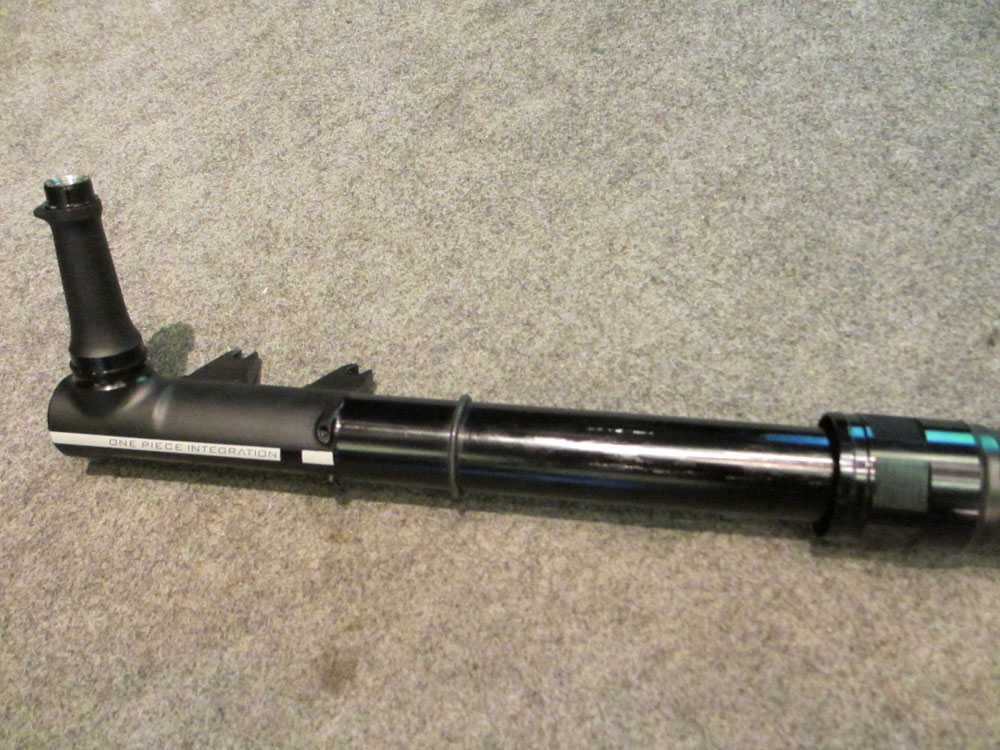 [/img]
Beefed up compared to the axle used on a conventional fork
I think it's more a case of the axle on a conventional fork being a bit marginal for today's demanding usage - due largely to the historic link back to a QR. Is a 15 mm or even a 20 mm through axle really big enough for a long travel enduro fork? In terms of stiffness I mean, not reliability.
BTW I think your choice of photo makes it look bigger than it is.
[img]  [/img]
Now that's a mightly looking fork.
Cannondale UK has no idea whether the Supermax Carbon 160mm would be available to the public, not to mention at the moment they have no idea about the pricing either.
2015 Jekyll Carbon is not exactly my cup of tea but that fork.... oh my....
Cranes, trucks, trolley jacks etc all require engineering 😛aracer - MemberThat diagram is wrong. Nobody does engineering to pick up chicks. Well nobody sane anyway.
I did go through a phase of wondering if I should get some regular forks to bring the trails alive but having seen friends' bikes blighted with fork issues, I'm not minded to. I'm sure it is enough fork for my needs.To whom are you referring?
It was just a figure of speech.... 😳

