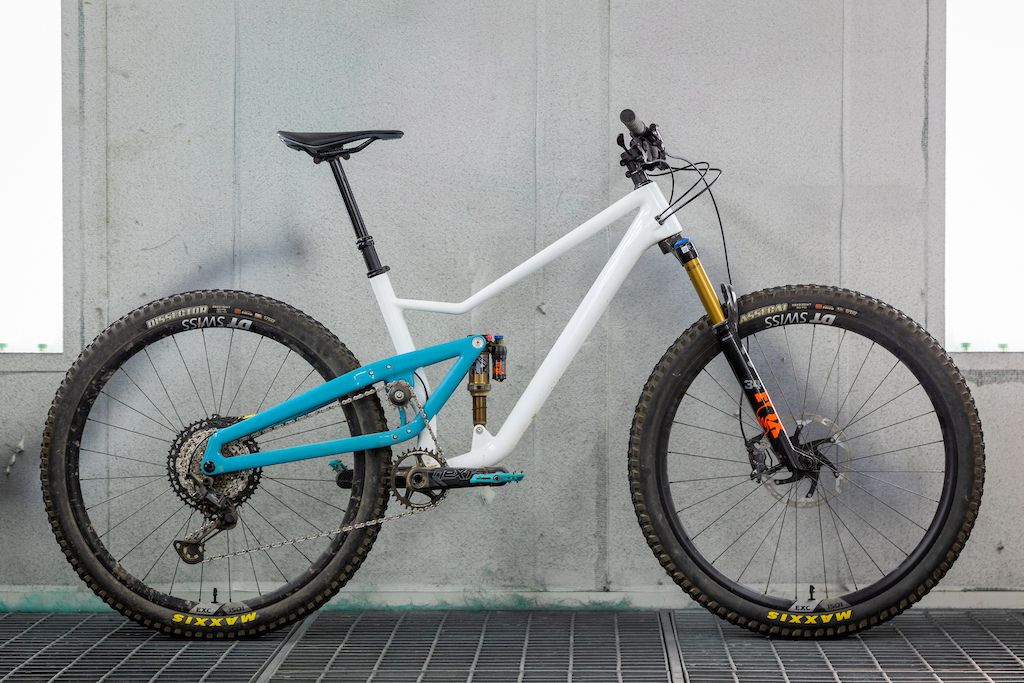
Came across Brazn bikes on pinkbike. I like it.
I remember seeing the 1994 Trek 9500 and thinking, why didn't anyone run with this idea?

Did it just look too simple?
Edit: Just realised this bike came out in 92, not 94. So more than 30 years ago.
The idler will make a big difference to how that suspension works. The Trek was awful


The Trek doesn't have an idler so would have had terrible pedaling. The shock would also have been terrible so the pivot will have moved to balance these out. There's a million and one other differences between the bikes too.
The shock would also have been terrible so the pivot will have moved to balance these out.
Can a row of urethane balls be described as a shock?
Brooklyn Machine Works, 2007
Not really the same design. I was thinking more just a beam in a see-saw type configuration. Not seen anyone else do it ever (apart from Trek).
I just remember seeing the Trek and thinking, 'That looks very simple, wonder what would happen if someone did it properly' so I'm glad someone seems to have done a proper job on it.
The idler will make a big difference to how that suspension works. The Trek was awful
From what I understand they are using a bottom bracket as the pivot so that that should also help with lateral stiffness which I understand was one of the other big problems with the Trek.
Not really the same design. I was thinking more just a beam in a see-saw type configuration.
It's laid out a bit differently, but they are both high-single pivot designs. In the BMW, the "seesaw" is bent, but that's for packaging reasons, it functions the same as having a straight beam with the shock placed underneath. There have been plenty of high-pivot bikes, they apparently descend well (I've never ridden one), but you need an idler gear to deal with the pedal bob. For practical reasons, that limits you to a single front ring, which used to limit it to DH bikes only.
It’s laid out a bit differently, but they are both high-single pivot designs. In the BMW, the “seesaw” is bent, but that’s for packaging reasons, it functions the same as having a straight beam with the shock placed underneath.
BMW had a few different designs, most if not all had linkages and a longer swingarm.
I think the Orange FS bikes are more similar to what we are talking about here given they mostly don't use linkages. However, the shock placement limits the height you can put the pivot.
This Brazn solution just seems much better in terms of packaging the pivot, shock, and idler and I just find it interesting that it is basically the same as a design that was tried over 30 years ago and was disregarded.
I always thought the issue was the execution rather than the concept.
Back in 1999 (I think) I worked at Middleburn. The company was approached by a frame builder who had built a high pivot full sus frame with idler. At the time there was very little about that used this design (this was pre BMW); I don't recall anything tbh. His prototype was rough but worked. At the time of riding I was blown away, it pedalled so well compared to other bikes I had ridden and with over 100mm travel. M'burn eventually had a mock up made for one of the bike shows (mock up made by Engima), it gained a fair bit of media but unfortunately never went anywhere. These designs have been around for a while, just for some reason never quite gained the market foot hold until now.
I will continue trying to find pictures....
Back then unless it was a full on dh bike, everyone needed a triple chainset so idlers were no good...
I think the basic issue with so many early 90s FS designs inc that Trek is they didn't seem to understand how chain tension affected things or didn't think it was worth fixing. Adding the idler makes it a very different design.
The Marin Mount Vision and Cannondale Super V were the first big brand single pivot bikes I remember who got the chain input part of the design right, 1997-98. Mert Lawill's bikes were earlier like the Fisher RS-1, 1991? Not sure when the first idlers came in.
Nice layout on the Brazn, I like that.
didn’t seem to understand how chain tension affected things
Different times. Everyone thought suspension added too much weight and sucked up all your energy. Designs like that Trek were sold with the benefit of chain tension opposing the suspension compression as you pedal and increasing traction by digging the rear wheel in. We’ve come a long way
BMW? Think you mean Balfa

A friend used to have one of those Balfas. He snapped the head tube off it. Luckily he was wearing a full-face helmet, he did a perfect faceplant. He found it quite a strange experience, he was just riding along and then he was face down in the dirt for no obvious reason.
Stiffness was a huge issue on those early bikes