Just had my first near miss of the year on Saturday, taxi driver turned off main road right in front of me, he barely slowed down and swung left like it was a race to the corner, forcing me to go with him slightly up the side street, luckily no car was exiting so he swung wider than normal. Total knob.
I feel less relaxed about it now than I used to. Driving definitely worse now than a decade ago.
And then I see clag nuggets like the one in the 4*4 behind me this morning. Honking his horn and flashing his lights to try and force me to overtake some cyclists.
3 riders about 4-5 car lengths apart, hatchings down the middle of the road to protect oncoming traffic turning right and barely 500m until a nice two lane stretch. Honk, flash, tailgate, repeat. Get bent and wait, no one likes work on a Monday that much that it's worth chancing a nasty accident over.
Having said that I still do ride on the road a bit but it's pretty rare to have a ride in daylight where someone doesn't close pass or similar. I'll take a bit less than recommended at 30mph in the dry, 60-90cm is enough for me to be comfy at that speed (and I live in southern Hampshire so my expectations are low!). It's the 6inches at 60 ones that proper shit me up.
I won't leave less than 1.5 for anyone if I'm the driver.
You could always go for double the tyre excitement by googling for “fat studs”…?
No you go for 50% more wheels. Trike to work day tomorrow. Low down trike rather than up high trike.
I doubt any statistics relate to pedestrians being killed on the “pavement”.
You doubt wrong. Fishing out some old database queries, there are about 30 a year (and well over 2000 injured).
children, old people and those incapacitated by drink or drugs. Most of those things don’t apply to cyclists in general.
Don't think it's much different than for pedestrians, actually. I'll crunch the numbers if I can be arsed 🙂
The first fatality on a Boris bike was after approx 34 millon miles had been cycled on them. So the risk of death is pretty close to zero.
https://understandinguncertainty.org/fatality-risk-boris-bikes
From a personal point of view in 50 years of cycling from playing on bikes as a kid, 20 odd years of urban commuting and 20k miles of touring I've had no injury needing more than an elastoplast.
Many accidents are avoidable. I rarely ride in groups so I've never had another rider knock me off. I look where I;m going so I,ve never crashed because of potholes or gravel. I avoid the doorzone. I avoid some roads. I no longer ride when there is an ice risk. I watch traffic and use a mirror so I've been able to avoid a few potential crashes over the years. I once had to ride off the road in the USA to avoid being hit. With no mirror I would have been.
FWIW, age distributions:

The children thing is interesting. Obviously they feature highly, but while the obvious assumption may be that children have less road sense, I'm not sure it's that simple.
The rapid drop in child pedestrian casualties around the age of 12 coincides with (for the majority) a change in school and a step change in independence. I suspect this means that many who previously walked to primary/junior school begin cycling or taking the bus to secondary school, taking them out of the pedestrian figures and pushing some into the cycling figures, where we see a rise. The cycling curve then drops around the age of 17, when many of them will start driving.
At the other end of the curve there seems to be a drop in cycling casualties round about 50, which perhaps isn't massively surprising since it's quite plausible that people tend to cycle less above that age.
And with drink impairment overlaid… (impaired figures on the right axis)

Probably fair to hypothesise that people aged 15-30 get pissed a fair bit and that people under 18 who get pissed rarely cycle home from the pub 🙂 Other than that, not much difference from the unimpaired curves: other than those two groups, something like 1.5% of both pedestrian and cyclist casualties are marked down as being tipsy.
(NB I left out drugs because it includes medicinal drugs, but it doesn't make much of a difference to the shapes of the curves.)
It's certainly a more active way of travelling. Not only am I pedalling but head on a swivel checking where the cars are and managing them by my road positioning. Passing a young woman last week on her way and she's barely clearing the gully grates at the side of the road. She was close passed twice while I caught her up.
It's rare on that I experience close passes on my commute some of it is down to my active management of my space and some is better driving due to more cyclists being on the road. (My experience, YMMV).
just arrived at work after a very nice 10 mile commute.
I made a concerted effort to try and stay away from traffic. I rode through a country park, on pavements and through a graveyard. the last mile or so happen to be on one of the busiest roads in leeds.
The one thing that genuinely scares me and I have to just ignore is the idea that just before work the road opens out, gets quieter and ups to 40mph and is the perfect opportunity for a driver to check their phone and then drive straight into me. Hasn't happened yet though so on I go
Just started up commuting two or three times a week from Wharfedale into Leeds by bike straight down Otley Road. Not had any close passes yet. Worst bit is the bus lanes in Headingley and traffic pulling into/out of side roads through a line a stationary traffic. Try to make myself as big and visible as possible. Trying to work out whether the Meanwood Valley Trail would be a viable alternative on a cross bike.
The only scare I had last night was when my front tyre hit some loose mud and debris in the middle of a downhill single track road. There were no cars in sight.
I won’t leave less than 1.5 for anyone if I’m the driver.
This. Wish more people did this. It's not hard and it never, ever slows me down when I consider my journey as a whole. Never.
Try to make myself as big and visible as possible.
I've spent the entire winter making myself as big as possible. I'd like to say that this was for safety reasons, but it's not 🙁
This is an interesting situation to consider:
What I can’t assess is whether Gaz from sales is tired from being up all night playing fortnite, is now late for his photocopier convention and is texting his colleague whilst doing twice the limit on a blind bend
If I'm on my bike travelling in the same direction as Gaz from sales, that feels really uncomfortable primarily because he's behind me, I can't see him, and he's less expectant of seeing me.
If I'm in my car travelling in the same direction as Gaz from sales, that doesn't feel uncomfortable to anywhere near the same degree, probably due to a combination of his likelihood of registering the fact I'm there being higher and the closing speed between us being lower than if I was cycling.
If I'm on my bike travelling in the opposite direction, that instinctively feels less uncomfortable, despite the fact our closing speed is still very high, as my road position means I'm physically further from his car as we pass and - probably most significantly - I can see him.
If I'm in my car travelling in the opposite direction, that instinctively feels slightly more dangerous than driving the other way but probably not much. Why not? I'd posit that this was objectively the most dangerous of the four scenarios - highest closing speed, closest proximity. My car is not a tank and would likely offer me little protection in the event of a head-on impact.
I know which of these feels most dangerous, but I think this highlights that my instinctive risk perception doesn't match the actual risk here. Being able to see Gaz from sales in front of me is probably offering me a level of comfort (and confidence in the situation) that's unwarranted.
Great topic.
Casualty rate per billion vehicle miles 2018
Only half a story without knowing how many billion miles were travelled by each type of vehicle or indeed how many users of each mode of transport were killed during 2018... Deaths per billion miles is an extrapolated number not a real life number.
In fact From the same linked page:
Reported Deaths by road user type, United Kingdom, 2018:
Pedestrians
Killed - 472
Pedal cyclists
Killed - 100
Horse riders
Killed - 3
Motorcycle users
Killed - 361
Car users
Killed - 807
You could choose to interpret the above as telling you that the second safest place to be sat in traffic is on a bicycle and that if you really want to get about safely you should use a horse and that cars are utterly deadly... But we all know that isn't what either set of numbers is really saying. They obviously omit use patterns or the numbers of users for each mode of transport, the whole picture is missing.
The only conclusive thing we can really say is that selective use of statistics is 99.9% likely to help you reinforce your existing beliefs...
There's lots of figures available relating to Road traffic casualties, but you need to read the whole lot and understand it fully to really interpret it...
Casualty rate per billion vehicle miles 2018
[is]
Only half a story without knowing how many billion miles were travelled by each type of vehicle
Eh? You can't calculate casualty rate per billion vehicle miles without knowing (estimating) how many billion miles were travelled by each type of vehicle.
I was nearly sideswiped today too !
I was lapping Watopia when someone came off the Volcano layout and suddenly they just missed me.
Eh? You can’t calculate casualty rate per billion vehicle miles without knowing (estimating) how many billion miles were travelled by each type of vehicle.
I know. But the presented figure doesn't say how many billion miles were cycled or driven in 2018 (it also omitted the actual number of deaths per vehicle type), it simply presents an extrapolated "Deaths per Billion Miles" (DBM) figure...
As I (selectively) pointed out far fewer people actually died riding a bicycle during the same sampling period (2018) than did in a car, but that isn't a credible basis to claim cars are a less safe mode of transport is it...
You can of course work back from the two numbers:
100/29 = 3.4 billion miles cycled in the UK in 2018
800/2 = 400 billion miles driven in the UK in 2018
(I'm sure more accurate figures are available)
all of this still only tells you that Car use outweighs bicycle use by a factor of ~117:1...
Car use is disproportionately higher than any other mode of transport, which probably has something to do with all of the DPM figures for all the other modes of transport...
The most interesting thing is that by that using that previously quoted DBM as a measure most forms of transport are apparently on a downward trend.
Since 2008 the figure has dropped for almost all groups. So are we all in fact "safer" despite our perceptions?
I worked in road safety for many years and fed into the KSI figures via STATS 19 with depressing regularity. The difficulty in relying on government crash stats to estimate danger / risk is that:
1) They only record certain types of incident, ie, reported deaths and reported record-able injuries. Near misses because the driver spotted the unlit cyclist and swerved or the cyclist bailed to the pavement to avoid the texting driver just don't figure. Non injury collisions and near miss incidents, in their many forms, are examples of real dangers encountered but not recorded. They influence our perceptions but are dismissed as anecdotal and cannot realistically be quantified due to the many input variables.
2) Official forms make numerous assumptions about causation factors and create a limited menu of set categories that police officers must follow. While they do allow multiple causation factors to be recorded, accuracy is only achieved if the set categories meet the individual circumstances of the incident and the reporting officer has the time and inclination to faithfully reproduce those circumstances on a very long and boring form.
Upshot is that we have people on here painting a picture that official stats allow a reasonable estimate of danger / risk, when they exclude all non injury / near miss incidents and the 'dark figure' of unrecorded incidents where those involved fit the recording criteria but didn't report.
Most on here are experienced and ride defensively, yet still we have to quite frequently take evasive action to avoid becoming a victim. Official statistics really do only give us a tiny snapshot of what actually goes on. The perception of danger felt by many cyclists is most likely justified and shouldn't be so readily dismissed based on deeply flawed official statistics.
painting a picture that official stats allow a reasonable estimate of danger / risk
To be fair the original question was about "taking your life in your hands", which is really a casualty-oriented question, not a perception-oriented question, and there have been many posts highlighting the difference.
The point about unrecorded figures is quite true—though again it's been alluded to, at least in the context of fatalities. I suspect the number of unreported slight injury cycling incidents is reasonably significant.
I know the risks are low but I feel they are more apparent than in a lot of activities. Every time a car close passes, overtakes before a blind corner and a car comes the other way etc,. make it feel a lot more risky and dangerous that the evidence suggests. As this can happen many times during a single ride it always feels like the next one make be that bit closer.
it was a question I was asked. i don’t have a problem riding in traffic or at busy times. i don’t enjoy it and if possible choose a quieter route, but it dint bother me. it is something i don’t even think about.
if i thought i was gonna die every time i went out on my bike, i would take up darts.
There are two types of people who usually make poorly informed risk statements like that:
1. People who drive around in tin boxes feeling safe but completely ignorant of the fact that about 4x as many pedestrians are killed as cyclists each year, and there are more people killed in cars than pedestrians and cyclists combined. Not to mention there has been a consistent and considerable downward trend in cycle fatalities since the 1930s. Every time they get in a car they are taking their life in their hands.
2. Lazy people, who would rather have an excuse not to have some exercise. 600x more people die from coronary heart disease each year than cycling. Those people would probably use the alarming pedestrian casualty rates to justify not walking to the shops if they knew them.
To be fair the original question was about “taking your life in your hands”, which is really a casualty-oriented question, not a perception-oriented question, and there have been many posts highlighting the difference.
Bez, I know you are well read on the subject but I would dispute that cyclists taking their lives into their hands is strictly casualty oriented when the perception (reality?) for many of us is a need to stay sharp to avoid becoming a statistic, recorded or otherwise. Official forms recording reported casualties don't recognise any other incident types, hence the temptation to rely heavily on one and dismiss the other. I've been doored and knocked off by a lane changer but neither incident was recorded anywhere. I've attended many non injury or self inflicted injury incidents that don't feature in the STATS 20 report but involved road user behaviour similar to those that do. There's so much more to the problem than official figures suggest.
The OP's question is a bit silly. Ton, what exactly are you implying?
Everything you do has an inherent risk.
This forum seems to be full of pointless threads like this. Pretty dull.
Actually while there has been a consistent decline in cyclist fatalities that was only because the number of miles cycled declined by approximately 80% between 1950 and 1970. The cyclist risk per billion miles more than doubled over the same time period.
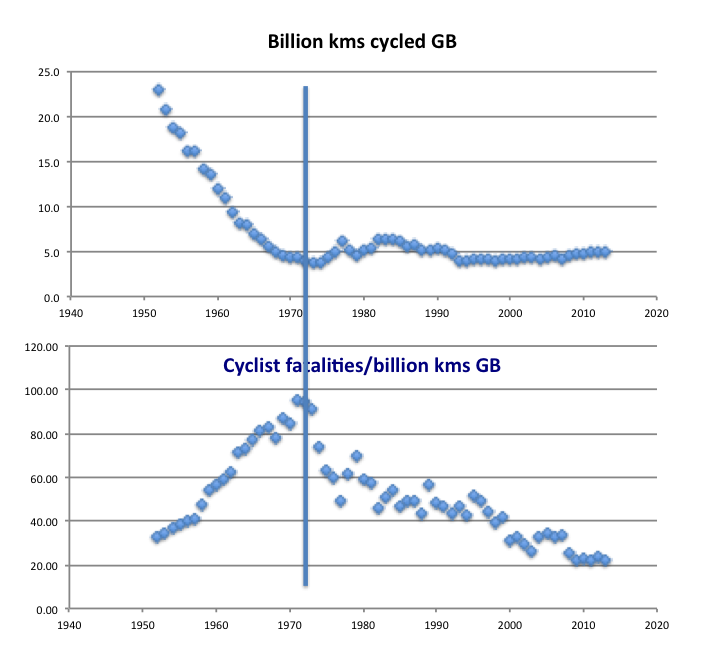
http://www.john-adams.co.uk/2015/11/23/cycling-and-safety-change-must-take-root-in-peoples-minds/
Even if the actual risk is low, the discomfort from being close passed is enough to stop many cycling on the road. I tend to stick to quieter local streets when commuting, and even then there's always one or two aggressive drivers per week that seem to have no regard for my safety that makes me question even that route.
The discomfort is what's stopping more people riding and why most cities are starting to build protected bike infrastructure.
Even if the actual risk is low, the discomfort from being close passed is enough to stop many cycling on the road.
This. I can think of many roads I would avoid like the plague but where there are no recorded accidents.
Even if the actual risk is low, the discomfort from being close passed is enough to stop many cycling on the road.
Nail, head, firmly whacked.
It doesn't have to be "unsafe" to be unattractive as a transport option.
I won’t leave less than 1.5 for anyone if I’m the driver.
This. Wish more people did this. It’s not hard and it never, ever slows me down when I consider my journey as a whole. Never.
There are definitely times that you've got to have thick skin and good nerves round here. There's quite a few who will dish out the aggression if you're holding back for a safe gap. That can be hard. I will not cave but I can kind of understand why someone might squeeze by when they're also on the receiving end of someone else's aggressive driving. Doesn't make it right but they're not the ones I'd want the book chucked at... its the impatient douche who's threatening them.
Even if the actual risk is low, the discomfort from being close passed is enough to stop many cycling on the road.
Yep, also in full agreement with that. I love cycling and will never stop but even after 45 years riding on roads I can still feel very worried/scared at times by how people are driving around me.
It usually manifests in a bit of anger, hand signals and sometimes a row with the person who didn't have a single thought for my safety.
So ending up angry after doing an activity where I should be feeling happy and relaxed is not a good end result.
What do I do, ride on as many gravel roads as possible and avoid as many road sections as possible.
Also in full agreement. I'd love to cycle on the road a bit more often, particularly in the current conditions, but even on short stretches, it's becomes clear that very few drivers are that motivated by your safety, and a small number seem hell-bent on flirting with disaster. That, over time, leads to an tense feeling whenever I am on even a moderately busy road, in anticipation of the next close pass. It is the consciousness that your life is in the hands of other people. Why I get that on a bike when I don't in a car, I don't know.
I don't know how any cyclist gets into a sufficiently Zen-like state to ride on the busy A roads around here.
There are definitely times that you’ve got to have thick skin and good nerves round here. There’s quite a few who will dish out the aggression if you’re holding back for a safe gap. That can be hard.
I know what you mean 🙁 I had some of this just a couple of days ago when I came upon a horse after dusk with only very marginal lighting on it. It was clearly very nervous and while I had room to get around, I would have had to move briskly due to the bends in the road and there was no way on earth that I would have done that given the animal's already nervous behaviour. I also knew that there were stables just a short distance down the road and that it was likely they were returning late from a somewhat mis-timed ride and were pretty desperate to get home. So I stayed behind them. It probably added no more than a couple of minutes to my journey, but the cars behind me acted like I had parked my car sideways across the road so I could show them my genitals.
In the end, and getting annoyed with the car behind (and genuinely concerned that he would just try to pass us both), I straddled the centre line and made it abundantly clear that they weren't going anywhere and they just had to stick it out and wait. I got a generous (and much relieved) wave from the horse person when they turned off at the stables and I proceeded down the road to join the back of the queue that would have still been there, horse or no horse.
Cars bring out the worst in people.
It is the consciousness that your life is in the hands of other people. Why I get that on a bike when I don’t in a car, I don’t know.
Possibly stating the obvious, but the massive steel box full of crumple zones and airbags kinda helps.
I used to drive karts, and when you'd spent the day at up to 80mph with your bum a couple of inches from the floor and your kart a couple of inches from the one in front, with no safety equipment at all except a helmet, getting back into a car and doing 70 down the motorway would seem absurdly safe. It felt obvious that you could have a major smash and the chances of getting hurt would be small.
I think that awareness of a car's protection lurks in everyone's head, it just rarely becomes consciously apparent.
Cars bring out the worst in people.
I think the issue is when dealing with the actions of people when they are not physically standing in front of you.