I've a titanium softail - 1" of travel at the shock.
[img]  [/img]
Friend's Dad commented that the the frame will INEVITABLY break at the b/b - chainstay area because of the movement. I suggested that the 1" of movement at the shock will translate to a tiny tiny movement at the b/b area, and titanium has 'natural flex'. He wasn't convinced.
[img]  [/img]
[img]  [/img]
So, who's right?
Ta
Going on the fact that movement will be small and that ti does in deed have a good elasticity(SP?) i can't see it snapping. Also i am sure that they would have done all the calculations needed when making it in the first place.
Only time will tell.
Frame looks well made and there is a brace between the two
chainstays to stop the flex at that point.
Titanium is a dam good material so ignore mate
unless its an unbrand bike frame or a lower quality
of the material.
Don't forget that the movement in degrees is miniscule, and due to the natural elasticity of ti I seriously doubt that it will [i]inevitably[/i] snap.
There were no issues with the old Ritchey Softail so it should be solid.
and there is a brace between the two chainstays to stop the flex at that point.
it may reduce twisting (one arm up and the other down) but won't influence common mode (both up or both down)
Steel has a property know as the 'limit of elasticity' which is pretty much describes how it performs, until stretched past that point, it springs back to the original dimensions without deformation.
Titanium presumably has behaves in a similar way, (don't remember covering it in college) so will be OK, as long as it's designed correctly and, guessing again, it will be.
Assuming they did their maths right, and you don't over load it, titanium has a near infinite fatigue life and so will be fine.
Other materials, Aluminium for example, no matter what the load, has a finite (but calculable) fatigue life so would eventually break. hence why aircraft cannot fly forever.
These things can be calculated, so the bike will be fine... but stress raisers (deep sctaches or cuts) will effect this massively, depending on where there are.
Well it may have natural flex, but I guess the important bit to know is the effect of that little movement on the fatigue life around the area of bb.
iRideSpesh
I think titanium is like aluminium and doens't have a fatigue limit(steel has a point, at lower stresses, where it will not fatigue, ever) so it will fail eventually.....but Ti is very much more resistant to fatigue so it goes on for a very long time before the crack start's to grow.
Damn, andyfb78 put it so much better than me. Of course this means that eventually your hardtail aluminium alloy frame will crack with very little deflection but a steel one may last forever.
Ever seen a lifetime warrantee on an aluminuim bike? This used to be fairly common on steel frames.
neilnevill, I think you got that the wrong way round chum.
The idea scares me completely for exactly that reason -but one would hope a reputable manufacturer would have got their sums right. I have no real knowledge to back this up tho.
tthew
Ever seen a lifetime warrantee on an aluminuim bike? This used to be fairly common on steel frames.
erm, Spesh and Trek for starters....
yes it'll break but probably after 200 years of continuous washboard riding!
Friend's Dad commented that the the frame will INEVITABLY break at the b/b - chainstay area because of the movement.He wasn't convinced.
Has he ever seen a spring?
Ever seen a lifetime warrantee on an aluminuim bike? This used to be fairly common on steel frames.erm, Spesh and Trek for starters....
😳
It probably will inventively break as your Dad's friend suggested. The pertinent (and nigh on impossible to answer) question is whether it will happen over the lifetime of your ownership of the frame.
Lifetime warranty on alloy frames?
Early Cannondales
Showerman (Off here) had a soft tail (Merlin IIRC) and it did fail eventually but it did take a long time but was not fixable without major work
Don't forget the chainstays will also bend along their length as well.
The maximum bending moment will be at the BB interface, but I doubt the thing will fail. The amount of bending, is as mentioned earlier, very very small.
Oh good, lots of opinions, very little in the way of facts. Yes alu will break due to fatigue eventually, but for a well made frame designed to last that eventually is more than your lifetime. Warranties are largely a marketing thing, with more expensive brands generally having better ones - I'd certainly not take the length of a warranty as any indication of frame longevity (simply means they've made enough from you that they can afford to replace at their cost price).
As to the original frame - it's hard to tell without knowing lots more specific details about tubing sizes etc. There's certainly no particular reason why just because it's ti it won't fail due fatigue (nor for steel) - you can still fatigue ti by flexing within it's elastic limit. I'd be inclined to think though that it should survive a reasonable lifespan, simply because the design is sufficiently similar to other older soft-tails, and I've certainly never heard of a spate of those breaking on the chainstays. Not that it's worth worrying about - any failure should be relatively benign and easy to spot well before the whole thing lets go if it did ever fatigue there.
Lifetime warranty on alloy frames? - Early Cannondales
Ok, ok, you made your point!
Oh good, lots of opinions, very little in the way of facts.
What do you expect? it's an internet forum. 99.99% of it factually incorrect*
*possibly unproven
What do you expect?
Not a lot admittedly, but the title of the thread would suggest the OP was requesting advice from those who had some proper knowledge about this, rather than any random forum person (OK so I'm not a [b]mechanical[/b] engineer, but I did study some for a couple of years).
tthew - Member
neilnevill, I think you got that the wrong way round chum.
which bit? Steel definitely has a stress level below which it does not fatigue, Aluminium definitely does not and will always fail in fatigue eventually (if not by another failure mechanism first). Ti I'm unsure of, like I said, I think it's like Aluminium but since it's elastic limit is fairly high it is usually High Cycle fatigue (not low cycle fatgue) and goes on for a loooooong while. Culd be wrong on that though, Ti might be like steel and go on for ever if low enough stressed.
(flicking through the Ashby and Jones - Materials selection and Engineering materials 1 and 2 that I can reach from my seat i can't find the answer, sorry)
It'll probably last as long as you need it too
andyfb78 has it. The fatigue properties of Ti alloys are reputably good, (I CBA to go look up numbers, my data book is at work 🙄 ) so providing the design engineer has his maths right you'll be fine so long as the area stay free of damage.
If you tried doing the same trick on a steel frame, it would break eventually.
If you did it with an aluminium alloy frame you wouldn't get very far.
he needs to quantify eventually - eventually it will, but then eventually it will degrade into the component atoms from whence it came etc etc...
I remember seeing a sintesi (I think) from some years back, that had a flexy plate behind the bb mad of ti, mated up to a one or 2 inch shock - maybe looking into the longevity of that frame would give some clue?
neilneville, sorry I misunderstood your (aluminium)
to mean it wasn't affected by fatigue.and doens't have a fatigue limit
It appears I'm full of $"!t and wine tonight, so I'm off before I talk more bollocks. Night all.
edit- actually, just having a quick review here looks like everyone is pretty much in agreement that, within any realistic/measurable time frame the material will be OK.
Ever seen a lifetime warrantee on an aluminuim bike?
FYI titanium isn't made of aluminium...
Has he ever seen a spring?
good point well made!
Oh and spesh and Marin bith did life time warranty on aluminium frames for a few years....then realised they were being a bit silly.
Aluminium won't work? So a bike with a thin aluminium chainstay with HOLES IN IT must be mental then?
Nobody must have told John Castellano - http://www.castellanodesigns.com/tech.html
Oh, and once again (it came up the other week), this "fatigue limit" about steel is something that gets quoted a lot, but I can assure you that all high performance mountainbike parts are always designed OUTSIDE of the "fatigue limit" zone - as they would be ludicrously heavy and stiff if they were.
Doesn't this design just turn the chainstays in to a leaf spring ?
Why should it be any more likely to break than any other spring ?
Hard to tell from the pic, but I take it the chainstays are tapered. This will spread the load along their length, rather than kinking them at the BB end.
Sorry about the non technical terms, I'm a mechanic, not an engineer.
I'm apprentice trained + degree + Chartered Mechanical Engineer working as Principal Engineer in a fatigue test laboratory - and I haven't a clue when it will break!
It will break eventually just like any other lightweight bike component (1 year - 50 years - who knows without testing a statistically representative sample?). But then very few companies in the bike industry test a statistically representative sample as it costs too much and takes too long. Calcs and FEA are fine but a fabricated Ti structure is going to be pretty variable (especially where the point of maximum bending is the weld).
Just ride it and enjoy the bike. It is unlikely that both chainstays will fracture at the same moment and throw you to the ground (and is very easy to visually inspect bare Ti for cracks once in a while)
Hmm I'll look in bycycle science tonight
Brant has undermined my post I thought bikes were within fatigue limit
...especially where the point of maximum bending is the weld
That was my point about the tapered chainstays.
No doubt the maximum force is at the point where the chainstays are welded to the BB, but by butting and tapering the tubes the elastic deformation can be made to take place more or less evenly along their length.
The Garry fisher sugar and I think some trek fuel/liquids were prrof that you can build an aluminium frame that has flexible stays rather than pivots.
Was it kooga who built an XC bike about 6 years back that had a crbon fiber plate under the downtube which the swingarm bolted to?
Slasa make the El Mariachi - a Scandium softail and the Big Mama uses pivotless chainstays also in Scandium - so they must be happy with its longevity.
Spesh still has a lifetime warranty on its frames.
Graham - the chainstays on the Global don't look very tapered to me so probably isn't any clever adjustment of the hinge point going on down there. Not sure about butting without cutting the tube open or asking Craig at Ride-On. As far as I'm aware they haven't had big problems with them breaking and they are nice guys if it does go wrong.
If it does ever break then could just weld it up and make a rigid strut to give new life as a hardtail 😉
The question is an open ended one really, but you could simplify it down to a simple beam bending calc as it stands though it is meaningless as the following has not really been defined:
1- The specific material (your frame will be made of a Titanium Alloy of some sort the exact composition of which will affect it’s material properties – modulus of elasticity, ductility etc)
2- The crodimensions of the chainstay (effectively the “beam” in question) a lot depends on this really, cross sectional area shape and wall thicknesses as well as length as these would be used to define the second moment of area and point at which the load is applied, you probably won’t be able to get these without a detailed spec sheet and/or a hacksaw…
Working in a materials elastic range requires a bit more thought and calculation but it’s far from impossible…
It’s worth noting of course that it hasn’t actually failed yet, and I assume it hasn’t gone past it’s yield point as your stays still return to their original position after each compression (they do right?), it’s also worth noting that Titanium springs aren’t exactly unheard of, which probably cycle through far bigger deflections, more often and under greater loads than your soft tail.
So in short your mates Dad appears to be an Expert armchair engineer and not much more…
The question is an open ended one really, but you could simplify it down to a simple beam bending calc as it stands though it is meaningless as the following has not really been defined:
1- The specific material (your frame will be made of a Titanium Alloy of some sort the exact composition of which will affect it’s material properties – modulus of elasticity, ductility etc)
2- The crodimensions of the chainstay (effectively the “beam” in question) a lot depends on this really, cross sectional area shape and wall thicknesses as well as length as these would be used to define the second moment of area and point at which the load is applied, you probably won’t be able to get these without a detailed spec sheet and/or a hacksaw…
Working in a materials elastic range requires a bit more thought and calculation but it’s far from impossible…
It’s worth noting of course that it hasn’t actually failed yet, and I assume it hasn’t gone past it’s yield point as your stays still return to their original position after each compression (they do right?), it’s also worth noting that Titanium springs aren’t exactly unheard of, which probably cycle through far bigger deflections, more often and under greater loads than your soft tail.
So in short your mates Dad appears to be an Expert armchair engineer and not much more…
Titanium presumably has behaves in a similar way
You'll find that all metal behave in a similar way. Some are just more plastic than others...
it’s also worth noting that Titanium springs aren’t exactly unheard of, which probably cycle through far bigger deflections, more often and under greater loads than your soft tail.
Not necessarily. Remember that a spring is simply a coiled torsion bar, so the loads in it aren't very similar to those in a softail's chainstays. Bigger deflections maybe, but that doesn't necessarily mean higher strain (using strain as a technical term there).
Titanium alloys have an endurance limit - that is, a stress level below which fatigue failure will not occur. This is the same for ferrous alloys (steels). Aluminium alloys do not have this, so even if the stress level is within the elastic limit, failure will occur at some point.
I would guess/hope that the design of the frame is such that any stresses are easily within the endurance limit of the material so failure will not occur. I say easily, because there would be a great deal of uncertainty of the stress levels at any welds.
Effectively you have a cantilever beam with a load at one end (at the drop-out) and fixed at the other (at the BB). The highest bending moment occurs at the BB (beam length x load) and the stress at this point (ignoring stress raisers such as the welds) is given by (bending moment x deflection)/second moment of area. So knowing the section properties at the BB you can calculate a stress level - allow extra for stress raisers and Bob's your mothers brother.
so if:
l = 0.4m
f = 2000N (assumes 200kg to bottom out shock)
then m = 800Nm
assuming 2 stays and that shock supports half the load = 200Nm/chain stay
estimating second moment of area for an elipse (I have assumed solid for simplicity but it shouldn't be too far off):
major dia = 0.025m
minor dia = 0.015m
I = 1/4 x pi x minor x major^3
I = 1.84E-07
Deflection = 0.05m
Therefore the stress = 54MPa
Which is quite easily within the range of an endurance limit for a titanium alloy even if you consider a 5 times factor for stress raisers and the other simplifications.
Suprising how far you can get with simple calcs 🙂
oops - I assumed 2" of travel not 1", so even better
Aluminium alloys do not have this, so even if the stress level is within the elastic limit, failure will occur at some point.
Even if the stress level is within the elastic limit, fatigue failure can occur with ti and steel. That's inherently the case unless those materials never fatigue (fairly sure all metals do to some extent or another), since as soon as you go beyond the elastic limit we're into plastic failure, not fatigue. As Brant points out (he'd know better than me, or most on here), steel components are designed so that they stay within the elastic limit, not necessarily within the endurance limit.
Suprising how far you can get with simple calcs
Yes, but GIGO. Not convinced assuming a solid is a very good approximation for example given how thin the walls are typically on a bicycle frame tube.
Ti and Steel DO have a stress level below which failure will not occur - termed the endurance limit. This will be within the accepted elastic range but depends on the specific material. Failure at loads above the elastic limit (i.e. plastic) are still fatigue - just at lower life at which point LCF strain-life becomes dominant along with many other considerations.
I would be concerned if components are not designed with the endurance limit in mind. The elastic limit describes the point at which the onset of yield becomes significant (typically at 0.2% strain) which could lead to low cycle fatigue - materials are NEVER completely elastic UNLESS they have an endurance limit and are below that limit. I do hope that someone with at least a bit of structural analysis capability designed my kit!
And tbh I couldn't remember or be bothered to find the formula for second moment of area for a hollow ellipse!
And tbh I couldn't remember or be bothered to find the formula for second moment of area for a hollow ellipse!
You already used it... just subtract the "internal" ellipse from the external one...
Materials scientist here. Although not going to claim to be a failure analysis or fracture mechanics expert.
I'm going to avoid getting drawn on some specifics of materials properties being thrown around in this thread. I would agree with the others who posted regarding the endurance limit (i.e. below a certain stress the fatigue life is practically infinite) of certain titanium and ferrous alloys, this was also my understanding.
Short answer to the OP - I wouldn't worry. This isn't based on any sort of professional judgement - it's just that plenty of other people have done it: Ibis, Moots to name a couple.
When I first saw this thread it reminded me of an Ibis I read about years ago - turns out it was the Ibis Bow Ti - which it also turns out was developed by the same guys Brant mentioned earlier in the thread:
[img] 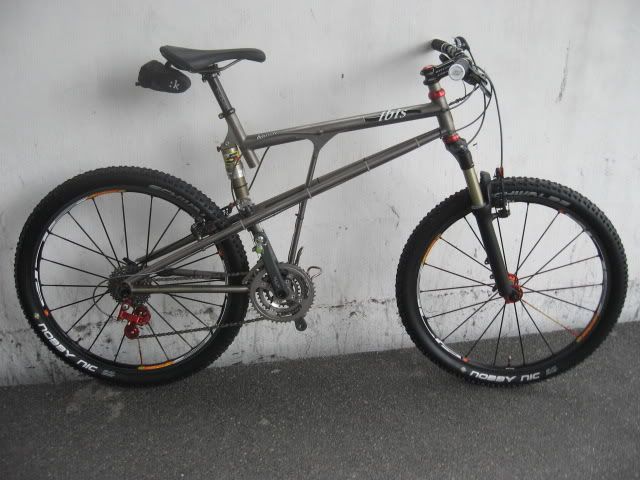 [/img]
http://www.castellanodesigns.com/diff.html
Moots are still making the YBB by the looks of things
http://www.moots.com/#/product/bicycles/mtb_26/ybb/
I've not come across pivot-less softails made out of any other materials other than Ti (EDIT: with the exception of the Fango already referenced). Maybe that's a fatigue related thing, maybe it's easier to get an appropriate spring-rate vs stiffness balance - dun know? Lahar did a pretty random carbon fibre thing though (though that's more of a soft(hard)tail I suppose):
[img] 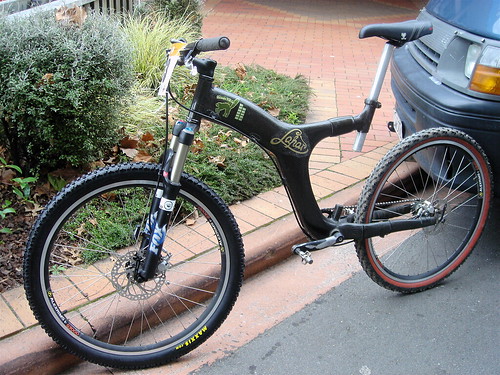 [/img]
I would assume these designs aren't that popular because people think (rightly or wrongly) they are going to break. That was my first thought when I saw that Ibis years ago. No plans on owning one, but I personally think they are a pretty interesting design.
the man is jealous!
[suck teeth mode]It's the poor quality welding that'll do for it, son.[/suck teeth mode]
Brant - both point valid but
1. the natty aluminium chainstay bridge is only necessary if the simple oval/circular section tubes don't work with alu, no? I hypothesise anyway, maybe he just wanted an expensive gimmick to make people believe it would work anyway.
2. I wouldn't expect any frames to be designed for infinite fatigue life, maybe only a judgement of useage and cycles. As you know there are empirical (crap) rules for adding your high/low cycle fatigue and given the fluffiness of any estimates of useage, riding and major impacts I'd be surprised if many even did that.
Anyway, I'm not a bike designer so toodle pip 😆
>I've not come across pivot-less softails made out of any other materials other than Ti
Cannondale Scalpel ?