UPDATE: CLASSIFIEDS section refreshed, redesigned, searchable: Go take a look
if you get back pain on a long road ride then something is wrong with your bike-fit/posture or lack of riding time
"Lack of riding time" is probably the key. I can't believe a road bike position is ergonomically comfortable. It's just that road cyclists are deformed to fit over time.
Swapping from a mountainbike to a road bike won't be a comfortable experience.
to the OP:
I found the stretching by bending over to try and touch my toes whilst trying to keep my back straight (as oppossed to the usual ? shape a bloke would adopt) - which therefore stretched my gluts - was very effective at warding off lower back pain.
It's just that road cyclists are deformed to fit over time.
+1 having been through that process over the last four months.
For what its worth I did 100-mile plus road rides on a hardtail with slicks / low stem / bar-ends with no drastic consequences, before getting a proper road bike. The road bike does them a bit faster, is all...
For back pain try lowering your saddle a touch.
I can't believe a road bike position is ergonomically comfortable. It's just that road cyclists are deformed to fit over time
Disagree with this. Flexibilty helps get into a nice tuck, but there's no need to put yourself through pain. Just not worth it. Just because roadies are miserable masochistic buggers doesn't mean you have to be 🙂
My road bike is supremely comfortable now, after I fettled it a lot.
High stem and riser bars? 😉My road bike is supremely comfortable now, after I fettled it a lot.
Hehe.. well a longer stem.. but that's cos the frame's a little small.. but I really do like the look of flat barred road bikes.
no need to put yourself through pain
Right, you can start with a comfortable more upright MTB-style position, then incrementally lower/stretch it as your body adjusts.
Which is what I did, and it takes time.
one thing to be aware of is check your rims max pressure. most disk rims are not designed to take the 80-120psi of a narrow slick tyre, they can fail quite spectacularly.
A reasonably fit rider, on a slicked-up MTB should have no problem doing 100 miles. I once did 110 miles on a hardtail round the Lancashire Cycleway, and lived to tell the tale. The issue is how fast do you want to go? I only averaged about 13ph, whereas I've done the same distance at over on my road bike. I think you need to talk to your mates and find out...
For what its worth I did 100-mile plus road rides on a hardtail with slicks / low stem / bar-ends with no drastic consequences, before getting a proper road bike. The road bike does them a bit faster, is all...
Just out of interest elliptic, you seem to have the necessary experience, how much faster did you find the road bike?
My guess is 10-20% faster, although when I did my road riding on a flat barred fully rigid stretched out MTB it was a long time ago and I was not as fit as now.
[i]My road bike is supremely comfortable now, after I fettled it a lot. [/i]
Funny, was having this discussion with a mate earlier. We decided that "comfort" on a bike doesn't really mean a lot and is in fact a relative term. My bed is comfortable. So is my sofa. The bike is simply less uncomfortable than others I may have ridden.
😉
You're right though, get the fit correct and a road bike can be so nice to ride; fast, comfy and fun.
how much faster did you find the road bike?
Depends on the terrain. Rolling/hilly there doesn't seem that much in it, on the flat maybe worth 2-3mph average over a long ride for me at the moment (reasonably fit but not a racer).
The difference is most noticeable in snap acceleration and pushing the pace 20mph+ where the MTB runs into a brick wall (as it were) rather sooner. Not an issue on long steady rides but tends to get you dropped from a quick roadie bunch if they're riding aggressively. But then they'll probably drop you anyway whatever you're riding... 😉
All that said, I did have my hardtail very specifically set up ie 1.2" slicks, rigid fork, 48-tooth big ring, narrow flat bars. And I do find the road bike more comfortable for my hands/shoulders in particular (but that's with four months of conditioning and fettling).
I managed fine putting Continental Contact Sports on my Stumpjumper. Though the bike with narrow tyres and me with baggies and Camelbak looked very out of place 🙂
Was about 100k up and down the classic Peak climbs. Found I could cope quite well with the changes in gradient as used to getting into the 'red zone' (or some other jargon) compared to the even tempo, tempo, tempo roadies 🙂
Keep off the front! Which should be no problem...
Depends on the terrain. Rolling/hilly there doesn't seem that much in it, on the flat maybe worth 2-3mph average over a long ride for me at the moment ...
That's kind of what I thought. Much as I try and justify it, it's not really worth me changing my slick shod mtb for a road bike to shave 3 mins off a 30 min commute. A road bike wouldn't look right with flat pedals either 😉
I'll just have to work on my fitness in order to chase the roadies down...
It is supposed to be just a social ride out. When pressed further, the figure of "ohh i'd say an average of 15mph" was mentioned, which I [i]think [/i] is a pedestrian pace.
However I don't want to hold them up unnecessarily, so with that in mind, I was already eyeing up some slicks (28c Conti Grand Prix 4 Season's on my 24mm ex/19mm int rims?) flipping the stem, and on with some ergon's w/bar-ends.
Just have to deal with the faux-pax of turning up with a camelbak, baggies, and a helmet with a peak. 🙂
Just have to deal with the faux-pax of turning up with a camelbak, baggies, and a helmet with a peak.
Don't be ashamed. Make a statement! Bury them on the climbs, like an MTBer should!
DO NOT GO INTO THE GRANNIE RING
you ever been to Lincolnshire?
one thing to be aware of is check your rims max pressure. most disk rims are not designed to take the 80-120psi of a narrow slick tyre, they can fail quite spectacularly.
is that true? when i remember i pump the slicks on mrs antigees commuter to about 80psi and have no idea what the rims are designed for 2nd hand off here - i would have though all the other forces on a rim much higher than the uniform pressure from inner tube
now putting a very narrow 700c tyre on a wide 29er rim may cause problems but that is tyre width not pressure?
Don't know the answer but like to know
What route are you taking? I'd be very careful. I thought that road was one of the most dangerous in Europe? Or is it a different one in Lincolnshire?
A great point that I was asking myself too giantjaunt.
The A 15 is a nightmare in a car (yes I own one :-)), never mind on a bike.
If that's your route TAKE CARE!
is that true?
seen it with 317's that have thin road type slicks fitted and pumped to the max (for the tyre) split the tyre bead
v-brake rims have more meat at the sides but mtb disk rims only have to take 40odd psi
there are recommended max psi's for mavic rims, some of the bigger 'all-mountain' and freeride rims have 45-50 max psi, the xc rims can take higher though.
MrSmithseen it with 317's that have thin road type slicks fitted and pumped to the max (for the tyre) split the tyre bead
v-brake rims have more meat at the sides but mtb disk rims only have to take 40odd psi.....
thanks i'll look at mavic site was thinking about building some disk 700c wheels so better be more careful on rim selection
Max pressure for a rim is new to me so I did some thinkinh/research
Not suprisingle max pressure depends on tyre size
force = preesure x area
X317
from whAT i can see in the picture its
113 psi for 1"
49 psi for 2.3"
I read this from the side of the rim in picture
I'm taking a hunch that wide rims take lower pressure as they can't take narrow tyres
Well I just got off the 'phone with Giant. They recommend a 32c [i]minimum [/i]size tyre for the P-XC 29 rim (19mm internal, 24mm external).
They have no problems with me putting in whatever the tyre manufacturer recommends for this size, which is going to be anything from around 45, to 80 psi. So there you go.... just thought I'd share.
[url= http://i419.photobucket.com/albums/pp271/repackrider/avatar235.jp g" target="_blank">http://i419.photobucket.com/albums/pp271/repackrider/avatar235.jp g"/> [/IMG][/url]
[url= http://sonic.net/~ckelly/Seekay/mtbwelcome.htm ][b]2retro4u[/b][/url]
Marin County, Cali
In the early '80s when MTBs were new and road riders were dismissive of them, I regularly went on the "century" rides, organized 100-mile rides on my Ritchey. Since I was selling them at the time, I set up a bike specifically for that type of event, with the lightest rims then available, close-ratio gearing, road pedals, and fat 2.125 tyres pumped to over 5 atmospheres. I had no trouble keeping up. As a former road racer I was experienced in group riding, drafting when necessary and taking monstrous pulls to get rid of slower riders.
Photo is from a century ride in 1981 that included 8000 feet of climbing, during which only two riders on road bikes managed to pass my friend and myself. I'm on the right.
[IMG] 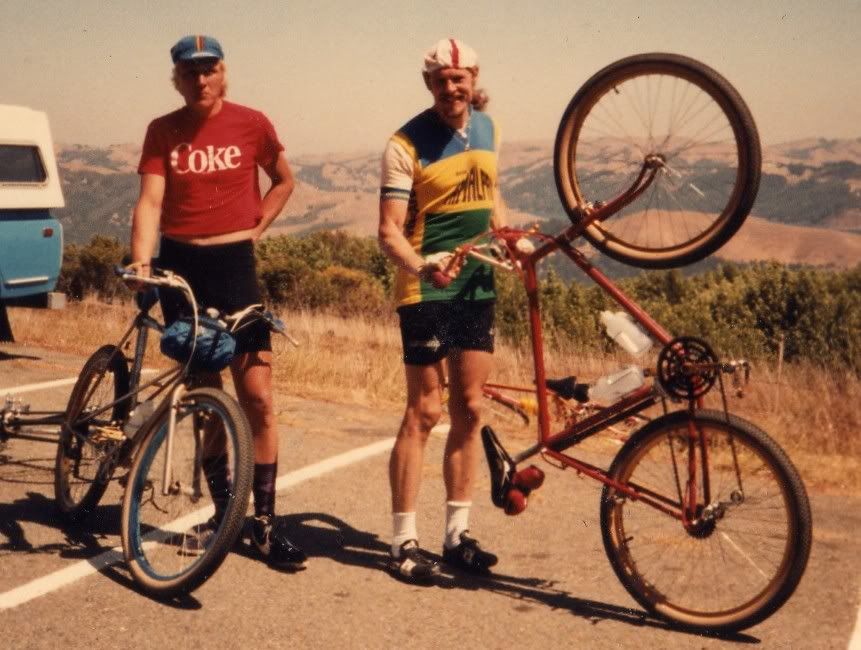 [/IMG]
Great pic ^ Here's hoping I'll be smiling as much as your good self, after my ride 🙂
force = preesure x area
Yeah but the force on the bead has nothign to do with the size of the tyre.
I'm thinking of the force pushing the rim outward, not the force on the bead
the only rim failure I've seen was the side pushed
I'd say bigger tyres exert more force either due to larger area or lower radius of curvature
The tyre pushes the rim outwards by a force exerted by the bead on the rim.
pressure dictates the force on the rim.
bigger tyres would probably come off the rim before failure, it's the narrow tyres with their higher max pressure that may cause problems.
I retract my radius argument total rubbish
Mr Smith
Mavic say one the 317 rim you can use a much higher pressure with a thinh tyre
Molgrips
are I see
Why wouldn't the pressure acting over a bigger area exert more force?
why do mavic say you can use more pressure in a thinner tyre if tyre size doesn't matter
Because pressures is force PER UNIT AREA. So 50psi is still 50psi if it's over a big tyre or small tyre. And the area of the bead in contact with the rim is the same regardless of the size of the tyre.
BUT
A larger tyre has a greater angle between the rim and the tyre sidewall. So the bead has less purchase on the hook on the rim and as MrSmith says the tyre would be more likely to blow off rather than the rim fail.
Because pressures is force PER UNIT AREA. So 50psi is still 50psi if it's over a big tyre or small tyre. And the area of the bead in contact with the rim is the same regardless of the size of the tyre.
I'm not expert on tyres but thats rubbish
when you pull your breaks you squeeze with a small cylinder. The break fluid behind the piston is at the same pressure. But it acts on a bigger area hence more force
its pounds per square inch
1 square inch 50 pounds
2 square inches 100 pounds
10 square inches 1000 pounds
That's exactly what I just said.
Gab344, you can certainly do it as you will probably know Lincoln side of the Humber is fairly flat once you get past Brigg going south unless you pick up the edge of the Wolds then you'll have some hilly bits.
Last year i set off from home (a village just north of Lincoln) and rode to Gainsborough, caught the train to York and rode home via the Humber bridge. I was on my Cotic Soul with some road tyres, it was one of the hottest weekends of the year and i had a steady headwind nearly all the way home from York 8O, after i had got across the Humber i could barely stand straight up out of the saddle i had to gently slip off the front of it whilst standing at the same time it was pretty painful on the gooch (think thats the right terminology) 😆
Anyway if you have any real issues i'm around tomorrow so pop in i live the near the Dambuster's pub which i believe has a real ale festival on all weekend 😀
Back to your original question ... yes you will!
Good luck & at least you'll look good dying it. 8)

