With the hot, dry weather set to continue, fire crews are warning that moorland and woodland across the UK is primed to burn – and plenty of it is exactly where we ride. Fires on dry moor can move faster than you’d believe. Here’s what to do if you come across one mid-ride, courtesy of West Yorkshire Fire & Rescue Service.
If you see smoke or flames
Move to a safe place and call 999 immediately – ask for FIRE. Give as much detail as you can: the size of the fire, the location and the terrain.
Don’t attempt to tackle the fire yourself, however small it looks. Moorland fires spread fast and can change direction with the wind.
If you haven’t already, get out of the area as soon as possible.
Tell them exactly where it is
This is where riders can be more useful than almost anyone else on the hill: you’re carrying GPS. Control room operators can work with any of these:
- A what3words address (the free app gives you one even offline)
- An OS grid reference – the free OS Locate app gives you one instantly, or pull it from your mapping app
- A lat/long from your bike computer or phone
- Failing that: the nearest named landmark, car park, trailhead or road
A precise location can save crews the better part of an hour searching moorland access tracks.
Don’t be the reason there’s a fire
- No BBQs, no campfires, no exceptions on the moors in this weather – and if you see someone using a BBQ on the moorland, call 999 and ask for FIRE. That’s the official advice, not curtain-twitching.
- Take glass bottles home. They can hurt people and animals, and they can magnify the sun’s rays and start a fire.
- Don’t park on dry grass at the trailhead – hot exhausts can easily start a fire.
Should you even ride?
The moors stay open during most wildfire warnings, but on extreme-risk days it’s worth checking your local fire service and National Park social feeds before heading up – crews sometimes ask people to stay off specific moors, and access tracks may be in use by appliances. If in doubt, there’s always a lower, greener loop to ride instead.
Fires don’t just close trails for a weekend – burned peat moorland can take decades to recover, and access disputes have a habit of following blazes.



Seems like odd advice. And so very British…. Couldn’t they say something more nuanced like don’t expose yourself to too much danger by tackling the fire?
So isn’t it therefore important to try to tackle it asap?
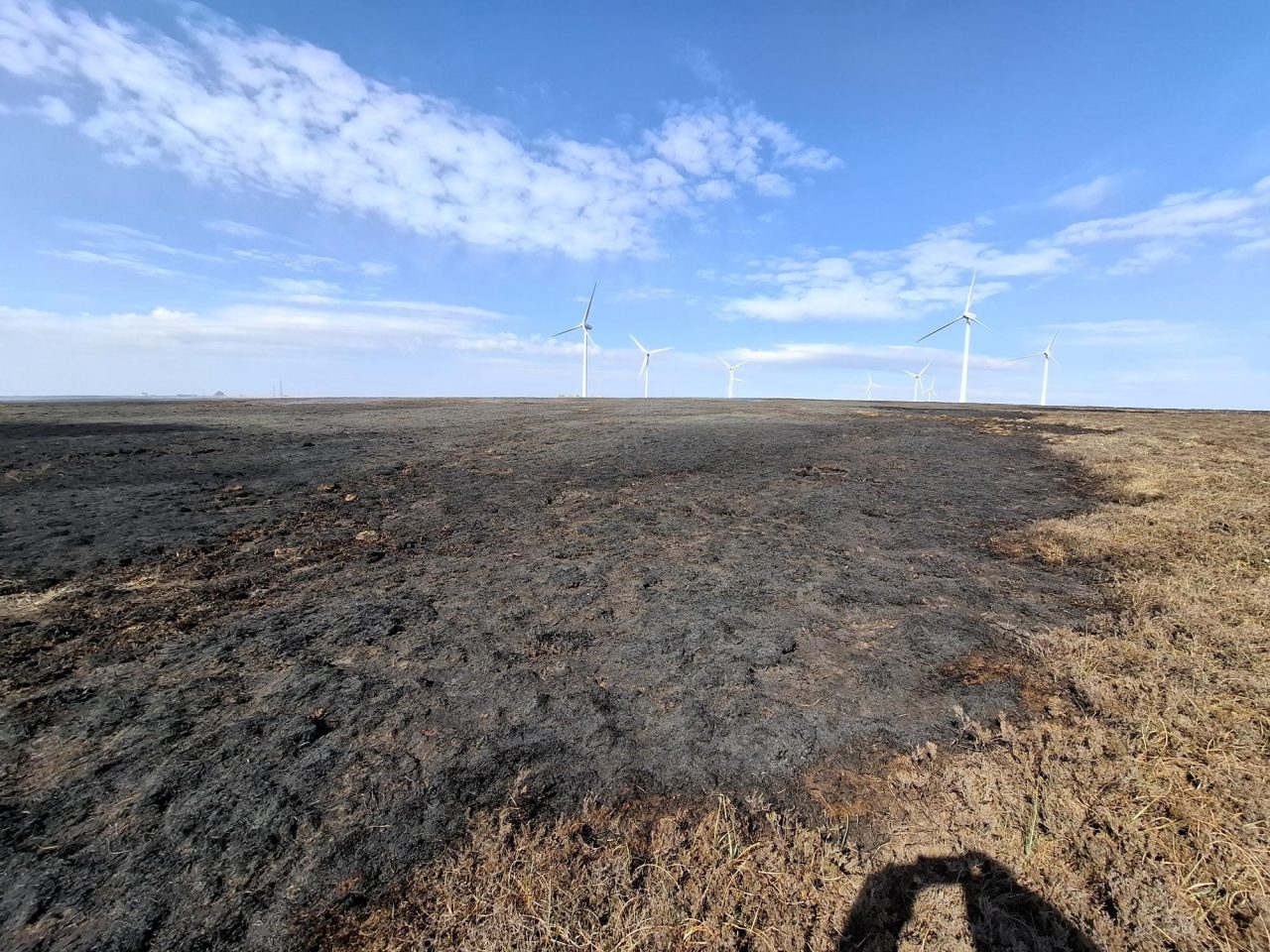
Good and timely advice. We have suffered many heathland fires in recent years here in Dorset, unfortunately a good proportion of them started deliberately or by people stupidly having camp fires or BBQ’s. The picture below is of Holt Heath (taken June 2026) and only shows a very small portion of the damage caused by a major fire in 2025, it is a long long way from recovering after 170+ acres were destroyed.
There was a small(ish) one on Froggat edge last year. I was amazed at how quickly the ferns grew back.
But still, no excuse.
Ah full forum. So after fire and a month later..
you won’t be able to tackle it yourself, even the smallest grass/scrubland fire takes way more water than you have available to extinguish.
I came across one last summer that was only a patch of around a metre squared and emptied my two water bottles onto it and it didn’t do jack to extinguish it, and there wasn’t even visible flames just smouldering.
Given how quickly it can turn to something really dangerous you’re far better off just ringing the fire service and leaving quickly.
What initially looked like nothing to me took two firefighters with huge backpacks of water with supersoakers to put it out and even then they basically ran out just as they managed to.
Sounds very sensible to me
It all seems very good, sensible advice to me, much if which seems quite logical for most (I hope), but one thing that had never occurred to me was
I’ll certainly be thinking about that in future.
If anyone is wondering how badly these can go, look up the Yarnell hill fire
I remember being at work late on a Friday watching the fire spread on the fields on the horizon as festival (boomtown, Winchester) goers cars all went up in flames.
I’m a Fire fighter. Don’t do this, wildfire, especially when it’s as dry as present can develop quickly and change direction without you realising leaving you with nowhere to go. Ring us.
I phoned in a moor/woodland edge fire left from a previous nights camp.
Fire brigade turned up wth a couple of those huge euro liquid cubes – and spent next 12 hours shipping water in with help of the farmer.
The fire area was about 4m x 4m – but deep in the peat and roots.
Just phone it in and get out of there.
It will depend though. Was in Scotland later on last year for some kayaking. Cant quite remember which area it was but drove through an area where there had been a major wildfire about 3-4 months early. For about a mile it was very obviously fire scarred both sides of the road stretching off into the distance. All the trees were dead.
Fire brigade turned up wth a couple of those huge euro liquid cubes
ICBs
I’ve helped put out a couple of wild fires, it’s scary how quickly these things get out of control. I certainly wouldn’t consider getting involved if I was on my own and didn’t have the right equipment.
Got to love this place. My wife frequently reminds me not to to try and explain things to people that are experts in that field. However if the Fire Brigade don’t want me to tackle moorland fires then in think I’ll go with the flow.
I think it was my mother that told me that they can burn underground so it’s easier to get cut off than you expect
This has happened a few times in the Peak District. The peat base effectively carries the fire underground and it’ll spring up again above ground somewhere else with no warning. It’s very easy to find yourself surrounded, like a high tide racing in and cutting off your escape. And it takes vast amounts of water. They’ve used helicopters sometimes on remote Peak District fires – thankfully a lot of reservoirs around the place!
Firefighters often stay on the site of a blaze for 2-3 days after it’s apparently been extinguished, damping things down and making sure that the fire doesn’t just spark up again where it’s been burning below ground in the peat.
This will invariably prompt wails of protest on social media if a road remains closed as morons shout that ‘the fire is out, let us drive along the road again..’
Years ago at the start of my tree cutting career and we were removing dead elm from Redford barracks. I’d been left on my own to cut the timber and tidy the fire.
The grass caught fire and spread with surprising speed. It took a lot of effort to beat out a small grass fire. I wouldn’t like to try to tackle a large moorland fire.
Cool, you do you. I’d rather make an assessment based on the info available to me at the time, rather than a blanket statement made by someone else possibly hundreds of miles and multiple weeks/months/ years away.
There are sometimes other ways of keeping a fire under control, and there may well be other people about to help.
But you did which in this circumstance was good as you succeeded and it didn’t become a huge fire.
Indeed neither would I. Which, as stated above, is why sometimes it might be worth the effort to put it out before it grows
With horrible inevitability Darwen Moor has gone up. Just hoping that they can contain it soon as the last time it happened it was ablaze for days and destroyed acres of peat.
Timely advice, it’s going to be an increasingly difficult problem.
https://www.bbc.co.uk/news/articles/cy8w67l642no
actually if all instructions were blindingly obvious, it wouldn’t need providing as advice. Advice is most useful when intuition (to try and put it out yourself) is contradicted by experience. Given the article was written for an MTB audience discovering a fire whilst riding what size of fire do you think you can put out with only your water bottle whilst wearing synthetic fibre?
If this advice is “so very British”, which country do you think would provide significantly contradictory advice?
Found & reported a fire in North Hampshire 6 weeks ago. 3 big takeaways
1) My What3Words had gone dormant so I had to re-install on 1 bar of 4g phone – very annoying so well worth regularly checking that the app works
2) I smelt smoke and was asking other forest users if they had seen anything. Some horse riders had seen smoke had but had not reported it. I then found the fire and 2 lads watching the fire – they’d been there 30mins but not reported it
3) stamping out smouldering vegetation – seemed like a good idea until I jumped back on my bike and the the cleats burnt the soles of my feet!! (yes, I’m a knobba!)
Fire crews and chopper busy at Dovestones again today courtesy of the grieving fireworks dickheads.
The bill for the chopper alone hopefully focussing the limited brain cells of the well documented perps.
Sounds somewhat familiar. My bouldering mat strongly objected to being used for that
https://flic.kr/p/2soJHLb
Had to resort to plan C at that point… Weirdly enough, it appears that that very same forest has gone up in flames again today. Alas nobody put it out whilst it was still small…
https://www.theguardian.com/world/2026/jul/13/france-fires-wildfires-fointaineblue-forest-paris
As previously stated, I’d base my decision on the facts at the time, rather than some hypothetical incomplete parameters that you have come up with just now.
I’d expect those countries without such a strong Murkan liability culture to be less inclined to give such advice. The ones that don’t see the need to festoon their toilets and kitchens with “Danger Hot Water" signs ( and indeed many other places with many other stupid signs)