UPDATE: CLASSIFIEDS section refreshed, redesigned, searchable: Go take a look
Here's my quandry. I'm using my lockdown and a pile of left-over Valchromat, Oak veneered MDF and Oak strips to make a TV/stereo/storage unit.
I need a couple of pieces of oak 27mm x 40mm section, 700mm long. I plan to make them from a piece of oak with a section whose width tapers from 33mm to 28mm. The depth is 42mm.
I don't have a table saw but I do have a router table. I have planes, but I know I'll just bugger them all up if I try planing by hand. I have a Festool Track Saw but I'm unable to hold the pieces firmly on my MFT to get them cut parallel because 42mm oak is going to take 3 or 4 passes to cut cleanly.
I know the trick with offsetting my router table fence to act as a jointer, but if I do that I'll still end up with a taper.
My plan is to set the fence right back so the gap between fence and cutter is 27mm (OK, I'll come down in stages) and feed the wood behind the cutter, going from left to right which in theory will give me a parallel finished piece. However, everywhere I look advises strongly not to attempt this. Why? I've done a small trial piece and I've still got both hands.
Who can tell me if this is a bad plan?
I guess the risk.is that the cutter is between you and the workpiece. If if pulls in your hands are close to a fully exposed cutter. Also it could jam.
It's a long enough piece that you can have your hands well away from the cutter. Taking tiny bites will reduce the risk. I'd probably try it but obviously now is not a great time to end up in A&E so I'd give it some more thought first
Do have push sticks / pads?
If I feed from left to right it's against the rotation of the cutter so won't be pulling it through.
Yes I have push sticks (notched) and I will have to make longer feather boards to reach the workpiece.
I'd attach a thin sacrificial fence to the router fence, then carefully break through it with the cutter about 5-10mm. Then secure the whole thing back so that around 2mm is protruding through the new fence.
Then get a baton with a straight edge and clamp to the table, starting at around 32mm from the original fence, and decreasing by a mil with each pass.
This should be a safer way to pass through without it catching badly or snedding your fingers off.
Now that's a good idea.
And stop feeding as soon as the cutter goes quiet.
In theory that (edit-what you said in the op) would work but I would set up a feather board to apply constant pressure near the cut so it can't come away, and clamp on a block somewhere to cover the cutter.
Narrow stuff like that you can normally still track saw if you have another piece the same thickness and use that to carry the width of the track. Clamp the track to the workpiece if you can, even if you saw a bit at a time then move the clamps to where you've cut already.
You can even use a woodturning trick and temporarily glue some mdf or something wider to the piece by using some paper between the wood and the mdf. The paper is what shears when you later break the joint.
You could use your saw upside down like this dude.
Also if you have a bearing guided trimmer you can temporary glue or clamp a straight edge to your workpiece and rout to that. I did it this morning on a curve on a narrow piece. Used loads of clamps, moving them while I routed a section so that it was never not clamped in at least 3 places.
Great ideas. You'll either see something in the what I made thread or the obituaries column.
I spent a lot of time yesterday with double sided tape, worktop offcuts and rail clamps. Nothing came close to good.
Wood doesn't tend to jam in a router table, it gets cut or it gets moved out of the way of the bit, with a cut like that it will just tend to fire the piece you are working with at very high speed away from the bit, upwards and possibly towards you.If you are pushing the piece you'll have nothing there to push against so you could end up with hands very close to the bit or falling toward the table, it's pretty terrifying when it happens and potentially very dangerous, and it happens so fast you don't get to react. As usual the answer to any question involving a router is build a jig, in this case I think you want a fence in front of the bit, takes small bits off at a time and either don't use the rear fence or at least ensure the piece can't come up at you, by using featherboards. if you still want to do the cut the way you suggested at least use featherboards on the rear fence to stop the wood getting thrown up and out.
Ok. I'm going to have a go this afternoon after an hour on the road bike.
Have we all seen Paul Sellers's April 1 contribution. For such a dour chap it's quite good.
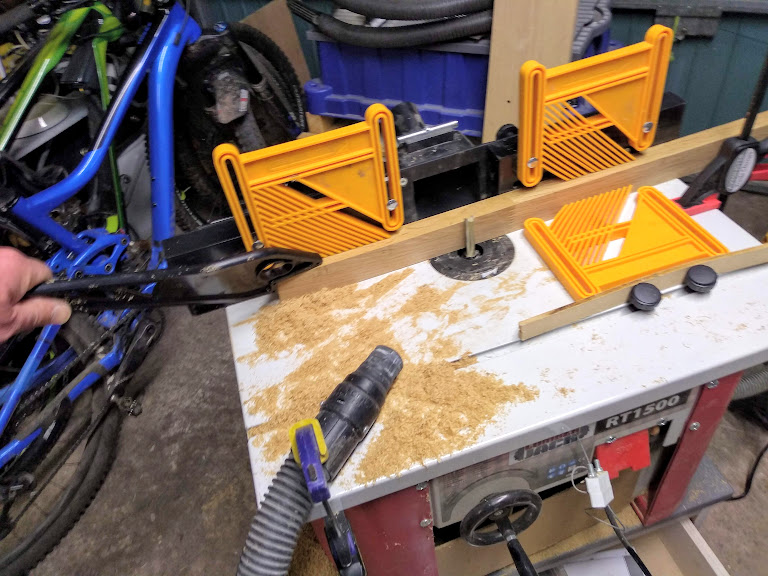
I had a go at cb200's approach. It meant that the tapered parts were unsupported and needed to be kept away from the cutter when passing. I couldn't find a suitable way of keeping them from flapping about, resulting in a couple of gouges on my test piece.
So I took it carefully with an overdose of feather boards. Stupidly I put the fence pieces on without leaving room for the perspex guard but I wasn't going to go near the cutter.
A great result! I'll hardly need to sand the pieces.
Kayak (or Blackteaonesugar, as I know you from Insta. I'm Smartrooms101 there.), you use Valchromat, don't you? And Osmo Polyx oil clear satin? I've made a table but there's a bit of streaking which was apparent after I'd applied the second coat and which I thought would disappear after a day or so. 6 months later the marks are still there. What did I do wrong? I'm going to sand it down and apply another coat.

