UPDATE: CLASSIFIEDS section refreshed, redesigned, searchable: Go take a look
Remember the national speed limit also depends on the weather conditions.
Anyone mentioned gateway signs yet?
I've seen roads with a signposted speed limit of 60mph. If you were driving an HGV.......
...can be signposted as higher (see A9)
another speed limit thread, so soon?
Yeah but this one will be a classic.
Remember the national speed limit also depends on the weather conditions.
It might do in France but not in UK.
All of which have lots of streetlights
They're not street lights.
scotroutes - MemberThat's another anomaly. I've seen roads with a signposted speed limit of 60mph. If you were driving an HGV.......
HGVs can do 60mph.
What's your understanding of the National Speed Limit in the UK?
My understanding is that the NSL applies unless their is a restriction in place, that a restriction will be indicated either by signs or the presence of streetlights no more than 200yds apart for a 30, and where there are streetlights but the road is not restricted to 30 there will be signs indicating this.
NSL sign indicates 60mph (for cars) generally observed after leaving a speed limited (30mph, 40mph, etc) area. Near where I live there is a streetlit road with no houses on it and NSL signs, so the speed limit is 60mph (for cars). But lots of people drive at 40 for some reason, so the uncertainty is probably quite widespread (or the world is full of dawdlers).
Don't forget the new 20mph speed limits in lots of built up areas which are also signed. And if you ever go into MOD areas (serviceman's housing areas etc, to the best of my recollection the (signed) speed limits are 15mph.
How fast can I go if I'm driving to pick up a crown race, or do they just come with the headset?
Really quite simple:
The NSL is the National Speed Limit, not National Speed Limit[b]s[/b] Therefore, it can only be one number which is 60 and is what the sign signifies
(Ignoring the caveats for different vehicle types)
For everywhere else the state informs you with the use of signs with permitted maximum speed (generally) 🙂
sbob - Member
scotroutes - Member
That's another anomaly. I've seen roads with a signposted speed limit of 60mph. If you were driving an HGV.......HGVs can do 60mph.
Do you mean that they are capable of doing 60 or allowed to do 60?
The NSL is the National Speed Limit, not National Speed Limits Therefore, it can only be one number which is 60 and is what the sign signifies
Or 70
[i]It might do in France but not in UK.[/i]
Just France?
Really quite simple:
The NSL is the National Speed Limit, not National Speed Limits Therefore, it can only be one Therefore National number which is 60/70 Nationally and is what the sign signifies unless there are street lightings, not National Street Lightings, but street lighting nationally indicating a 60/70 National 30 limit.
Got it?
Do you mean that they are capable of doing 60 or allowed to do 60?
Strictly speaking both, but then you know the rules and you'll know that an HGV limited to 56mph will still be able to do 60mph downhill and still have a 60mph speed limit (English dual carriageway).
Ah, interesting - 50 up here for the big ones on DC's.
but then you know the rules
I didn't actually, not that one at least 😀
(Ignoring the caveats for different vehicle types)
And different road types?
Glad I put in the English bit then, for some reason I was under the impression that you were south of the border.
Used to be, took a wrong turn on the M6 ten years ago...
And different road types?
Of course, I left that out to create more rage within the thread for those that didn't think that a motrorway or dual carriageway would be treated differently 😀
Have we got to the point where it is revealed that at least one person on the thread is confused by what [i]"dual carriageway"[/i] means and has spent decades doing 70 on all two lane roads with NSLs wondering why everyone else is going so slow?
That's always my favourite bit. 😀
I agree that the NSL sign indicates a speed limit of 60/70 mph for cars, however can see where the OP is coming from, the below are both from the gov.uk website:
1: This confirms that the NSL sign indicates that 'The national speed limit for the type of road and class of traffic applies':
[img] 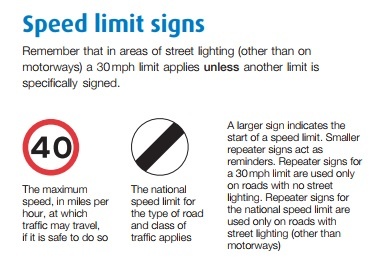 [/img]
2: However this states that the NSL in a built up area is 30mph:
[img] 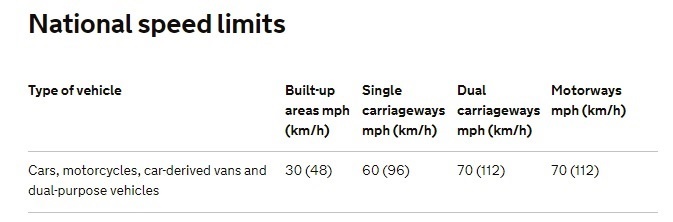 [/img]
can see where the OP is coming from
Well that's two of you now, so I'm making some progress 😆 Thanks
[url= https://www.askthe.police.uk/content/Q594.htm ]Q594: What is the national speed limit?[/url]
That's what the police have to say on the matter, anyway.
Internally I seem to consider the NSL sign to be a "derestriction" sign. Possibly that's how it used to be used, long ago before speed limits were imposed on all roads, and I've picked it up from someone older than me. So it means something along the lines of "no previous speed limit applies, the limit is the maximum for this road type and your vehicle". With a car that means 60mph, or 70mph if the road is a dual carriageway with a central reservation.
that is very ambiguously worded IMO, looking at the rest of that page I can only assume they're using the words "national speed limits" as a counter point to "locally set speed limits" rather than meaning National Speed Limit. That is all I can think of. The speed limit is NEVER 30 when there's an NSL sign.2: However this states that the NSL in a built up area is 30mph:
Have you a google maps link to this road, it can be viewed in Street view.
The distance between the street lights is a factor, not just the fact that street lights exist.
And if you're on a motorbike, all bets are off.
Yes but it doesn't override signage. If there's street lights & no repeaters, it's a 30 (because the distance between the lights will be 200 yards or less). If there are repeaters, it's whatever the signage says. They don't expect drivers to get out and measure the distance with a trundle wheel just to figure out what the speed limit is 😆The distance between the street lights is a factor, not just the fact that street lights exist.
if a speed limit is in force, apart from 30mph in 'built up areas', or NSL, it should be signed.
So my questions;
40mph haS A 40MPH SIGN. these should be EVERY 400metres? 1/4 mile?
If there is a sign missing or obscured can you still get done?
On a dual carriageway in a built up area, is the limit still 30mph unless signed otherwise?
And why do (some) roundabouts have 60mph/NSL signs just before them?
shifter - MemberAnd if you're on a motorbike, all bets are off.
[b]N[/b]o [b]S[/b]peed [b]L[/b]imit. 😀
500m on the same side or 350m on alternate signs AFAIK. (The gap is larger where the limits are higher)40mph haS A 40MPH SIGN. these should be EVERY 400metres? 1/4 mile?
Depends how good your solicitor is, it gives you an "out" but you've still had to go through the main speed limit sign 🙂If there is a sign missing or obscured can you still get done?
because the other roads coming off the roundabout will have a different (faster) speed limit than the one you're onAnd why do (some) roundabouts have 60mph/NSL signs just before them?
Did my course just before chrimbo so it's pretty fresh still 😆
Having street lights is not the only marker of a street being a built up area.
My understanding following my speed awareness course is that the NSL sign (black diagonal) does indicate the National Speed Limit which is 60mph for cars. In a built up area the National Speed Limit drops to 30mph BUT there should be a 30 mph sign to denote this zone i.e. number 30 inside a red ring.
The reason you need a speed limit sign in a reduced NSL zone is to avoid the type of ambiguity and confusion that is reigning on this thread. Again, some roads that are not in built up areas may have street lights and visa versa.
At the end of the day the signs rule. You are only told about the street light thing on the speed awareness course to make you aware of certain visual cue's to help you see in advance when a speed limit change is coming so you can look ahead and make better decisions. But ultimately the signs rule and a black diagonal sign means 60mph for a car. Other wise why would you need any other speed sign at all? All signs would just be the black diagonal and leave it upto drivers to decide what the speed limit was based upon there being street lights or not.
If there is a sign missing or obscured can you still get done?
If there was a sign missing or obscured would you speed?
On a dual carriageway in a built up area, is the limit still 30mph unless signed otherwise?
There are always signs at the start of the limit.
And why do (some) roundabouts have 60mph/NSL signs just before them?
To indicate a change in speed limit. 😆
You may have different speed limits on the roads leading to a roundabout so it is common to have a change of limit so they are harmonized on the roundabout itself.
NSL is either 50, 60, or 70 depending on the type of road and what you're driving. If you're not in a NSL area, you will have passed a sign that says 20,30,40,50 or 60. Perfectly simple and nothing to do with street lights.
Now prove me wrong....
daveatextremistsdotcouk - MemberNSL is either 50, 60, or 70 depending on the type of road and what you're driving. Perfectly simple and nothing to do with street lights.
Now prove me wrong....
40mph for HGVs on single carriageways in Scotland. 😛
So [url= https://www.askthe.police.uk/content/Q594.htm ]Q594[/url] is wrong then?
And 80+ if you are “making progress” 😉
And 80+ if you are “making progress”
Only if you declare yourself a "tasty driver", if not you're a crazy maniac who's a danger to themselves and everyone else on the road.
this sentence is wrong, yes, wrt to motorways and/or Scotland (as mentioned above):So Q594 is wrong then?
The national speed limits for goods vehicles, such as non car based vans, and also for vehicles with more than 8 passenger seats are 10mph less than the limits mentioned above.
You think it's confusing in the UK. Here in Spain there are many sections of road where on a long hill there is a lane for slow vehicles with an overtaking lane. The vehicles using this overtaking lane must not drop below 70kph but the maximum speed limit os 80kph, so you have a 10kph window in which to drive. A road locally had a temporary limit of 60kph but kept the 70 minimum on a hill which is obviously impossible to achieve.
[s]When is it 50 in a car?[/s]
Ooops I misread your post.
#speeders 😆
One of the most useful things I learned on my naughty boys' speeding class was to check side roads if you missed a sign and you don't know whether it's a 30 or 40. If it's a little residential road, it will definitely be a 30. If there's a big sign telling you a 30 zone starts there, you're in a 40, possibly 50, and if there's no big sign at the junction telling you that you'd be entering a 30mph zone, you're in one already.
I think NSL confusion is partly down to the course presenters trying to make their courses more interesting:
Presenter: What's the National Speed Limit everyone?
everyone: 60/70mph
Presenter: ha, well it's [i]actually[/i] not that simple! There are [i]actually[/i] 27 "national" speed limits!
NSL is either 50, 60, or 70 depending on the type of road and what you're driving. If you're not in a NSL area, you will have passed a sign that says 20,30,40,50 or 60. Perfectly simple and nothing to do with street lights.Now prove me wrong....
The link below, screen shots of the contents of this link, and copied and pasted text from this link have cropped up many times already on this thread. It clearly shows that the NSL is 30mph in certain circumstances and is from Gov.uk, a source that we should be able to rely on.
[url= https://www.gov.uk/speed-limits ]https://www.gov.uk/speed-limits[/url]
I'm not sorry I started this thread. It proves the system is imperfect and mis-understood. The conclusion I'm drawing is that I'll take the bus instead 😆

