
Subscribe now and choose from over 30 free gifts worth up to £49 - Plus get £25 to spend in our shop
I was thinking about this, as I drifted off to sleep last night.
I mean, there's things like plates and cups, which everyone on Earth has, near enough, but what single object is the most abundant?
It has to be bricks, surely? IE, something made of natural material, clay, mud etc, and baked hard, then used in the construction of a building.
Consider how long Man has used bricks. Then consider how many buildings have been made, using bricks. Over the last few thousand years or so.
Take Britain, for example. Lots and lots of brick-built buildings. How many bricks in the average structure? Thousands? Hundreds of thousands? Millions? Then, how many structures in Britain alone?
So, add all these bricks up, globally, and how many has Mankind created, since bricks were first used?
I'd say, probably more than any other man-made thing. Ever.
What do youse lot think? What about other things; nails, match-sticks, coins, Deore rear mechs, computer chips, etc?
I tried to start imagining the number oof bricks that have ever existed, but then I fell asleep.
How many bricks???
I thought it was commonly accepted that it was on-one inbreds?
The wheel or variations in its form, its design is used in all moving parts.
Umm i reckon if you count bricks as a generalization such as igloo bricks, huge pyramid bricks to your london brick then yeah might well be, although coins and and pens/pencils must be in the running.
Ah, but the Wheel is a concept, not an necessarily object. IE, a wheel can be made of wood, stone, metal etc and have myriad purposes. A brick is just a brick.
Like your thinking, though.
Babies
Nettles, back of the class, please.
There's always one, isn't there? 🙄
What? It was a serious answer. Man(kind) has made a serious amount of babies.
Alright then, particles of dust from the production of bricks in all their various forms.
Yolu're an awkward ****er, aren't you? 😆
The particles of dust are the result of erosion or other destruction. Plus, the particles themselves are just whatever the brick is made from, so they were there in the first place, smarty-pants!
I suppose transitors, in various forms, are plentiful, but they take many different types and forms. I meant a specific object that does a specific job, and whose form does not change radically, from one application to another.
Come on, people. any more ideas?
I heard this week that 100,000,000 processing chips are made annually for PCs and laptops, and 10,000,000,000 processing chips are made annually for other purposes (microwaves, phones, tellies etc etc).
And, as an aside, that the chip on your debit card has 30 times the processing power of the guidance computer on the Apollo 11 moon lander.
Easy Transistors theres billions of um
bullets ? 🙁
The current AMD dual-core Athlon Processor has 154-233 Million transistor. An Intel Pentium D has 230 million transistors.
... spokes, 40 to a bicycle, how many Flying Pigeons are there in China? Including tricyles and rickshaws:-)
Apparently, [url= http://uk.youtube.com/watch?v=DTy3WA0Pq8M ]there are 9 million bicycles in Beijing[/url], and that's a fact. So, a lot of spokes.
Hmm, the transistor thing has clouded the issue somewhat. But maybe transistors, in all their forms, are perhaps the most abundant man-made thing on Earth. Mind-boggling.
As for babies, well, apparently, there have been more people born in the last 200 years or so, than have ever been alive prior to that. So, Not as plentiful as bricks, or transistors, then.
Screws. No s****ing, please.
I reckon right-angles!
They don't really occur in nature, so must be man-made. There are 4 to every piece of paper, 24 to every brick...
I like that, Foxy Chick, but right-angles aren't really any physical object. But there must be quite a few, you're right!
And, sorry to piss on your chips, but salt crystals are cubic...
[img] 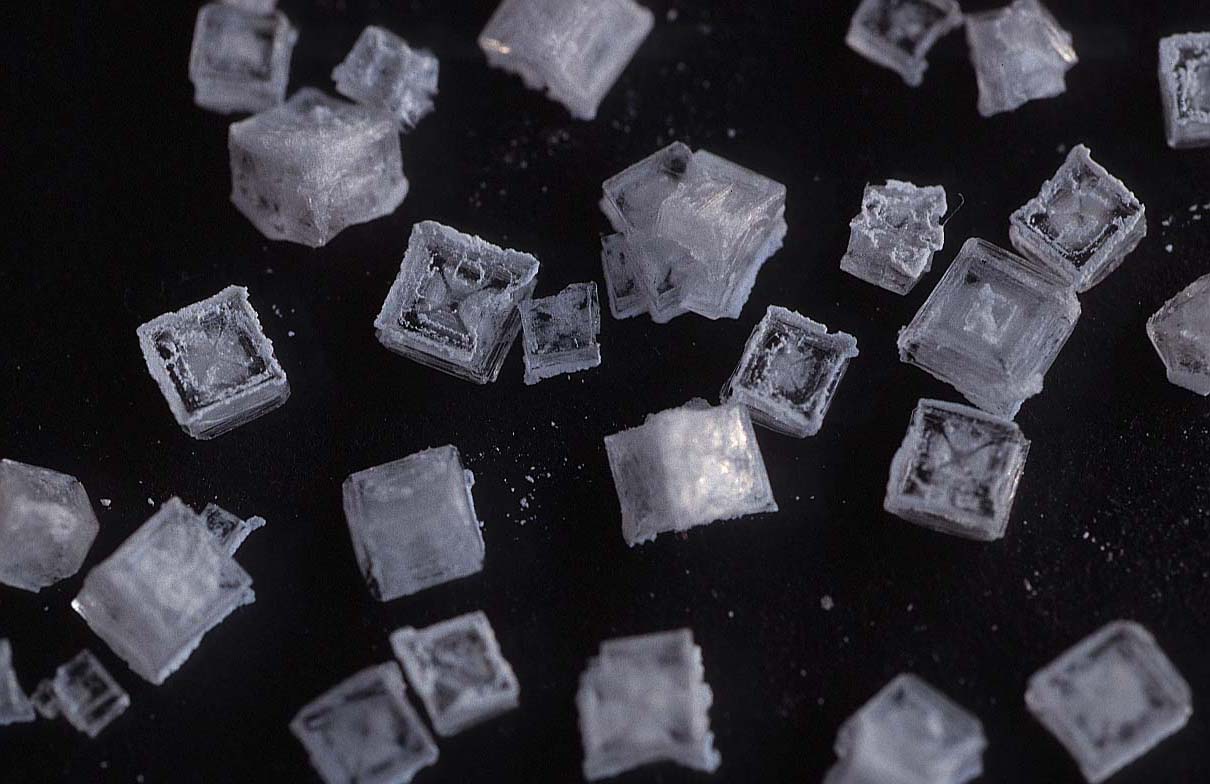 [/img]
TBH Fred I prefer vinegar on my chips... 🙄 😉
Could be an interesting answer because not everything is always as obvious as it seems - I mean, according to James May's (excellent) recent programme on toys, Lego are the world's largest producer of tyres!
I would say that it's something which is made daily for a once only use. Probably newspapers. Although they haven't been made for that long, many millions are produced every day in just the UK.
Globally, 464 million people get a daily newspaper (2 years ago) and even more than that will have been produed every day.
[url] http://www.guardian.co.uk/media/2006/jun/05/pressandpublishing3 [/url]
There's no way that bricks can compete with that, even if they have been made for a lot longer.
Mistakes?
do 'idiots' count?
how about tesco plastic bags?
FC; you may have me confused with someone else.
GG; good call, but if you expand that a bit, then you're looking at individual sheets of paper. Considering how many books/leaflets/newspapers/magazines etc that have been produced, that's got to be a colossal number. Tricky to assess actual numbers, though, as paper is produced in reams, and sheets cut from that. So, it's in tonnage, perhaps, or square meters?
I still think bricks, as one type of thing produced. A brick is a brick is a brick...
Yep, Rudey, you could be right...but then there's been that many "editions" of you, you can't blame a girl for getting mixed up now, can you? 😉
if you expand that a bit
You don't need to - just 'a' newspaper will do. You're looking at well over half a billion newspapers [u]very day[/u].
However many bricks there are in a house, the occupiers of the house will easily read more newspapers for duration of the life of the house, than there are bricks in the house.
So, does a written word count as an 'object'?
"FC; you may have me confused with someone else. "
Sure. Like there are 2 people who abuse commas like you do...
GG...what about tea-bags? Now I may or may not read a newspaper each day, but I do get through many more teabags than one a day.
Oh, hell, now I'm going to be thinking about this all the time!!! 🙄
Right, I reckon it has to be be pieces of paper.
Including pages of newsprint, pages in a book etc.
❓
GG: Out of my window, I'm currently looking at several buildings, including a row of terraced houses, an old church, a school, and a housing estate. All brick-built. The building I'm in, is brick-built, as are most around. Assuming there are 40-50 bricks per square meter, then I'm currently looking at millions of bricks. And that's just the external walls, that I can see. If you think about all the bricks in London alone, that's got to be [url= http://wiki.answers.com/Q/Approximately_how_many_bricks_are_there_in_London ]hundreds of millions, trillions of bricks.[/url] Multiply that by the Whole World, and that's beyond even names for unfeasibly large numbers of things. Then, considering the thousands of years of mankind's production and use of bricks, then I'd say, that outnumbers newspapers!
Over a billion computer mice have been made by logitec.
Nah Rudy, say the average 'dwelling' has, what - 10,000 bricks ? If just one person in each dwelling bought a paper every day, that would be more than 10,000 every 30 years. And plenty of people don't live in brick houses or flats.
Tea bags FC ? Well maybe if not so much paper was used to produce newspapers !
[url= http://sundaytimes.lk/080601/FinancialTimes/ft302.html ]Global filter paper shortage to hit Sri Lankan tea[/url]
Obviously those who need to be kept informed, outnumber those who need to relax and not worry !
So, it's pieces of paper then?
Yes, specially if you include all those houses in Japan which are made out of paper and not bricks.
My house is made of papier mache.
Does that count, seeing as it's all mushed up and all?
No, I'm not having that, GG. You're forgetting all the non-residential buldings, such as offices, railway stations, schools, hospitals, etc.
This well-known London landmark was the biggest brick-built building in Europe, once.
[img]  ?v=0[/img]
Most of the buildings in Docklands were brick. Huge great warehouses. And think about places like the West End. Mostly brick. King's Cross/St. Pancras. Westminster Cathedral. Etc. And that's just London...
My house is made of papier mache.
Does that count
No.
You are obviously a wasp - so it can hardly be considered to be "man-made"
Can it ?
My house is made of papier mache.
Does that count
No.
You are obviously a wasp - so it can hardly be considered to be "man-made"
Can it ?
EDIT : there's obviously some sort of 'echo' in here, but why did I get a page come up saying "slow down you're moving too fast - back to Singletrack" ? !
Think off the amount of sperm exited onto yer "auld sock" just on this forum alone. 😛
Slow down, you move too fast
You've got to make the morning last
Just kickin' down the cobble stones
Looking for fun and feelin' groovy!
PFM: Not nice.
GG; you know I'm right, don't you? Come on, admit defeat!
All those newspapers and tea bags will have been recycled, used to wrap fish and chips or composted, so they no longer exist as newspapers or teabags, unless that is what they were recycled into. But, most bricks ever made probably still exist as bricks, even if they're just buried underground somewhere.
If there's 10,000 bricks in my house, I don't own ten thousand of anything else, so there must be more bricks.
teabags? what about tea LEAVES then? They are manufactured...
Plenty of ****ing tea-leaves round here, brant. Wish they'd LEAVE my bike alone!
See what I did there? Eh? Eh?
Ah, sod the lot of you, then...
tea bags will have been recycled
Yorkshire man miketually ?
[img]  [/img]
But Mike...surely you have a few books in your house? And magazines, and catalogues, and phone books,etc...and they are all made up of pieces of paper!!!!!!!!
I bet there are more than 50000 pieces of paper in your house...now there's a challenge...happy counting! 😉
1, 2, 3, 4, 5...
9 shelves of books in the living room. About 25 books per shelf. 200 pages per book. 45,000 pages.
Plus more books upstairs. Maybe there is more paper than bricks then...
[b]What's the biggest number of man-made things on Earth?[/b]
and I thought you were going to brag about your latest sperm count results..
😉
Threads.
As in, threads in man-made fibres. There's sh1t-loads of them in the world.
Closely followed by pointless threads on mountain biking forums.
Sperm?
ball bearings
Thoughts
Good call, Ernie. But, like paper, threads are manufactured in vast great lengths, and then cut. So, by the meter? And you could include string, rope, twine, etc.
Ball-bearings is another good one, epicyclo. Got to be a fair number of them, rolling around.
But I think ernie might actually have it.
There can surely be nothing greater than the number of pointless threads on tinternet...
nails?
screws?
I was reading 'The world without us'*, the author of that book reckons that the most numerous man made thing on the planet is the little polymer fibres that are left behind when plastics are shredded/bashed/destroyed/broken down by UV. Incredibly stable (should last billions of years) and there are trillions upon trillions of them. They get everywhere, shellfish, people, where ever as they're so small.
*Good book, scientific (ish) look at what would happen if we all disappeared over night.
buttons?
Must be transistors, late to the "man made" party compared to bricks, sure, but very rough and ready research suggests [url= http://wiki.answers.com/Q/How_many_bricks_are_there_in_the_Great_Wall_of_China ]3,873 million "bricks" in the great wall of China[/url] and [url= http://www.anandtech.com/cpuchipsets/showdoc.aspx?i=2795 ]376 million transistors in a Pentium D 900[/url].
Call it 11 Pentiums and we have done that big wall.
[url= http://news.bbc.co.uk/1/hi/world/middle_east/6514155.stm ]3 million "bricks" in the great pyramid[/url], well, we need a hundred odd pyramids for one Pentium!
Chips may be more efficient with fewer transistors, but the extra thousands in every calculator, car processors, microwaves, TV's etc.
Just got to be, surely?
Tesco torches?
Is it socks? I got 6x10^17 in my drawer alone, yet not a single matching pair?
[i]As for babies, well, apparently, there have been more people born in the last 200 years or so, than have ever been alive prior to that.[/i]
That's an urban myth that's been around for a while, Snopes puts explains why it's not true:
http://www.snopes.com/science/stats/dead.asp