UPDATE: Reviews section refreshed, redesigned, searchable: Go take a look
I was only 16 at the time so not paying much attention to interest rates and mortgages etc... more time watching Neighbours and riding my bike!
I remember interest rates went up to 15% very quickly which obviously increased mortgage repayments. But did this lead to new buyers not being able to afford anything and therefore sellers had to massively drop their prices, or did it lead to people having to sell up because they couldn't afford to pay their mortgage any more - and as it was a distress sale, supply increased very quickly and they sold at whatever price would get them a quick sale... or a combination of both.
And what led to the big increase in prices in the first place? Was it excess demand/restricted supply or too much cheap mortgage money?
It's an interesting facet of bubbles and the period before crashes which is that lots of people say 'it's different this time' which is what some people are saying about the current dip in prices - especially in London. But if we have another crash now it will actually be the 4th in 40 years - there were 2 in the early 70's and the big one in the late 80's.
Prices are based on sentiment and expectations of the future as muh as any factual/structural factors like the balance between supply and demand, and one of the key facets of deflation in any market is that as prices begin to fall, buyers hold off their purchase on the basis it would be daft to buy now when the thing you're after will be cheaper in the future. And when you're talking hundreds of thousands of pounds of debt over 25+ years, this desire not to overpay is likely to be much stronger than cheaper things...
So how similar were the circumstances in 1989 to now and does it look likely to repeat? And does it even matter how similar circumstances are - if buyers think prices are falling, a crash will inevitably follow?
Thatcher and Lawson....
Here's something to look at:
http://www.housepricecrash.co.uk/forum/index.php?/topic/45010-press-articles-1989-1996/
[url= http://en.wikipedia.org/wiki/Black_Monday_(1987) ]Black Monday[/url]
[i]interest rates went up to 15% [/i]
I paid 17.5% interest on my first mortgage at about that time.
This tosser....
[img] 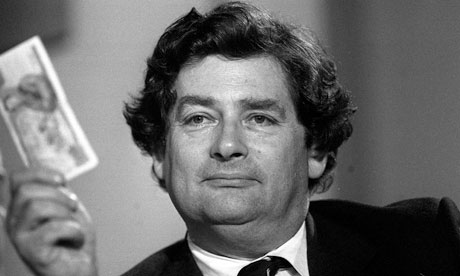 [/img]
One of a multitude of things he will have to answer for come the glorious revolution, comrades 👿
Yes the rate move was a big part of the price decline. As for the world crash, I wouldn't use that then or or now. Irish property is still down 50% versus 2007 whilst UK is now higher in many places. I think a better word is "correction".
This tosser....
I thought the accepted defence was "worldwide financial crisis"?
Or does that defence only apply to them what ended boom and bust? 😉
It's an interesting facet of bubbles and the period before crashes which is that lots of people say 'it's different this time' which is what some people are saying about the current dip in prices - especially in London.
http://en.m.wikipedia.org/wiki/Extraordinary_Popular_Delusions_and_the_Madness_of_Crowds
Ninfan - financial incompetence seems to be territory that both main political parties share equally, unfortunately. But I don't think we can blame Gordon for 1989. Though no doubt George Osbourne would make a case against him 😉
We had a 100% mortgage that went to nearly 17% , I was a hod carrier for Bryant homes at the time -layed off and we ended up having to take 2 lodgers in just to survive . Not a good time 👿
My memory says it was something to do with mortgage tax relief changes but I'm happy to be rubbished on this one.
I remember sitting on the stairs with head in hands over the 15% plus rates being the Black Wednesday ERM debacle in 1992 and Lamont.
Can't recall what they were in 89, I know we'd bought the year before and it not being such a thing.
Rates (bank base) in the 70's were also up in that region
mortgage tax relief - Yes I think that was a trigger
Mudshark - that review of news headlines is interesting - we're seeing exactly the same again - as sentiment has gone bearish and the figures are published which prove that demand is falling away and prices are dropping - certain vested interests either comment in very vague terms that 'this is a slowdown' or 'price rises are easing temporarily' or 'growth of xx% forecast over the next xx years'
A bit of googling shows that hedge funds are all shorting stocks related to housing - e.g. Foxtons, Rightmove (they have to publish particularly large short positions that they take)
Plus, Foxtons share price has dropped from 399p in Feb to 165p in Sept - and the private equity firm who bought them sold 50% of its stake.
So very clever people who spend their days getting rich on speculation and investment are expecting prices to fall, not rise, which is in opposition to press releases from estate agents and mortgage lenders who stand to lose - the same trick they tried in 1989
I remember immediately after that crash the Head of the Bank of England stating publicly that they would never allow such a thing to happen again. I wonder if they still regards that as their policy.
I believe it was caused by me buying my first house, sinking a whole heap of overtime into it as equity. At the age of 20. And losing the whole ****ing lot when I had to move down south for work.
Luckily, I moved back north under the governance of the mighty messiahs Blair and Brown, made a heap on the house in Sussex, managed to buy up here before prices went daft again, and as of last week I'm mortgage free.
The irony is that the Tories destroy the housing market and Labour got me all my money back. Who'd have thought, eh?
It's an interesting facet of bubbles and the period before crashes which is that lots of people say 'it's different this time'
It probably is. The results may or may not be the same though!
lets face it.
you will never buy a house brooess as prices will always be going to get lower in your mind.
not seen evidence of a crash or even a slump yet....
how ever i expect a knock on shortly as the big boys are streamlining operations.
They abolished joint mortgage tax relief and advertised it in advance. As a result there was a surge of demand in an already overheated market that, once the tax change came in, resulted in the botom tier of demand being kicked out of the market with a resultant crash.
There were other factors but that started it off.
I had the combo of a low start mortgage, negative equity and crappy endowment policy that impacted my finances for at least 15 years. Having said that, i'd still rather be buying in the market as it was then than now.
TrailRat - you're kindof right. Basically I'm struggling to afford to buy anything at current prices, and neither can a lot of people...There is however a lot of evidence of falling prices (in London at least) if you track asking prices on Rightmove, and selling prices on Land Registry...
They abolished joint mortgage tax relief and advertised it in advance. As a result there was a surge of demand in an already overheated market that, once the tax change came in, resulted in the botom tier of demand being kicked out of the market with a resultant crash.
This is kind of what happened in London last year - prices hadn't dropped since 2008 but no-one was buying. Help to Buy led to a surge in demand, which has driven up prices beyond the reach of all but the very wealthy, leading to a sudden halt in demand as there's hardly anyone who can get the sums together to buy, especially now lending is being restricted...
Houses are not moving around our way i.e. Northants. Market has been stagnant for months on end, even estate agents are admitting it. We're looking at moving up, but no joy selling and nothing interesting to buy. Pretty much given up looking for the time being. Certainly no housing boom happening here, but I notice developers are building more at the moment. Quite a few new estates popping up.
I just got a new mortgage deal this week.
I bought the house in the SE just over 2 years ago.
I was worried about getting the "loan to value" down to where the good deals are.
I needn't of worried, they price index system reckoned it had increased by 20%.
No down turn around here then? Is it ever going to stop?
House prices increasing like that don't help many. The people who really seem to gain are those people, from a family with only 1 or 2 kids, who inherit the family home, which is now worth a fortune.
@brooess, the performance of Foxtons is driven by fees (ie turnover) not house prices. Foxton's shares have fallen as turnover is down markedly. Yes, there is a correlation between turnover and price, ie a rising market tends to have more turnover but that's secondary.
@slowoldgit - it's daft the BoE making statements like "we won't let that happen again", they cannot absolutely control the markets. i would be willing to bet they didn't actually say that.
But that's what I remember hearing.
As I recall, you can (or could, maybe it's different this time) show a correlation between average house prices and average income - I think the multiple was 2.5 to 3, which would tie in with mortgage multiples at 3.25, but I could be wrong.
Whenever that had been stretched previously it was followed by inflation, particularly but not exclusively wage inflation, which corrected the multiple until it became affordable.
But the ERM effectively meant governments had to take action to control inflation so the correction could only be by house price reduction low wage inflation has also generally been seen as a good thing by Conservative governments. A bubble pre-MIRAS changes didn't help.
Now prices have been very high for a long time, possibly explained by low interest rates and relatively low supply of housing stock, but the conditions look about right for a correction...
Nigel Lawson is an anagram of We all sign on!
oh they do IGM ... but the powers that be wont let that happen till after the election..... and who ever gets in will blame the whole mess on those that were in power before....
Couldn't pin it on one single thing, but the three or four years before it i was working 70+ hours a week and banging all the extra cash on the mortgage, by the time the crash hit we were mortgage free.
Then like a daft **** moved house and started all over again.
Through the late eighties the government made house ownership more fashionable and 'the thing to do'. In the same period the lenders fuelled the rises by drastically raising the multiples of buyer's incomes they were willing to lend and coming up with ridiculous deals such as 105% mortgages and deferred interest that meant your loan increased over the first few years on the assumption that the value of your house would continue to rise ahead of it. I worked with several people at the time who bought back street terraced houses in Swindon for £20000 and sold them less than a year later for £40000. That sort of thing was happening in ripples emanating from London. That was when mega-commutes of 100 miles or more started to become more normal.
The following crash was a result of high interest rates and job losses. Then because house prices had dropped so drastically even people who could afford their mortgages started defaulting and walking away to buy elsewhere as it was cheaper than selling their house for far less than they owed on it. Some people were chased by their lenders, a lot got away with it. In '91 a girlfriend bought a studio for £22000 that had previously been sold for £50000. 6 out of 12 in that block had been reposessed within 3 years of it being built.
In the current climate there are too many folks now clued up as to the investment potential of property for there to ever be another crash like the early nineties. As soon as there is a small drop they will be rushing in to pick up a bargain.
It was too much cheap money. Inflation was taking off and Lawson over extended the money supply, so then had to reign it all back in by upping interest rates.
In the current climate there are too many folks now clued up as to the investment potential of property for there to ever be another crash like the early nineties.
Five years ago approximately one million people were affected by negative equity. The fact that it was less than the 1.6 million of the early nineties has less imo to do with "too many folks now clued up" and a lot more to do with the levels of unemployment ...... unemployment, irregular work, and stagnant/falling incomes, affects people's ability to secure mortgages.
And the reason that despite the worse economic crises since the 1930s for the considerably lower unemployment levels than the early nineties ? Because of government policies ..... stimulating demand and expanding the public sector as the private sector severely contracted. The private sector certainly didn't come to the rescue.
It's worth reminding people when they whinge about the last Labour government a likely reason why they didn't lose their jobs and their homes.
[img] 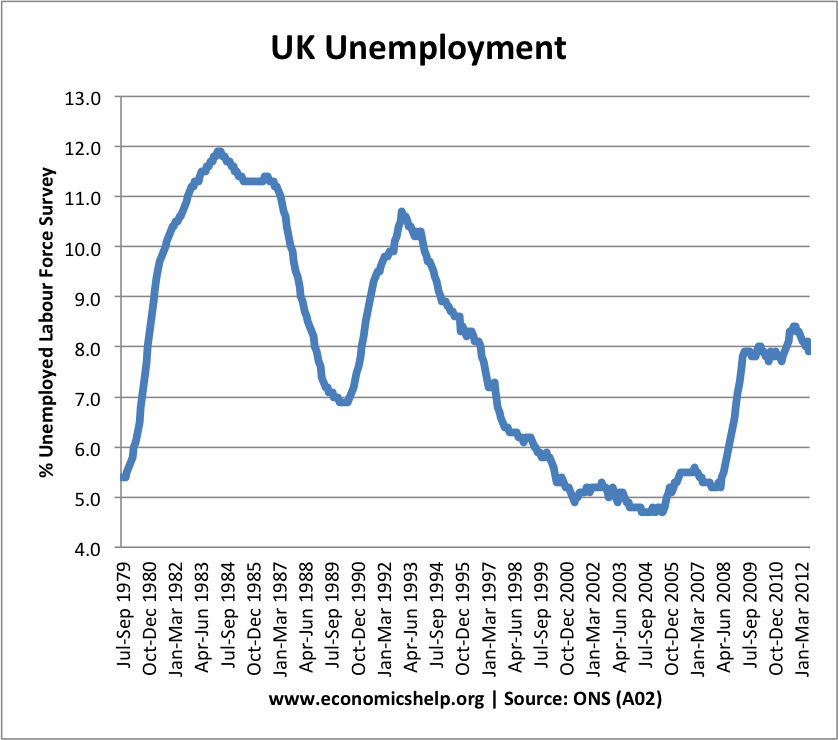 [/img]
During 13 years of New Labour in power the only thing which truly impressed me was Gordon Brown's and Alistair Darling's handling of the global economic crises.
Mind you US Republican president George Bush followed simular policies. For a while it was a case of [url= http://en.wikipedia.org/wiki/We_are_all_Keynesians_now ]We are all Keynesians now.[/url]
jambalaya - Member
Yes the rate move was a big part of the price decline. As for the world crash, I wouldn't use that then or or now. Irish property is still down 50% versus 2007 whilst UK is now higher in many places. I think a better word is "correction".
I think a better question is; why do we allow the artificial over inflation of house prices. homes are one thing I would restrict profiteering on.
The shockwaves from the October 1987 stock market were still rippling through the economy. Any time when lenders will offer 5X joint income loans you can be certain another property slump is bound to follow. And the "we're all too clued-up to let prices fall - we'll Buy the Dip!" argument? Perleeaze!... That could've been said in 2006. We all should be much wiser but seemingly there are still some True Believers out there... P.T Barnum was indeed right...
Oh dear oh dear. Housing is impacted primarily by supply and demand. We are a growing population and demographic factors more people are divorcing and living alone after are affecting. It is also much easier to borrow money today than it was 50 years ago, my parents had to wait in a mortgage queue having saved with a specific building society for a number of years. However that sort of restriction on credit would be politically impossible now even if it would avert the sort of financial crises we say in 2008 ever happening again.
What I would advocate is a Singapore style system where government builds affordable housing available to citizens plus we need to rebuild our social/council housing stock.
@ohno - 5x income with interest rates above 10% is very different to the situation today. Loans are now made on the basis of affordability, ie post tax income versus mortgage payments.
FWIW house prices are now way above the levels of 1989, hence my use of the word correction
What caused the 1989 house price crash?
I'm sorry, it was me, I wanted to get on the housing ladder at a young age, bought into the hype at the time and then lost 25% of the value when my relationship broke up and needed to sell up.
Then spent another several years paying back the neg equity with my next mortgage, causing financial problems for me and my (next) partner which helped that relationship break down too.
Thanks 80's housing boom, you set me up for life.
However that sort of restriction on credit would be politically impossible now even if it would avert the sort of financial crises we say in 2008 ever happening again.
Have you got some sort of evidence to back up that claim or is it just a hunch ?
If people are willing to accept ideologically motivated spending cuts packaged as "austerity measures", or "difficult decisions" as politicians like to describe unpopular policies, then it is perfectly feasible that they would accept and recognize the benefits of credit controls to cool down an overheated housing market.
Ah 1989, 5 years into our mortgage and child number 3 on the way. Can't seem to remember much about it, probably because I was working every extra hour available. 🙁
If people are willing to accept ideologically motivated spending cuts packaged as "austerity measures"
No one is silly enough to believe that surely?
Intervention into in markets such as housing, interest rates, lending, FX have caused more problems than they have solved.
UK house Price-earnings ratio higher than in 1989 now - heaven help us if the Tories stop fixing IR artificially low and messing about with the housing market. * But lemmings love to follow bubbles.
* mortgage payments / income well below average since early 80s
Intervention will never happen directly but the memory of what happened back in 89 etc. must also weigh heavily with people as they continue to prop up the housing market. The number of people who now own houses and have borrowed heavily to do that makes it unpalatable to let prices drop too far.
No one is silly enough to believe that surely?
Oh look, THM rolls in with his usual arrogant and patronizing persona.
David Cameron himself made it very clear only a couple of days ago that the "austerity measures" are not just about deficit reduction but an ideological and [u]permanent[/u] commitment.
[url= http://www.huffingtonpost.co.uk/2013/11/12/david-cameron-austerity_n_4258733.html ]David Cameron Says Austerity And 'Leaner State' Should Be 'Permanent'[/url]
A "fundamental culture change", as he calls it, proves that it is an ideological commitment, not simply a commitment to reduce the deficit.
Presumably you think that David Cameron is lying THM, if according to you anyone who believes that the austerity measures will be permanent is being "silly" ?
I reckon DC is pretty silly so....
Oh look, EL rolls in with his usual incorrect analysis/spin
FTFY - the first version was a little pot and kettle.
DC lying? (Although tbc, did he use the word austerity?)
Of course he is. Pretty silly if folk don't spot that too. Tax cuts coming.... yes right!?!??As the FT has been analysing all week, despite all the austerity headlines, we are barely half way through the cuts that they (the Tories) believe are required. They haven't even started on the tough stuff yet. Even the insiders are puzzled by the tax cuts stuff. So make your own mind up if he is lying or just being silly himself. So if this is, as you claim, ideologically driven, then they are very weak followers of said ideology. But you only have to look around the world to see that this has bugger all to do with ideology, that is just (surprise, surprise) spin. But then again if you think GB had a good financial crisis then you are obviously keen on spin. And darling too????? Rabbits and headlights spring to mind more than "good crisis."

