thank you for both denying and proving my point in only 8 word
You spanner.
People relocating their families for permanently and for generations is absolutely opposite to what we are talking about in terms of personal mobility. I suppose you consider Jews escaping pre WWII Europe as an increase in international tourism too? 😆
Except you can't get fast broadband out here in the country
Way the heck easier and cheaper to install BB to rural areas though than to provide transport infrastructure. Plus it makes a lot more sense to move around people's information at 10% the speed of light than chug them around at 40mph doesn't it?
to claim it would lead to the dark ages
If that's a reference to my comment about the [i]middle[/i] ages, it was clearly only a reference point for a static population, rather than a suggestion we'd return wholesale to that level of social development.
I'm 48, and only 2 generations on from a period before widespread car use - I can remember the tail end of this period as a child. We had relatives dispersed in other parts of the UK that I rarely saw, and visiting my grandparents at the other side of the city was a rare treat. The level of social mobility we have now is a recent phenomenon, but now that genie is out of the bottle, I'm not sure how you get it back in?
Way the heck easier and cheaper to install BB to rural areas though than to provide transport infrastructure.
But BT and Virgin don't provide transport infrastructure, so that's not an financial decision they have to make - for them it's a simple question of "is it worth the financial outlay of the engineering work to lay cable that far from Glasgow" - as the answer is "no", then they've told us it's not going to happen in any timescale they're currently working to.
If we lived in a planned economy, then the bigger questions of economic necessity might be asked, but that's not the government people voted for...
I'm interested to hear more about the places in the world where [b]people commute from the country each day [/b]without and significant reliance on cars
You're still not getting it. Things go to where we are by adapting over time; things are going to have to adapt over time again. One of the things that might have to change is people driving long distances every day to and from work relatively cheaply; either an alternative means of transport exists or is developed; or we pay more for the journeys for which there is no alternative; or we change the way we live, work and travel.
I suppose you consider Jews escaping pre WWII Europe as an increase in international tourism too?
lol!
loving the comparison of [s]evidence[/s] assumptions from completely different historical contexts to prove a point 😆
You're still not getting it.
Oh I do - I'm not arguing your point about the need for change. You said it happens in other parts of the world, and I asked you for an example - it's not that complicated a question, assuming you had an example in mind when you made the comment.
We had relatives dispersed in other parts of the UK that I rarely saw, and visiting my grandparents at the other side of the city was a rare treat. The level of social mobility we have now is a recent phenomenon, but now that genie is out of the bottle, I'm not sure how you get it back in?
"Social mobility" doesn't mean what you think it means. It has nothing to do with how often you see your relatives because they don't live in the same place.
In sociology and economics, as well as in common political discourse, social mobility refers to the degree to which an individual's or group's status is able to change in terms of position in the social hierarchy. To this extent it most commonly refers to material wealth and the ability of an agent to move up the class system. Such a change may be described as "vertical mobility," in contrast to a more general change in position ("horizontal mobility").[1] Mobility is enabled to a varying and debatable extent by economic capital, cultural capital (such as higher education or an authoritative accent), human capital (such as competence and effort in labour), social capital (such as support from one's social network), physical capital (such as ownership of tools, or the 'means of production'), and symbolic capital (such as the worth of an official title, status class, celebrity, etc). Many of these factors, however, ultimately remain intertwined with economic capital. In modern nation states, policy issues such as welfare, education and public transport exercise influence. In other societies religious affiliation, caste membership, or simple geography may be of central importance. The extent to which a nation is open and meritocratic is fundamental: a society in which traditional or religious caste systems dominate is unlikely to present the opportunity for social mobility.
http://en.wikipedia.org/wiki/Social_mobility
By the way, if you saw your grandparents who lived across town "rarely" in the 60s and 70s, it was because your parents didn't like them very much. You're not that old!
I think people have got social mobility confused with personal mobility. That's what the original thread was about. Social mobility has little to do with diesel prices.
Ditch_jockey - don't the govt have a programme for rolling out broadband to rural areas? Presumably through means of subsidies?
"Social mobility" doesn't mean what you think it means.
It does, but you're correct in pointing out I didn't use it correctly in the context it appeared. It's the peril of typing quick responses under an anonymous username on the internet, rather than preparing a submission for peer review under my real name!
As to you other point - my parents and grandparents are all dead now, so I can't go back and verify your allegation. My point, which I probably didn't make very clear, was that regular car use for domestic purposes was something that became a feature of our family life well into my parent's generation - my first long car journey was from Aberdeen to Glasgow when I was around 12years old, and I saw it as a major adventure. Nowadays, I'd think nothing of jumping in the car and driving to Aberdeen and back in a day to visit some of my remaining elderly relatives (who may also not like me very much 😆 ).
However, I do think there is a correlation between the increasing use of cars as part of the [i]democratisation of luxury[/i] and the realities of social mobility in the UK, but that connection wasn't very clear in my original post - apologies!
don't the govt have a programme for rolling out broadband to rural areas?
I believe so, although it seems more targeted at properly rural areas like Buttend of Nowhere, Sutherland, rather than a commuter village 15 miles outside Glasgow. We've spoken to BT, who basically told us "tough luck".
I don't see any political will for bringing about the changes necessary to shift our relationship to private car use - our village is currently fighting a planning app from Bellway who are looking to plant over 200 'affordable' houses in land currently designated as greenbelt. That's going to put 200 more families into a situation where they're dependent on private car use to go to work and pay their mortgages. East Dunbartonshire council are totally opposed, but apparently the current planning regs mean the decision is taken by some nameless bod in an office in Edinburgh! Situations like this do tend to subvert people's willingness to listen to arguments about reducing our dependence on fossil fuel by lowering car use, when the government's own decision making is adding to the problem, rather than contributing solutions.
I'm also not sure we'll get anywhere if we continue to have discussions about mass transport, broadband etc in separate silos - private enterprise driven by profit doesn't have the motivation to sort this, so it will have to come from elsewhere.
Agree with you 100% DJ.
If only we had PR, then we might have a few Green MPs in Government. Then you could give them jobs like Minister for Sustainable Working and let them get on with it - where they have all the contacts, the ideas and the desire.
1979-1980 was a bit of an aberration in terms of historical oil prices due to Iran-Iraq kick off.
[img] 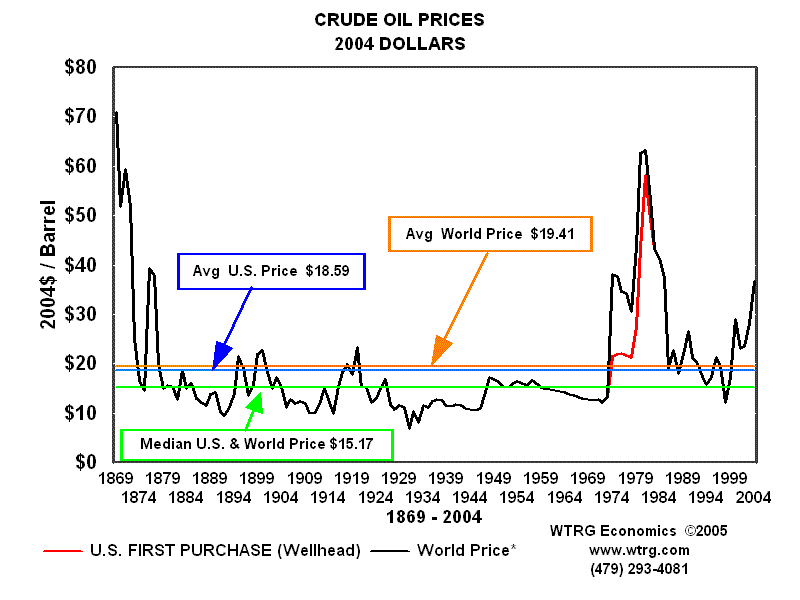 [/img]

You spanner.People relocating their families for permanently and for generations is absolutely opposite to what we are talking about in terms of personal mobility. I suppose you consider Jews escaping pre WWII Europe as an increase in international tourism too?
well one of the most amusing uses of Goodwin ..chapeau. I suggest you reread the thread
I was not talking about personal mobility I was replying to someone else about population mobility. Paradoxically you do accept that populations did indeed move but and insist I am wrong on this. Personal mobility and social mobility are not issues that I have been directly commenting on.Next time I advising you to do the welding and calling the darwin awards 😉my point is that we had population mobility without cars
And what about the fact that wages have not followed inflation?
Good point - IIRC they've done rather better than inflation since 1980. Based on figures [url= http://news.bbc.co.uk/1/hi/business/593477.stm ]here[/url] average wage in 1980 was £5720. From the first link, fuel cost in the Cortina for 12,000 miles at year at 27mpg and 28p a litre was £565.74, or 9.9% of the average wage. Given the current average salary of £25900, the Mondeo fuel bill of £2081 is only 8% of that, proving motoring has got cheaper in real terms relative to wages. That was the point you were trying to prove, coffeeking?
These days you'd be lucky not to spend half the annual fuel costs in insurance alone
Speak for yourself, mine is a lot less than that, and less in actual (let alone real) terms than it was in 1989. The question has to be though, if insurance really is the big issue nowadays why didn't everybody go and blockade the insurance offices (or maybe Lloyds of London) rather than the oil depots? Or ask the Chancellor to leave fuel duty alone and cut tax on insurance instead?
I was not talking about personal mobility I was replying to someone else about population mobility.
Eh what? You're weird sometimes. As if personal transport would apply in any way to population migration.. odd. I'd have thought it glaringly obvious what I was talking about. But you can't take much for granted when arguing with some folk eh? 🙂
Oh and how are those inflation figures calcualted? Since the price of fuel is intrinsically linked to the price of a large number of goods (transport costs) it's not accurate to use the general inflation figures to adjust fuel prices...
Speak for yourself, mine is a lot less than that, and less in actual (let alone real) terms than it was in 1989
Are you older? Do you have more no claims?
You're weird sometimes
Only sometimes 🙄
I'd have thought it glaringly obvious what I was talking about
I am not even sure it is to you sometimes 😆
Why do some people find this simple concept so hard to understand?
Its not forced urbanisation. Its not about pricing people out of transport before putting alternatives in place. its not about punitive measures.
The profligate energy use for cheap personal transpoort in cars will become more and more expensive as oil will runout.
We have two choices - wait to be forced to act or prepare for this change. It has only been since the 60s that cheap cars were available, the change in society took 50 years. I suggest to change to a less energy intensive transport system will take 25 years.
So if we want to make this change in a planned and orderly way it has costs. I suggest that raising this money from private motoring will provide impetus and also is fair as personal motoring receives huge subsidy .
So slowly rack up the cost of motoring using the revenue gained to improve public transport. The more peoplethatuse public transport the more viable it is. This is why in the victorian era we had a far bigger rail network than we do now. So use the money raised from motoring taxation to subsidise public transport making it faster, cheaper and more convenient. More folk will use it thus less subsidy is required thus freeing up more money to develop public transport further.
Teh increased transport costs will also make the long car commute less viable driving down the cost of rural housing ( thus allowing rural workers to live in these villages) and will also make village shops more viable reducing another driver of car usage.
A village of a few thousand folk all using cars - public transport as a profit making venture is not viable. But provide cheap efficient public transport at the same time as motoring costs rise will encourage people onto public transport. Tehen as more folk us the public transport it needs less subsidy
other areas to help reduce our dependence on the car are such things as rural broadband, internet shopping, supermarket deliveries and so on
I am not advocating a year zero solution. I am advocating planning for and minimising the effects of an inevitable ever rising energy and motoring costs.
I believe this should occur over 25 years.
As for place that do this already. Try the Netherlands or Denmark
The Netherlands took a decision in the 70s to encourage bicycle use as it was reducing and traffic congestion increasing. This policy has meant ever increasing numbers of people cycling since the 70s. Denmark has IIRC nearly 50% of commuter journeys by bike. Both countries have integrated public transport systems that are efficient.
Transport policies can make huge differences to the way people do things over long timespans
I merely want us to approach the inevitable end of cheap personal transport in private cars in a methodical and planned manner
Teh scaremongering and bleating of those addicted to their cars is laughable. What do you expect to do when the oil runs out? If we wait until we are foced to act it will be too late
TJ - sorry to take so long to get back to you. I've just had a rethink. My wife gets free fuel, so our lifestyle is safe. Perhaps.
Lifestyle is an interesting word though. Both educated to Masters level in different fields, we can't easily work close by each other - and we both want to work. And there is no train between the two points that we could use without a similar ride before we got on it (30 miles each, each way) - not your point I know but someone said it.
I'm amazed no one mentioned hydrogen cars - pleased though, as the smart money says they don't work in the real world (hydrogen plumbing and storage is notoriously difficult).
Electric cars now, hmmm... now that's interesting. Someone was saying they are years away - well possibly for the mass market, but we're installing the charging points now (not many in yet but there'll be a lot more next year). Also it's looking like the electricity grid will require a good take up of electric cars for balancing purposes (otherwise your broadband might work, but your computer won't). So a lot of people have a lot riding on that one.
The predictions game is always difficult and even as a reasonably senior guy in the electricity game paid to write papers on these sorts of predictions, I certainly get more wrong than I get right.
However I will make one prediction. The human race so far has proven itself to be surprisingly adaptable, and I bet we will adapt. Same is true of rats of course.
Are you older? Do you have more no claims?
Well yeah, but even if I add my current insurance cost and my current VED to the £2081 for fuel it still doesn't make it to £2560 (9.9% of the average wage), hence my motoring is cheaper in real terms indexed against wages than it would have been in 1980 even if insurance was free then.
eh scaremongering and bleating of those addicted to their cars is laughable.
You know TJ, we were having a civilised conversation about this until you wandered along with what appears to be your stock in trade denigration of people who you neither know, or really understand. In real life, you may well be the reasonable, personable chap that people like Druidh affirm you are, but on here, you consistently come across as a total dobber.
If you actually took the time to comprehend the conversation above, you'll find there's general assent to the notion that we need to adapt our lifestyle to the realities of a finite supply of oil. The discussion has centred more around the current policy realities which [i]don't[/i] encourage alternative forms of transport. Your own example of the Netherlands makes the point that commuting by bike was encouraged at the policy level.
My point is simple enough - unless the political will exists to make it viable, people simply can't make the changes required without changes which will, for some, be unacceptably disruptive to their existing patterns of living. This is not just about being personally inconvenienced - it's about the unwillingness of other key decision makers, like employers, to accept these changes as well.
On a personal level, my wife's employers are a good example - she's demonstrated the ability to be highly productive on the rare occasion she's been forced to work from home, but they still won't sanction it on a regular basis. They're a global company, who use the internet to service their customers across national boundaries, but they still want her sitting in their office in Glasgow when she talks online to people in the US and Europe. They have no facility for bike storage at their city centre offices, and no changing facilities, so it's difficult for her to commute by bike. wherever possible, she travels by bus or train, but if there's any disruption to the already basic service, we have no choice but to get the car out.
If you want progress on this, then 'bleating' on here won't effect meaningful change - you need to engage with the people who make policy and influence them. Get them to think beyond the silos of their specific remits and you'll make a significant step forward in achieving your aspirations.
Ditch jockey - some folk might have been having a civilised conversion. However some just have their head stuck in the sand or attack the messenger such as
ditch_jockey - MemberWhat TJ is proposing, although he may not realise it, is the urbanisation of almost the entire global population. ................, living in vast shanty towns like Kibera. Having been there, it's not a prospect I relish in the same way as TJ.
I have not proposed anything like that nor is that implicit.
igm - MemberTJ - Nice theory on pushing us to public transport, but my wife's job and mine are around 60 mile apart. I suppose we could cycle (and do the TdF for light relief) but I think it actually make one of us unemployed or we only see each other at the weekends (and likewise our sons for one of us)
Or this - someone who refuses to see that their actions are unsustainable and who will not countenance any alternative
People are addicted to their cars and refuse to countenance any alternative to them. LIke this
That's not a very social policy though is it? It'll make a lot of people very depressed and miserable as they struggle to adapt. It's the policy of the breadline again - if you make things people want progressively more expensive people will only change when they absolutely cannot afford it any more, which means that most people will be hovering around that threshold ie be strapped for cash all the time.And in this case you have the additional issue that it's often very difficult for people to move. You're forcing them to either a) take a crappier job and/or b) move away from their friends or family, both of which can have serious negative implications for quality of life.
It's all stick, no carrot. I think it's much better to provide incentive for change by making the alternative better in real terms FIRST, not just making it appear better by making the original worse.
People will have to give up their cars and easily availanble cheap personal transpotrt. This is inevitabvle
However on this thread as on may other on here people will make any excuse that the slightest compromise for them is impossible and nothing must interfere with their right to cheap personal transport
TJ - I wouldn't have this forum without you. I sometimes agree with you sometimes disagree, but unlike some others I would say that most of the time you come across as reasonably intelligent and always passionate about your chosen subjects.
However, and you knew there was a however coming, I think you are crediting me with views I do not have - or at least have not espoused in this thread.
igm - Member
[i]TJ - Nice theory on pushing us to public transport, but my wife's job and mine are around 60 mile apart. I suppose we could cycle (and do the TdF for light relief) but I think it actually make one of us unemployed or we only see each other at the weekends (and likewise our sons for one of us)[/i][b]Or this - someone who refuses to see that their actions are unsustainable and who will not countenance any alternative[/b]
I am pointing out the options that would be realistic to my wife and I, given where our jobs are located (and current public transport - but we can't use improved public transport until after it exists; Catch 22) - and there are very few places in the country that do what I do to the level I do it; my wife might have a little more flexibility.
Now I am not you note excluding those options - merely highlighting them. And if I gave the impression that I don't like the options very much, then that is probably a fair reflection.
Will oil run out, yes.
Will we be able to run cars in their current form forever - no.
Has society got a reasonable answer to transport in Britain - as you say, and I agree, not yet.
But your statement on inevitability - well only death and taxes fall into that category.
And my arguments would have been more convincing if I had spell checked my first post.
hang on,
petrol cost 28p/litre in 1980.
just following inflation, that would be 79p today.
(plenty of online inflation calculator correctors available - i haven't cherry picked)
i've just checked, and petrol costs £1.35ish.
?
Now go and read the article.
i did thanks.
modern engines are definitely more efficient, burning less fuel. But modern cars weigh more, burning more fuel.
i could get 70mpg out of my Grandpa's old fiesta - which would be about 30years old if it was still going.
my mum's family went on a driving tour around europe about 50 years ago, she kept track of all the fuel and mileage, and their fully loaded morris traveller got 40-something mpg over the whole trip.
and a little more digging suggests that 1980 was a really expensive year for fuel, at $37/barrel, the price dropped pretty sharply after that, and didn't go as high until 2004.
(in 1978 it was $15, in 1982 it was $32 and falling, by 1986 it was down to $15 again, and it wobbled around the $15/20 price until 2003)
[url= http://www.inflationdata.com/inflation/inflation_rate/historical_oil_prices_table.asp ]data here[/url]
but, in contrast, fuel accounts for less than half of my annual driving costs, which isn't so bad...
i could get 70mpg out of my Grandpa's old fiesta
How? You can get 115mpg from a Prius if you are being silly about it.
she kept track of all the fuel and mileage, and their fully loaded morris traveller got 40-something mpg over the whole trip
Again nowt special. You can get 80-90mpg from a Polo nowadays and it's still stacks better. These cars are available, we just don't choose to buy them very often because we'd rather (and can afford to) pay the extra on fuel.
i bet you can't get 90mpg out of a polo once it's fully loaded and being driven over the alps...
(like what my mum did with her parents)
it'll probably drop to something closer to 40ish, give or take a bit.
all i'm trying to say (clearly badly) is that i'm not convinced there's a massive difference between old-car mpg numbers, and modern-car mpg numbers.
obviously depends a bit on the cars in question.
(modern cars are obviously better, what with crash protection, more space and comfort, etc.)
the 70mpg-fiesta was achieved on a not-rushing-home run from st agnes to sheffield, with a 7'6" mini-mal just about squeezed into the passenger seat.
i try not to complain about the price of petrol, it's only going to go up, and before we know it we'll be talking about the good old days when petrol was only £1.40/litre...
you should be just research it a bit more. Equaly sized modern engines are more econimical.i'm not convinced there's a massive difference between old-car mpg numbers, and modern-car mpg numbers
70 mpg from a 30 yr old Fiesta - assuming a 950 - unless you were doing 30 on a motorway I think 40-50 may be a more accurate claim having owned one of these. the current model with a 1.2 engine does 60 mpg ecxtar -urban so it has improved.
i bet you can't get 90mpg out of a polo once it's fully loaded and being driven over the alps
No? 80 I'm sure, if you factored in the journey down there. Even at 65mpg that'd be a 50% improvement on a similar sized car. I'm seeing 52-54mpg on winter diesel from my Passat on our weekend trips in the Alps right now, and not only is it not the Bluemotion version it's auto and the 2.0 140bhp version.
it'll probably drop to something closer to 40ish, give or take a bit.
Based on what? Pure guess work?
all i'm trying to say (clearly badly) is that i'm not convinced there's a massive difference between old-car mpg numbers, and modern-car mpg numbers.
And I am saying that there is. A full sized car that could do 70mpg was a total fantasy 30 years ago, today it's a reality. My point is that very economical cars are clearly available if you look for them, they are just not common because people are not buying them. People still think 45mpg is acceptable so they buy a faster/bigger car that'll do 45mpg, rather than going for more economy still. Which is relevant to the topic in some way 🙂
Btw I learned to drive in a 950cc Fiesta that was D reg so 1986, and it never did more than 40mpg.
i would suggest there's a little cherry picking going on.
i have personal experience (via my mum and her note-book in the case of the morris) of an old fiesta, and a morris traveller, these were hardly unusual cars of their day.
i shall leave it ... here.
see you in the next topic/bun fight!
🙂
i would suggest there's a little cherry picking going on.
Yes, but it's not by molgrips. Does your mum have figures for what the average speed of that trip was? Rather less than anybody would consider reasonable nowadays in cars which can go a lot faster - I'm sure if you did drive at those speeds it really wouldn't be that hard to average at least 70mpg in a suitable car.
dammit, i cracked, i'm a weak person, so soo me.
cherry picking: choosing 1980 as the year for comparison.
(it's exactly the same as choosing 1997/8 as a starting point, and then saying that global warming isn't happening)
fiesta: 1.6 diesel, 70mpg = easy.
(imagine putting a modern diesel engine in a car that light and simple - maybe it will happen when fuel prices actually start to bother us, rather than cause us to moan a bit)
awhiles - you are quite right. However there are good reasons for much of the weight gain, like safety.
My point (which is relevant to the thread and not about bickering) is that yes the technology exists to achieve maybe 80-100mpg in normal use but that comes with compromises that most people do not want to make. Which could indicate that fuel is not expensive enough. The problem is that people who need cheap fuel (ie the rural poor) also don't have the money to go out and shop for a modern eco mobile, which leaves them with few alternatives.
IIRC the development of diesel in passenger cars was as a direct result of the 70s oil crisis, when fuel economy suddenly mattered a lot more than it had done.
i think we're agreeing with each other...
blimey!
🙂
i do wonder what will happen to places like what where my parents live, as there are no jobs there, and surely the price of fuel has to be a consideration for people who might like to move there and commute (20miles each way to nearest job).
the old people die or get bundled into care homes, but few young working people want to move into a house they can't afford to commute from.
interesting times...
i do wonder what will happen to places like what where my parents live, as there are no jobs there
Rural depopulation has been happening since the industrial revolution, and I suspect that only the widespread use of the motor car has retarted it in recent decades. It was far worse at first, then it seems to have plateaued but who knows what'll happen if fuel gets very expensive.
My guess is that telecommuting will save the countryside but not its indigenous population... A lot of people already seem to run their businesses from small villages in London's hinterland, I reckon this has already massively altered the demographic of places like rural Surrey and Hampshire.
So use the money raised from motoring taxation to subsidise public transport
Erm, TJ, do you know how many billions the taxpayer actually subsidises the rail industry already? Bit harsh to paint cars are the total evil.
How much 'subsidy' does motoring actual have? The large percentage of fuel cost goes to the government already, plus insurances taxes and, of course, car tax.
So if we want to make this change in a planned and orderly way it has costs. I suggest that raising this money from private motoring will provide impetus and also is fair as personal motoring receives huge subsidy.
of course it's chicken and egg. No-one will commit to spending public money on public transport until people use it. People won't use it until it is viable. How to break out of that vicious circle is the problem. And hopefully will be done by education in some respects, even at school level if we have time for the next greener generation to come along.
Then again we're just doing the proverbial into the wind in this country when you realise India and China are just getting to points now where they all want cars to drive....
No-one will commit to spending public money on public transport until people use it. People won't use it until it is viable. How to break out of that vicious circle is the problem
The population density issue won't go away unfortunately. Viable public transport in many cases will never be profitable and is consequently going to be a huge burden on public finances.
private motoring gets huge subsidies from the public purse.
TJ - can you back up this claim with some figures please, I'm calling you on it because I think its utter bollocks!
breathesay.
Yes - massive subsidy. Each death costs a million pounds. All the deaths and ill health from pollution as well as in crashes.
The cost of enforcing motoring law
The value of the land used for roads and parking
The cost of local roads - paid for by council tax payers
The damage to buildings from vibration and from polution
And loads more
One set of calculations here
http://www.igreens.org.uk/great_road_transport_subsidy.htm
So, Rail does not impose any of those costs I presume?
No rail deaths, costing millions to investigate, public enquiries, things like that? Trains and buses cause no pollution I presume?
in fact, even your own later suggestion is contradictory:
I suggest that raising this money from private motoring will provide impetus and also is fair as personal motoring receives huge subsidy ....
... So use the money raised from motoring taxation to subsidise public transport
How can you do that? completely contradictory bullshit as usual! Private motoring raises about 30 billion quid a year for the exchequer, (fuel tax, VED, VAT on fuel and vehicle sales) it pays out a fraction of this in maintenance, and only a fraction on other costs.
Private motoring is a [b]massive[/b] net beneficiary for the treasury - in fact, although the money is not hypothecated, its fairly reasonable to claim that it pays for all the costs of public transportation subsidy (about five billion a year for the rail network alone) many times over!
zulu - pointless as it is to debate with you you simply are wrong. Private motoring costs far more than the money raised in motoring taxes. This is an absolute fact. When you include the total costs of motoring to the country.
Have a read of the link I just posted Motoring costs to the country are around 100 bn a year. So the subsidy is around 70 bm a year
But TJ, is that lot really all more than tax revenue? If you're going to be thorough about it, you have to include:
Fuel duty receipts
VED
VAT/tax on new cars and on spare parts
Economic contribution from car companies, car parts suppliers, garages, tax from their employees etc (I suspect this bit is absolutely massive, and the economy would have to do a hell of a lot of growing to take up that slack)
I struggle with long sentences in that badly worded and formated article, but what's that about 'true cost of car parking?'
EDIT after a further skim they seem to be counting the asset value of all the land used as roads. This is bloody ridiculous since even if there were no private cars you would not be able to rip them all up would you?
I like the idea of "absolute facts". Other people have facts. TJ has absolute facts.
TJ's article is 15 years old btw.
zulu - pointless as it is to debate with you you simply are wrong.
GAH!
It's stuff like this that makes you absoultely insufferable, TJ.
If he's wrong, all the more reason to debate with him, isn't it? He is rebutting your input, you rebut his. And I'm talking about constructive argument not simply repeating yourself:
TJ, earlier (on the right)
[img]  [/img]
And with that I bow out of this contentious argument again. Its simply pointless.
TJ what happened to the list of absolute facts that was there a moment ago?
I hope there's no Stalinist conspiracy to erase the truth going on.
TJ standard flounce 🙂
Flouncetastic! I consider my work here done, however if he bounces back, I [i]was[/i] going to say:
Private motoring costs far more than the money raised in motoring taxes. This is an absolute fact. When you include the total costs of motoring to the country.
But, you haven't included total revenues to the country of private motoring have you, you see if you want to play with ethereal "total costs" then you have to think about the effect of tourism on local areas, the effect of mental health of people being able to do stuff in their cars, like visiting family for example, you need to include the expansion of sports like mountain biking, since people use private motoring to go to trail centres and things - if you want to play the "total cost" then you cannot only include "money raised in motoring taxes" you have to compare it to "total beneficial value to the country of private motoring" which goes far, far beyond fuel duty and VAT
TJ, you might have been having an argument, but Molgrips and i were having an interesting discussion about the affect high and increasing fuel prices might have on rural populations.
as M-G pointed out, there was an exodus during the industrial revolution, for nearly similar reasons; mechanisation of farming meant that jobs dried up, forcing people to leave for the towns and the jobs, i hadn't thought of this...
and that's why i keep coming back to this place, cos of the interesting interactions with clever people like M-G, i can take his comments and put them in my head with my own thoughts and let them simmer nicely for a few hours while i attempt to do some work.
for example, during the industrial revolution, people left the countryside because there were fewer jobs, this time round people will be moving closer to the jobs they already have, or accepting less money to work close to home. or something.
so it's similar, but not the same. I'm not clever enough to foresee the implications of it all, but i'm sure someone will say something interesting and intelligent.
awhiles - on that one. We have a situation in fife where the urban workers live in the villages and commute to the towns and the rural workers live in the towns and commute to the villages. This is because the urban workers have priced the rural population out of the villages.
so actually a pricier commute will see a shift in the relative price of these homes allowing the rural worker to live in the villages again
Its simply pointless
Cos you made it that way by refusing to take anything on board that anyone else has said..!
Almost every single contributor on this forum ridicules the way you argue and your attitude on these threads. Surely that should tell you something?
🙂 awhiles.. likewise I come here to discuss and learn.
Molgrips - its pointless as no one listens and no on will have their mind changed.
I've had 4 pals recently take up or look seriously into cycling/motorbikes as a transport alternative. 5 years ago they would have thought of bikes as toys/daft/too much like hard work. One has even asked me about electric bikes.
I reckon change has started...slowly...but confidence is high.
Also TJ has only been wrong once and it wasn't even important. 😉
TandemJeremy - Member
Molgrips - its pointless as no one listens and no on will have their mind changed.
Brilliant 😉
FWIW, I fundamentally agree with you TJ, just your way of debating/discussing is so counter-productive that it's simply not worth getting involved and it's far funnier to poke fun. YMMV.
That's not the point though.
The point of threads like this is to raise issues that we may or may not have thought, [b]in a polite and respectful way[/b].
It's not a fight to force people to see the world the way you do.
Almost everyone else treats it this way, it's just you that marches in here and complains that no-one listens, when we ARE listening full well, but simply disagreeing. Like any good discussion we take your points and then reason forwards from them as part of an ongoing discussion.
What do you want us to do? "Yes sir Mr TJ sir, you are right of course!" All threads would be over on the first page.
there was an exodus during the industrial revolution, for nearly similar reasons; mechanisation of farming meant that jobs dried up, forcing people to leave for the towns and the jobs
That's not what happened. The major rural to urban migration took place [i]prior [/i]to the Industrial Revolution as a result of the enclosure of the commons and the shift from arable to livestock farming. Beer St/Gin Lane, transportation to America and Australia etc all began before the Industrial Revolution had had much of an effect.
What kind of mechanisation in agriculture was there before the 20th century anyway?
http://en.wikipedia.org/wiki/Enclosure
awhiles - on that one. We have a situation in fife where the urban workers live in the villages and commute to the towns and the rural workers live in the towns and commute to the villages. This is because the urban workers have priced the rural population out of the villages.so actually a pricier commute will see a shift in the relative price of these homes allowing the rural worker to live in the villages again
Or, alternatively, it will lead to the continuation of the, better paid, urban workers commute, and the closure of the rural firms, as their low value production is replaced by cheaper imports - cheaper food from abroad, cheaper timber imports etc.
So, maybe not as simplistic a calculation as you initially claim!
Molgrips - that is laughable coming from you. You have a very closed mind and I could point to many places where you simply have refused to even listen to points made.
It was pointed out to me by Druidh that [i]everyone [/i]comes to threads like this with their own fixed ideas and nothing will dissuade them from that position. Therefore the debate is pointless as it will not achieve anything as no one will change their mind.
I was a bit bored and allowed myself to get sucked into two contentious threads recently
It was foolish of me to do so thus I will back away from it.
You have a very closed mind and I could point to many places where you simply have refused to even listen to points made
I have a very open mind. Taking a position counter to yours does not mean a closed mind. You're often wrong or poorly informed (as am I) but you simply cannot handle the concept at all.
Since we're on the subject, I'd like to see some of these places please.
Therefore the debate is pointless as it will not achieve anything as no one will change their mind
THAT IS NOT THE POINT OF THESE THREADS OR THIS FORUM!
But, you haven't included total revenues to the country of private motoring have you, you see if you want to play with ethereal "total costs" then you have to think about the effect of tourism on local areas, the effect of mental health of people being able to do stuff in their cars, like visiting family for example, you need to include the expansion of sports like mountain biking, since people use private motoring to go to trail centres and things - if you want to play the "total cost" then you cannot only include "money raised in motoring taxes" you have to compare it to "total beneficial value to the country of private motoring" which goes far, far beyond fuel duty and VAT
If you want to do that, then you'd also have to take into account the negative effects too. The communities cut off and destroyed because they were on the wrong side of the motorway (ever heard the expression wrong side of the tracks? The same happens with large/busy roads). The additional stres and mental health issues caused by the congestion and stress of driving. The removal of tourism from local areas due to people travelling farther away.
There's no easy answer, I've had this debate many times and nobody has been able to say definitely one way or the other, so everyone stays convinced they're correct.
TJ is right, no one will be convinced they are wrong.
The major rural to urban migration took place prior to the Industrial Revolution
Ah yes.. Enclosure act. Interesting, but what did people do when they came to the city? The big growth of cities and towns was surely due to factories needing workers, wasn't it?
Molgrips this post is a classic example. You are argueing against things that are not a part of my proposals. You don't want to accept the case thus invent loads of nonsense to argue your side
i continually reiterate this change needs to be done over a generatation. thus all of your counter arguments are invalid. You claim its all stick no carrot. is cheap efficient public transport not a carrot?
molgrips - Memberratchet up the cost of motoring which in itself will slowly push change and use the money raised to subsidise public transport
That's not a very social policy though is it? It'll make a lot of people very depressed and miserable as they struggle to adapt. It's the policy of the breadline again - if you make things people want progressively more expensive people will only change when they absolutely cannot afford it any more, which means that most people will be hovering around that threshold ie be strapped for cash all the time.
And in this case you have the additional issue that it's often very difficult for people to move. You're forcing them to either a) take a crappier job and/or b) move away from their friends or family, both of which can have serious negative implications for quality of life.
It's all stick, no carrot. I think it's much better to provide incentive for change by making the alternative better in real terms FIRST, not just making it appear better by making the original worse.
I agree with everything you say about the problem, I just don't agree with that particular solution.
And there are also inherent problems with public transport. The feasibility of public transport depends on population density. Densely populated areas are already pretty well served, and it'd be (relatively) easy to lay on more busses or increase train capacity etc. However for the more lightly populated areas it becomes EXPONENTIALLY more expensive to cover fewer and fewer people. So there is a practical limit on who can be covered even with big subsidies.
what did people do when they came to the city
Mostly they sat around and waited for the Industrial Revolution...
Peyote - I agree, you have to include [b]both[/b] sides, which was my point - the calculation of "total costs" and "total benefits" is so wildly complex so as to be little more than guesswork.
Molgrips this post is a classic example. You are argueing against things that are not a part of my proposals
Hang on - my posts are not always directed at your posts - often directed at no-one in particular, rather the subject in general.
Thanks for quoting my post so I don't have to look for it.
I did say I agreed with you in principle, but I thought your solution was not very progressive.
If you'd have said something like "I think the negative impact would be acceptable if it was done over a long enough timescale" then I'd have agreed. I was simply voicing my concerns.
I'm not actually arguing against you in principle. My most recent disagreement with you on this thread is about the claim that the government subsidises private motoring. I'm sceptical about this, but fair enough - neither you nor I or really anyone else has incontrovertible facts about this since it's all so complicated.
I'm happy to discuss with you TJ but PLEASE be frigging reasonable and not go off at the deep end all the time with all the personal insults.
I do not have a closed mind, anyone who actually knows me well will agree.
[i]It was pointed out to me by Druidh that everyone comes to threads like this with their own fixed ideas and nothing will dissuade them from that position.[/i]
Well i disagree with both of you then. There are a number of threads i have read where they have made me think i may well not have the full picture. The good thing about these forums is you get people from all walks of life so you may be having a discussion on policing and you get policeman posting with their point of view. Not to say you simply have to accept but surely worth a listen ?
If you really believe that no one ever changes their mind then perhaps that is more a reflection on you than it is on others. You have one point of view but is it really inconceivable to you that you just might be wrong now and then or that others may have something to say you could learn from ?
Mind you, i do agree with much of what you say in this post, just not the way you say it 🙂
konabunny - MemberThe major rural to urban migration took place prior to the Industrial Revolution as a result of the enclosure of the commons and the shift from arable to livestock farming. Beer St/Gin Lane, transportation to America and Australia etc all began before the Industrial Revolution had had much of an effect.
What kind of mechanisation in agriculture was there before the 20th century anyway?
er, dunno? - you raise lots of interesting things for me to think about/do some homework on, thankyou!
🙂
Sorry - didn't mean to sound snippy (if I did, like usual!). The whole process was a lot more nasty and forceful than just country folks shrugging their shoulders and saying to each other, "well, there's not much for us to do here any more, I suppose we might as well go into town and get job at t'mill". You have a whole social system that is displaced from the land and the introduction of new property laws to stop landless people taking the bounty of the land, and that directly leads into the perception of lawlessness, and transportation, and the workhouse and bulging prisons, and the rise of sociology, penal reform etc etc...
It's really interesting. Actually Tony Robinson did a really good docco which covered all of this in 90 mins but I have no idea what it is called (think it was part of a series) bc I missed the start!