UPDATE: CLASSIFIEDS section refreshed, redesigned, searchable: Go take a look
14th of September ?
My 3.6kw inverter produced 10kwh
I'm 10 miles inland from bruneep
My roof is much steeper than his.
So as bruneep says the sun doth shine on Aberdeen.
My 3.6kw inverter produced 10kwh
So 33% less! (Steeper roof will help now also)
Given he has 30% more panel area than me it seems logical.
7.5kWp S and W array here with two inverters totalling 6.5kW, in Chester just like you sharkbait, and the best I've seen during August was w/c 8th Aug with 205kWh generated (I think that may be my best solar week this year) so 140kWh in September in Aberdeen is going some.
Edit: Just realised my second array was't connected until 1st Sep so that 205kwh was generated from a 5kWp array and 3.75 kW inverter. Maybe 140kWh could be possible in sunny Aberdeen
I have 3 quotes and I'm close to asking one of them to proceed but I have not looked into tariffs. I'll have a battery I'd like to charge overnight but with no EV I'm not eligible for EV tarrifs
I'm with Shell at the moment after previous supplier went bust.
If Octopus aren't taking new customers what options do I have?
Does anyone know or can they find out the lead times on either the Powerwall 2 or the new LG RESU 10h or 16h Primes?
I ordered my Powerwall 2 back in September 2021 with an April 2022 delivery date. This was postponed twice and the Powerwall was finally installed beginning of this month. I noted that Tesla sent a load of Powerwalls to the Ukraine and whilst it would be churlish to complain that may have had something to do with my delivery date getting pushed back. I seem to remember the LG RESU which was the other option was almost immediate delivery.
We are 100% electric and have a 10KW inverter and just over 13KW of panels. The roof is not optimal so the the base generation is spread out over more of the day and tends not to clip.
We are in Aus so generally a bit sunnier than good old Blighty and currently averaging about 40KWH over the last month which I expect to increase as the angles improve as we approach Summer. The major difference is we pay 22c per KWH and get 9c feed in so vastly different pricing to UK. I cant make a battery look viable here, as much as I would like one.
I'm in Warrington, about midway between trail-rat and sharkbait. On 14 September my main array (2.15kWp) generated 5.1kWh; so that's about 2.4kWh/kWp (or just 2.4h/p?). The 15kWh bruneep made would be 3.8h/p (if inverter limited), which is much better, but East coasts are often sunnier than West coasts.
does anyone know what the optimum angle of solar panels is from a money-saving perspective? It seems that (south of england) the optimum angle from a generation perspective is around 35-40 degrees, but if you don't have unlimited battery storage, most generators will be pushing at least some electricity back to the grid during the summer (so the value is extremely low) vs not consuming energy from the grid in the winter (so the value is high).
Is it theoretically better to mount the panels steeper than commonly thought so to optimise for generation in winter instead of during the summer? you'd get less generation overall in terms of kwh, but maybe a more valuable haul?
Is it theoretically better to mount the panels steeper than commonly thought so to optimise for generation in winter instead of during the summer? you’d get less generation overall in terms of kwh, but maybe a more valuable haul?
Mines are 55degeees.
This benifits me early and late in season - I am making about double the predicted for a standard (30-40deg) angle roof in march and September.... And I'm clipped in peak summer. I've been making 430kwh/AVE since march. If they were at less angle I'd make more in peak summer but less in the shoulder seasons
My old man has an 8kwh array half mounts due south at 45 degrees and the other half laid flat on a frame for prolonging summer generation for the pool infrastructure and the many showers guests take.
When he only had the 4kwh array his generation started to decline at 3pm - with the flat panels they decline at about 6pm
Given he has 30% more panel area than me it seems logical.
Not really when the inverters have the same maximum output.
I'll just leave this here for you to mull over
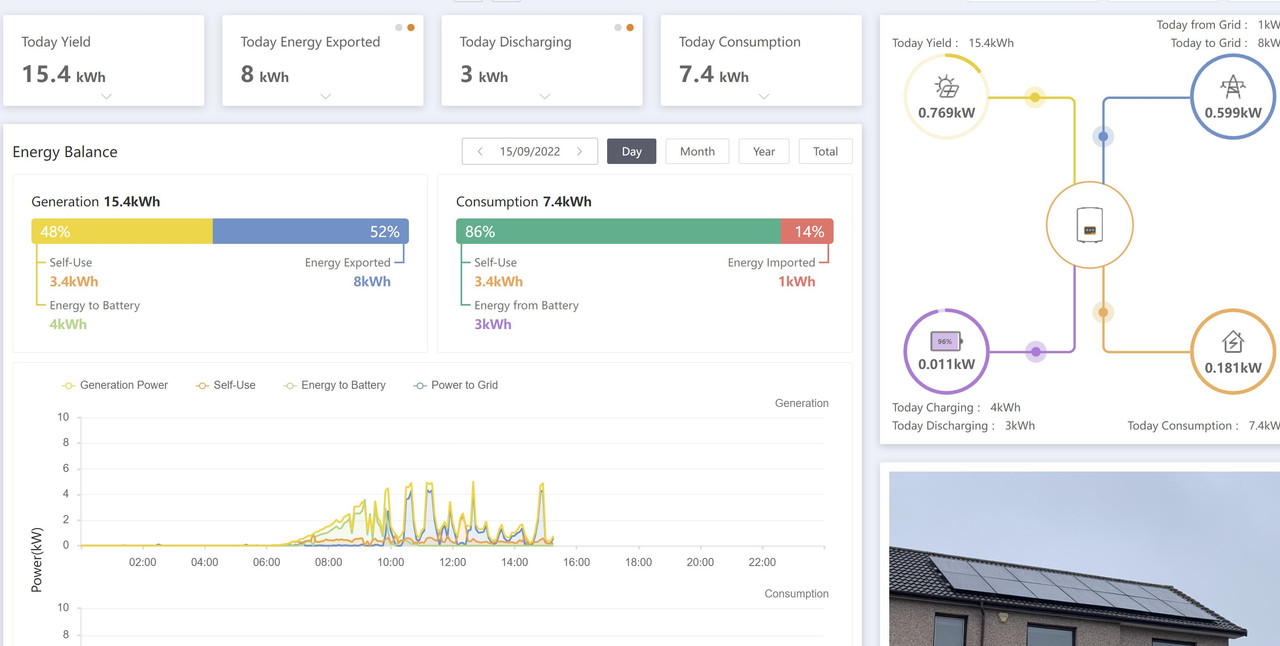
been a mix of sun and rain today, still happy the 5kw battery is charged up. Dishwasher been on and tea made for tonight.
Given he has 30% more panel area than me it seems logical.
Not really when the inverters have the same maximum output.
more panels providing a lower input due to solar capacity at any given time.
he has 30% more surface area collecting the lower quality sun light
its exactly how over sized east/west arrays work to provide peak power for a longer period..... The inverter only affects his peak output . he has a solis so he has a 7k peak input at 600v and and will clip peak output to 3.6K
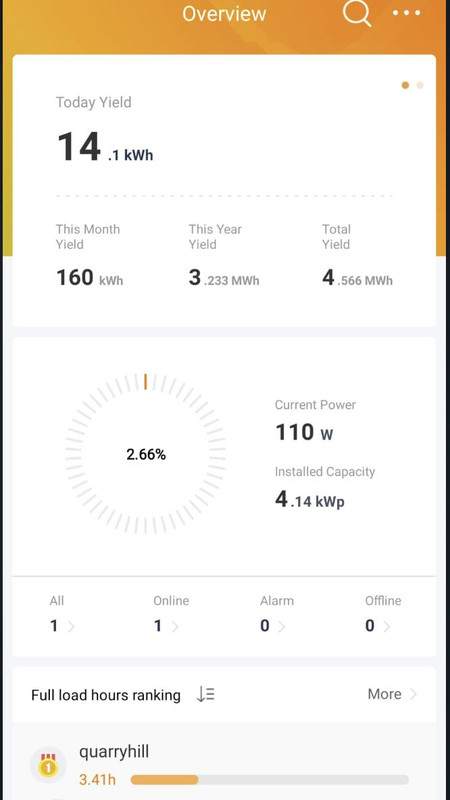
Interesting seeing everyone else's app readings for comparison to my system (still cant master the forum posting images thingy so cant show mine) but its very much entertaining my inner Nerd 🙂
Day 2 of my system running and the battery was at about 11% first thing. It was overcast for the start of the day but the solar panels have been working well and the battery was fully recharged by about 2:30pm.
My small-moderate-ish 10 panel system has yielded (is that right?) about 8kWh aginst a consumption of 6kWh (again, not sure if im reading things right...) so far today, the bit im so far intersted in is the generation/use vs what needs to be imported which is currently 67% from the system/battery against 33% from the grid. Thats pretty much what the survey estimated the system would give me on a normal day for the south coast so I'm pretty happy so far.
I need to let things run for a few weeks, sort out when to run the dishwasher and washing machine so it can use as much solar as poss (we tend to run the dishwasher late at night). SEG definatley needs to be sorted as the energy being exported to grid is not being paid for (will check Octopus for this) and the second battery will probably be added in the Spring when funds allow.
@bruneep Your graph appears to me to show that you were, at times, exporting 4kW. How is that possible with a 3.6kW inverter? I'm not saying you're wrong, I just don't understand.
I have just received a quote from GenFit
9 grand for 15 Longi all black panels + 15 SolarEdge optimizers + Invertor etc
Also includes a Zappi EV charger as I wanted to find out what it would cost to supply/fit at the same time, that may be removed as I don't have an EV car currently and not ordered one yet as I was hoping for more choice at not ridiculous prices as well as the utility price hikes making home charging a lot less inviting.
Details show annual estimated energy production to be 5.54 MWh and shows another small figure next to it of 4.53MWh. Will find out what that means.
Also how good are these estimates in terms of real world figures (ignoring weather). Placement on roof + some on garage roof seems about right based upon how the sun moves round but I have a 4 sided hip roof so panels won't all be getting sun at the same time. Again, I will raise this with them.
Price includes scaffolding and I have no idea if it's a good price or not. Very well laid out quote.
Will get 1 or 2 more.
^his export totals for the day are 8kwh, so about 2.5 hours worth of production if you look at it that way. Fwiw I can back up his figures as I’ve a similar set up. 12x385W JA Solar panels & 3.65kw inverter and getting similar daily figures (if not slightly less due to a. Less panels and b. Living in Glasgow).
Edit-ah yes, sorry just checked the graph, does seem a tad high given the inverter rating!
wookster
assiming that the company are MCS affiliated then the predictions are regulated by the MCS handbook
They cant just throw spurious numbers at it .
For me due to the aforementioned angle of my roof i am producing more than anticipated by the predictions due to the longer shoulders afforded by the higher angle panels.
Look at PVGIS and put your numbers in there to get your own figures for comparison.
How is that possible with a 3.6kW inverter?
I'm wondering if the figures being produced are for the power being generated by the panels - not what is actually sent out of the inverter.
If so that's a little bit crafty (you could have a load of panels producing, say, 7Kw but you'd still only get 3.6kW to use)
That's a good price @Wooksterbo.
The optimisers alone will be ~£1000, the panels around ~£2500, the inverter around £1500, the charger £800, + other materials @ £300-£500.
Totally naive question here, what's the longevity of panels, inverter, etc. Are they likely to fail before they've achieved payback?
@dooosuk Panels I got quoted for have 12 year product warranty and 25 year linear power output warranty.
The most likely thing to fail is the inverter and most have a warranty of 10 years. Panels are cheap. Batteries are the great unknown. MY ROI is 7.5 years with the battery, at the current energy prices and assuming we can charge from the grid, off peak in the winter, but we use 6500kWh of electric per year. So assuming it lasts 10 years, it'll save me ~£6500 over the same period if nothing goes wrong, but it'll also be much sustainable and stable than it is now and that's quite important to me.
I have just received a quote from GenFit
9 grand for 15 Longi all black panels + 15 SolarEdge optimizers + Invertor etc
@wooksterbo that's a fair price. Genfit did my installation almost a year ago and estimated I'd get 5MWh per year and I'm as near as dammit going to get that. I can also vouch for the competency of their installers. In fact I had no hesitation in going back to them for an additional array
@wooksterbo they had panels and inverters essentially in stock in 2021 and for my second array, installed June this year, which is 6 x Longi black panels with a Solaredge inverter they basically had those in stock too. As for lead time for the installation the first array went into a new roof and the second into a new garage so they worked around my builders schedule. I can't comment on what they charge for scaff as they used my builders scaff.
Cheers. Scaffolding quote seemed reasonable in all honesty. I just need to get my head around the export to grid percentage vs home use now.
You want to minimise any export as on a normal export guarantee you'll be getting about 4p per kWh from your supplier who will then sell it back to your neighbours for 30p per kWh. That's why its worth considering a solar diverter to heat your water and/or home battery storage. If you have an EV parked in the drive during the day that could soak up excess generation too but it sounds from your earlier post that's not on the cards quite yet. BTW charging an EV at 30p per kWh is still way cheaper than running an ICE car. Even at the 34p per kWh that their suggesting will happen in October its still way cheaper. Oh and I have the Zappi charger and can recommend that also.
Can I stipulate how much goes to the grid, regardless of home battery or water heater? We have a combo boiler so unfortunately we can't divert energy to a water heater.
Not as far as I'm aware - everything you don't use will go to the grid.
Unfortunately PV and hot water tanks are a match (almost made in heaven).
Use it or lose it!
Is there any reason why an unvented hot water cylinder (with heating from an immersion heater) couldn't be used as the water source for a combi boiler? I mean, a combi takes in cold water from the mains at whatever temperature that happens to be and just supplies heat to boost it up to the set temperature. Would it really care of it was receiving its feed at, say up to 60C? Would be important to ensure that the cylinder gets up to temperature once in a while to prevent nasties like Legionnaire's disease, but that wouldn't be too hard.
Is that crazy? Obviously an alternative would be to just switch the combi for an unvented system, but there must be loads of people like me who have a modern combi already, but are considering PV panels and have space in a loft that could hold a modest cylinder with just a mains feed and return, and a cleverly controlled immersion. I guess it's probably just not worth it for the amount we spend on gas powered DHW... OK waffle end.
You can use pre-heated water from a hot water tank to feed a combi boiler. We looked into it when considering whether to install solar thermal when grants were available a couple of years ago.
It depends on your combi boiler. Our British Gas branded Worcester Bosch was OK. There may be a maximum feed temperature.
Solar PV and immersion heater would work similarly.
We didn't go for it in the end due to the upheaval of finding tank space etc. but not fully ruled it out for future.
Some more info here:
https://yougen.co.uk/2015/01/28/how-to-benefit-from-solar-hot-water-with-a-combi-boiler/
Can I stipulate how much goes to the grid, regardless of home battery or water heater?
No like sharkbait said any excess goes back into the grid unless you can find a way to use it. For example its nice and sunny here today and my Powerwall will be fully charged by lunchtime, despite the dishwasher running, but after that the Zappi will divert any excess generation into my EV.
I'm getting a little tired of exporting 10kWh to the grid every day in exchange for sweet FA, so have added a WiFi connected smart switch to the immersion heater. When the solar export goes above 1kW, it'll start cycling the immersion heater on a 30% duty cycle. It'll tap a bit off the batteries, which will then recharge during the off cycle.
This has a payback time in a matter of weeks, as opposed to the various other solar diverters which are years (if ever).
https://www.amazon.co.uk/Lilon-Heater-Switch-Remote-Control/dp/B08VMX8ZTH/
Also added an intumescent pad to the back box since I trust cheap Chinese-made electrical items about this much 🤏, so that was another tenner.
Is it just me or does that link go to read.amazon.co.uk?
Ok cheers guys. GenFit also quoted for a Solaredge 10KW battery for an extra 7 grand. No idea on whether to get it or not just yet. I'll also look into a hot water tank and plumbing in to the combi boiler too.
If you can't time shift your high power usage like washing and cooking to the middle of the day you could well, worst case, lose 50% of your solar generation to grid. Given Genfit are predicting 5.54MWh annual production thats about £800 per year so 9 year payback for battery at todays prices. 10kWh battery is a decent size and would probably cover most of your daily requirements and would let you make use of a time based tariff to charge the battery at night for daytime use bringing the payback period down a bit. Time to get some old envelopes out.
We also inherited solar panels and the FIT payments are about £600. Had anyone had them cleaned and saw an increase in payment? Hard to judge due to the amount of sun, but we’re considering having ours done
Unlimited information and advice on Youtube but I have found this channel helpful, among others.
When the solar export goes above 1kW, it’ll start cycling the immersion heater on a 30% duty cycle
Any link @flaperon
When the solar export goes above 1kW, it’ll start cycling the immersion heater on a 30% duty cycle.
@flaperon
Can you clarify this - are you saying that you're only putting 1kw into the hot water?
(And how?)
I have something similar where the a raspi checks the amount of power being generated and if it's over a certain level (and the hot water tank is above a certain temperature) then the electric underfloor thermostat is set to 25c using IFTTT. It's checks every few minutes and sets the thermostat back to 10c when the generation drops.
It only runs at certain times of the day and there's quite a big margin of error built in to the power level so it shouldn't pull too much power from the grid of the generation suddenly tanks.
But in only dealing with 800w, not 3kw!
Personally, for hot water diversion, I'd go with a dedicated hardware solution for a few reasons:
They work continuously, rather than a script that checks every 5 minutes or so.
They will put a variable amount of power into the tank dependent upon the spare generation, rather than the full 3kw or nothing.
When the tank is hot some systems will send spare power to a second (and maybe even a third) destination. My Immersun sends excess to a dedicated room heater once the water is hot - and can send it to third destination as well if required.
With regards to payback, according to the numbers it's supplying, it's paid for itself many times over.
When the tank is hot some systems will send spare power to a second (and maybe even a third) destination
This is something I am trying to get my head around and a possible supplier is just saying yes, but at the moment not convinced.
For me:
Solar generation is used there and then
Spare goes to recharge battery
After that to recharge EV if connected
After that iBoost to heat water
Only then back to grid
Not sure if this is all achievable particularly as different manufacturers...
Anybody doing the same/similar???
Can I ask a question from you solar experts
I bought a new build house with solar panels on the roof about 4 years ago. Nothing was really said about them and I wasn't bothered about what they did.
Now I have an interest in what they do! I never signed up for any fit tariff and there's no battery in the house so I'm assuming for the last 4 years everything they have generated has gone straight the grid for free.
What do I need to do to use this capacity for house? There are panels on the roof, an invertor in the loft and some kind of meter by the fuse board that look like this
[img]  [/img]
[img]  [/img]
Panels are apparently 0.75kw
[img]  [/img]
Complete novice to all this, but if it's there I'd like to use it. Cheers
You'll be using that at source.
The mention of installed under competent persons scheme worries me if you are thinking export as that suggests its not got MCs paperwork which cannot be had retrospectively. (Nor is it a legal requirement but it is required by SEG accounts)
The good news about that is that 0.75 of panels would create about 12 quid a year in payments.
I'm guessing it's a new build ? - they often fit token number of panels to get the EPC down without putting in the requisit insulation to get to that level. (Ie above building standards minimum) - the panels are cheaper.....

